Thursday, July 28, 2022

REDUCING BIASED POLICING..OK Sure; There's an Algo for that!

 Hold on before you get way-too-excited about. Here is the last paragraph and final words on that subject from Tim Cushing writing in Techdirt yesterday afternoon, followed by the entire report

But what if it wasn’t built for cops, but rather for the public and police oversight entities? Perhaps this is how the software should be used.

“We acknowledge the danger that powerful predictive tools place in the hands of over-zealous states in the name of civilian protection,” the authors conclude, “but here we demonstrate their unprecedented ability to audit enforcement biases and hold states accountable in ways inconceivable in the past.”

That sounds like a better use of predictive policing tech: tracking police enforcement activity rather than subjecting citizens to cops who treat everyone in a certain area like a suspect just because a computer told them criminal acts were in the forecast. But no government is willing to spend millions holding officers accountable or providing the public with better insight into law enforcement activities. Those millions have already been earmarked to buy cops more tech under the dubious assumption that past performance is indicative of future results.

University Of Chicago Researchers Think They’ve Built A Better Pre-Crime Mousetrap

from the better-guesswork-equals-better-policing? dept

Here are just two of the many things the Securities and Exchange Commission forbids investment companies from putting in their marketing literature:

(B) Representations implying that future gain or income may be inferred from or predicted based on past investment performance; or

(C) Portrayals of past performance, made in a manner which would imply that gains or income realized in the past would be repeated in the future.

No one’s policing police tech with as much zeal, because that’s basically the entirety of predictive policing programs: the assumption that past crime data can project where future crimes are likely to occur.

Predictive policing programs, for the most part, combine garbage data generated by biased policing efforts with proprietary software to generate “heat maps” or “area voted most likely to contain a future crime” or whatever to give law enforcement agencies guidance on how to best deploy their limited resources.

The problem isn’t necessarily the software. But even if it’s robust as fuck, it’s still going to reflect the bias inherent in the raw data. Areas where minorities live tend to be over-policed. Minorities are arrested at rates far exceeding their demographic percentage. Years of overt racism has created skewed data sets that over-represent victims of systemic bias. Predictions based on that data are only going to create more of the same of racist policing. But this time it will look like science, rather than cops rousting black kids just because they can.

Not only is predictive policing tech-based recycling of decades of bad ideas, it just never seems to result in the crime reduction and community-based policing advocates of these systems claim deployment will lead to.


Someone (well, several someones) claim they’ve finally gotten predictive policing right.

Scientists from the University of Chicago have developed a new algorithm that can predict future crime a week in advance with about 90% accuracy, and within a range of about 1000 feet.

It does so by learning patterns from public data on violent and property crimes.

“We report an approach to predict crime in cities at the level of individual events, with predictive accuracy far greater than has been achieved in past,” the authors write.

Sounds great, but what is really being celebrated here? This tool may tell cops what they already know (or believe), but it’s not really a solution. It suggests enforcement and patrols should be concentrated where crimes are likely to occur simply because that’s where crimes have occurred in the past. Being right 90% of the time doesn’t mean more crimes will be prevented. Nor does it mean more cases will be closed. Software with better accuracy can’t change how cops respond to crimes. It can only put a few more cops in certain areas and hope that this somehow produces positive results.

Besides the obvious problem of declaring an area to be the host of future crimes (making everyone in the area a possible suspect until a crime is committed), there’s the problem of bias introduced by the data set. These researchers claim they can mitigate this omnipresent problem of predictive policing.

Somehow this helps?

It divides the city into “spatial tiles” roughly 1,000 feet across, and predicts crime within these areas.

Previous models relied more on traditional neighborhood or political boundaries, which are subject to bias.

That may prevent snap judgments when heat maps are first seen, but that seems something better suited to, say, setting up Congressional districts than trying to prevent garbage data from generating garbage results. This only changes how the end results are displayed. It doesn’t somehow remove the bias from the underlying data.

And, for all its accuracy, the researchers acknowledged the improved software can’t really do much to reduce biased policing.

The research team also studied the police response to crime by analyzing the number of arrests following incidents, and comparing those rates among different neighborhoods

They found that when crime levels in wealthier areas increased, that resulted in more arrests. But this did not happen in disadvantaged neighborhoods, suggesting an imbalance in police response and enforcement.

But what if it wasn’t built for cops, but rather for the public and police oversight entities? Perhaps this is how the software should be used.

“We acknowledge the danger that powerful predictive tools place in the hands of over-zealous states in the name of civilian protection,” the authors conclude, “but here we demonstrate their unprecedented ability to audit enforcement biases and hold states accountable in ways inconceivable in the past.”

That sounds like a better use of predictive policing tech: tracking police enforcement activity rather than subjecting citizens to cops who treat everyone in a certain area like a suspect just because a computer told them criminal acts were in the forecast. But no government is willing to spend millions holding officers accountable or providing the public with better insight into law enforcement activities. Those millions have already been earmarked to buy cops more tech under the dubious assumption that past performance is indicative of future results.

Filed Under: , , ,


"Recession" Denial: THE YIELD CURVE has been wrong only once before

 There are inserts from earlier posts two years ago featured in this blog from before for some perspectives currently that hem-and-haw and side-step saying that fear-filled word 'recession' or even the desperate evasion of an economic word "DEPRESSION" relegated to a state of mind.

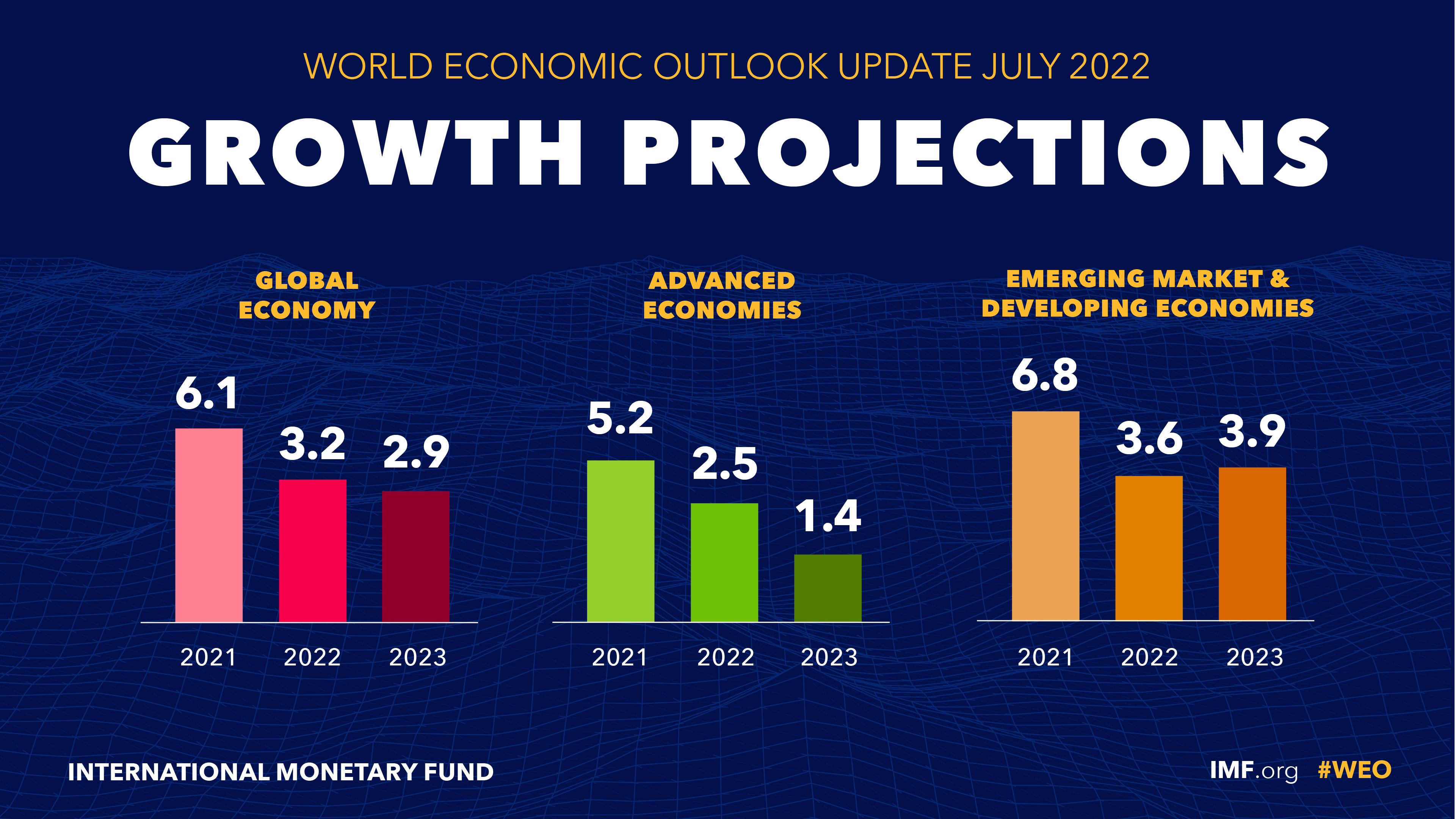
Reality Check -The IMF announced on Tuesday (July 26, 2022) a 3.2% revised downward forecast to global growth in 2022 and 2.9% in 2023. The IMF announced on Tuesday (July 26, 2022) a 3.2% revised downward forecast to global growth in 2022 and 2.9% in 2023.

Gloomy and More Uncertain

WEO July 2022 Thumbnail

A tentative recovery in 2021 has been followed by increasingly gloomy developments in 2022 as risks began to materialize. Global output contracted in the second quarter of this year, owing to downturns in China and Russia, while US consumer spending undershot expectations. Several shocks have hit a world economy already weakened by the pandemic: higher-than-expected inflation worldwide––especially in the United States and major European economies––triggering tighter financial conditions; a worse-than-anticipated slowdown in China, reflecting COVID- 19 outbreaks and lockdowns; and further negative spillovers from the war in Ukraine.


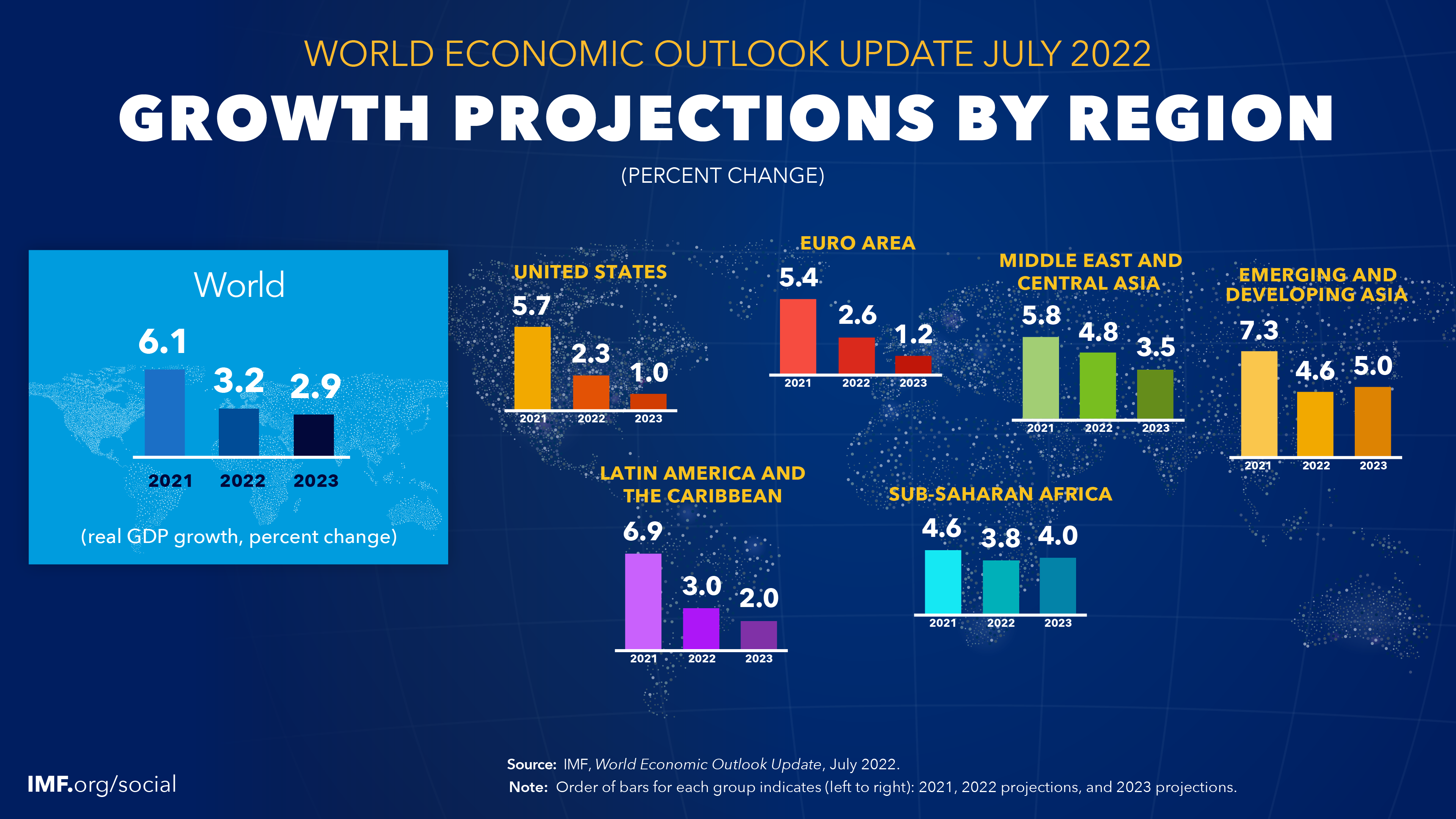
The baseline forecast is for growth to slow from 6.1 percent last year to 3.2 percent in 2022, 0.4 percentage point lower than in the April 2022 World Economic Outlook. Lower growth earlier this year, reduced household purchasing power, and tighter monetary policy drove a downward revision of 1.4 percentage points in the United States. In China, further lockdowns and the deepening real estate crisis have led growth to be revised down by 1.1 percentage points, with major global spillovers. And in Europe, significant downgrades reflect spillovers from the war in Ukraine and tighter monetary policy. Global inflation has been revised up due to food and energy prices as well as lingering supply-demand imbalances, and is anticipated to reach 6.6 percent in advanced economies and 9.5 percent in emerging market and developing economies this year—upward revisions of 0.9 and 0.8 percentage point, respectively. In 2023, disinflationary monetary policy is expected to bite, with global output growing by just 2.9 percent.


The risks to the outlook are overwhelmingly tilted to the downside. The war in Ukraine could lead to a sudden stop of European gas imports from Russia; inflation could be harder to bring down than anticipated either if labor markets are tighter than expected or inflation expectations unanchor; tighter global financial conditions could induce debt distress in emerging market and developing economies; renewed COVID-19 outbreaks and lockdowns as well as a further escalation of the property sector crisis might further suppress Chinese growth; and geopolitical fragmentation could impede global trade and cooperation. A plausible alternative scenario in which risks materialize, inflation rises further, and global growth declines to about 2.6 percent and 2.0 percent in 2022 and 2023, respectively, would put growth in the bottom 10 percent of outcomes since 1970.


With increasing prices continuing to squeeze living standards worldwide, taming inflation should be the first priority for policymakers. Tighter monetary policy will inevitably have real economic costs, but delay will only exacerbate them. Targeted fiscal support can help cushion the impact on the most vulnerable, but with government budgets stretched by the pandemic and the need for a disinflationary overall macroeconomic policy stance, such policies will need to be offset by increased taxes or lower government spending. Tighter monetary conditions will also affect financial stability, requiring judicious use of macroprudential tools and making reforms to debt resolution frameworks all the more necessary. Policies to address specific impacts on energy and food prices should focus on those most affected without distorting prices. And as the pandemic continues, vaccination rates must rise to guard against future variants. Finally, mitigating climate change continues to require urgent multilateral action to limit emissions and raise investments to hasten the green transition.

WEO-Bars
Region

WONDER NO MORE. . .Tell me again. . .What Wi-Fi Hacking tools do hackers use?

Wednesday, July 27, 2022

YOU GET THE IDEA: 'Those about to Die'

 Morituri Salutamos - a phrase from high school spoken Latin class

Independence Day director Roland Emmerich is making a gladiatorial epic for Peacock

1 comment

Those About to Die will reportedly enter production next year


Roland Emmerich, the director behind disaster movies such as Independence Day, The Day After Tomorrow, and Moonfall, is making a “gladiatorial epic” series for NBCUniversal’s streaming service Peacock. The show, which will be titled Those About to Die, is based on the book of the same name by Daniel Mannix (which, incidentally, previously served as the inspiration for Ridley Scott’s Gladiator). The series is set to be written by Robert Rodat, whose previous work includes Saving Private Ryan.

Those About to Die is the first TV show created by Emmerich. Although he previously directed 2012 TV movie Dark Horse, the director’s career has otherwise been focused on the big screen, with a filmography packed with summer blockbusters. It sounds like the aim is to preserve these big-screen sensibilities despite the show being destined for streamers. Here’s how Peacock’s announcement post describes it:

Those About to Die is a large-scale drama set within the spectacular, complex, and corrupt world of gladiatorial sports in Ancient Rome. The series introduces an ensemble of diverse characters across the many layers of Roman society where sports, politics, and business intersect and collide.

And don’t worry, as well as gladiatorial battles, Those About to Die will also feature the spectacle of chariot racing, according to NBCUniversal television and streaming’s president of scripted content Lisa Katz. Deadline reports that the budget for the series sits at around $140 million and that production is due to kick off early next year in Italy.


Your Smart Home Camera Footage Access...Get Informed First

 Report by Mitchell Clark from The Verge

Google, like Amazon, will let police see your video without a warrant

24 comments

Arlo, Apple, Wyze, and Anker, have all promised not to

If you buy something from a Verge link, Vox Media may earn a commission. See our ethics statement.

Arlo, Apple, Wyze, and Anker, owner of Eufy, all confirmed to CNET that they won’t give authorities access to your smart home camera’s footage unless they’re shown a warrant or court order. If you’re wondering why they’re specifying that, it’s because we’ve now learned Google and Amazon are doing just the opposite: they allow police to get this data without a warrant if police claim there’s been an emergency.

Earlier this month my colleague Sean Hollister wrote about how Amazon, the company behind the smart doorbells and security systems, will indeed give police that warrantless access to customers’ footage in those “emergency” situations. And as CNET now points out, Google’s privacy policy has a similar carveout as Amazon’s, meaning law enforcement can access data from its Nest products — or theoretically any other data you store with Google — without a warrant.

Google and Amazon’s information request policies for the US say that in most cases, authorities will have to present a warrant, subpoena, or similar court order before they’ll hand over data. This much is true for Apple, Arlo, Anker, and Wyze too — they’d be breaking the law if they didn’t. Unlike those companies, though, Google and Amazon will make exceptions if a law enforcement submits an emergency request for data.

Earlier this month, Amazon disclosed that it had already fulfilled 11 such requests this year. Google’s transparency report doesn’t seem to include information specifically about emergency requests, and the company didn’t immediately respond to The Verge’s request for comment on how many it’s fulfilled.

Here’s what Google’s information request policy has to say about “requests for information in emergencies:”

If we reasonably believe that we can prevent someone from dying or from suffering serious physical harm, we may provide information to a government agency — for example, in the case of bomb threats, school shootings, kidnappings, suicide prevention, and missing persons cases. We still consider these requests in light of applicable laws and our policies

An unnamed Nest spokesperson did tell CNET that the company tries to give its users notice when it provides their data under these circumstances (though it does say that in emergency cases that notice may not come unless Google hears that “the emergency has passed”). Amazon, on the other hand, declined to tell either The Verge or CNET whether it would even let its users know that it let police access their videos.

Legally speaking, a company is allowed to share this kind of data with police if it believes there’s an emergency, but the laws we’ve seen don’t force companies to share. Perhaps that’s why Arlo is pushing back against Amazon and Google’s practices and suggesting that police should get a warrant if the situation really is an emergency.

“If a situation is urgent enough for law enforcement to request a warrantless search of Arlo’s property then this situation also should be urgent enough for law enforcement or a prosecuting attorney to instead request an immediate hearing from a judge for issuance of a warrant to promptly serve on Arlo,” the company told CNET. Amazon told CNET that it does deny some emergency requests “when we believe that law enforcement can swiftly obtain and serve us with such a demand.”

Apple and Anker’s Eufy, meanwhile, claim that even they don’t have access to users’ video, thanks to the fact that their systems use end-to-end encryption by default. Despite all the partnerships Ring has with police, you can turn on end-to-end encryption for some of its products, though there are a lot of caveats. For one, the feature doesn’t work with its battery-operated cameras, which are, you know, pretty much the thing everybody thinks of when they think of Ring. It’s also not on by default, and you have to give up a few features to use it, like using Alexa greetings, or viewing Ring videos on your computer. Google, meanwhile, doesn’t offer end-to-end encryption on its Nest Cams last we checked.

It’s worth stating the obvious: Arlo, Apple, Wyze, and Eufy’s policies around emergency requests from law enforcement don’t necessarily mean these companies are keeping your data safe in other ways. Last year, Anker apologized after hundreds of Eufy customers had their cameras’ feeds exposed to strangers, and it recently came to light that Wyze failed failed to alert its customers to gaping security flaws in some of its cameras that it had known about for years. And while Apple may not have a way to share your HomeKit Secure Video footage, it does comply with other emergency data requests from law enforcement — as evidenced by reports that it, and other companies like Meta, shared customer information with hackers sending in phony emergency requests.

THE ANTONOV ("The Guppy") is no more...Inside The Biggest Plane In The World

POV: Aljazeera

 News source in The Middle East

Key takeaways from former President Trump’s speech in Washington

During speech at America First Policy Institute, Trump hinted at 2024 run, repeated unfounded claims of election fraud and re-upped themes from past campaigns.

Donald Trump
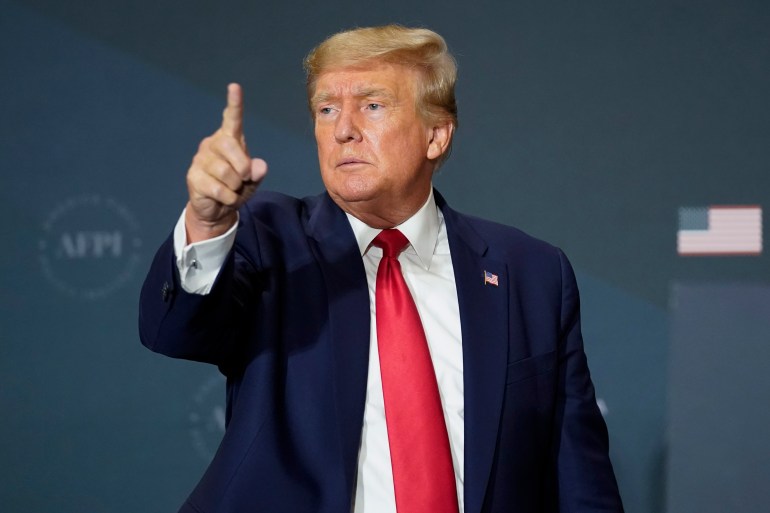
Former President Donald Trump gestures to the audience after speaking at America First Policy Institute summit at the Marriott Marquis in Washington, DC [Andrew Harnik/AP Photo]

Former United States President Donald Trump has made his first public speech in Washington, DC since leaving the White House in January 2021, following his election loss to Joe Biden.

He spoke for 90 minutes on Tuesday at the right-wing America First Policy Institute, laying out what he said should be the policy platforms for the “next Republican president”.

Since moving out of the White House days after his supporters stormed the US Capitol in an attempt to overturn the election results on January 6, 2021, Trump has remained one of the most polarising figures in the country. He has continued to spread unfounded claims the election was rife with widespread fraud and was ultimately “stolen” from him while throwing his political clout behind Republican candidates across the country who continue to spread that misinformation before legislative elections in November.

Trump has also continued to divide his own Republican Party, with some sects seeing his passionate base, populist messaging and institutional hostility as an advantage going into 2024, and others seeing it as a liability.

Here are the key takeaways from Trump’s speech:

Trump stops short of declaring his candidacy

Since leaving office, speculation has grown over if and when Trump would announce his plan to run again for a second term, as is permitted under the US constitution.

But while Tuesday’s speech resembled those the former reality television personality made on the campaign trail in his presidential bids in 2016 and 2020, Trump on Tuesday stopped short of declaring his candidacy to be the Republican nominee for the 2024 presidential election.

“I always say I ran the first time and I won, then I ran a second time and I did much better,” Trump said. “We may just have to do it again. We have to straighten out our country.”

He added the tease: “I look forward to laying out many more details in the weeks and months to come.”

The New York Times and several US media outlets have reported Trump has told allies he was weighing announcing his candidacy as early as this summer.

Privacy Policy

Trump repeats claims of election fraud

The former president bucked calls from some Republican leaders for him to downplay his persistent, and unfounded claims, that he only lost the 2020 presidential election through coordinated malfeasance, with some in the party saying the focus has alienated would-be supporters.

Trump dismissed the congressional panel probing his role in the January 6 attack, an investigation that could possibly lead to the Department of Justice pursuing criminal charges against him, as “hacks and thugs”.

“If I renounced my beliefs, if I agreed to stay silent, if I stayed at home and just took it easy, the persecution of Donald Trump would stop immediately,” he said. “But that’s not what I will do. I can’t do that.

“They really want to damage me so I can no longer go back to work for you. And I don’t think that’s going to happen,” Trump said.

Crime, immigration and the economy

While Trump’s election denial loomed large, he spent most of the speech focusing on themes that defined his successful 2016 campaign: crime and immigration.

The former president said the US “is now a cesspool of crime”, repeating a Republican talking point that a spike in violent crime in 2020, and a smaller increase in 2021, are the result of liberal policies in US cities. The rates for both years remain far below the all-time high crime rates recorded in the US in the 1990s.

“We have blood, death and suffering on a scale once unthinkable,” he said.

Trump, who launched his 2016 campaign by pledging to build a wall to stop undocumented migrants from crossing the southern border with Mexico, while accusing migrants of being “rapists” and bringing drugs and crime with them, called on the “next Republican president” to restore his hardline border policies.

“The next Republican president must immediately implement every aspect of the Trump agenda that achieved the most secure border in history,” he said.

He blamed Biden for the 40-year high inflation and energy prices in the US, which the current president has blamed on the fallout from Russia’s invasion of Ukraine.

“We are a nation in decline,” he said. “We are a failing nation.”

Two versions of a possible Republican candidate

Several hours before Trump took the stage on Tuesday, his former vice president, Mike Pence, addressed a different conservative audience in Washington, DC, offering an alternative version of a possible Republican presidential candidate.

Pence, who fell out with Trump after rebuffing pressure to overturn Biden’s election victory, sought to downplay his policy differences with the former president while promising a new tone.

“I don’t know that the president and I differ on issues,” Pence told a conservative student group. “But we may differ on focus.”

“I believe conservatives must focus on the future to win back America. We can’t afford to take our eyes off the road in front of us because what’s at stake is the very survival of our way of life,” he said.

Source: Al Jazeera and news agencies


CLASSIC ART MEMES Zara Zentira