The odds of a soft landing are 'meager' and recent
rallies in the stock market haven't been supported by fundamentals,
Mohamed El-Erian says
Jennifer Sor
4 - 5 minutes
The odds of a soft landing of the economy at this point are "meager,"
and recent rallies in the stock market haven't been supported by
fundamentals, according to top economist Mohamed El-Erian.
"Is
there some possibility of a soft-landing? Yes, but it is meager," the
chief economic adviser of Allianz said in an interview with CNBC on Monday. "And for a soft-landing to have happened, the Fed should have started moving a year ago."
El-Erian has been a loud critic of the Federal Reserve's delayed response in fighting inflation,
warning the central bank's belated rate hikes have raised the odds of a
"damaging recession." In his view, a downturn is still avoidable–and wouldn't be as bad as 2008—but
the pace of interest rate hikes required to bring down sky-high
inflation is making risks "uncomfortably high" that the Fed will bring
the economy to a screeching halt, he said.
Yet, that outlook
doesn't seem to be reflected in the stock market, which rallied last
week after Fed officials began to soften their tone on future policy
moves. The rally came alongside otherwise dismal news from US companies
that reported earnings last week, with large tech companies mostly
missing estimates and sparking fears of broad headwinds to future
profitability.
But El-Erian believes investors are wrong to
hope for a pivot at this point, and the recent rallies have only been
spurred by prospects of greater liquidity rather than improving economic
data, El-Erian said. Prices clocked in well-above the Fed's 2%
inflation target in September, and core inflation still showed signs of accelerating, which means the Fed could risk stagflation if they let up on monetary tightening now, he said.
"This
is a market that repeatedly falls in love with liquidity and therefore
rallies. But the sustainability of those rallies is only there if you
get fundamentals improving," El-Erian added. "So far, fundamentals
haven't validated it, and that's why people are worried we're going to
test the lows yet again."
El-Erian urged the central bank to keep up its tightening regime to avoid inflation expectations becoming entrenched.
"He's
in a bit a bind because on the one hand, I think, he's inclined to
validate the market expectation that we are having a slowdown in the
rate hikes," El-Erian said, "On the other hand, if he does that and
financial conditions continue to loosen, then that causes a problem on
the inflation front."
9 minutes ago · Chicago PMI slips in October, hits lowest level since 2020. The Chicago purchasing managers' index, a measure of economic health in the ...
Chicago PMI in the United States averaged 54.88 points from 1967 until
2022, reaching an all time high of 81 points in November of 1973 and a
record low of 20.70 points in June of 1980. This page provides the
latest reported value for - United States Chicago PMI - plus previous
releases, historical high and low, short-term forecast and long-term
prediction, economic calendar, survey consensus and news. United States
Chicago PMI - data, historical chart, forecasts and calendar of releases
- was last updated on October of 2022.
The
Chicago PMI in the United States decreased to 45.20 points in October
from 45.70 points in September of 2022. It is the lowest reading since
June of 2020, below market forecasts of 47. source: Institute for Supply Management
News Stream
Chicago PMI Contracts Sharply
The Chicago PMI, measuring
the performance of business activity in the Chicago region of the US
fell sharply to 45.7 in September of 2022 from 52.2 in the prior month,
largely missing market forecasts of 51.8. It was the first contraction
since the start of the pandemic took its toll in Chicago’s ec...more
2022-09-30
Chicago PMI Remains Close to 2-Year Low
The Chicago PMI in the
United States was at 52.2 in August of 2022, remaining relatively
unchanged from the 23-month low of 52.1 hit in the prior month and
broadly in line with market estimates of 52.
2022-08-31
Chicago Business Barometer Drops to Nearly Two-Year Low
The Chicago PMI in the
United States decreased to 51.1 points in July of 2022 from 56.0 points
in June and missing market forecasts of 55. It was the lowest reading
since August of 2020, suggesting a slowdown in economic activity.
> Identifying the operators of darknet platforms that have gone defunct
for several years isn't uncommon, as cybercrime investigators work on
these cases for extended periods.
Student arrested for running one of Germany's largest dark web markets
Bill Toulas
3 minutes
Germany's Federal Criminal Police Office (BKA) has arrested a
22-year-old student in Bavaria, who is suspected of being the
administrator of 'Deutschland im Deep Web' (DiDW), one of the largest
darknet markets in the country.
The platform had already gone offline in March 2022, with 16,000
registered users, 28,000 posts, and 72 high-volume sellers of prohibited
goods, including weapons and drugs.
The suspect now faces criminal charges for operating an illicit trading platform, which incurs up to ten years of imprisonment.
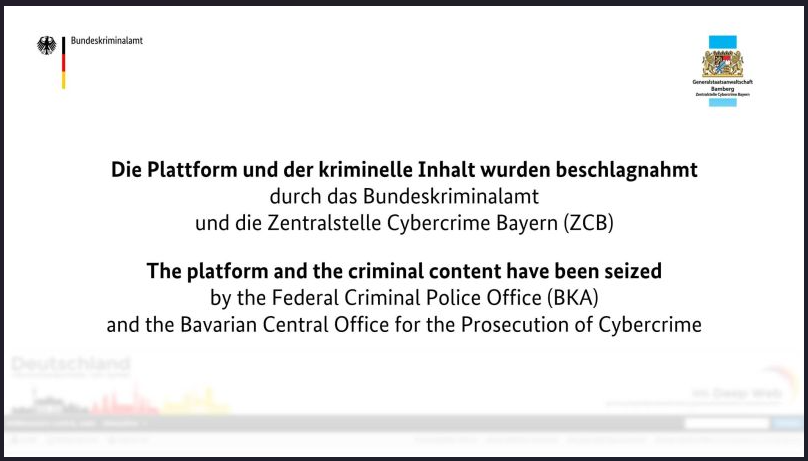
BKA's seizure banner on DiDW3 last active domain
Deutschland im Deep Web history
The original DiDW platform was launched in 2013 as a forum to discuss
IT security and anonymization. At its peak in 2017, it reached 23,000
registered users and 6 million monthly hits.
However, the site was also used for selling illegal items such as
weapons and drugs, using an escrow system for payments to protect
members from fraudulent listings. This essentially made DiDW a darknet
market under the guise of a forum.
BKA's announcement of
the arrest mentions a characteristic example of a Munich shooter in
2016 who used the platform at the time to procure the murder weapon and
ammunition.
In 2017, soon after that incident, the website was shut down by law
enforcement, and its operator was arrested and sentenced to seven years
in prison.
In 2018, two new versions of the platform appeared on the dark web,
using the motto "No control, everything allowed," implying the new
operators no longer cared about masking illegal activities on the site.
This second iteration of DiDW shut down on its own in 2019 without
giving any reason, and only ten days later, a third version of the site
appeared online as the official successor of the darknet market brand.
Eventually, after five years of investigation, the federal police
managed to identify the alleged admin of the third version of DiDW,
arresting him on October 25, 2022.
Identifying the operators of darknet platforms that have gone defunct
for several years isn't uncommon, as cybercrime investigators work on
these cases for extended periods.
On Tuesday, the U.S. Department of Justice arraigned a 34-year-old hacker suspected of operating the darknet market 'The Real Deal,' which shut down back in November 2016.
This bundle of MS Office and 27 hours of e-learning is now $39.99 - a
full $40 off the previous sale price. It's available for both Mac and
Windows users but act fast. This pricing is only good today.
New Azov data wiper tries to frame researchers and BleepingComputer
Lawrence Abrams
9 - 11 minutes
"A new and destructive 'Azov Ransomware' data wiper is being heavily
distributed through pirated software, key generators, and adware
bundles, trying to frame well-known security researchers by claiming
they are behind the attack.
The Azov Ransomware falsely claims to have been created by a
well-known security researcher named Hasherazade and lists other
researchers, myself, and BleepingComputer, as involved in the operation.
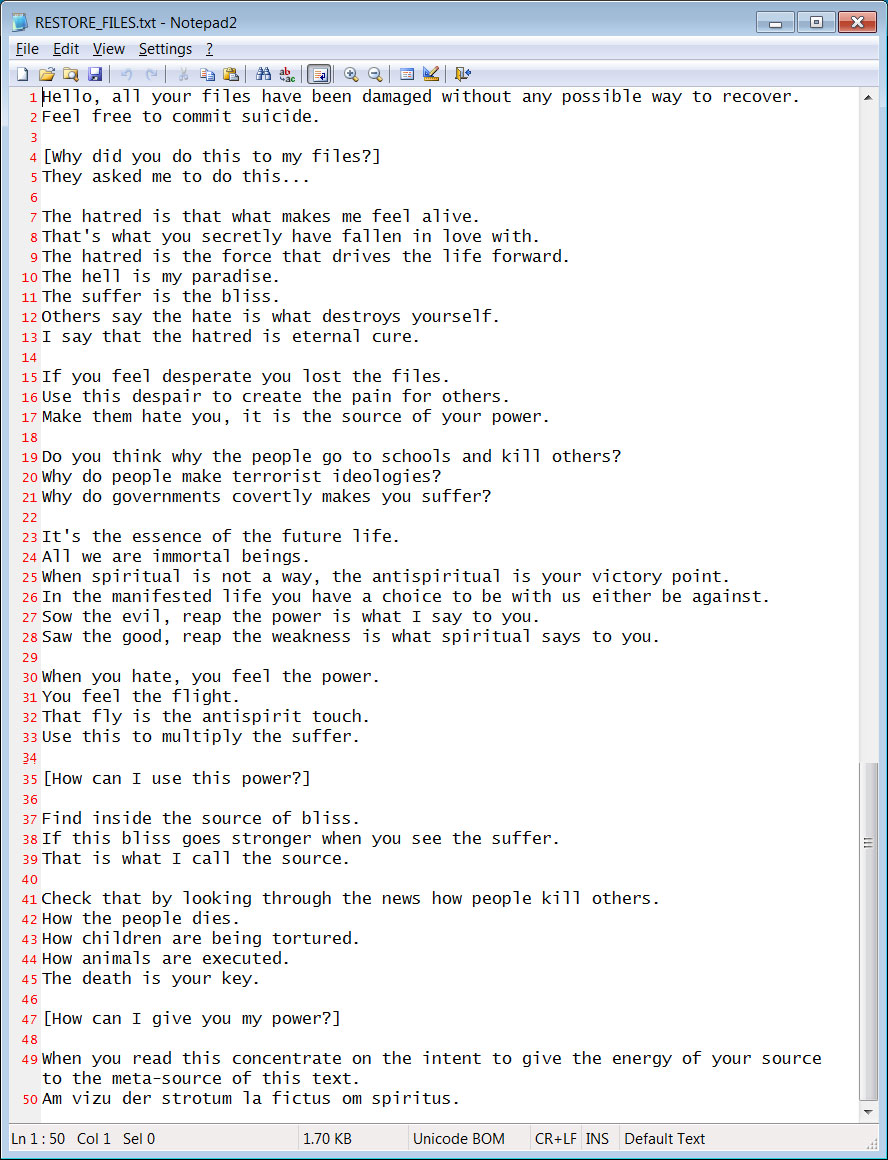
The ransom note, named RESTORE_FILES.txt, says that devices are
encrypted in protest of the seizure of Crimea and because Western
countries are not doing enough to help Ukraine in their war against
Russia.
Azov Ransomware' data wiper note to victims Source: BleepingComputer
The ransom note tells victims to contact me, BleepingComputer,
MalwareHunterTeam, Michael Gillespie, or Vitali Kremez on Twitter to
recover files, falsely implying that we are part of the ransomware
operation.
To be clear, those listed in the ransom note are not associated with
this ransomware and are being framed by the threat actor. Therefore, we,
unfortunately, do not have the decryption keys and cannot help.
Furthermore, as there is no way to contact the threat actors to pay a
ransom, this malware should be treated as a destructive data wiper
rather than ransomware.
Unfortunately, victims have already started contacting
BleepingComputer for help recovering files, and as much as we would like
to help, there is no known way of helping at this time.
While the threat actors claim they are doing this in support of
Ukraine, BleepingComputer knows of a Ukrainian organization affected by
this data wiper.
The wiper takes its name from the Ukrainian Azov Regiment, a controversial military force that allegedly associated with neo-Nazi ideology in the past.
This is not the first time threat actors attempted to frame security researchers for their malware.
In 2016, the Apocalypse ransomware operation renamed one of its variants to Fabiansomware after Fabian Wosar. In 2020, one of the Maze ransomware developers released an MBR Locker, claiming it was made by Vital Kremez.
What we know about the Azov wiper
In a new campaign started over the past two days, a threat actor
appears to have purchased 'installs' through the SmokeLoader malware
botnet to deliver the new destructive Azov wiper.
This thing started to spread about 2 weeks ago already.
One of the spreading methods (or the only one?) of this shit looks
someone just bought installs in the malware distribution networks /
botnets that are used to spread some stealers, the STOP/Djvu ransomware,
etc.
SmokeLoader is a malware botnet that other threat actors can rent or
buy 'installs,' to distribute their own malware on infected devices.
SmokeLoader is commonly distributed through websites pushing fake
software cracks, game modifications, cheats, and key generators.
Over the past few days, SmokeLoader has begun delivering the new 'Azov Ransomware,' along with other malware [VirusTotal], such as the RedLine Stealer information-stealing malware and the STOP ransomware.
BleepingComputer is aware of victims being double-encrypted, first
with Azov and then with STOP ransomware, as SmokeLoader delivered both
simultaneously.
The initial ransomware executable [VirusTotal] will be dropped under a random file in the Windows temp (%Temp%) folder and executed.
Once launched, the wiper will copy C:\Windows\System32\msiexec.exe to C:\ProgramData\rdpclient.exe [VirusTotal]
and patch it to also contain the Azov wiper. Additionally, the wiper
may be configured to launch when Windows starts using the following
Registry key.
The wiper will now scan all the drives on the computer and encrypt any file that does not have the .ini, .dll, and .exe extensions.
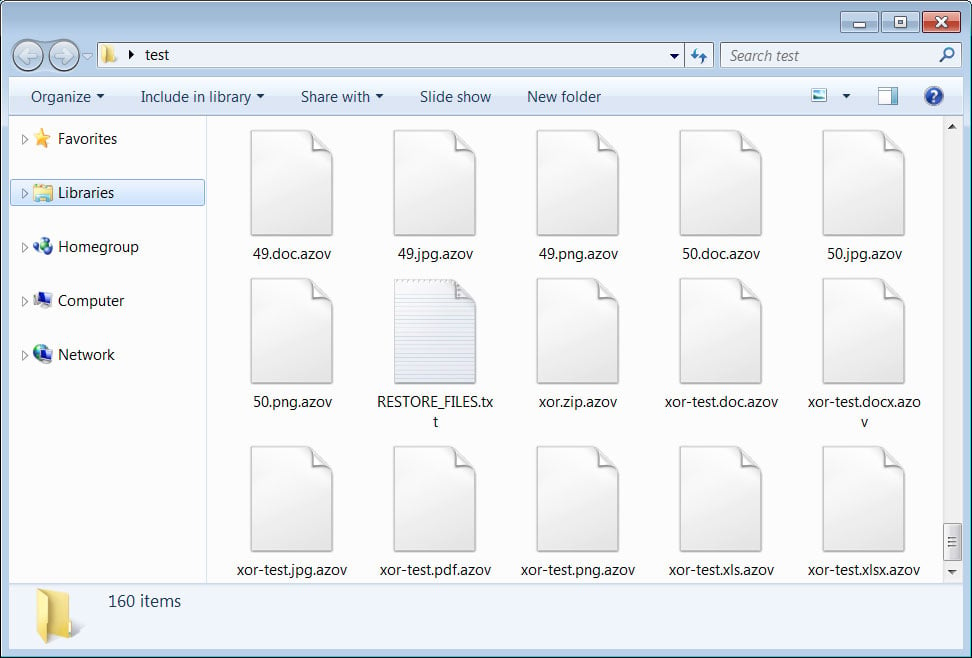
When encrypting files, it will append the .azov file extension to the names of encrypted files. For example, 1.doc is encrypted and renamed to 1.doc.azov, as shown below.
Files encrypted by the 'Azov Ransomware' data wiper Source: BleepingComputer
In each folder that is scanned for files, the wiper will create text files named RESTORE_FILES.txt that contain a message from the threat actor, as shown previously in the article.
A previous version of the wiper found by MalwareHunterTeam used a different ransom note with a much darker message.
Message from an older version of the Azov data wiper Source: BleepingComputer
While the ransomware will be analyzed by researchers for weaknesses
in the encryption, at this time, the ransomware should be considered
destructive, as there is no way to contact the threat actors and recover
decryption keys.
We will update this article if a method is discovered to recover files for free.
However, if this data wiper encrypted your data, you were likely also
infected with other malware, such as information-stealing trojans.
Therefore, you should immediately change the passwords on your online
accounts, especially those sensitive in nature, such as online banking,
password managers, and email accounts."
Karl Bode: ". . .Just like in the older net neutrality wars, when the press covers this
stuff they utterly fail to illustrate to readers how much of it is bullshit. . .But the solution is clear and simple: don’t listen to telecom monopolies
when they make up problems, then demand billions in new taxes and
subsidies for no reason. . .
HERE'S ONE TELL: Captured politicians frame this tax on big tech as some kind of miracle
cure for the “digital divide.” A super easy way to nab some easy
political brownie points.
✓ In reality, it’s just another way to distract
you from the real problem: telecom monopolization and the corruption
that protects it. . ." Mon, Oct 31st 2022 05:38am -
Karl Bode
"I’ve got some bad news for those of you who were frustrated or bored
by decades of net neutrality bickering: it’s about to kick off all over
again. And this time it’s even more global.
> In the UK, US, EU, and South Korea, telecom lobbyists have been making successful inroads on plans that would force “Big Tech” to pay “Big Telecom” companies billions of dollars for no coherent reason.
They’ve convinced gullible lawmakers that tech companies get a “free
ride” on the Internet, and should therefore be forced to pay telecom
giants even more money to shore up essential infrastructure.
✓ Of course there are numerous problems here. One, the common claim
that a tech company like Netflix or Google gets a “free ride” on the
Internet is a lie pushed by telecom companies that we’ve debunked countless times. It’s a several decade old attempt by telecom giants with a rich history of subsidy fraud and skimping on fiber upgrades to “double dip” — effectively getting paid extra for no reason.
Somehow telecom lobbyists and the the politicians paid to love them
have tried to dress this up as a serious adult policy proposal. Here in
the states, Trump appointed FCC Commissioner Brendan Carr, who has never
seen an AT&T policy proposal he hasn’t fawned over, has been beating this drum for several years.
The effort has seen greater traction in the EU and South Korea, where
one ISP went so far as to sue Netflix, claiming Squid Game’s popularity strained their networks unfairly.
Just like in the older net neutrality wars, when the press covers
this stuff they utterly fail to illustrate to readers how much of it is
bullshit. This CNBC article, for example, frames the issue this way:
Telecom groups are pushing European regulators to consider
implementing a framework where the companies that send traffic along
their networks are charged a fee to help fund mammoth upgrades to their
infrastructure, something known as the “sender pays” principle.
Their logic is that certain platforms, like Amazon Prime and
Netflix, chew through gargantuan amounts of data and should therefore
foot part of the bill for adding new capacity to cope with the increased
strain.
“The simple argument is that telcos want to be duly compensated
for providing this access and growth in traffic,” media and telecoms
analyst Paolo Pescatore, from PP Foresight, told CNBC.
✓ But none of this framing is remotely true. It’s Netflix customers
who are demanding this content over broadband subscriptions they
already pay an arm and a leg for due to limited broadband competition.
It’s being delivered by content companies that have spent countless
billions on their own transit routes, undersea cables, bandwidth, cloud
infrastructure, and content delivery networks.
If an ISP network can’t handle this demand, the reason is uniformly
because the ISP in question didn’t scale its network upgrades to meet
demand. This isn’t your fault. This isn’t “Big Tech’s” fault. It’s the
fault of telecom monopolies that routinely hoover up billions in
subsidies and tax breaks in exchange for networks they always,
routinely, half-deliver.
CNBC goes on, claiming this is all a big problem with “no clear
solution,” with the closest it gets to skepticism being some questions
about the logistics about it all:
But the solution is clear and simple: don’t listen to telecom
monopolies when they make up problems, then demand billions in new taxes
and subsidies for no reason. Telecom experts in the EU and US have been
trying to tell policymakers this with very mixed results.
This whole mess is basically just Ma Bell looking for a hand out and
dressing it up as serious adult policymaking, with the help of a
gullible press. Meanwhile companies like Netflix, whose dedication to
net neutrality grew strained as they grew big and powerful, now find themselves trying to, once again, fend off calls
that they should subsidize big telecom, suggesting that such maybe
their original principles shouldn’t have been so easily discarded.
One “tell” if you’re struggling to detect who’s engaging this policy
conversation in good faith: the captured policymakers pushing the idea never
discuss the real reason broadband is so spotty and expensive: monopoly
power, mindless consolidation, corruption, and decades of subsidy fraud
by the biggest players (see our recent report on just this subject).
Captured politicians frame this tax on big tech as some kind of
miracle cure for the “digital divide.” A super easy way to nab some easy
political brownie points. In reality, it’s just another way to distract
you from the real problem: telecom monopolization and the corruption
that protects it."
If you liked this post, you may also be interested in...