Tuesday, November 01, 2022

Cyber InSecurity

 Ready for more...

Hackers selling access to 576 corporate networks for $4 million

 
  • October 31, 2022
  •  
  • 02:45 PM

"A new report shows that hackers are selling access to 576 corporate networks worldwide for a total cumulative sales price of $4,000,000, fueling attacks on the enterprise.

The research comes from Israeli cyber-intelligence firm KELA which published its Q3 2022 ransomware report, reflecting stable activity in the sector of initial access sales but a steep rise in the value of the offerings.

Although the number of sales for network access remained about the same as in the previous two quarters, the cumulative requested price has now reached $4,000,000.

For comparison, the total value of initial access listings in Q2 2022 was $660,000, recording a drop in value that coincided with the summer ransomware hiatus that hurt demand.

The road to ransomware

Initial access brokers (IABs) are hackers who sell access to corporate networks, usually achieved through credential theft, webshells, or exploiting vulnerabilities in publicly exposed hardware.

After establishing a foothold on the network, the threat actors sell this corporate access to other hackers who use it to steal valuable data, deploy ransomware, or conduct other malicious activity.

The reasons IABs choose not to leverage network access vary, ranging from lacking diverse intrusion skills to preferring not to risk increased legal trouble.

IABs still play a crucial role in the ransomware infection chain, even if they got sidelined last year when big ransomware gangs that operated as crime syndicates operated their own IAB departments.

Q3 '22 numbers

In the third quarter of 2022, KELA's analysts observed 110 threat actors posting 576 initial access offerings totaling a cumulative value of $4,000,000.
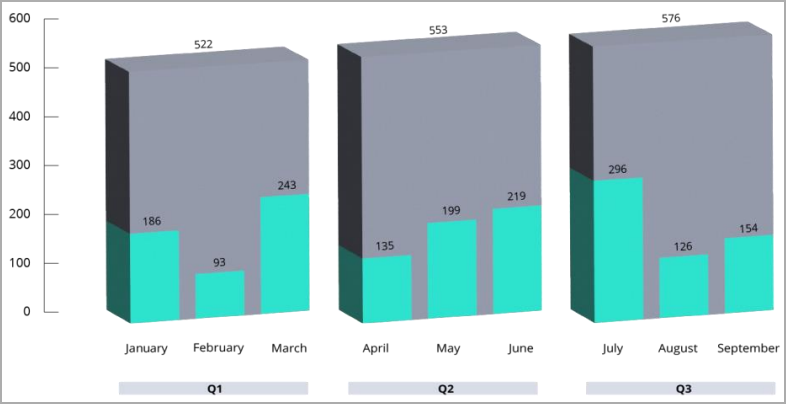
Monthly volume of initial access sales
Monthly volume of initial access sales (KELA)

The average selling price of these listings was $2,800, while the median selling price reached a record figure of $1,350.
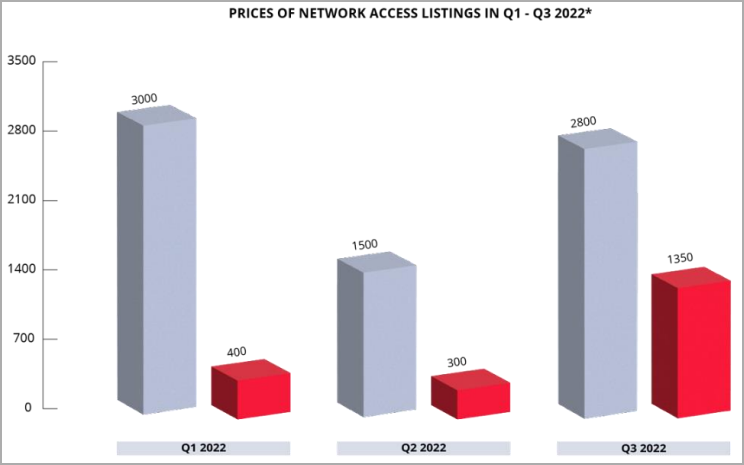
Initial access sales prices

When looking at the targeted sectors, professional services, manufacturing, and technology topped the list with 13.4%, 10.8%, and 9.4%, respectively. Again, ransomware attacks feature a similar ranking,  emphasizing the connection between the two.
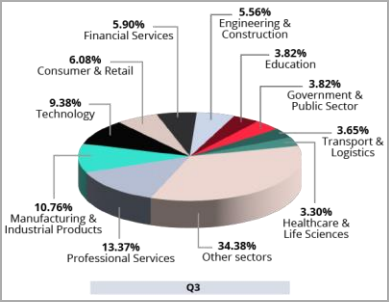
Sectors IABs targeted the most in Q3
Sectors IABs targeted the most in Q3 (KELA)

As initial access brokers have become an integral part of the ransomware attack chain, properly securing your network from intrusion is crucial.

This includes placing remote access servers behind VPNs, restricting access to publicly exposed devices, enabling MFA, and conducting phishing training to prevent the theft of corporate credentials.'

Related Articles:

The Week in Ransomware - October 28th 2022 - Healthcare leaks

Microsoft links Raspberry Robin worm to Clop ransomware attacks

Australian Clinical Labs says patient data stolen in ransomware attack

Notorious ‘BestBuy’ hacker arraigned for running dark web market

Medibank now says hackers accessed all its customers’ personal data

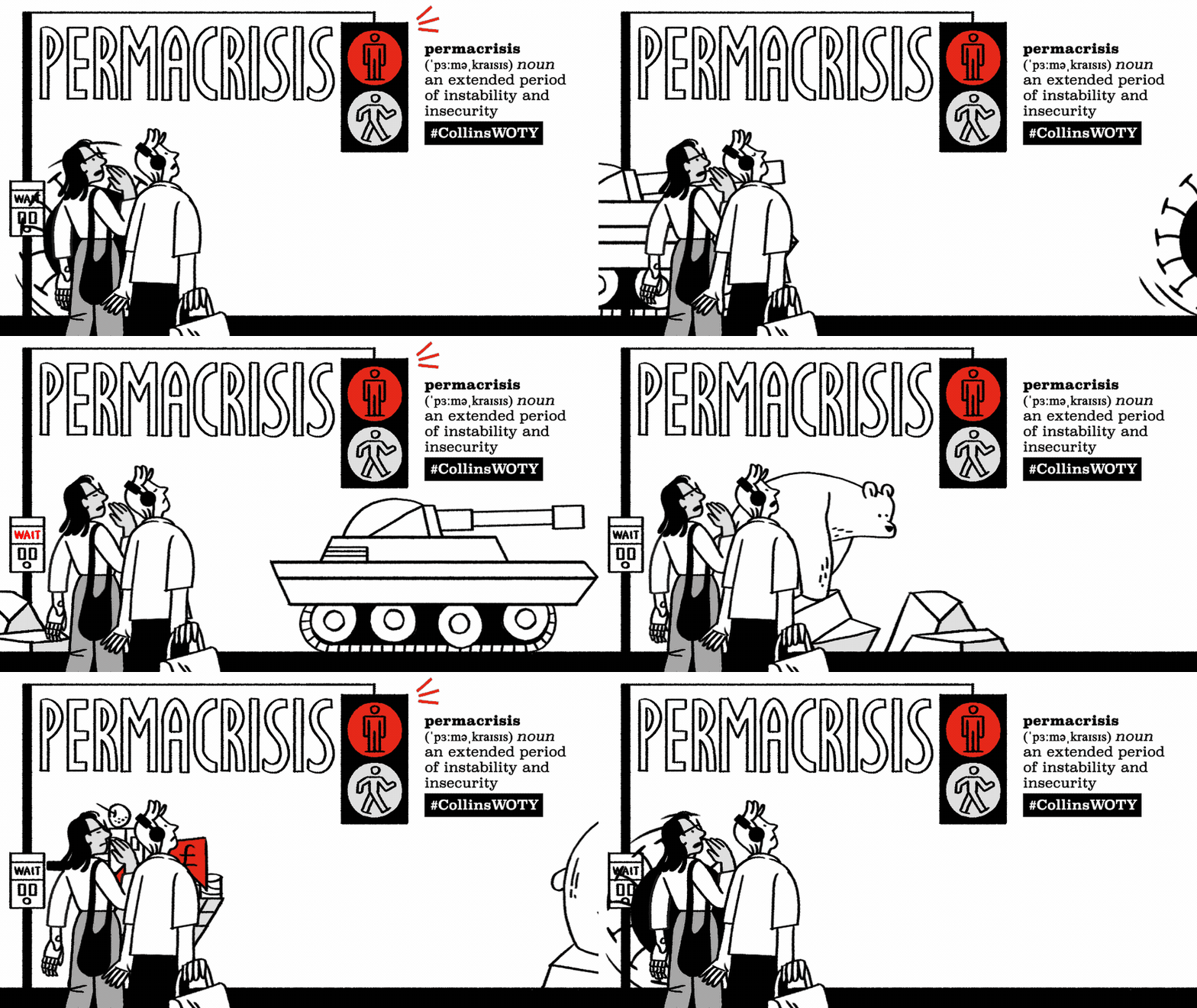
Word of the Year 2022: Permacrisis | Collins Dictionary

“Permacrisis” which is defined as “an extended period of instability and insecurity,” by the publisher is one of a handful of words relating to challenges, amid rampant climate change, war in Europe, a cost of living crisis and political chaos in many quarters.
7 minutes ago 

 Permacrisis
While the crisis is a temporary period of risks, losses and serious damage, the term permacrisis refers to a long and permanent period of crisis, as a result of different factors that come together or follow each other. 
The term was coined around 2022 when, after the crisis caused by the COVID virus, the invasion of Ukraine by Russia caused a relapse in the economic and social crisis caused by the notable rise in prices of oil, gas and other products. 
But what really reflects the permacrisis or rather the origin of the concept is the pessimism that prevails in global society, the feeling that there is no way out and that we are close to the collapse of our civilization.  
A similar term, generalized crisis, was used by Hannah Arendt in her book Crisis of Culture, emphasizing the fact that any crisis that occurs in a particular place shows that it can happen anywhere. The distinctive sign of permacrisis is that, due to globalization and interdependence, crises cause a domino effect that accentuates their duration and disruptive nature.

The Collins Word of the Year 2022 is...

permacrisis

The Collins Word of the Year 2022 is...

permacrisis

‘Permacrisis’, a term that describes ‘an extended period of instability and insecurity’, has been named Collins Word of the Year 2022. It is one of several words Collins highlights that relate to ongoing crises the UK and the world have faced and continue to face, including political instability, the war in Ukraine, climate change, and the cost-of-living crisis. Six words on Collins’ list of ten words of the year are new to CollinsDictionary.com, including ‘permacrisis’.

Blog

Words of the Year

Competition

This page in
Top stories


RELATED CONTENT

medium.com

Are We in an Age of ‘Permacrisis’? - Predict - Medium

Lilybell Evergreen
7 - 8 minutes

The world is facing multiple, interconnected, overlapping crises. Will this lessen over time or are we trapped in ‘permacrisis’?

Image by Polina Kondrashova on Unsplash

There’s an idea that has been floating around the back of my mind for a while. In April, I read an article by Christine LaGarde, the President of the European Central Bank, on leadership during crisis. In this, LaGarde mentioned something that interested me:

Some say that we live in an age of “permacrisis”, where we move seamlessly from one emergency to the next. In just over a decade, we have faced the largest financial crisis since the 1930s, the worst pandemic since 1919, and now the most serious geopolitical crisis in Europe since the end of the Cold War.

She writes that many of today’s challenges have been present in the past but there are three factors which make the current situation unique:

  • Scale and complexity. Global challenges, like climate change, now involve many more actors than in the past and therefore require much more complex coordination. Different places are also affected in very different ways and at different speeds, making generating and implementing solutions efficiently more difficult.
  • The need for cooperation. Current and recent challenges, including the COVID-19 pandemic and the climate crisis, require working together as no country can tackle the problem alone. Furthermore, this requires cooperation beyond governments as civil society, private companies, and other actors are key to developing and implementing solutions.
  • Collective action is becoming harder. This presents a challenge to meeting the need for cooperation. Public trust in governments is falling and the spread of fake news is creating conflicting narratives, sowing divisions. The world is also becoming more geopolitically fractured and security-oriented as tensions between countries like the US and China, or Russia and Ukraine disrupt supply chains.
Image by Polina Kondrashova on Unsplash

What is the Age of ‘Permacrisis’?

I was intrigued by the notion of ‘permacrisis’ and found it often playing in the back of my mind while I analysed policy and political events during my studies and work. If the crises of this era really are combining in never-before-seen ways, how can we foster the right environment for collective action?

I followed LaGarde’s citation to a European Policy Centre article to learn more. This piece highlighted that the COVID-19 pandemic is something to live with, not overcome as it persists globally and more pandemics will occur in the future. Additionally, its economic impact is structural, meaning it will continue to impact countries over time rather than being a one-off event. Finally, COVID-19 has exacerbated what was already present in our societies: inequalities and the need for green and digital transformations. They argue that:

We are living in an age of permacrisis, with one challenge seamlessly followed by the next… Political uncertainty and change will remain our constant companions.

Alongside these pressures, we may see a return of old and familiar challenges due to changing international dynamics including the spread of authoritarianism. These challenges include migration, debt, and the deteriorating climate.

The article argues against the idea of a ‘new normal’ and instead proposes that we will have to continue to significantly adapt to an ever-changing environment which is fragile and unpredictable. In writing this, I don’t intend to be ‘alarmist’, instead I am interested in this new landscape and how it may change the traditional methods of governance and policymaking.

Image by Polina Kondrashova on Unsplash

What impacts will this have?

The reality of an age of ‘permacrisis’ has many impacts on our society. A key consideration is that those without many resources will become even less resilient over time as multiple, interconnected, overlapping crises erode the little resources they do have. This will impact those in poverty across the developing and developed worlds.

For example, the COVID-19 pandemic has affected those in the middle classes, creating a large group of people who are in in-work poverty and are at risk of being unable to keep a safe home. Those who were already without basic needs have only become more disadvantaged. This has a real impact on people over time, leading to health problems and educational defecits if people do not have the resources to participate in basic life. Governments must begin to consider how to deal with this, otherwise inequality will grow even faster than it already is.

Another impact to consider is the fact that, in a world of relentless crises, governments are going to have to make decisions much quicker than they are used to. Each crisis will interact with other crises and exiting societal conditions in new and unpredictable ways. Traditional policy analysis may not be able to provide solid evaluation to inform government strategy. Instead, governments may have to rely on incomplete scientific information like in the COVID-19 pandemic.

This makes capacity building more important than ever. Throughout all levels of government and civil society, we must be able to react and adapt quickly with whatever we are presented with. There is no way to accurately predict what we will face but we can predict that it will be complex and require coordination within and between countries and beyond the government sector. We must also be open to new ways of doing things and using experimentation as a method to challenge our current preconceptions about how government and policy making should work. The age of permacrisis does not care that we have formed a status quo.

Image by Polina Kondrashova on Unsplash

How do we move forwards?

The world is facing multiple, interconnected, overlapping crises. No single person, government, or organisation has all of the answers and tools that we need. Collective action is needed to respond to collective problems.

The notion of ‘permacrisis’ presents new challenges to the traditional methods of governance. This is an area I am very interested in and has fed into a lot of my thinking on other policy issues. I wrote this article to begin to formally form thoughts on this idea but also to help identify many of the questions I still have. This topic is a complex one which is essential to understand as we move further into this new era.

About the author: Lilybell Evergreen is an International Studies student who influences European political policy through work with the Council of the Baltic Sea States and the OSCE. She has also won an international policy paper prize. See her LinkedIn here.

Monday, October 31, 2022

THE A$U MONEY-PIT Has Opened...with Disney's "Coco" Streaming on The JumboTron

This is the official public OVER-HYPE article 3042. . .


"This world-class facility is a significant puzzle piece in the evolution of our city's central core, and further solidifies Mesa's Downtown Innovation District as a destination for education, entrepreneurship, and community collaboration," said Mesa Mayor John Giles.

www.mesanow.org

ASU at Mesa City Center Grand Opening 


5 - 7 minutes 
October 28, 2022 at 6:54 pm

"ASU at Mesa City Center in downtown Mesa is celebrating its grand opening in a two-day event bringing together community members, Mesa city leaders and ASU faculty, students and staff.

ASU at Mesa City Center is a joint project between the City of Mesa and Arizona State University, which includes two separate buildings, the MIX Center and The Studios, and outdoor plaza space.

The new Media and Immersive eXperience Center (MIX Center) officially opened its doors to students in the fall of 2022 and is expected to put Arizona State University in the top tier of academic filmmaking and media production.

✓ Friday's event on October 28 included presentations from ASU President Michael Crow, City of Mesa Mayor John Giles and Vice Mayor Jenn Duff, Cheryl Boone Isaacs, founding director of The Sidney Poitier New American Film School and Regent Lyndel Manson.

✓ Saturday's free event from 12- 8 p.m. will be a family-friendly housewarming event with performances, demonstrations, food and an evening screening of Disney's Coco on the outdoor 100-foot movie screen starting at 7:00 pm. Families are welcome to bring chairs and blankets and watch the film on the lawn.

"Arizona State University is committed to collaborations that support student success while also meeting the needs of the broader communities we serve," said ASU President Michael M. Crow. "We are proud to see ASU at Mesa City Center come to life as a vanguard facility for learning and creativity, and we appreciate the City of Mesa's vision and confidence in advancing opportunities for generations to come."

The weekend's events are a celebratory culmination after many years of joint work between the city and ASU. The city invested $63.5 million toward the project and managed the design and construction of the building while ASU contributed $33.5 million, which included interior work and high-end equipment. ASU will pay all operation and maintenance costs for the MIX Center; costs will be shared with the city of Mesa for The Studios.

"This world-class facility is a significant puzzle piece in the evolution of our city's central core, and further solidifies Mesa's Downtown Innovation District as a destination for education, entrepreneurship, and community collaboration," said Mesa Mayor John Giles. "The strong partnership between ASU and the City of Mesa is attracting new businesses and bringing educational programs that will prepare students for the jobs of tomorrow."

MIX Center

The MIX Center hosts hundreds of students who will be making films, designing virtual worlds and creating immersive media experiences. It is capable of producing anything from blockbuster superhero movies to VR video games -- and teaching students the skills they need to succeed in a digital economy.

"It's an exciting time at The Poitier School, and our new home in Mesa is a huge part of that excitement. We pride ourselves on fostering spaces that help empower our students, so they feel confident enough to tell their stories," said Cheryl Boone Issacs, founding director of The Sidney Poitier New American Film School. "At the MIX, whether that story is in film, AR/VR/XR, short-form video or any other type of experiential media, our students will find the state-of-the-art tools they need. And their stories will enrich the cultural life of the university, the state, the region and beyond."

The MIX Center houses The Sidney Poitier New American Film School's production and post-production programs, plus classes in digital media technology, worldbuilding, experience design and gaming from The Design School and the School of Arts, Media and Engineering (both, like the Poitier Film School, part of the Herberger Institute for Design and the Arts), as well as from the Ira A. Fulton Schools of Engineering and the College of Global Futures.

"The MIX Center and the larger ASU at Mesa City Center complex are just at the beginning of their long-term benefits to our students and the Downtown Mesa community. We are thrilled to have this chance to celebrate how far we have already come - a celebration of the good that a university and a city can do together," said Jake Pinholster, associate dean for enterprise design and operations in the Herberger Institute for Design and the Arts.

The Studios at Mesa City Center

The Studios at Mesa City Center is a repurposed mid-century building that houses programming and support services for local community entrepreneurs, facilitated by the J. Orin Edson Entrepreneurship + Innovation Institute. The Studios will help develop entrepreneurs, innovators and small businesses at every stage.

"We are excited that we have the opportunity to connect with more of Mesa's local entrepreneurs and the family and friends that support them. This celebration will provide an opportunity to highlight local entrepreneurs and showcase the ways in which the community can engage with the resources offered," said Nyasha Stone Sheppard, community manager for The Studios.

The Studios is housed on the ground floor of a building that was originally the Mesa Public Library and has since been renovated by Mesa in support of ASU's entrepreneurship programs. ✓ The Studios and many of the spaces in the MIX Center are fully open to the community, including the fabrication studio."

You can read more about ASU's MIX Center in downtown Mesa on ASU News.