Wednesday, November 09, 2022

THE HIGH-FLYING ART MARKET | New York Times

 Attesting to the apparent immunity to world events of the uppermost sliver of the art market, bidding at the sale was vigorous on several lots (there were four on the Seurat). Some art experts said the lack of a potentially market-rattling political rout in Tuesday’s election gave buyers greater comfort in parting with their funds for pretty pictures.

"People want to put their money into hard assets,” said the dealer Nicholas Maclean of London and New York.

Paul G. Allen’s Art at Christie’s Tops $1.5 Billion, Cracking Records

A museum’s worth of masterworks from the Microsoft co-founder’s collection are offered in a two-part charity sale. Five topped $100 million 


Georges Seurat’s “Les Poseuses Ensemble (Petite version)” (1888) being auctioned during the Paul Allen sale at Christie’s in New York on Wednesday. The sale realized $1 billion with fees at about 8:30 p.m.Credit...Jeenah Moon for The New York Times
An auctioneer gestures behind a lectern, with Seurat’s painting dispalyed to one side and the bid, in several currencies, on the other.

Just when it seemed the high-flying art market couldn’t soar any higher, paintings and sculptures from the collection of the Microsoft co-founder Paul G. Allen, hit the $1.5 billion mark at Christie’s New York on Wednesday night, making it the biggest sale in auction history.

The first of two Allen sales, it shattered a six-month-old record of $922 million set at Sotheby’s for art from Harry and Linda Macklowe, squabbling spouses whose divorce settlement included the sale of their collection.

Where a price of $100 million used to signify entry to a rarefied club of auction record holders, the salesroom scarcely applauded as five lots exceeded that mark, including Georges Seurat’s “Les Poseuses, Ensemble (Petite version)” ($149 million, with fees);


Georges Seurat’s “Les Poseuses, Ensemble (Petite version)” was estimated at over $100 million. It sold for $149 million.Credit...via Christie's
A pointillist painting depicts three women, nude or partially dressed, in a room with paintings on the wall and clothing lying around.

Right from the start, the first three lots sold well above their estimates. These included Edward Steichen’s dark, haunting 1904 “Flatiron,” showing the Flatiron Building in New York. At $12 million — four times the high estimate — it set an auction high for the artist.

✓  It was the second highest price ever paid for a photograph, after Man Ray’s 1924 “Le Violon d’Ingres,” which went for $12.4 million at Christie’s last May.

Paul Cézanne’s 1888-90 Cubism precursor “La Montagne Sainte-Victoire” ($138 million); van Gogh’s verdant scene of Arles, “Verger avec cyprès” ($117 million); and Gustav Klimt’s 1903 autumnal “Birch Forest” ($105 million).

✓ The Klimt sale broke the previous high for the artist at auction: $88 million for “Portrait of Adele Bloch-Bauer II” in 2006, the same year Allen bought his Klimt for about $40 million. . .The sale hit the $1 billion mark at Lot 32, Alberto Giacometti’s graceful standing nude “Femme de Venise III,” which sold for $25 million on an estimate of $15 million to $20 million. This development, however, was not announced by the auctioneer; those in the room were unaware that the art market had just made history.

About one quarter of the lots by value went to Asian buyers. “Buyers in Asia are very much alive,” Gagosian said. “When something is rare and great, they are strong.”

. . .

Paul G. Allen’s Art at Christie’s Tops $1.5 Billion, Cracking Records

A museum’s worth of masterworks from the Microsoft co-founder’s collection are offered in a two-part charity sale. Five topped $100 million.

An auctioneer gestures behind a lectern, with Seurat’s painting dispalyed to one side and the bid, in several currencies, on the other.
Georges Seurat’s “Les Poseuses Ensemble (Petite version)” (1888) being auctioned during the Paul Allen sale at Christie’s in New York on Wednesday. The sale realized $1 billion with fees at about 8:30 p.m.Credit...Jeenah Moon for The New York Times
An auctioneer gestures behind a lectern, with Seurat’s painting dispalyed to one side and the bid, in several currencies, on the other.

Just when it seemed the high-flying art market couldn’t soar any higher, paintings and sculptures from the collection of the Microsoft co-founder Paul G. Allen, hit the $1.5 billion mark at Christie’s New York on Wednesday night, making it the biggest sale in auction history.

The first of two Allen sales, it shattered a six-month-old record of $922 million set at Sotheby’s for art from Harry and Linda Macklowe, squabbling spouses whose divorce settlement included the sale of their collection.

Where a price of $100 million used to signify entry to a rarefied club of auction record holders, the salesroom scarcely applauded as five lots exceeded that mark, including Georges Seurat’s “Les Poseuses, Ensemble (Petite version)” ($149 million, with fees); Paul Cézanne’s 1888-90 Cubism precursor “La Montagne Sainte-Victoire” ($138 million); van Gogh’s verdant scene of Arles, “Verger avec cyprès” ($117 million); and Gustav Klimt’s 1903 autumnal “Birch Forest” ($105 million).

The Klimt sale broke the previous high for the artist at auction: $88 million for “Portrait of Adele Bloch-Bauer II” in 2006, the same year Allen bought his Klimt for about $40 million.

Attesting to the apparent immunity to world events of the uppermost sliver of the art market, bidding at the sale was vigorous on several lots (there were four on the Seurat). Some art experts said the lack of a potentially market-rattling political rout in Tuesday’s election gave buyers greater comfort in parting with their funds for pretty pictures.

“People want to put their money into hard assets,” said the dealer Nicholas Maclean of London and New York.

  • Dig deeper into the moment.
Special offer: Subscribe for $1 a week.

The auction of the art of Allen, who died in 2018, generated a level of excitement not typically seen in an often-jaded art world. Among the usual suspects in the room — such as the dealers Larry Gagosian, David Zwirner, Amalia Dayan and Joe Nahmad — those who had flocked to the auction included the Christie’s owner, François-Henri Pinault, who sat in one of the more discreet skyboxes.

“We are seeing a very focused activity from collectors in response to rare masterpieces coming to market,” the dealer Dominique Lévy said. “A sale like this does not reflect the art market at large, but the appetite for exceptional rare works. It’s very important to understand the patina of this unique legendary provenance.”

The sale hit the $1 billion mark at Lot 32, Alberto Giacometti’s graceful standing nude “Femme de Venise III,” which sold for $25 million on an estimate of $15 million to $20 million. This development, however, was not announced by the auctioneer; those in the room were unaware that the art market had just made history.

About one quarter of the lots by value went to Asian buyers. “Buyers in Asia are very much alive,” Gagosian said. “When something is rare and great, they are strong.”

Image
A pointillist painting depicts three women, nude or partially dressed, in a room with paintings on the wall and clothing lying around.
Georges Seurat’s “Les Poseuses, Ensemble (Petite version)” was estimated at over $100 million. It sold for $149 million.Credit...via Christie's
A pointillist painting depicts three women, nude or partially dressed, in a room with paintings on the wall and clothing lying around.

Right from the start, the first three lots sold well above their estimates. These included Edward Steichen’s dark, haunting 1904 “Flatiron,” showing the Flatiron Building in New York. At $12 million — four times the high estimate — it set an auction high for the artist. It was the second highest price ever paid for a photograph, after Man Ray’s 1924 “Le Violon d’Ingres,” which went for $12.4 million at Christie’s last May.

More than 20,000 people viewed the collection in advance, with lines as long as two hours stretching down Rockefeller Plaza in midtown. Such previews often attract art fans who are eager to see masterworks before many of them disappear into private collections.

The sale had been eagerly anticipated by collectors, not only for its record-setting estimates but because of the range of blue-chip works represented in Allen’s collection, which he started in the 1980s.

The artworks — more than 150 of which came to Christie’s, which will offer 95 of them in a day sale on Thursday — spanned 500 years of history. It ranged from Botticelli’s classical “Madonna of the Magnificat” (mid-15th to early 16th century), which sold for $48 million on an estimate of $40 million, to Wayne Thiebaud’s whimsical array of desserts, “Café Cart” (2012), which sold for $6 million on an estimate of $3 million to $5 million.

. . .Christie’s guaranteed the entire sale, meaning the auction house had agreed to pay the Allen estate a minimum negotiated price for the whole cache. Christie’s then in turn offset that risk by securing minimum bids on many of the lots from third parties — people who agreed to a purchase price in advance, thereby ensuring they could buy the work if it didn’t exceed the guarantee.

All of the proceeds went to philanthropy, as Allen directed; his estate has not disclosed the beneficiaries, perhaps to avoid alienating potential buyers who did not agree with the charitable causes.

✓ ✓ The high prices affirmed Allen’s discerning taste, as well as his eye for art that was likely to appreciate. In 2016 he sold Gerhard Richter’s painting of an American fighter jet for $25.6 million, more than double the $11.2 million he had paid a decade before, and in 2014, he sold a Mark Rothko painting for $56.1 million, for which he had paid $34.2 million in 2007.

“He was a top-of-the-market buyer,” said Amy Cappellazzo, a prominent adviser and former auction executive, “without a lot of competition.”


It included a fiery abstract painting by Jasper Johns, “Small False Start,” an early work from 1960, which sold for $55 million (the estimate was $45 million to $65 million). The work of blues, red, yellow and orange broke the artist’s $36 million record, set in 2014, for a flag painting bought by Alice Walton. “It tells the story of his relationship to collage,” said the art adviser Allan Schwartzman, who has a professional relationship with the Allen estate. “It’s an exquisite object.”


Rydberg atoms and atomic engineering


www.openaccessgovernment.org

Rydberg atoms and atomic engineering


7 - 9 minutes

F Barry Dunning, a professor in the Department of Physics & Astronomy at Rice University, explores the atomic states within Rydberg atoms and their possibilities in atomic engineering

One overarching goal in the present quantum revolution is the development of techniques to manipulate atomic states and create “designer” atoms with carefully-tailored properties for application in areas such as quantum sensing and quantum computation.  Atoms in highly-excited “Rydberg” states provide a powerful platform for exploring and testing different possible protocols for such “atomic engineering” and have also furnished new insights into light-matter interactions and the non-linear dynamics of driven systems.

As discussed in a recent e-book, if an electron in an atom is given additional energy it can transition to one of an allowed series of excited states whose characteristics depend on the principal quantum number n.  In particular, atomic radii grow rapidly with n, scaling as n2, and by n ~ 1000 approach 0.1 millimeters.  Given their large physical size, many properties of such atoms can be discussed using the classical Bohr model of the hydrogen atom, namely a point-like electron moving in orbit about the nucleus held in place by its electrostatic attraction to the nucleus.

“Kicked” Rydberg atoms

For large values of n the electric field the electron experiences from the nucleus becomes very small allowing its motion to be controlled by application of even small external electric fields in the form of microwave radiation or pulses with durations less than the electron orbital period, which increases as n3 and reaches ~ 150 nanoseconds at n ~ 1000.  For sufficiently short pulses, each one simply delivers an impulsive “kick” to the electron whereupon a carefully-tailored sequence of such kicks can be used to control its motion and drive it into a desired final state much as the orbit of a satellite can be manipulated by a series of carefully-timed rocket bursts.

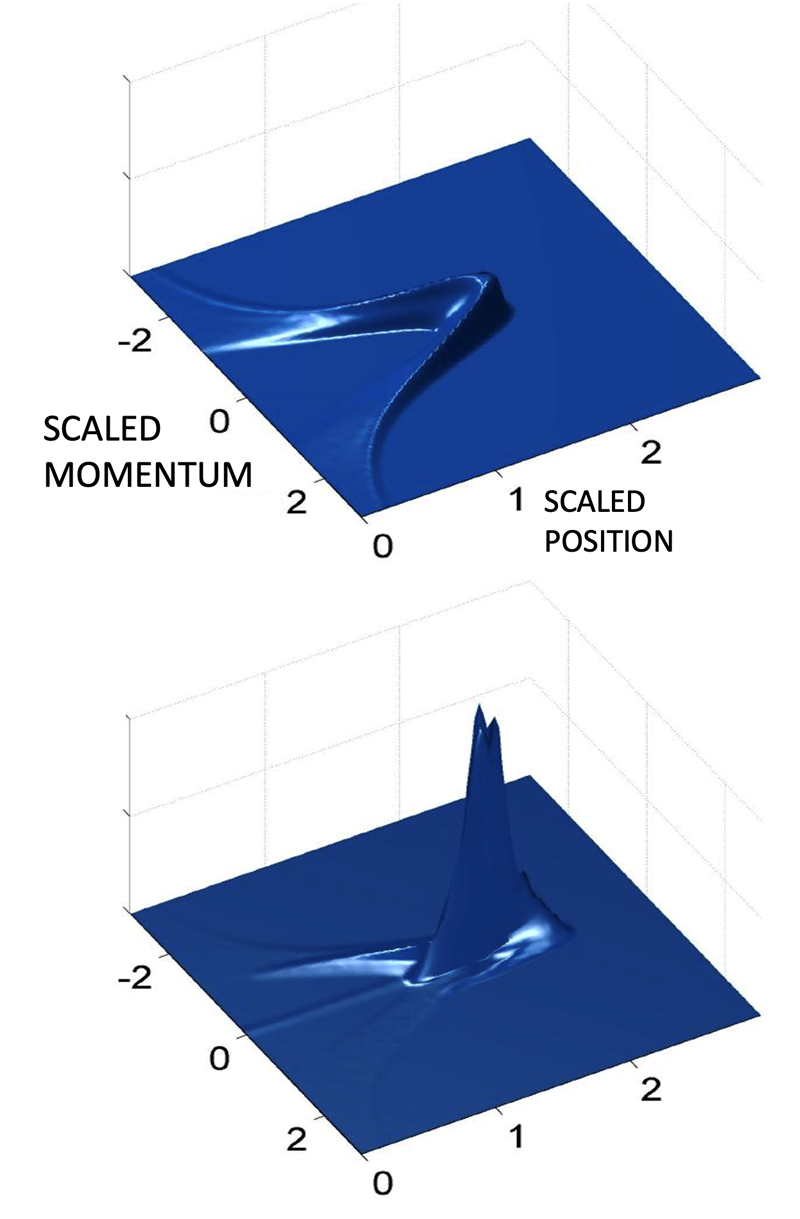
Figure 1. Momentum (velocity) versus position distribution for an electron in a quasi-1D orbit before and after application of an axial kick which transiently localizes it far from the nucleus where its velocity is small.

Initial studies of “kicked” Rydberg atoms utilized quasi-one-dimensional (quasi-1D) atoms, produced by laser excitation in a weak DC electric field, in which the electron executes a highly elliptical orbit whose axis is aligned with the field.  It might be expected that, were such atoms to be subjected to a series of strong equally-spaced kicks directed along this axis, the electron would simply be kicked off the atom.  Such behavior was indeed seen but it was observed that for certain kick strengths and frequencies the atoms could survive many, many kicks.  Such “dynamical-stabilization” was surprising and led to the realization that “islands of stability” could form within an otherwise chaotic sea.  Their analysis provided new insights into both classical and quantum chaos and the relationship between them.

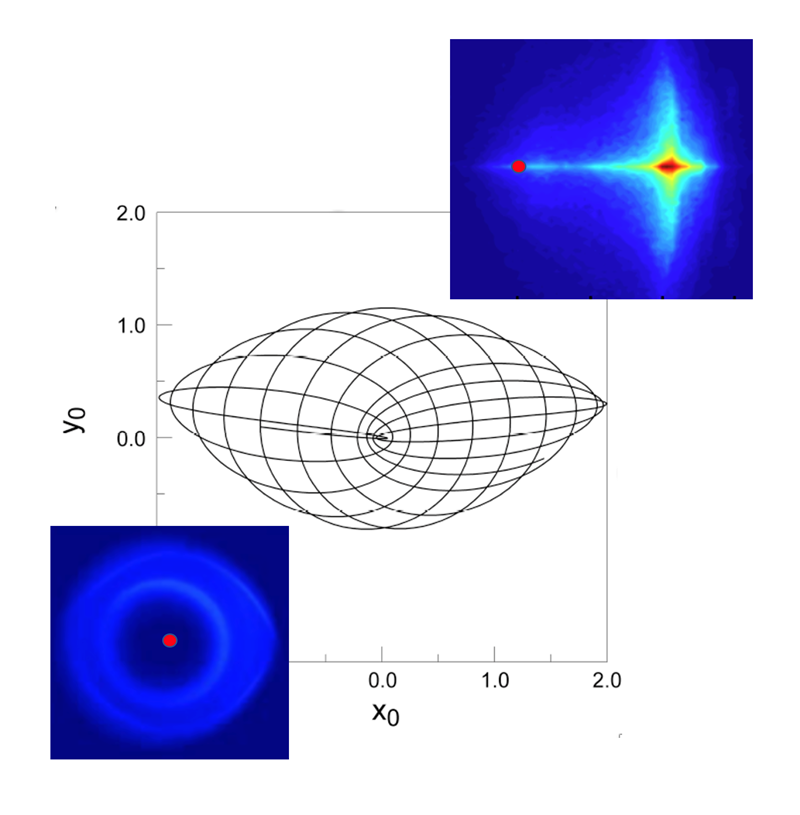
Figure 2. Classical evolution of the electron orbit in a transverse electric field. The orbit cycles between being highly elliptical for which the electron probability density is localized at points far from the nucleus (upper inset) to a near circular orbit for which the electron probability density is distributed around the nucleus (lower inset). Red dots indicate the position of the nucleus.

In the initial quasi-1D atoms the electron probability density, characterized by its wavefunction, is distributed around its orbit. Application of a single kick, however, can lead to its transient localization in the outermost regions of the orbit thereby providing a well-defined starting point for further atomic engineering.  In particular, the electron motion can then be locked to an external microwave drive field or a periodic series of unidirectional kicks. This allows the electron to be transported to states of higher or lower n simply by slowly varying the frequency of the drive field. Alternately, application of a sideways kick at the time of optimum localization can launch the electron into a near-circular orbit and create a quasi-two-dimensional “circular state.”

Circular states which mimic a tiny solar system

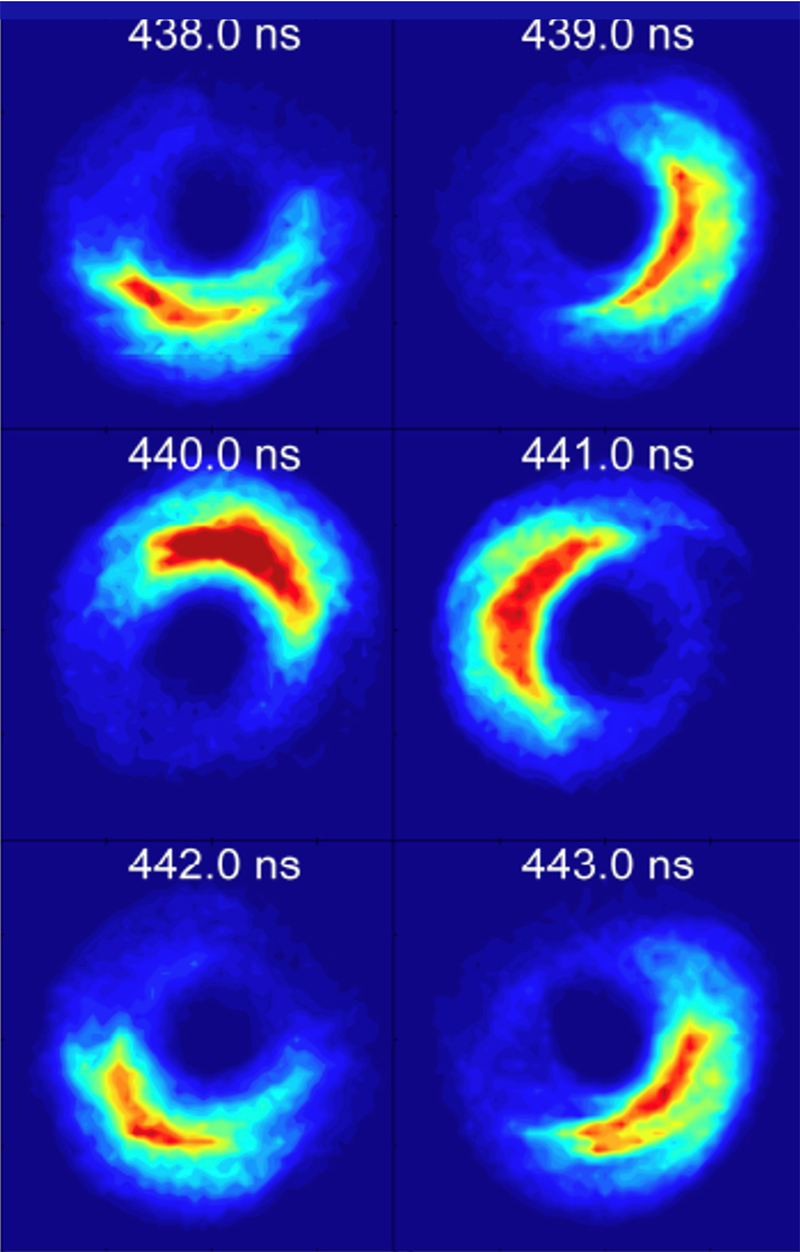
Circular states can also be generated by suddenly applying smaller somewhat longer transverse pulsed electric fields to a quasi-1D atom. This field causes the electron orbit to precess, resulting in periodic transitions between highly-elliptical and near-circular paths. If the field is turned off just as circularity is reached, the electron remains frozen in a circular orbit. Following turn-off, the electron wavefunction becomes transiently localized within its orbit. However, it does not remain localized and spreads around its orbit resulting in so-called “dephasing.” Classically, such dephasing is irreversible. In contrast, quantum mechanics predicts that, because atomic energy levels are quantized, the wavefunction will periodically relocalize, leading to “quantum revivals.” Such revivals are indeed observed, indicating that even at high n, where classical physics might be expected to rule, quantum mechanical effects can still be observed.  Delocalization can be suppressed by application of a carefully-tailored periodic sequence of drive pulses or a microwave field, allowing the creation of atoms whose behavior mimics that of the Bohr atom, or of a tiny solar system.

Figure 3. Simulations illustrating stabilization of a “Bohr-like” wavepacket by a periodic driving field. The electron remains localized in its orbit even after more than one hundred orbits, each taking about 4.4 nanoseconds.

Perturbations introduced by the atomic environment can lead to “decoherence” which results in a transition from quantum to classical behavior and represents a serious problem to the operation of quantum devices. High-n Rydberg atoms furnish a sensitive probe of environmental influences, permitting, for example, detailed studies of decoherence induced by stray background electrical fields whose “noise” characteristics can be carefully-controlled. Nonetheless, this work also demonstrated that under appropriate conditions quantum information can be imprinted, stored, and read out in Rydberg atoms.

Illuminating the behavior of other mesoscale systems

Insights gained through Rydberg atom engineering are of value in many areas.  For example, they illuminate the behavior of other mesoscale systems such as quantum dots that also play a prominent role in exploring concepts and technologies related to quantum information processing. Furthermore, since frequencies of a few gigahertz and fields of a few volts per centimeter appear ultrafast and ultra-intense to a high-n atom, Rydberg atoms also speak to the engineering of low-lying atomic (and molecular) states at the sub-nanoscale using intense ultrashort (attosecond) laser pulses.  In addition, Rydberg atoms provide a valuable bridge between the micro- and macroscopic worlds and help elucidate the transition from quantum to classical behavior."

In this final article in his series discussing the properties and applications of Rydberg atoms, Dr. F. Barry Dunning further explores Giant Rydberg atoms and quantum electric field sensors in more exclusive articles for Open Access Government. 


If you’d like to read his earlier articles, follow these links:

Rydberg Wave Packets: An Entirely New Way of Measuring Time

Amazing! It was these very 'fingerprints' of time that the physicists behind this latest set of experiments set out to test, showing they were consistent and reliable enough to serve as a form of quantum timestamping.

All Humans have is the brief history of Time, and that has been changed recently!


Alaina Ali Beg
6 - 7 minutes

Time is an entity without which human lives will come to an absolute stop, all our lives we have just been programmed to find a workable solution with respect to our time.

The inherent passage of time has been troubling us humans for eternity wherein prehistoric civilization recorded time with phases of Moon, nearly 30000 years ago. Their own reflections could only be expressed in time. . ."

READ MORE

✓  Current research directions Edit

Since 2000's Rydberg atoms research encompasses broadly five directions: sensing, quantum optics,[29][30][31][32][33][34] quantum computation,[35][36][37][38] quantum simulation[39][2][40][41] and quantum matters.[42][43] High electric dipole moments between Rydberg atomic states are used for radio frequency and terahertz sensing and imaging,[44][45] including non-demolition measurements of individual microwave photons.[46] Electromagnetically induced transparency was used in combination with strong interactions between two atoms excited in Rydberg state to provide medium that exhibits strongly nonlinear behaviour at the level of individual optical photons.[47][48] The tuneable interaction between Rydberg states, enabled also first quantum simulation experiments.[49][50]

www.sciencealert.com

Scientists Just Discovered an Entirely New Way of Measuring Time


Mike McRae
4 - 5 minutes

Marking the passage of time in a world of ticking clocks and swinging pendulums is a simple case of counting the seconds between 'then' and 'now'.

Down at the quantum scale of buzzing electrons, however, 'then' can't always be anticipated. Worse still, 'now' often blurs into a haze of uncertainty. A stopwatch simply isn't going to cut it for some scenarios.


A potential solution could be found in the very shape of the quantum fog itself, according to researchers from Uppsala University in Sweden.

Their experiments on the wave-like nature of something called a Rydberg state have revealed a novel way to measure time that doesn't require a precise starting point.

Rydberg atoms are the over-inflated balloons of the particle kingdom. Puffed-up with lasers instead of air, these atoms contain electrons in extremely high energy states, orbiting far from the nucleus.

Of course, not every pump of a laser needs to puff an atom up to cartoonish proportions. In fact, lasers are routinely used to tickle electrons into higher energy states for a variety of uses.

In some applications, a second laser can be used to monitor the changes in the electron's position, including the passing of time. These 'pump-probe' techniques can be used to measure the speed of certain ultrafast electronics, for instance.


Inducing atoms into Rydberg states is a handy trick for engineers, not least when it comes to designing novel components for quantum computers. Needless to say, physicists have amassed a significant amount of information about the way electrons move about when nudged into a Rydberg state.

Being quantum animals, though, their movements are less like beads sliding about on a tiny abacus, and more like an evening at the roulette table, where every roll and jump of the ball is squeezed into a single game of chance.

The mathematical rule book behind this wild game of Rydberg electron roulette is referred to as a Rydberg wave packet.

Just like actual waves in a pond, having more than one Rydberg wave packet rippling about in a space creates interference, resulting in unique patterns of ripples. Throw enough Rydberg wave packets into the same atomic pond, and those unique patterns will each represent the distinct time it takes for the wave packets to evolve in accordance with one another.

It was these very 'fingerprints' of time that the physicists behind this latest set of experiments set out to test, showing they were consistent and reliable enough to serve as a form of quantum timestamping.

Their research involved measuring the results of laser-excited helium atoms and matching their findings with theoretical predictions to show how their signature results could stand in for a duration of time.

"If you're using a counter, you have to define zero. You start counting at some point," physicist Marta Berholts from the University of Uppsala in Sweden, who led the team, explained to New Scientist.

"The benefit of this is that you don't have to start the clock – you just look at the interference structure and say 'okay, it's been 4 nanoseconds.'"

A guide book of evolving Rydberg wave packets could be used in combination with other forms of pump-probe spectroscopy that measure events on a tiny scale, when now and then are less clear, or simply too inconvenient to measure.

Importantly, none of the fingerprints require a then and now to serve as a starting and stopping point for time. It'd be like measuring an unknown sprinter's race against a number of competitors running at set speeds.

By looking for the signature of interfering Rydberg states amid a sample of pump-probe atoms, technicians could observe a timestamp for events as fleeting as just 1.7 trillionths of a second.

Future quantum watch experiments could replace the helium with other atoms, or even use laser pulse of different energies, to broaden the guide book of timestamps to suit a broader range of conditions.

This research was published in Physical Review Research

www.openaccessgovernment.org

Rydberg atoms: quantum electric field sensors

6 - 7 minutes

Rydberg atoms: quantum electric field sensors
Figure 1   Artistic representation of Rydberg atoms excited in a tightly-focused laser beam interacting with incoming EM radiation. (CREDIT – US Army)

Professor Barry Dunning discusses new research in quantum electric field sensors using Rydberg atoms of a higher sensitivity

Electromagnetic (EM) radiation is critically important to the functioning of modern technological society in areas such as telecommunications, radar, and GPS navigation.  Whereas EM waves are now typically detected using antennae and electronic receivers, recent work using atoms in highly-excited states, termed Rydberg atoms, has demonstrated that, following in the footsteps of quantum sensors of time (atomic clocks) and magnetic fields (magnetometers), controllable quantum systems can also provide a powerful electric field sensor (electrometer) that has the potential to reach unprecedented levels of sensitivity and selectivity.  Quantum-based atomic sensors have the advantage over more traditional technologies in that all atoms of a given species possess identical characteristics which allows for repeatable, high precision measurements that can be directly related to known absolute standards.

As highlighted in a recent e-book, atoms in which one electron is excited to a Rydberg state possess many novel characteristics.  In particular, as their level of excitation increases they become very large and can approach the size of a grain of sand.  The excited electron orbits so far from the nucleus and remaining electrons that the electric field it experiences from them is very weak.  In consequence, its motion can be strongly perturbed by even very small external electric fields and it is this sensitivity that forms the basis for the use of Rydberg atoms in electrometry. . ." READ MORE

Multi-Media Economist Mohamed Aly El-Erian


✓ WATCH THIS MARKET ALERT Mohamed El-Erian, Allianz and Gramercy advisor and president of Queens' College, joins CNBC's 'Squawk Box' to discuss Binance's planned acquisition of crypto exchange FTX, what the midterm election results mean for the economy, and more. For access to live and exclusive video from CNBC subscribe to CNBC PRO: https://cnb.cx/2NGeIvi


Video for El erian
Duration: 3:17
Posted: 7 hours ago

m.youtube.com › watch
Video for El erian
Duration: 3:17
Posted: 7 hours ago 

www.thinkadvisor.com


Political Gridlock 'Not Good News' for Today's Markets: El-Erian | ThinkAdvisor

By Dinah Wisenberg Brin
1 - 2 minutes


"The conventional wisdom that Washington political gridlock is good for markets may not hold up this time, economist Mohamed El-Erian suggested Wednesday.

“We have to understand that it depends what path you think the economy is on,” the Allianz chief economic advisor said on CNBC’s Squawk Box as officials counted votes from Tuesday’s election to determine control of the U.S. House and Senate.

In 2010, the economy was on a similar path, meaning it would decline without stimulus from the Federal Reserve, he noted.

“This time around, the Fed cannot step in and provide stimulus. So I don’t think it’s good news that we’re not going to get anything out of Congress over the next two years,” El-Erian said.

“We need to focus on a new growth model, we need to take the supply side more seriously, and I do think there’s a problem that the emphasis will immediately shift to the election in two years’ time and very little will get done,” he said.

Apart from the election, El-Erian suggested the market hasn’t yet taken liquidity risk into account.


We have overcome inflation risk and interest rate risk. … We are starting to understand credit risk, recession, etc. What we haven’t got our arms around as a market is market functioning risk, liquidity risk, and that’s the one thing I keep my eye on,” he said. “That still has to play out as the Fed continues to march up with these interest rates.”

While he would have preferred the Fed wasn’t so late in responding to inflation that it had to hike interest rates aggressively, “given that it’s so late I don’t think they have a choice. The alternative of not reacting would be worse for the economy and worse for the markets long term.”

El-Erian also noted Americans are relying more on their credit cards. “Revolving credit is now at a record high. It’s gone up by 9% in the last year,” he said.

The economy also is seeing a segmentation of the consumer base, even though consumers in general have a strong balance sheet and the labor market overall is strong. “If you are selling to the low-income segments of the population, you’re seeing significant declines in sales,” he said."

(Photo: Wei Leng Tay/Bloomberg)

3 hours ago · Apart from the election, El-Erian suggested the market hasn't yet taken liquidity risk into account. Learn the latest trends in real-world ...
 
>> ". . . Both the stock market and the bond market have been tumbling lately, and El-Erian notes that when these market corrections happen simultaneously, investors should move to “risk-off” assets.


“What we have again learned since the middle of August, is that [stocks and bonds] can both go down at the same time,” he says. “In a world like that, you have to look at short-dated fixed income, and you have to look at cash as an alternative.”

You can hide your cash under a mattress or put them in a savings account. Or, you can use ETFs to tap into the so-called “short-dated fixed income.”

Here’s a look at three of them.

 
www.yahoo.com

‘Get out of these distorted markets’: Mohamed El-Erian issues a dire warning to stock and bond investors — but also offered 1 shockproof asset for safety

Jing Pan
4 - 6 minutes

‘Get out of these distorted markets’: Mohamed El-Erian issues a dire warning to stock and bond investors — but also offered 1 shockproof asset for safety

‘Get out of these distorted markets’: Mohamed El-Erian issues a dire warning to stock and bond investors — but also offered 1 shockproof asset for safety

Due to rampant inflation, holding cash may not be a wise move. (Higher and higher price levels erode the purchasing power of cash savings.)

That’s one of the reasons many investors have been holding stocks and bonds instead. But according to Mohamed El-Erian — president of Queens’ College, Cambridge University, and chief economic advisor at Allianz SE — it might be time to switch gears.

“We need to get out of these distorted markets that have created a lot of damage,” the famed economist tells CNBC.


Top stories 


X

Phoenix New Times had a lot to say about Election Day in Maricopa County...

Way too much to process - extracts for Mesa only...
FIRST THIS: Maricopa County's Republican Recorder Stephen Richer made this promise to voters in Arizona and their ballots: “We will tabulate them as quickly as we can.”
www.phoenixnewtimes.com

Vote Counting Isn’t Quick in Maricopa County. Here’s Why That’s OK


Elias Weiss
25 - 32 minutes

It’s all over — except for the counting. Mostly.


www.phoenixnewtimes.com

Election Day in Arizona: Kari Lake Attacks Hobbs, Media, and Voting Issues

Matt Hennie, Katya Schwenk, Elias Weiss, Natasha Yee
18 - 23 minutes

"It’s all over — except for the counting. Mostly.

The final day to cast ballots has arrived in Arizona. What a ride it’s been to get to Election Day 2022. Election deniers. Antisemitism. Racism. Debategate. Bounties. Rallies. Lots of them. And so much more.

But here we are, with Arizonans facing two women running for governor for the first time in state history. And whether Katie Hobbs or Kari Lake wins, it’ll be the fifth time a woman becomes Arizona’s chief executive — which is more than any other state in the U.S. Yet for women in Arizona, getting to be governor is complicated.

Polls are open until 7 p.m., and the first batch of results is expected to be announced in Maricopa County about 8 p.m. After that, final results could be days away.

Sit back and follow our Election Day coverage right here. And enjoy this playlist we compiled for our gubernatorial candidates.


✓ Voting Location Mormon Church 
(Joanne Smith and Sam Nicolosi carpooled to a Mesa polling place inside The Church of Jesus Christ of Latter-day Saints on Tuesday.)

‘Golden Tickets,’ Conservative Issues Motivate Some Voters in Mesa 

"A lengthy line snaked its way around The Church of Jesus Christ of Latter-day Saints on Southern Avenue in Mesa.

As vehicles pulled in and out of the parking lot on Tuesday afternoon, a box at the entrance to the Mormon church was labeled, “(R) Golden Tickets Here.” The sheets of paper included a Republican guide to voting, including a nod to Randy Kaufman. The GOP candidate for the Maricopa County Community College Governing Board was arrested in October and charged for masturbating in public.

Some voters dropped off their ballots and left, while others, including Mesa resident Kimberly West, waited an hour and a half to cast her vote. It was well worth it, though, West said.

“I would have waited if it was 50 miles long. I’m concerned about the wide-open border, the economy, and the indoctrination of our children at school,” West said. “They’re teaching that America is bad and that white people are bad. We celebrated being American when I grew up.”

Kimberly Perrault, also a Mesa resident, checked a few polling spots before landing at The Church of Latter-day Saints with lines that were just as long as the other locations, she said.

West and Perrault became fast friends at the polling location, the women said, bonding over many of their shared beliefs.

“I wouldn’t call it indoctrination, but they’re putting things in the curriculum that are not important to our children,” Perrault said. “Why don’t they just stick with the basics, like writing, reading, and arithmetic?”

Perrault didn’t expand on specific things in the curriculum that she disagreed with and instead responded that civics and school choice are also important to her.

Joanne Smith, 83, and Sam Nicolosi, 74, carpooled to the ballot box. The neighbors had their own concerns about American democracy.

“I want to make our country great again,” Smith said. “I was especially interested in the proposition requiring people to show proof of citizenship, as well as the one that would fund our fire and policemen.”

Nicolosi said that he was most alarmed by immigration, inflation, gas prices, and the economy.

“We are on a fixed income as seniors,” he said.

The two waited in line before casting their ballots, but they wouldn’t dream of mailing in their ballots or filling them out at home and dropping them off.

“The way things are going nowadays, they say there’s election fraud,” Smith said.

For Nicolosi, waiting in line on Election Day was the way he’d always done it, he said.

Voters continued to add onto the line at the church into the late afternoon. At the parking lot entrance, just one lonely “golden ticket” remained as the sun began to set."

— Natasha Yee

✓ Voting Location ASU Campus Downtown Tempe ( Kari Lake ) 
 

Kari Lake continued her attacks on her opponent, elections officials, and the media after casting her ballot on Tuesday.

Elias Weiss


✓ Voting Location

Hmmm... The City says its “Limited Income Senior Rate Program,” or “LISR” for short, helps give qualifying residents an $8.77 discount, a 30% decrease in their water service rates from $29.23 to $20.46 per month.

 WHOA! 

Mesa’s low income seniors encouraged to site for water bill discount


Published: Nov. 9, 2022 at 11:15 AM MST|Updated: 39 minutes ago


MESA, AZ (3TV/CBS 5) -- The City of Mesa is helping out some of the most vulnerable residents at a time when record inflation is hurting Arizona pocketbooks.

The City says its “Limited Income Senior Rate Program,” or “LISR” for short, helps give qualifying residents an $8.77 discount, a 30% decrease in their water service rates from $29.23 to $20.46 per month.

“The Limited Income Senior Rate Program is a very effective and easy way to provide a significant discount to some of our senior residents in Mesa who face financial challenges,” said Ed Quedens, City of Mesa Business Services Department Director.


Those wishing to use the program must be at least 60 years old, be a permanent full-time resident at the address and be at no more than 200% of the federal poverty level. Once accepted, the discount applies for five years. To learn more or to apply, click/tap here.

Blood Moon NYC 2022