"When polls opened in the Phoenix area Tuesday morning, some vote-tabulation machines weren’t working; within half an hour, conspiracy theories about the problem were running rampant on the internet. Prominent right-wing influencers with millions of followers were clamoring for arrests, and outraged citizens using Telegram channels and online message boards debated whether prison or execution was the appropriate punishment for what was clearly another steal. In reality, officials in Republican-run Maricopa County had transparently informed residents about the problem and offered a few options to make sure everyone’s ballots would be counted: Voters could wait until the problem was fixed, go to a different polling place, or put their completed paper ballot into what was called Box 3 for processing later. Although some social-media users appreciated this information, others sincerely believed they’d uncovered a nefarious plot. The voting machines had been deliberately broken, they insisted, and word on Twitter was that they were broken only in Republican parts of town. Whatever went into Box 3, many were convinced, was not going to get counted. . ."
Revelations about reported surveillance of journalists and politicians with spyware continue to surface in the European Union. Four EU member states have been accused of illegitimate snooping.
https://p.dw.com/p/4JE9V
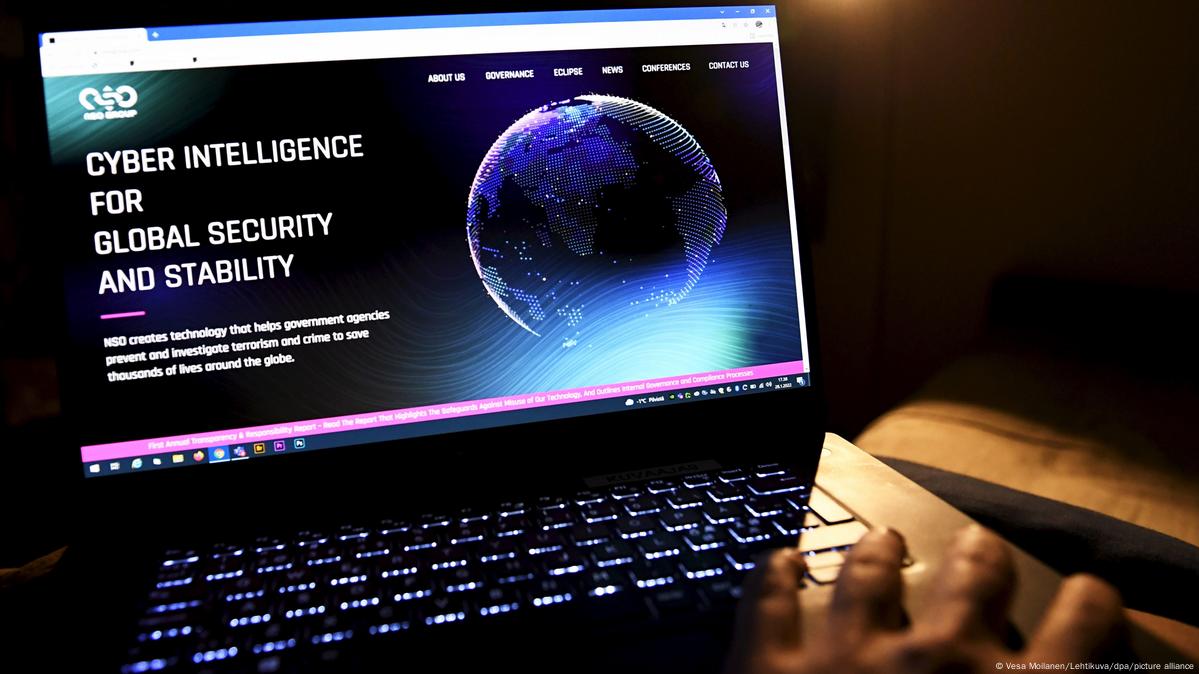
Would you like to browse the contents of a cellphone in the interest of national security? If you have millions of dollars and are a government agency, you could try approaching the NSO Group, an Israeli company that has sold its Pegasus spyware to scrupulous governments worldwide, and its products in 14 EU states, according to the European Parliament.
In the past eighteen months, Hungary, Poland, Spain and Greece have all been accused of using Pegasus or equivalent technology against citizens or politicians.
Spyware 'integral' to systematic oppression in Poland, Hungary
In Poland and Hungary, use of such spyware is an "integral element" of a "system, which is designed to control and even oppress the citizens — that is, critics of the government, opposition, journalists, whistleblowers," said Dutch EU lawmaker Sophie in 't Veld on Tuesday, as she presented a damning interim European Parliamant report.
The liberal politician led the report as part of a committee of EU parliamentarians conducting an inquiry. She has visited Israel, Hungary, Poland, Greece and Cyprus so far and has called for an immediate moratorium on such spyware pending proper regulation.
For Greece, where allegations of surveillance of opposition politicians and journalists continue to surface, the situation was less severe but there were also signs of systematic use "as part of a political strategy," she said.
In Spain, where many pro-Catalan independence figures but also Prime Minister Pedro Sanchez were reportedly targeted, there were "strong indications" that politicians and others were being watched without an appropriate serious national security justification, the politician noted.
The EU Watergate? Pegasus spyware scandal grows
Ella Joyner
November 8, 2022
Revelations about reported surveillance of journalists and politicians with spyware continue to surface in the European Union. Four EU member states have been accused of illegitimate snooping.
"As recently as early last year, the Federal Bureau of Investigation was considering using NSO Group’s infamous Pegasus spyware in criminal investigations,reportsThe New York Times. Between late 2020 and early 2021, agency officials were in the “advanced” stages of developing plans to brief FBI leadership on the software, according to internal bureau documents and court records seen byThe Times. Those documents also reveal the bureau had developed guidelines for federal prosecutors detailing how the FBI’s use of Pegasus would need to be disclosed during court cases.
Based on the documents, it’s unclear if the FBI had considered using the spyware against American citizens. Earlier this year,The Timesfound that the agency had tested Phantom, a version of Pegasus that can target phones withUS numbers.
By July 2021, the FBI eventually decided not to use Pegasus in criminal investigations. That’s the same month thatTheWashington Postpublished an investigation that claimed the software had been used to compromise the phones of two women close to murdered Saudi journalistJamal Khashoggi. A few months later, the US placed Pegasus creator NSO Group on the Commerce Department’s entity list, a designation that prevents US companies from conducting business with the firm. Despite the decision not to use Pegasus, the FBI indicated it remains open to using spyware in the future.
“Just because the FBI ultimately decided not to deploy the tool in support of criminal investigations does not mean it would not test, evaluate and potentially deploy other similar tools for gaining access to encrypted communications used by criminals,” states alegal briefingfiled by the FBI last month.
The documents appear to present a different picture of the agency’s interest in Pegasus than the one FBI Director Chris Wray shared with Congress during a closed-doors hearing this past December. “If you mean have we used it in any of our investigations to collect or target somebody, the answer is - as I’m assured - no,” hesaid in response to a question from Senator Ron Wyden. “The reason why I hedge, and I want to be transparent, that we have acquired some of their tools for research and development. In other words, to be able to figure out how bad guys could use it, for example.”
". . The nation’s mightiest, most mythic waterway has been strangledby months of dry conditions,
which have sent water levels plummeting to historic lows. For weeks
now, that slow-moving crisis has made it difficult, if not impossible,
to move barges down a river that serves as a highway for about 60 percent of the nation’s foreign-bound corn and soybeans.
The
result is a season of uncertainty for many up and down the river who
depend on it for their livelihoods, from farmers growing crops to the
tugboat pilots who steer barges toward the Gulf of Mexico and back. The
deep worries over the crippled supply chain have mingled with the sheer
curiosity of people who have flocked to the banks of the Mississippi to
marvel at a sight few can ever recall.
Aerial images and meteorological data
help to illustrate how dire the situation has become: Sandbars line a
narrowing river channel, the result of scant precipitation and parchedsoils across the Missouri River Valley to the west and the Ohio River Basin to the east.
.In its outlook for the coming winter, National Oceanic and Atmospheric Administration scientists said they expect drought conditions to worsen
in the lower Mississippi Valley, with the climate pattern known as La
Niña expected to bring dry conditions to the southern tier of the United
States.
“Right now
there’s no end in sight,” said Lisa Parker, a spokeswoman for the
Mississippi Valley Division of the Army Corps of Engineers.
The
Army Corps regularly dredges the river bottom to maintain a channel
that is at least nine feet deep, enough to float towboats and the barges
they push. The riverbanks are also dotted with structures that extend
from the banks toward the center of the river, designed to send water
flowing toward the channel and create currents that help maintain its
depth.
The Corps has had
five vessels out on the river in recent weeks to conduct emergency
dredging, needed when barges get stuck and the channel becomes
impassable, Parker said. Each time, the river channel is closed for at
least 12 to 24 hours, further disrupting already slow barge traffic. .
Updated October 27, 2022 at 6:57 p.m. EDT|Published October 26, 2022 at 3:59 p.m. EDT
7 - 9 minutes
Updated October 27, 2022 at 6:57 p.m. EDT|Published
October 26, 2022 at 3:59 p.m. EDT
Dredge
Jadwin, a U.S. Army Corps of Engineers dredging vessel, powers south
down the Mississippi River on Oct. 19 past Commerce, Mo. (Jeff
Roberson/AP)
The drought is “showing us
the other extreme,” said Clint Willson, a professor of civil and
environmental engineering at Louisiana State University and director of
its Center for River Studies.
“We’ve
engineered it to promote this navigation and enable the commerce and
the trade and reduce the risk for communities and ports. But at the end
of the day, it’s still Mother Nature who is supplying the water.”
Daniel Wolfe
contributed to this report. ESA Sentinel-2 imagery for Oct. 17 was
used. Oct. 25 gage data was obtained via the U.S. Geological Survey.
Soil moisture data was provided by Jonathan Case of ENSCO Inc. and the NASA SPoRT Center.
The
world’s wealthiest economy — with the deepest and most liquid market —
is a riskier place than it used to be for investors. And politics is a
big reason.
Why it matters: “Political risk” is an investment thesis used to evaluate developing economies with histories of weak governance and social instability. . .
Yes, but: Clayton Allen, U.S. director at Eurasia
Group, explained to Axios in an email that, “for domestic investors,
there would seem to be little reason to change the way they perceive the
U.S. relative to the rest of the world."
The world is
becoming more volatile, but the U.S.' relative strength in
institutions…means that this is still the first option for investment,”
he said.
“The same dynamic looks different when you are looking
at the U.S. from the vantage point of an increasingly destabilized and
decentralized world, and even a less stable U.S. likely appears more
attractive as a haven from global trends than other markets.”
The bottom line:
For all its flaws, the U.S. is still what most investors consider the
cleanest dirty shirt in a global economy wracked by instability. That
said, “it does mean that investors must consider political risk more
heavily in the context of the U.S. than they have in decades, perhaps
ever,” Allen says."
From Ukraine to Myanmar, These Are the Conflicts to Watch in 2022
Comfort Ero, Richard Atwood
41 - 52 minutes
"After a year that saw an assault on the U.S. Capitol, horrific
bloodshed in Ethiopia, a Taliban triumph in Afghanistan, great-power
showdowns over Ukraine and Taiwan amid dwindling U.S. ambition on the
global stage, COVID-19, and a climate emergency, it’s easy to see a
world careening off the tracks.
Trending Articles
Elon Musk’s Twitter Chaos Is Going to Be Even Worse Overseas
Gutting the workforce will make it harder to protect dissidents and police misinformation.
But maybe one could argue things are better than they seem.
After all, by some measures, war is in retreat. The number of people
killed in fighting worldwide has mostly declined since 2014—if you count
only those dying directly in combat. According to the Uppsala Conflict
Data Program, figures through the end of 2020 show battle deaths are down from seven years ago, mostly because Syria’s terrible slaughter has largely subsided.
The number of major wars has also descended from a recent peak.
Despite Russian President Vladimir Putin menacing Ukraine, states rarely
go to war with one another. More local conflicts rage than ever, but
they tend to be of lower intensity. For the most part, 21st-century wars
are less lethal than their 20th-century predecessors.
A more cautious United States might also have an upside. The 1990s
bloodletting in Bosnia, Rwanda, and Somalia; the post-9/11 Afghanistan
and Iraq wars; Sri Lanka’s murderous campaign against the Tamils; and
the collapse of Libya and South Sudan all happened at a time of—and, in
some cases, thanks to—a dominant U.S.-led West. That recent U.S.
presidents have refrained from toppling enemies by force is a good
thing. Besides, one shouldn’t overstate Washington’s sway even in its
post-Cold War heyday; absent an invasion, it has always struggled to
bend recalcitrant leaders (former Sudanese leader Omar al-Bashir, for
example) to its will.
Still, if these are silver linings, they’re awfully thin.
Battle deaths, after all, tell just a fraction of the story. Yemen’s
conflict kills more people, mostly women and young children, due to
starvation or preventable disease than violence. Millions of Ethiopians
suffer acute food insecurity because of the country’s civil war.
Fighting involving Islamists elsewhere in Africa often doesn’t entail
thousands of deaths but drives millions of people from their homes and
causes humanitarian devastation.
Afghanistan’s violence levels have sharply dropped since the Taliban
seized power in August, but starvation, caused mostly by Western
policies, could leave more Afghans dead—including millions of
children—than past decades of fighting. Worldwide, the number of
displaced people, most due to war, is at a record high. Battle deaths
may be down, in other words, but suffering due to conflict is not.
Moreover, states compete fiercely even when they’re not fighting
directly. They do battle with cyberattacks, disinformation campaigns,
election interference, economic coercion, and by instrumentalizing
migrants. Major and regional powers vie for influence, often through
local allies, in war zones. Proxy fighting has not so far sparked direct
confrontation among meddling states. Indeed, some navigate the danger
adeptly: Russia and Turkey maintain cordial relations despite backing
competing sides in the Syrian and Libyan conflicts. Still, foreign
involvement in conflicts creates the risk that local clashes light
bigger fires.
Standoffs involving major powers look increasingly dangerous. Putin
may gamble on another incursion into Ukraine. A China-U.S. clash over
Taiwan is unlikely in 2022, but the Chinese and U.S. militaries
increasingly bump up against each another around the island and in the
South China Sea, with all the peril of entanglement that entails. If the
Iran nuclear deal collapses, which now seems probable, the United
States or Israel may attempt—possibly even early in 2022—to knock out
Iranian nuclear facilities, likely prompting Tehran to sprint toward
weaponization while lashing out across the region. One mishap or
miscalculation, in other words, and interstate war could make a
comeback.
And whatever one thinks of U.S. influence, its decline inevitably
brings hazards, given that American might and alliances have structured
global affairs for decades. No one should exaggerate the decay: U.S.
forces are still deployed around the globe, NATO stands, and
Washington’s recent Asia diplomacy shows it can still marshal coalitions
like no other power. But with much in flux, Washington’s rivals are
probing to see how far they can go. . .



.jpg)


.jpg)
.jpg)

.jpg)

.jpg)
.jpg)

.webp)
.jpg)





.jpg)