Monday, November 14, 2022

Shadow Government Statistics (and General Headlines)

G E N E R A L .. H E A D L I N E S .. 


  -- Contrary to happy political and financial media hype, Pandemic-driven U.S. Economic Collapse continues to harden in a protracted non-Recovery, amidst mounting evidence of a renewed Economic Downturn and accelerating Inflation, exacerbated by risks from the still-evolving Russia-Ukraine War and increasingly conflicted FOMC monetary and Administration fiscal activity.

-- Despite recent GDP Benchmark Revisions and current gimmicked reporting, key Economic Series show not only that the Pandemic-driven Economic Collapse was worse than headlined, but also that the still-unfolding Recovery has been much weaker than indicated, again, amidst signals of renewed, faltering activity.

-- Severe Systemic structural damage from the Pandemic-driven Shutdown continues to forestall meaningful Economic Rebound into 2023 or beyond, in context of ever-evolving COVID-19 and related circumstances, and the evolving Russia-Ukraine conflict.

-- The Fed’s planned Balance Sheet Reduction formally began in June and should have begun to relieve some Money Supply pressures on Inflation at that time, in theory, although early hard Money Supply numbers through recently published September 2022 still show nothing of substance. Announced FOMC policies are little more than jawboning and targeted financial-market hype, until put into actual effect. That said, expanded Federal Government Deficit Spending continues, despite political hype to the contrary, helping to accelerate domestic Inflation.

-- With fundamental U.S. Dollar debasement (inflation) intensifying, irrespective of short-lived games with reduced oil prices, holding physical Gold and Silver protects the purchasing power of One’s assets, irrespective of any near-term Central Bank or other precious metals’ price machinations to the contrary.


Scroll down for the latest ShadowStats Outlook, Headline Economic News and Background Information on the U.S. Economy, Financial System (FOMC), Financial Markets and Alternate Data, also for publicly available Special Reports and contact information.

L A T E S T .. N U M B E R S [See the later SYSTEMIC RISK SECTION - FEDERAL RESERVE for the latest-published September 2022 Monetary Conditions and current FOMC coverage] – More-specific analysis of the latest economic statistics, headlined earlier in this DAILY UPDATE, begins here with the most-recent data release, followed by others, usually in reverse chronological sequence:

.. EARLY NOVEMBER 2022 CONSUMER SENTIMENT – Early November Consumer Sentiment deepened to a 45.8% (-45.8%) shortfall, previously 40.7% (-40.7%) in October, in recovering pre-Pandemic levels. The University of Michigan’s Early November 2022 “Consumer Sentiment fell about 9% below October, erasing about half of the gains that had been recorded since the historic low in June.” (November 11th, go to http://www.sca.isr.umich.edu for details).

(November 10th) OCTOBER 2022 CONSUMER PRICE INDEX – October 2022 headline CPI-U inflation gained 7.45% unadjusted year-to-year, down from 8.20% in September and from its 9.06% near-term peak in June, but outside the current near-term Pandemic circumstance that annual inflation is the worst in 40-plus years, since February 2022 (Bureau of Labor Statistics - BLS). On a month-to-month basis, October CPI-U inflation gained a seasonally adjusted 0.44%, following gains of 0.39% in September and 0.12% in August and, and a 0.02% (-0.02%) decline in July. Such reflected monthly October Food inflation of 0.60%, versus 0.78% in September, 0.79% in August and 1.10% in July. Dominated by a 3.99% monthly jump in Gasoline prices, following three months of collapse, Energy inflation gained 1.80% October, having declined by 2.11% (-2.11%) in September, by 5.02% (-5.02%) in August and by 4.56% (-4.56%) in July. “Core” Inflation (ex-Food and Energy) gained 0.7% in October, 0.58% in September 2022,0.57% in August and 0.31% in July.

Beyond the varying impact of volatile gasoline prices, headline October inflation numbers continued in context of soaring inflation, triggered by the Pandemic-related explosive growth in the Federal Reserve’s Money Supply creation and in the Federal Government’s Deficit Spending and related Federal Debt Expansion. The Inflation still is not being driven by the FOMC’s hypothetical economic boom.


SHADOWSTATS DAILY UPDATE –- November 11th to 15th [Updated November 11th, 12:10 p.m. ET]. -– IN THE NEWS: No economic rebound/ recovery here: Early November 2022 Consumer Sentiment [University of Michigan] plunged anew, shy by a deepening 45.8% (-45.8%) of ever recovering its pre-Pandemic peak level. Headline October 2022 CPI-U year-to-year inflation eased to 7.75% in October 2022, from 8.20% in September, with the ShadowStats Alternate CPI easing to 15.9% in October from 16.4% in September, despite some rebound in gasoline prices. Although off near-term peak in the post-Pandemic cycle, those current year-to-year inflation rates otherwise remain at respective 42-year and 75-year highs.

Based on last month’s Third-Quarter 2022 CPI-W inflation, the 2022 Social Security Cost of Living Adjustment (COLA) headline increase was set at 8.7% for payments beginning January 2023; per the ShadowStats alternate inflation estimate, it would have been 17.0%, if the CPI-W calculations had not been redefined following the CPI Inflation and COLA spikes of 1980/ 1981. Headline CPI-U year-to-year inflation in September 2022, which tends to run lower than the CPI-W over time, was up year-to-year in the month (not quarter) by 8.2%, versus 8.3% in August, versus ShadowStats Alternate estimates of 16.4% in September, down from 16.5% August.

Following three straight months through September, of both CPI and PPI headline annual inflation being depressed temporarily by weaker gasoline and energy prices from what then was continuing depletion of the Strategic Petroleum Reserve, October 2022 CPI monthly gasoline and aggregate energy inflation turned positive for the first time in four months, with gasoline up by 4.0% in the month, having dropped by 21.5% (-21.5%) in the prior three months. October PPI reporting on November 15th likely will show similar patterns in its Finished Goods sector.

–- DEPLETION OF STRATEGIC PETROLEUM RESERVE GETS CREDIT FOR RECENT HEADLINE GDP GROWTH (as reviewed November 5th). Well timed in advance of the Mid-Term Elections, the Administration’s massive release of petroleum and heavy depletion of the U.S. Strategic Petroleum Reserve not only temporarily softened excessively high inflation (gasoline prices) into headline September reporting, but it also narrowed the U.S. Trade Deficit, given largely unadvertised exports of related oil, which, along with artificially depressed inflation, helped to generate a temporary boost to Third-Quarter 2022 GDP.

Headline October 2022 Unemployment Rate U.3 deteriorated to 3.7%, from 3.5% in September, reflecting a rising count of unemployed against a continuing and unusual shrinkage of the headline Labor Force (employed plus unemployed). Payroll Employment rose by 261,000 in the month, within the expected range, having recovered its Pre-Pandemic Peak in August, gaining against, but still shy by about 5.6 million jobs of what would have been the normal level of payroll activity expected, at present, without the Pandemic. That suggests the system is about three years shy of full recovery.

Federal Reserve Board (FRB) policies remained in place at the November 2022 Federal Open Market Committee Meeting (November 2nd FOMC Statement and Press Conference), along with an otherwise anticipated 75-basis point (0.75%) rate hike in the Federal Funds Rate. While higher rates continue to hit the Economy hard, contrary to FOMC hype, they do little to constrain current Inflation. Headline economic activity is moribund, not overheating, and it is not driving the inflation. Instead, reflecting extreme FRB money creation and consumer flight to liquidity, inflation-driving Money Supply growth in the most liquid measure of “Basic M1” (Currency plus Checking Accounts) has received the equivalent of 21 years of Monetary Stimulus in the 31 months (2.6 years) since the March 2020 Pandemic Shutdown. Under current FRB/ FOMC policies, headline economic activity should continue to falter, and inflation should continue to soar (expanded economic specifics are detailed in the later OPENING HEADLINE and LATEST NUMBERS Sections).

Consider from the FOMC Statement [separately see the ShadowStats comment on the Administration’s recent manipulations] that, “Recent indicators point to modest growth in spending and production. Job gains have been robust in recent months, and the unemployment rate has remained low.” Yet, that “robust” headline Payroll Employment just minimally recovered its Pre-Pandemic level two months ago, in headline August 2022 reporting. Consider that in normal economic times [no Pandemic], Payroll Employment currently would be running higher by about 5,600,000 jobs than seen at present. Separately, the broader Unemployment Rate U.6 already has defined out of existence, a large number of “discouraged workers,” who lost their jobs during the Pandemic, and who are not looking for work, at present, because they believe there are no jobs to be had.

Happy FOMC economic musings aside, consistent with a contracting domestic economy, the November 1st estimate of Third-Quarter 2022 Real Construction Spending continued in deepening annual collapse for the fourth straight quarter, down by 10.0% (-10.0%) year-to-year, and down at an annualized quarterly pace of 16.. . 7% (-16.7%), which was the fourth quarter-to-quarter contraction in the last five quarters. . .

READ MORE>>


YES IT'S THE ECONOMY. . .M2 Money Supply, major precipitator of a recession, a downturn in 2023 "baked in the cake."


 ✓ ARTICLE | Financial Review 

". . . After serving a seemingly never-ending punch of nearly free money, as well as ample and predictable liquidity replenishments, inflation has forced central banks back into their traditional role of taking away the punch bowl. This overdue pivot involves an inherently unpopular journey of policy and communication adaptation.

The temptation to prematurely render this journey more comfortable in the face of recent gains would risk losing sight of the much greater prize — that of restoring the type of macro stability that is essential for enabling high, inclusive and sustainable economic well-being."

www.afr.com

Central banks get a breather but can’t afford to rest 


4 - 5 minutes
Mohamed A. El-Erian
(

"All this has changed in the last year with the emergence of high and persistent inflation. The initial policy fumbles — of analysis, forecasting, communication and reaction — meant that the Fed, in particular, had to pivot sharply from relative complacency to uber-tightening, delivering since the summer an unprecedented four consecutive 0.75 percentage point interest-rate increases in the face of an already slowing economy.

Such front-loading of rate hikes was sure to attract criticism — from politicians, market participants and, most important, households facing soaring mortgage rates and companies confronting harsher financing terms.

BoE’s ‘courageous stand’

> The criticism mounted as inflation remained worrisomely high and the risk of recession rose significantly.

That criticism has eased somewhat in the last few weeks, starting with the Bank of England’s expert handling of a near meltdown in the financial system triggered by Prime Minister Liz Truss’s government going too far and too fast in cutting taxes.

This was followed by a courageous stand by the bank against both fiscal dominance, whereby governments force central banks to fund their excesses, and moral hazard, whereby markets push them to subsidise excessive risk-taking.

Finally, last week’s US inflation report, which was better than consensus forecasts, sparked a rally in stocks and bonds that loosened financial conditions and encouraged more investors to embrace the possibility of a “soft landing” and less Fed policy tightening.

Three key lessons

While greatly welcomed, this respite is far from guaranteed to continue. To manage it well, central banks — and the Fed in particular — would be well advised to apply three key lessons from this year’s experience.

1 > First, as uncomfortable as it is to face criticism on the policy journey to containing inflation, this pales in comparison to what would happen if central banks failed to deliver macroeconomic stability.

Specifically, the unpleasant alternative would be an “Arthur Burns Fed” that leads the economy into a stagflation morass that would be much worse in every respect — economically, financially, institutionally, politically and socially. This is important as the Fed considers how best to tweak its messaging, including forward policy guidance, after the latest inflation report.

2 > Second, given years of investors’ over-extension in risk-taking enabled by persistently cheap and readily available money, central banks should never underestimate the fragility of the financial system.

Rather than falling back into the trap of having monetary policy co-opted by the threat of unsettling financial instability, they should be busily formulating a broad range of a risk-based policy scenarios that involve the greater deployment of preemptive measures and, if needed, reactive tools.

3 > Finally, straight talk is particularly important at a time of such considerable domestic and global economic fluidity. It is also critical for institutions that wish, as they should, to maintain their operational autonomy in the context of strained accountability.

The Bank of England has been an impressive example in this regard, setting aside politically inclined remarks for frankness and professionalism about economic developments and prospects, be it the threat of inflation surging to 13 per cent in the absence of timely policy responses or the possibility of a recession extending into 2023.

After serving a seemingly never-ending punch of nearly free money, as well as ample and predictable liquidity replenishments, inflation has forced central banks back into their traditional role of taking away the punch bowl. This overdue pivot involves an inherently unpopular journey of policy and communication adaptation.

The temptation to prematurely render this journey more comfortable in the face of recent gains would risk losing sight of the much greater prize — that of restoring the type of macro stability that is essential for enabling high, inclusive and sustainable economic well-being."

Mohamed A. El-Erian is a former chief executive officer of Pimco, he is president of Queens’ College, Cambridge; chief economic adviser at Allianz ; and chairman of Gramercy Fund Management.


✓ ARTICLE | Markets Business Insider 

markets.businessinsider.com

October inflation cooled more than expected, but it's still close to 40-year highs. Here's what 5 experts have said about the risk of stagflation hitting the US economy

Jennifer Sor
7 - 9 minutes

Paul Volcker
Paul Volcker, former Fed Chair 1979 to 1987.

Bettmann / Getty Images

  • Inflation cooled in October, but prices have been elevated for over 20 months now, raising concerns of stagflation.
  • That means the economy could be slammed with high unemployment, low growth, and persistent inflation - as well as a steep drop in stocks.
  • Here's what five experts have said about the risks of stagflation and why markets should be more concerned.

Inflation cooled more than expected in October's Consumer Price Index report - but prices are still well above the Fed's 2% target, and they've been above-target for 20 months now.

That "sticky" inflation has sparked fears of stagflation, a dreaded scenario where high inflation gets entrenched into expectations, slamming the economy with a whirlwind of slow growth, high unemployment (and yes, high prices).

Those conditions defined the US economy throughout the 1970s and early 1980s, pushing the Fed to hike rates past 19% in the early 1980s. That's the tightest monetary policy on record, and it spurred a recession and a stunning crash in the stock market. 

Luckily, evidence for another potential crisis is mixed, and October's cool-down in inflation should help soothe some fears. Five-year expectations of inflation are still hovering around the 2% level, and experts have pointed out that inflation often lags behind the official statistics - meaning that prices could be overstated, and are even lower than the latest CPI suggests. Hiring is still tight, and unemployment remained in check at 3.7% in October, which means the labor market has held up amid the Fed's scramble to rein in prices.

As investors digest mixed signals on the direction of the economy, here's what five experts have said about the risk of stagflation descending on the US economy. 

Henry Allen, Deutsche Bank analyst

Deutsche Bank

REUTERS/Kai Pfaffenbach

Despite inflation cooling in recent months, markets are seriously underpricing the risks of returning back to 70s-style stagflation, Deutsche bank analyst Henry Allen wrote in a recent note. 

Allen pointed that inflation has remained high for a significant portion of this year, and while headline inflation is on the downtrend, "sticky" prices - prices for goods and services that don't change frequently - were still accelerating in September's inflation report, and barely cooled by .03% percentage points in October. Together, those indicators are "seriously bad news," as they're major omens for inflation expectations getting embedded in the economy.

If inflation remains persistent, that would result in an even higher interest rate from the Fed, Allen warned, which could spell trouble for stocks: "If the experience of the 1970s repeats, investors are in for a prolonged period of negative real returns for both bond and equities," he said.

Mohamed El-Erian, Allianz chief economic advisor

Mohamed El-Erian
Mohamed El-Erian

YouTube / TEDx Talks

Top economist Mohamed El-Erian believes the US is already headed into a stagflationary crisis, as seen by low levels of growth and high levels of inflation this year.

"We are slowly slipping into stagflation," El-Erian said in a recent interview with Bloomberg. "We may not end up doing enough on the inflation side and then end up in a recession for Europe, near recession for the US and for China."

El-Erian has sounded the alarm on rising inflation since 2021, and has become a loud critic of the Fed's policy response, and of the central bank's insistence that rising prices were "transitory" before aggressively hiking rates this year. That raises the probability of a downturn - but stagflation risks mean the Fed can't back down from its aggressive rate-hiking regime, he said, warning it would be another policy mistake to stop Fed tightening at this point.

"I don't think they can stop now. Because their credibility is so damaged that if they were to stop now, people would immediately say, 'This is the Federal Reserve of the 1970s. This is the flip-flopping Fed, and we will have prolonged stagflation,'" he warned in an interview with New York Magazine in October. "I'll tell you that the consequences of that are worse than the consequences of the Fed continuing."

"Dr. Doom" Nouriel Roubini, NYU Stern economics professor

roubini

REUTERS/Fred Prouser

Roubini, who has earned a reputation as Wall Street's top doomsayer, warned high inflation levels and high debt means the US could be slammed by a stagflationary debt crisis - a Frankenstein-style crash that combines aspects of 70s stagflation and the '08 financial crisis. 

That means low growth, high unemployment, and a painful recession in the US, he warned. In a recent interview with Fortune, he estimated that a mild recession could send the S&P 500 down another 10%, and a severe recession could send the index falling 30% to the 2,700 level. Bonds, credit, and other assets could also see a crash, topping on more damage.

That market rout could also last for years, he warned, due to high levels of debt and ongoing supply issues around the world, which could delay any recovery for the market.

"We might be closer to a period like we saw between 1973 and 1982, where stocks dropped and stayed very, very low for a long time … We could have a long-term crash," Roubini said, adding that its severity would be comparable to what was seen in 2008.

Steve Hanke, John Hopkins University economics professor

Steve Hanke Johns Hopkins finance class

Portia Crowe/Business Insider

The Fed could easily drive the US into a stagflationary crisis next year, Hanke said, given elevated inflation and the high prospects for an incoming recession. In a recent op-ed for the Daily Caller, the top economist pointed to a contraction in the M2 money supply this year, which includes all cash, checking, and savings deposits in circulation. That's a major precipitator of a recession, he said, calling a downturn in 2023 "baked in the cake."

"Thanks to the Fed's monetary mismanagement, broad money (M2) in the US has contracted by 1.1% in the last 7 months," he tweeted in early November. "With that contraction, a recession is right around the corner. In 2023 we will see persistent inflation & a recession - a STAGFLATION," Hanke warned.

Michael Hartnett, Bank of America chief global stock strategist

Bank of America
A sign hangs above a Bank of America branch in the Financial District on November 1, 2011 in Chicago, Illinois. Bank of America Corp. has reportedly announced they will drop its plan to charge customers a $5-per-month fee for making purchases with their debit cards.

Scott Olson/Getty Images

The US has already been slammed with stagflation this year, Hartnett's team of strategists said in a note earlier this month.

"Inflation and stagflation was unanticipated in 2022… hence the $35 trillion collapse in asset valuations," the note said. In a separate note, Bank of America warned investors to prepare for the scenario that the next recession is stagflationary, given that it takes around a decade on average for a developed country to bring inflation back down to 2%, once prices pass the 5% threshold.

But it doesn't necessarily mean prolonged losses for the stock market, Hartnett's team said. Relative returns in 2022 closely follow what was seen in 1973 to 1974, the years when the inflation shock began to ease in. In the 70s, that prompted stocks to enter "one of the greatest bull markets of all time" - meaning that a major rally could soon take hold and spark a recovery for the market.

Read the original article on Business Insider 


RELATED CONTENT

www.longtermtrends.net

M2 Money Supply Growth vs. Inflation - 154 Year Chart


Silvan Frank
2 - 3 minutes

Interpretation

The "M2 Money Supply", also referred to as "M2 Money Stock", is a measure for the amount of currency in circulation. M2 includes M1 (physical cash and checkable deposits) as well as "less liquid money", such as saving bank accounts. The chart above plots the yearly M2 Growth Rate and the Inflation Rate, which is defined as the yearly change in the Consumer Price Index (CPI). When inflation is high, prices for goods and services rise and thus the purchasing power per unit of currency decreases.
Historically, M2 has grown along with the economy (see in the chart below). However, it has also grown along with Federal Debt to GDP during wars and recessions. In most recent history, M2 growth surpassed 10 percent in the crisis of 2001 and 2009, during which an expansionary monetary policy was deployed by the central bank, including large scale asset purchases.
According to Bannister and Forward (2002, page 28), Money supply growth and inflation are inexorably linked.

Data Sources

Further Information

FACE-OFF @ G20 SUMMIT INDONESIA 2022: Chart of The Day...and more


 Pre-Note: As central banks ramp up interest rates to tame runaway prices, there are growing fears the world may soon lurch from a cost-of-living crisis to a global recession

At the same time, the United States, China and other leading economies are facing urgent calls for drastic action to avert a looming climate crisis.

Meanwhile, despite the summit’s optimistic tagline, “Recover Together, Recover Stronger,” prospects for cooperation at the first summit since the invasion of Ukraine appear to be slim as the US and its partners find themselves increasingly at odds with China and Russia."

news.cgtn.com

Chart of the Day: China and the G20, and their role in global recovery

CGTN,China Global Television Network
2 - 3 minutes

"Under the theme of "Recover Together, Recover Stronger," the 17th Group of 20 (G20) Heads of State and Government Summit will take place between Tuesday and Wednesday in Bali, Indonesia, addressing the global economy's ever-increasing challenges.

Comprising 19 countries and the European Union (EU), the G20 is a major intergovernmental forum that can spur global economic recovery and development. Together, the G20 members represent more than 85 percent of the global GDP, 75 percent of the international trade and 60 percent of the world's population, according to the World Bank data in 2021.

UN Secretary-General Antonio Guterres acknowledged the leadership of the G20 in the difficult context posed by "the COVID-19 pandemic, impacts of the war in Ukraine seen in the rising cost of living and tightening financial conditions and unsustainable debt burdens, along with the escalating climate emergency," in a letter to G20 finance ministers and central bank governors last month. 

"Now more than ever, the leadership of the G20 is needed to steer the world out of its deepest crises," he wrote in the letter.


Among the G20, China took up 21 percent in terms of GDP, 18 percent of the trade and 29 percent of the population in 2021. 

✓ China supports Indonesia in playing its role as the president of the G20 and expects the upcoming G20 summit to contribute to global COVID-19 response, economic recovery, and food and energy security, China's Vice Foreign Minister Ma Zhaoxu said at a press conference held on the sidelines of the 20th National Congress of the Communist Party of China.

As a G20 member, China has been taking an active part in international economic cooperation and global economic governance, and working with other parties to propel strong global growth that is sustainable, balanced and inclusive, he added."

(Data editor: Zhao Hong; Graphics & animation: Mukesh Mohanan, Wang Li)

 RELATED CONTENT


www.aljazeera.com

At G20, tensions among US, China, Russia cloud economic agenda


Aisyah Llewellyn
7 - 9 minutes

Medan, Indonesia – The G20, the world’s largest economic forum, is tasked with hashing out solutions to some of the thorniest problems facing the global economy.

This year, the list of challenges facing the club of leading economies, whose headline summit takes place on Tuesday and Wednesday in Bali, is more daunting than usual.

Inflation in many countries is running at 40-year highs, in large part due to soaring energy prices, as the war in Ukraine and China’s “zero COVID” policies disrupt supply chains.

As central banks ramp up interest rates to tame runaway prices, there are growing fears the world may soon lurch from a cost-of-living crisis to a global recession.

At the same time, the United States, China and other leading economies are facing urgent calls for drastic action to avert a looming climate crisis.

Meanwhile, despite the summit’s optimistic tagline, “Recover Together, Recover Stronger,” prospects for cooperation at the first summit since the invasion of Ukraine appear to be slim as the US and its partners find themselves increasingly at odds with China and Russia.

“The issue of inflation, which is immediate, and the longer term issue of having more sustainable development to reduce our carbon footprint requires global coordination which is difficult in a much more fragmented world where geopolitical tensions are rising,” Trinh Nguyen, a senior economist for emerging Asia at Natixis in Hong Kong, told Al Jazeera.

“So the challenge for the G20 is to bring leaders, who diverge in geopolitics, together to find common ground and solutions to both short-term and longer-term crises.”

Nguyen said inflation, above other issues, will top the agenda as it has “impacted everyone from households that find essentials more expensive to corporations.”

Nguyen added that another challenge for the G20 would be to forge a more integrated global supply chain that is less vulnerable to geopolitical shocks such as Russia’s invasion of Ukraine.

 . . .

“The issue of inflation, which is immediate, and the longer term issue of having more sustainable development to reduce our carbon footprint requires global coordination which is difficult in a much more fragmented world where geopolitical tensions are rising,” Trinh Nguyen, a senior economist for emerging Asia at Natixis in Hong Kong, told Al Jazeera.

“So the challenge for the G20 is to bring leaders, who diverge in geopolitics, together to find common ground and solutions to both short-term and longer-term crises.”

Nguyen said inflation, above other issues, will top the agenda as it has “impacted everyone from households that find essentials more expensive to corporations.”

Nguyen added that another challenge for the G20 would be to forge a more integrated global supply chain that is less vulnerable to geopolitical shocks such as Russia’s invasion of Ukraine.

The International Monetary Fund (IMF) estimates global inflation, which has risen steadily throughout the year, to reach 8.8 percent in 2022, compared with 4.7 percent in 2021, due to a combination of factors including the COVID-19 pandemic, supply-chain disruptions, the war in Ukraine and higher fuel prices.

The G20, which includes 19 countries and the European Union, has struggled to reach a consensus on the cost-of-living crisis, with finance ministers and central bank governors in July scrapping a planned communique that would have addressed inflation, global food and supply shortages, and sluggish economic growth due to discord over Ukraine.

Summit host Indonesia has sought to maintain the forum’s neutrality, rejecting calls by Western countries and Ukraine to exclude Russia, and highlighted the potential for cooperation on food and energy security.

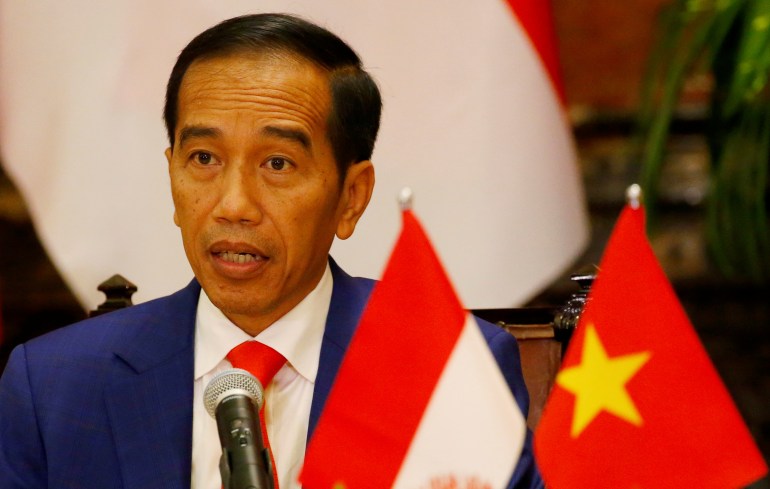
In a newspaper interview last week, Indonesian President Joko Widodo lamented the possibility of geopolitical tensions overshadowing the summit, which he said is “not meant to be a political forum”.

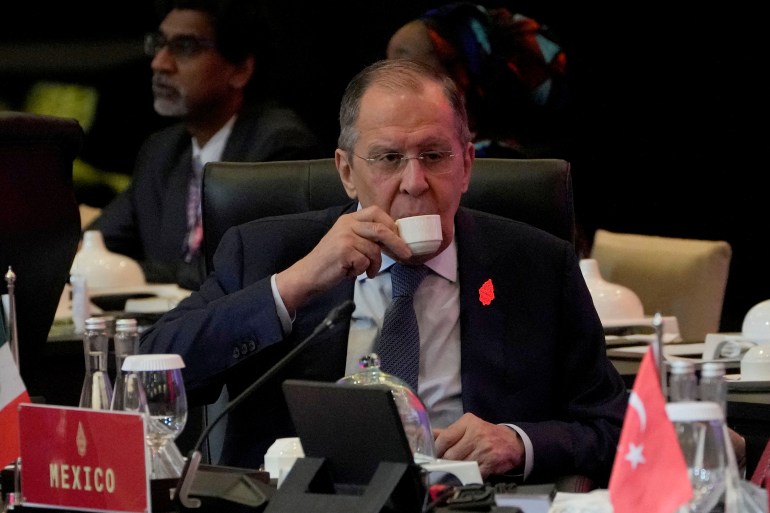
At the G20 finance ministers meeting held in Washington in April, representatives from the US, UK and Canada walked out of a closed-door session when Russian delegates began to speak, and in July, Russian Foreign Minister Sergey Lavrov stormed out of G20 talks in Indonesia following criticism of the Russian invasion of Ukraine.

Lavrov
Russian Foreign Minister Sergey Lavrov will represent Russia at the G20 leaders’ summit in Bali [File: Dita Alangkara/Pool via Reuters]

Russian and Indonesian officials confirmed last week that Russian President Vladimir Putin would not attend the summit and would instead be represented by Lavrov. Putin is, however, expected to attend at least one of the meetings virtually. US President Joe Biden and Chinese President Xi Jinping will both attend, with the two leaders scheduled to have their first face-to-face meeting on Monday ahead of the summit. Other high-profile attendees include Indian Prime Minister Narendra Modi and Japanese Prime Minister Fumio Kishida.

Radityo Dharmaputra, an international relations lecturer at Airlangga University in Surabaya, Indonesia, said the main challenge for the summit will be to find a way to encourage some positive movement in relations between Russia and Ukraine.

“Indonesia only invited both presidents without offering any kind of proposals,” Dharmaputra told Al Jazeera.

He said that Russia likely considered the invitation to attend the summit to be a trap since Putin’s attendance would have likely been boycotted by Western leaders.

In June, Widodo visited Ukraine and Russia in a diplomatic effort to broker peace talks and allow the free passage of grain exports again.

The following month, Russia, Ukraine and Turkey signed the United Nations-brokered Black Sea Grain Initiative aimed at guaranteeing the safe transportation of grain and other foodstuffs from Ukrainian ports.

“Indonesia at the moment only wants to build trust, but it will be almost impossible during the war,” Dharmaputra said.

“Apparently, Indonesia is continuing the ASEAN way of building trust with informal meetings, meals, golf, and coffee. But it is very difficult to make it work for a very different conflict and cultural background as well.”

widodo
Indonesian President Joko Widodo has lamented the possibility of geopolitical tensions overshadowing the G20 summit [File: Bullit Marquez/Pool via Reuters]

Shahar Hameiri, a political economist at the University of Queensland, said energy would be an important focus of the summit as the war in Ukraine had highlighted the power of energy-producing countries to influence prices for everyone else.

“Some of those are members of the G20, including of course Russia itself, but also Saudi Arabia and Indonesia,” Hameiri told Al Jazeera.

“The US was outraged when so many producer countries have not increased production to keep prices high, in apparent support of Russia.”

Hameiri said another important issue he expected the G20 to discuss is debt restructuring for developing countries facing financial difficulties.

“The G20 has been attempting to coordinate this for a while, but the scale of the debt problem has gotten so much bigger recently, as the US Federal Reserve Bank has raised interest rates to combat domestic inflation,” he said.

Despite the scale of the challenges and political discord, some observers see room for optimism about the G20’s ability to tackle common issues of concern.

Dandy Rafitrandi, an economic researcher at the Center for Strategic and International Studies, said the forum has had achievements in recent years, including initiatives to pause debt payments to the poorest countries and provide financing to countries facing urgent liquidity shortfalls during the pandemic.

“The G20 Finance Track has discussed several follow-up initiatives from the previous presidency such as the Debt Service Suspension Initiative (DSSI) and Special Drawing Rights (SDR), which aim to protect developing countries that are vulnerable to macroeconomic pressures in the face of COVID-19 and rising food prices and energy,” Rafitrandi told Al Jazeera.

“However, the legacy of this year’s G20 Indonesia will be the successful establishment of the Pandemic Prevention, Preparedness and Response Financial Intermediary Fund (PPR FIF), which will be managed by the World Bank in collaboration with the World Health Organization (WHO),” Rafitrandi said, referring to an initiative aimed at helping low and middle-income countries strengthen their pandemic preparedness.

“In the midst of heated geopolitical tensions, this achievement must be appreciated.”


At G20, tensions among US, China, Russia cloud economic agenda

Summit comes as rifts between United States, China and Russia dampen prospects for coordination on economic crises.

Wido
The G20 leaders' summit comes at a difficult time for the global economy [File: Dita Alangkar/AP]


Sunday, November 13, 2022

FTX COLLAPSE


www.dailymail.co.uk

$515m is STOLEN from crypto exchange FTX in matter of hours. Is it hackers or an inside job?

Paul Farrell
7 - 9 minutes

$515m is STOLEN from collapsed crypto exchange FTX in matter of hours... but is it hackers or an inside job? New CEO locks down remaining funds in secure storage as FBI is called in and amateur sleuths try to track down thieves 

, updated

  • In the latest twist in the downfall of crypto exchange FTX, internet sleuths discovered that $515 million has disappeared from the company's accounts
  • Multiple reports suggest that the withdrawal bears the hallmarks of a hacker with a crypto security expert saying his company knows the identity of the user
  • This comes hours after FTX's founder Sam Bankman-Fried resigned as CEO to be replaced by corporate firefighter John J. Ray III 

Internet sleuths have discovered that $515 million has disappeared from the accounts of collapsed crypto exchange FTX under 'suspicious circumstances.'

Company founder Sam Bankman-Fried resigned from FTX on Friday, as the crypto IIIexchange filed for bankruptcy and reports emerged that, separate to the missing $515 million, up to $2 billion in client funds had vanished from the company's books in recent weeks.


Nick Percoco, chief security officer of Kraken, was among the industry officials seemingly piecing the situation together. He said in a tweet: 'We know the identity of the user' who withdrew the funds from FTX. 

FTX's U.S. general counsel Ryne Miller then responded to that tweet: 'Interested in anything you are open to share. Could you reach out to me?' 

Enthusiasts invested in the manic crypto episode also took it upon themselves to examine public records and find out who may have hacked or stolen the millions of dollars.  

At the time of writing, Percoco has not elaborated further as to whether or not the withdrawal was the work of a hacker. Multiple reports have pointed out that the methods used to withdraw the money bear the hallmarks of a hacker.  

Meanwhile, FTX's new Chief Executive John J. Ray III, known for guiding Enron through bankruptcy in the 2000s, said on Saturday that the company was working with law enforcement and regulators to mitigate the problem, and was making 'every effort to secure all assets, wherever located.'

. . .

'Among other things, we are in the process of removing trading and withdrawal functionality,' he said. 

It's reported that Bankman-Fried, known for regularly wearing t-shirts and shorts, is holed up in the Bahamas as his empire continues to crumble. DailyMail.com has reached out to Bankman-Fried for comment. 

In 2022, Bankman-Fried was one of the biggest donors to the Democratic Party. 

On Saturday, Ryne Miller said in a Twitter post that the firm's digital assets were being moved into so-called cold storage 'to mitigate damage upon observing unauthorized transactions.'

Cold storage refers to crypto wallets that are not connected to the internet to guard against hackers.

Miller earlier tweeted that he was 'investigating abnormalities with wallet movements related to consolidation of FTX balances across exchanges.'  

Bankman-Fried had transferred $10 billion of customer funds to his trading company, Alameda Research.

The company is run by Bankman-Fried's girlfriend, Caroline Ellison. 

A large portion of that total has since disappeared, they said. One source put the missing amount at about $1.7 billion. The other said the gap was between $1 billion and $2 billion. 

Blockchain analytics firm Nansen said it saw $659 million in outflows from FTX International and FTX U.S. in the last 24 hours.

A separate blockchain analytics firm Elliptic said that around $515 million worth of cryptoassets were 'suspected to have been stolen,' while $186 million were likely moved into secure storage by FTX.

The firm described the movement of the funds as 'suspicious.' 

Crypto exchange Kraken said: 'We can confirm our team is aware of the identity of the account associated with the ongoing FTX hack, and we are committed to working with law enforcement to ensure they have everything they need to sufficiently investigate this matter.'

In its bankruptcy petition, FTX Trading said it has $10 billion to $50 billion in assets, $10 billion to $50 billion in liabilities, and more than 100,000 creditors.

Ray, a restructuring expert, was appointed to take over as CEO. . ."

READ MORE 


TESLA'S VAST SUPER-CHARGERS NETWORK


www.theverge.com

Tesla opens up its charging connector in a bid to become the North American standard

By Umar Shakir
3 - 4 minutes

After promising for more than a year to make its vast Supercharger network available for all EVs, Tesla is now pivoting to make its plug the standard instead.


Tesla is opening up its charging system, but not in the way that helps people who own electric vehicles that aren’t Teslas.

The automaker is renaming its Tesla connector the “North American Charging Standard” (NACS) and is pitting it against the current CCS combo charging standard. CCS is the agreed-upon standard that every manufacturer selling in North America has adopted for DC fast charging.

In a new blog, Tesla says that its connector is “half the size, and twice as powerful” as CCS and points out that it’s “the most common charging standard” by a degree of 2 to 1. Tesla currently sells more EVs than any other manufacturer in the US, but other automakers are starting to catch up. According to the Department of Energy, there are about 17,000 Tesla Supercharger connectors in the US and Canada, compared to about 11,000 CCS combo ports. . .

✓ Earlier this year, a White House memo revealed that Tesla Superchargers in the US will start serving non-Tesla EVs by late 2022, but since then, there have been no updates from the company. The Biden administration passed an infrastructure law that aims to help boost EV adoption and grow charging infrastructure, but funding would only go to companies that build charging stations that can accommodate more than one company’s EVs. As it stands, this would disqualify Tesla from receiving these funds unless it can convince at least one other automaker to adopt its plug. . ." 

READ MORE 


www.statista.com

Infographic: The Growth Of Tesla's Supercharger Network

Niall McCarthy,
3 - 4 minutes

Tesla's recent moves to drastically expand the production of its vehicles will only prove effective if the development of infrastructure to support EVs keeps pace. The company is actively expanding its supercharger network with an increasing focus on urban areas including convenient locations like supermarkets, hotels and downtown districts. Tesla now has more than 17,000 superchargers in operation across the world in close to 2,000 charging stations, according to website supercharge.info.

Infographic: The Growth Of Tesla's Supercharger Network | Statista

Description

This chart shows the number of active Tesla supercharger stations worldwide by month.

Top stories


Imperialst Rhetoric, Tom Horn to Defuse Tensions, Gold Tops $5,000 in Demand Frenzy, . . .Japan Bond Crash

         Stephen Maturen/Getty Images Trump, Democrats Hurtle Toward Shutdown After Minnesota Killing A fatal shooting by Border Patrol agen...