The People of Praise, a secretive Christian faith group that counts the conservative supreme court justice Amy Coney Barrett as a member, considered women's obedience and subservience to men as one of its central early teachings, according to leaked remarks and writings of the wife of one of the group's founders.
Amy Coney Barrett urged to step away from gay rights case because of faith affiliation
Stephanie Kirchgaessner
6 - 7 minutes
"Former
members of Amy Coney Barrett’s secretive faith group, the People of
Praise, are calling on the US supreme court justice to recuse herself
from an upcoming case involving gay rights, saying Barrett’s continued
affiliation with the Christian group means she has participated in
discriminatory policies against LGBTQ+ people.
The former members
are part of a network of “survivors” of the controversial charismatic
group who say Barrett’s “lifelong and continued” membership in the
People of Praise make her too biased to fairly adjudicate an upcoming
case that will decide whether private business owners have a right to
decline services to potential clients based on their sexual orientation.
They
point to Barrett’s former role on the board of Trinity Schools Inc, a
private group of Christian schools that is affiliated with the People of
Praise and, in effect, barred admission to children of same-sex parents from attending the school. . .
The schools’ attitude, the former People of Praise members said,
reflect the Christian group’s staunchly anti-gay beliefs and adherence
to traditional family values, including – they say – expelling or
ostracizing members of the People of Praise “community” who came out as
gay later in life or their gay children.
“I don’t believe that
someone in her position, who is a member of this group, could put those
biases aside, especially in a decision like the one coming up,” said
Maura Sullivan, a 46-year-old who was raised in the People of Praise
community in South Bend, Indiana. . .
Questions about the People of Praise’s attitude toward LGBTQ+ members
and their families, and Trinity Schools’ policies, have resurfaced
because the supreme court will hear oral arguments on 5 December in the
case of 303 Creative LLC v Elenis.
It centers on a Christian
website developer, Lori Smith, who has claimed an anti-discrimination
law in Colorado has violated her right to free speech over same-sex
marriage, which she says goes against her religious faith. Smith has
said the Colorado law has forced her to “create messages that go against
my deeply held beliefs” since she cannot legally turn away gay couples
seeking her website services.
Barrett said in her confirmation
hearing that her personal religious beliefs would not interfere with her
abilities to be an unbiased judge. Conservatives have also lashed out
against any suggestion that her affiliation with a Christian sect could
compromise her independence.
But some former members of the faith
group say they see a big difference between judges who have faith and
are religious, and Barrett’s affiliation with the People of Praise, a
tight-knit community whose members agree to a lifelong covenant of loyalty to one another.
. . .
“The People of Praise has deeply entrenched, anti-gay values that
negatively affect the lives of real people, including vulnerable youth.
These values show up in the everyday policies of the People of Praise
and their schools. They are policies that are way outside the
mainstream, and most Americans would be disturbed by them,” said Kevin
Connolly, a former member of the People of Praise who is the brother of
the group’s chief spokesperson. Connolly has previously made public
remarks about physical abuse he suffered at the hands of his father.
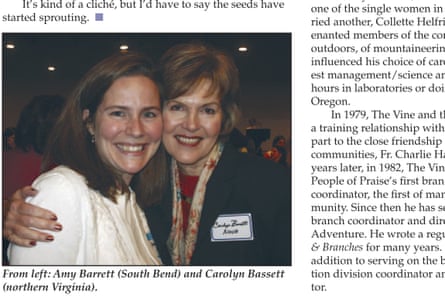
The
May 2006 issue of Vine and Branches, produced by the People of Praise,
shows Amy Coney Barrett pictured at a People of Praise Leaders'
Conference for Women in 2006. Photograph: AP
Stop right there: A guide to how we make our calls
WRAL
6 - 8 minutes
RALEIGH, N.C.
— Maybe you've been reading about a political speech or listening to a
television commercial and something strikes you as, well, not quite
right.
Us too. Which is why the fact check is a useful and popular tool for WRAL News and WRAL.com.
This post updates our original fact-checking scale and answers a few of the more frequently asked questions we've gotten from readers.
What is a fact check? Shouldn't all your facts be checked?
Yes,
journalists do pride ourselves on having the, "If your mother says she
loves you, check it out" mentality. And yes, it is routine to double
check names, spellings, numbers, etc., in our stories.
As we're
using the term here, fact-checking connotes a particular subspecies of
journalism that challenges assertions made by politicians, business
leaders and others on the public stage. FactCheck.org, Politifact and the Washington Post's Fact Checker
are probably the three best known brands in the fact-checking business,
although many news outlets have regular fact-checking features.
The
idea is to tackle an assertion and see if it holds up to scrutiny. Fact
checks developed, in part, as an antidote to problems associated with
political reporting that attempted to be fair to both sides of a
partisan debate but sometimes ended up with he-said, she-said stories.
Sometimes, there really is a right answer, and a fact check aims to
bring that to readers and viewers.
What will you check?
Just
about anything. During campaign season, we spend a lot of time looking
at political ads, which can seem both ubiquitous and persistently
dubious. But we'll run down statements from candidate debates, floor
speeches in the legislature, pundits on weekend chat shows, fliers put
out by businesses or anything else that has become part of the public
conversation.
Commonly, we bring a fact check to bear when the
purported fact goes from being part of a story to becoming a story unto
itself. So, that meme everyone is passing around Facebook or the pithy
one-liner in a fundraising email are both fair game.
Why do you favor Democrats/Republicans/etc...?
We
don't. During the 2014 U.S. Senate campaign, for example, WRAL News
fact checked, and found fault with, Republican and Democratic speakers
in roughly equal numbers. We choose fact check subjects by how pervasive
a particular assertion is and whether a fact check will lend light to a
larger policy issue. If you have a suggestion for a fact check, please
click on the reporter contact link at the bottom of this story or email
mbinker (at) wral.com.
What's your process?
Any
fact check begins with the person or organization making the statement.
The most typical question we ask is "how do you know that?" Was the
statement in question something that came from hearsay, or is it backed
up by research?
With regard to television ads, most political
campaigns and independent expenditure groups will provide a rundown of
their campaign commercials with attribution pointing to where they drew
specific facts. When such a document is available, we will link to it.
In the case of statements made by individuals, businesses or groups
outside of a campaign context, we will ask them for their sources.
After
that, we will conduct our own research, looking for documents, videos,
news reports and other material that might bolster a claim or knock it
down. In general, we try to prove someone is right before we try to
prove them wrong. Our fact checks will include links to source material
when available so viewers and readers can see what we're seeing. Often,
we'll also call on experts in the field to help us understand why a
particular statement might be true or false, or somewhere in between.
Why is context so important?
It
isn't unusual for a fact check to say a particular piece of data has
been "cherry-picked" or has been offered out of context. We have seem
numerous examples of true facts being used in misleading ways. So, our
fact checks aim to help you understand both the specific facts in play
as well as how those facts are being employed. If a statement uses facts
that are true but can leave readers with an impression that is wrong,
it doesn't get a clean bill of health.
How do you make the call?
On
each fact check, we'll offer "the call," a quick graphical reference
and synopsis to show you whether the statement is question is reliable, a
real howler or somewhere in between. Here's our fact-checking scale as
it has been revised at the beginning of 2015:
Green light: Go
ahead, run with it. The WRAL News fact check has found no materially
incorrect assertions or misleading statements. We don't demand
perfection in order to award a green light, but anything more than
rounding error or a slip of the tongue will have us thinking about
downgrading to a yellow light.
Yellow light:
Slow down and use caution. The statement in question contains a minor
but significant factual error or is lacking important context. A yellow
light is frequently the call when a statement has some basis in fact but
has taken a bad turn along the way. You may also see a yellow light
when the speaker in question tried to get something right but made an
honest mistake that misinterprets, but doesn't completely butcher, a
piece of data.
Red light: Stop
right there. The statement in question is demonstrably false or
unfounded. Even if some of the numbers or other facts cited are correct,
the overall conclusion does not hold up.
Moving Violation:
Someone has just blown through the stop sign and earned a rhetorical
citation – the kind that would land you in front of a judge if committed
on the road. The statement in question is not just wrong, but was
offered with gusto. Either the person speaking ignored easily accessible
resources that could have corrected the statement, has persisted in
putting something forward even though he or she knows better, or has
offered a statement with no reasonable basis in fact. These statements
frequently verge on the ridiculous. (This category was added to our
fact-checking scale in January 2015.)
U-turn: The
statement in question may or may not be correct. However, it represents
a change in position for the individual in question. This indicates a
"flip-flop."
Grandfather of Colorado gay bar shooter 'is MAGA California lawmaker who hailed January 6 riots'
James Gordon
30 - 38 minutes
Grandfather of 'Colorado gay bar mass-shooter' is MAGA
California lawmaker who hailed January 6 riots, as it's claimed 'killer'
evaded red flag law despite threatening mom with bomb
, updated
Authorities have named Anderson Lee Aldrich, 22, as
the lone suspect in the deadly shooting at a gay nightclub in Colorado
Springs, Colorado on Saturday
Aldrich’s grandfather is allegedly Randy Voepel, a Republican state lawmaker in the California State Assembly
Voepel
compared the January 6, 2021 attack on the U.S. Capitol to the
Revolutionary War - Voepel lost his seat to a challenger in the midterm
elections
Aldrich’s mother, Laura Voepel told police her son threatened her with a homemade bomb and other weapons last June
Aldrich
was charged with two counts of felony menacing and three counts of
first-degree kidnapping, but the charges were later dropped and records
sealed
Incident raises questions about
Colorado’s red flag law, which empowers authorities to temporarily seize
firearms from those deemed a potential threat
On
Sunday, details of some of the five who lost their lives and 25 who
were injured were released including two bar tenders who were killed
California State Assemblyman Randy Voepel is said to be the grandfather
of the man alleged to be behind the mass-shooting at a Colorado gay bar
this weekend, Anderson Lee Aldrich
The grandfather of the man alleged to be behind the mass-shooting at a Colorado gay bar this weekend has been named as a MAGA Republican lawmaker who praised the January 6 riots at the U.S. Capitol last year.
Anderson Lee Aldrich, 22, is accused of killing five people and injuring 25 more at Club Q.
Posts on social media posts made under Aldrich's mother's name, Laura Voepel, have linked him to former Republican California state assembly member Randy Voepel - claiming he is his grandfather, reports The Guardian.
Confirmed photos of Aldrich himself have yet to emerge, and no mugshot has been released.
Following the attack on the Capitol, Voepel hailed the rioters comparing their actions to that of American Revolutionaries.
'This
is Lexington and Concord. First shots fired against tyranny. Tyranny
will follow in the aftermath of the Biden swear in on January 20th,'
Voepel said.
Voepel, as a member of the California State Assembly
from the 71st district represented most of inland San Diego County and
part of Riverside County, but he lost his seat to a primary challenger
in August. He later tweeted that he 'condemned violence and
lawlessness.'
The former mayor of Santee, California at one point
left the Republican party for the tea party movement because he deemed
the GOP too 'liberal.'
Voepel is believed to be a MAGA Republican lawmaker who praised the January 6 riots at the U.S. Capitol last year Former California State Assemblyman Randy Voepel (c) as pictured on his Facebook page
Later on Sunday, two bartenders killed in the deadly mass shooting at a LGBTQ club in Colorado Springs were pictured - hours after police confirmed the arrest of Aldrich, whose mugshot has not yet been released.
Derrick
Rump and Daniel Aston were among the five killed Saturday night at Club
Q in what appeared to be a premediated attack, carried out by a single
gunman armed with an AR-15.
Both men worked as bartenders at the
establishment and are so far the only two named victims of the attack -
which occurred on the eve of The Transgender Day of Remembrance, at
11:57pm. Aston, 28, was a trans man.
Derrick Rump (left) and Daniel Aston (right) were among the five killed
Saturday night at Club Q in the seemingly premeditated attack, carried
out by a single gunman armed with an AR-15
Charlene and James Slaugh were also hurt during the attack and have
both undergone surgeries. Charlene was found with 13 holes and a
collapsed left lung Charlene Slaugh is one of the dozens of injured victims in the Club Q nightclub shooting Slaugh was found with 13 holes having been shot at multiple times. She faces a long road to recovery
Pictures of others caught up and injured during the shooting have also been emerging including Charlene and James Slaugh.
Charlene
was shot in the abdomen and suffered a collapsed lung after suffering
13 wounds caused by an unknown number of bullets. She is fighting for
her life having undergone the first of what is likely to be numerous
surgeries, with a long road to recovery ahead.
On Sunday night her mother reported her being on a ventilator but in stable condition.
James was shot in the shoulder and is expected to recover following shoulder surgery on Sunday. A GoFundMe account has been set up to help pay their medical bills.
His
partner was shot in the leg and is also expected to fully recover.
James and his partner met at Club Q and had always considered it a safe
space.
Pictures of others caught up during
the shooting have also been emerging including Tara Bush, aka DJ
T-Beatz, who is one of the dozens of injured victims in the nightclub
Tara Bush, aka DJ T-Beatz, is one of the dozens of injured victims in
the Club Q nightclub shooting. She is currently still in the hospital
Tara Bush, aka DJ T-Beatz, who is one of the dozens of injured victims in the nightclub shooting.
Bush is currently still in the hospital, ABC News reported.
As
investigators attempted to piece together what led to the tragedy, on
Sunday it also emerged how last June, Aldrich, had been accused of
threatening to blow up his mother's home with a makeshift bomb.
Luckily his mother, Laura, was able to escape and alerted police while driving to safety away from her Colorado Springs home.
Officers
found Aldrich who was seen walking out on the street about one mile
from the house. He ignored police orders and managed to evade the
arrest.
There was finally a stand-off between police officers and
the bomb squad at the home before Aldrich walked out and surrendered
after an hour of negotiations.
Laura Voepel, who is reportedly the mother of suspected Club Q shooter Anderson Lee Aldrich
When the bomb squad went into the residence they were unable to find any explosives.
He
was arrested and charged with two felony menacing charges after the
police had to evacuate all the residents within quarter mile radius of
the home, leading to the entire neighborhood having to be evacuated.
The charges were later dropped and the records were sealed.
The
incident has raised questions about Colorado’s red flag law, which
empowers authorities to temporarily seize firearms from an individual
determined as a potential threat to the community.
His own
mother, Laura Voepel is believed to have posted requests for help on
Facebook including trauma and PTSD therapist together with
recommendations for a boxing coach.
Law
enforcement officers walk through the parking lot of Club Q, an LGBTQ
nightclub, in Colorado Springs, Colorado, on Sunday. At least five
people were killed
PICTURED:
Two bartenders among five killed and 25 wounded in mass shooting at gay
club by suspect brandishing an AR-15 who was known to authorities after
bomb threat last year: FBI join probe and police mull hate crime
charges
The shooting is now being investigated as a hate crime - with sole suspect Anderson Lee Aldrich, 22, currently in police custody.
Police have also revealed that Aldrich was subdued by at least two heroic patrons who confronted him during the mayhem, and are credited with saving lives. At least five were confirmed Sunday to be among the dead, with a further 25 injured.
As
cops look to glean a motive for the tragedy, relatives and members of
the LGBTQ community affected by the horrors have offered heartfelt
tributes for those slain - with Rump and Aston the first to be named.
Aldrich,
meanwhile, remains in custody at a local hospital for unknown injuries.
He was previously arrested in June 2021 for a bomb threat but was never
formally charged. It is not clear when he was apprehended by lawmen.
Both men worked as bartenders at the establishment and are so far the
only two named victims of the attack - which occurred on the eve of The
Transgender Day of Remembrance, at 11:57pm. Daniel Aston (pictured here
in this photo posted by a mourner), was a trans man. The shooting is
currently being investigated as a hate crime
Derrick Rump, the only other victim to be named in the attack, like
Aston, was 'active in the local LGBTQ community' and beloved by those
who knew him. Police have since revealed that the suspect who allegedly
carried out the attack was subdued by at least two heroic patrons who
confronted and subdued him, and are credited with saving lives
A
worker at Club Qu, which is billed as a 'happening gay nightclub' on
its website, paid tribute to his two slain colleagues Sunday, sharing a
picture of Rump and Aston to Facebook.
The post featured a photo of the pair behind Club Q's bar, as well as an accompanying caption mourning the loss.
'My boys are gone,' the tribute read. 'Plz (sic) take care of each other. I love you both so much.'
A friend of Rump also posted a tribute to his late friend, who, like Aston, was a member of the local LGBTQ community.
'Two
beautiful souls were taken from us last night,' the poster wrote,
adding that while he did not know Aston well, 'both [would] be missed.'
The poster would go on to paint a picture of Rump from accounts of those who knew him, describing him as 'an amazing person with a big heart.'
Tributes have flooded in as cops look to glean a motive for the mayhem.
Relatives and members of the LGBTQ community affected by the tragedy,
meanwhile, have offered heartfelt tributes for those slain - with Rump
and Aston the first to be named
They went on to cite how Rump, again, like Aston, was 'active in the local LGBTQ community' and 'loved by some of my friends.'
'My
heart hurts for them,' the mourner wrote, before going on to offer a
tribute to Aston, a trans man who recently moved to Colorado from his
native Oklahoma and had since blossomed into a beloved stalwart of the
local gay and trans communities.
'Derrick, you always treated me
so sweetly and brightened up my days when I'd come out and see you at
the Club,' the poster remembered, writing that Aston 'always made sure I
was taken care of and not just as a bar patron.
'As a friend.
I'll miss you and your smile that could light up the darkest of your
rooms, and your laugh that rubbed off on everyone around you. Love you
always. RIP to them both.'
Aston's mother, Sabrina Aston, described her son to ABC News as the youngest
of their family, who was able to make friends quickly after moving
because of his magnetic personality. According to his social media, the
28-year-old had his top surgery in 2021.
Another friend remembered both men fondly as 'two of the sweetest souls I have ever met.'
Intro: With the prospect of blackouts and rationing looming, officials in
cities including Helsinki, Lisbon and London are pulling the plug on
some decorative lighting in main streets and squares.
Oct 2, 2022 · Germany urged to dim Christmas lights this year Hamburg at Christmas [Image by Karsten Bergmann from Pixabay] ; Christmas lights may be dimmed ...
Originally Answered: Which North American city feels the most 'European'? Definitely Montreal. While it's not at all Paris, it still feels, as you drive ...
Oct 5, 2022 · Europe is switching off its Christmas lights this year to cut energy usage as Russia keeps tight hold on gas supply · European countries are ...
Sep 30, 2022 · Other cities in countries like Spain and Portugal have moved to turn off or dim the Christmas lights this year. The mayor of Alicante in Spain ...
A rich moron bought a thing he didn’t understand for a price that
makes him an even bigger moron. He has since done everything possible
to wreck that thing he bought in record time. That includes his decision
to let a shitload of the staff running that thing he bought leave him
and a relative handful of employees left to run the thing he barely
understands.
And you think that isn’t going to be a huge news story for days, if not weeks?
So, I’m a teacher. If I take the position of refusing to check to
see if my students are cheating, and I tell my boss, “I’m simply not
taking a position on whether cheating is being committed”, I’m going to
get run through the ringer and held out by the MAGAs as an example of
why public education is dying.
I think it’s reasonable that we hold candidates to the Presidency
to the same basic standard that I expect a 15 year old to follow.
> For editor’s choice on the insightful side, we’ve got two more comments about Facebook’s fact checking policy. First, it’s an anonymous response:
Fact checkers should be free to check anything a politician says
or writes even if the politician and their supports are not going to
like it. Truth matters and trying to stay “neutral” is not an option. It
just lets bullshit, lies and falsehoods propagate.
Let’s say a politician—doesn’t matter which party they belong
to—tells a lie. That the statement is a lie can be easily proven by a
quick Google search. Is it “neutral” for someone to say that the
politician told a lie, or would that be going too far into
“editorializing”? What determines whether saying “this statement is a
lie” is a statement of fact or a partisan opinion? When, if ever, should
a news source state that a politician’s lie is actually, provably, 100%
a lie?
> Over on the funny side, our first place winner is an anonymous
comment on last week’s winning comments post. I was away for the week
and didn’t write the post (or, mercifully, closely follow all the latest
Musk happenings) and I haven’t yet caught up, so I’m still parsing the
layers of this joke in response to Mike mentioning that a new Techdirt feature must be live in a week:
They are probably ghost anyhow, so they many not care.
Fifteen years ago, I worked with a small group of
reporters and editors at the St. Petersburg Times (now the Tampa Bay
Times) to start something bold: a fact-checking website that called out
politicians for being liars.
That concept was too gutsy for the Times political editor.
Sure, he liked the idea, he said at a meeting of editors, “but I want
nothing to do with it.”
That was my first lesson that PolitiFact was going to disrupt
the status quo, especially for political journalists. Back then, most of
them were timid about calling out lies by politicians. They were afraid
fact-checking would displease the elected officials they covered. I
understood his reluctance because I had been a political reporter for
many years. But after watching the lying grow in the early days of the
internet, I felt it was time for us to change our approach.
Today, some political reporters have developed more courage,
but many still won’t call out the falsehoods they hear. PolitiFact does.
So I’m proud it’s going strong.
It’s now owned by the Poynter Institute, and it has evolved
with the times. As a proud parent, allow me to brag: PolitiFact has
published more than 22,000 fact-checks, won a Pulitzer Prize and sparked
a global movement for political fact-checking. Pretty good for a
journalism org that’s not even old enough to drive.
On PolitiFact’s 15th birthday, I thought it would be useful to
share the lesson about disruption and a few others from my unusual
journey through American political journalism. Among them:
Gimmicks are good. . .
Empower the pirates
I was the founding editor, the guy with the initial ideas and
some terrible sketches (my first design had an ugly rendering of the
meter with “Kinda True” scribbled above). But the editors at the Tampa
Bay Times believed in the idea enough to assign other staffers who had
actual talent, including a spirited data journalist named Matt Waite and
a marvelous designer named Martin Frobisher.
Times Executive Editor Neil Brown, now president of Poynter,
gave us freedom. He cut me loose from my duties as Washington bureau
chief so I could write sample fact-checks. Waite and Frobisher were
allowed to build a website outside the infrastructure of the Times
website so we had a fresh look and more flexibility to grow.
We were like a band of pirates, empowered to be creative. We
were free of the gravitational pull of the Times, and not bound by its
rules and conventions. That gave us a powerful spirit that infused
everything we did.
Design is as important as content
We created PolitiFact at a time when political journalism, even
on the web, was just words or pictures. But we spent as much energy on
the design as on the journalism.
The PolitiFact home page from August 2007 had a simple design. Source: Wayback Machine – Internet Archive
. . .
Twitter is not real life
My occasional baddays as editor always seemed
more miserable because of Twitter. If we made an error or just got
attacked by a partisan group, it showed up first and worst on Twitter.
I stewed over that. Twitter made it seem like the whole world
hated us. The platform doesn’t foster a lot of nuance. You’re loved or
hated. I got so caught up in it that when I left the office to go to
lunch, I’d look around and have irrational thoughts about whether
everyone had been reading the tweets and thought I was an idiot.
But then when I went out with friends or talked with my family,
I realized that real people don’t use Twitter. It’s largely a platform
for journalists and the most passionate (read: angry) political
operatives. My friends and family never saw the attacks on us, nor would
they care if they did.
So when the talk on Twitter turned nasty (which was often), I would remind our staff: Twitter is not real life.
People hate referees
My initial sketch of the website was called “The Campaign
Referee” because I thought it was a good metaphor for our work: We were
calling the fouls in a rough and tumble sport. But Times editors vetoed
that name… and I soon saw why.
People hate referees! On many days, it seemed PolitiFact made everyone mad!
Bill Adair’s original sketch of “The Campaign Referee”
That phenomenon became clearer in 2013 when I stepped down as
editor and came to Duke as a journalism professor. I became a Duke
basketball fan and quickly noticed the shoddy work of the referees in
the Atlantic Coast Conference. THEY ARE SO UNFAIR! Their calls always
favor the University of North Carolina! What’s the deal? Did all the
refs attend UNC.
Seek inspiration in unlikely places
When we expanded PolitiFact to the states (PolitiFact
Wisconsin, PolitiFact Florida, etc.), our model was similar to fast-food
franchises. We licensed our brand to local newspapers and TV and radio
stations and let them do their own fact-checks using our Truth-O-Meter.
That was risky. We were allowing other news organizations to
use our name and methods. If they did shoddy work, it would damage our
brand. But how could we protect ourselves? . .
Adjust to complaints and dump the duds
We made adjustments. We had envisioned Pants on Fire as a joke rating (the first one
was on a Joe Biden claim that President Bush was brain-dead), but
readers liked the rating so much that we decided to use it on all claims
that were ridiculously false. (There were a lot!)
In the meantime, though, we lost enthusiasm for the animated
GIF for Pants on Fire. The burning Truth-O-Meter was amusing the first
few times you saw it, but then … it was too much. Pants on Fire is now a
static image.
As good as our design was, one section on the home page called
the Attack File was too confusing. It showed the person making the
attack as well as the individual being attacked. But readers didn’t
grasp what we were doing. We 86’d the Attack File.
Initially, the rating between Half True and False was called
Barely True, but many people didn’t understand it – and the National
Republican Congressional Committee once distorted it. When the NRCC
earned a Barely True, the group boasted in a news release, “POLITIFACT
OHIO SAYS TRUE.”
Um, no. We changed the rating to Mostly False. We also rated the NRCC’s news release. This time: Pants on Fire!
The number of fact-checkers around the world doubled over
the past six years, with nearly 400 teams of journalists and
researchers taking on political lies, hoaxes and other forms of
misinformation in 105 countries.
The Duke Reporters’ Lab annual fact-checking census counted 391
fact-checking projects that were active in 2021. Of those, 378 are
operating now.
That’s up from a revised count of 186 active sites in 2016 –
the year when the Brexit vote and the U.S. presidential election
elevated global concerns about the spread of inaccurate information and
rumors, especially in digital media. Misleading posts about ethnic
conflicts, wars, the climate and the pandemic only amplified those
worries in the years since.
While this vital journalism now appears in at least 69
languages on six continents, the pace of growth in the international
fact-checking community has slowed over the past several years. . ."
Fact-Checking – An Effective Weapon Against Misinformation? - Lindau Nobel Laureate Meetings
Jude Dineley
6 - 8 minutes
Picture/Credit: Anne-Marie Miller/iStock.com
Starting out as a science writer, I fact-checked articles for a
popular science magazine. Having pored over the text and checked each
name, date and statement, it was satisfying to know that the reader
would find facts, not fiction, on the pages. Invisible to the reader,
this kind of fact-checking in journalism was used by TIME magazine and
the New Yorker as early as the 1920s.
Today, anyone who reads the news is likely to have noticed another
kind of fact-check: articles and media coverage examining the accuracy
of reported claims or rumours, with politicians a common target. As
independent checks, they are a way to tackle misinformation.
Fact-checking activity has increased dramatically within the last decade, long before the terms ‘fake news’ and ‘post-fact’ began popping up in headlines. In a recent census, there were 149 active projects in 53 countries. They include groups within the traditional media, like the BBC in the UK, and independent charities and NGOs like Germany’s Correct!v’s Echtjetzt. Not surprisingly, politics and economics dominate. A handful of projects, such as SciCheck and Détecteur de Rumeurs, are dedicated to science.
The rise of the fact-check is partly a response to the deluge of
misinformation accompanying the internet and social media: never before
could dubious claims be shared so easily, widely and quickly.
Fact-checking is also, however, a chance to document issues more
thoroughly than in routine news reporting. An important goal of
journalists is to cover all points of view to maintain impartiality.
However this, along with increasingly under-resourced newsrooms and
tight deadlines, can ironically result in false balance and misleading coverage . . . READ MORE
Activities of U.S. Multinational Enterprises, 2020
4 - 5 minutes
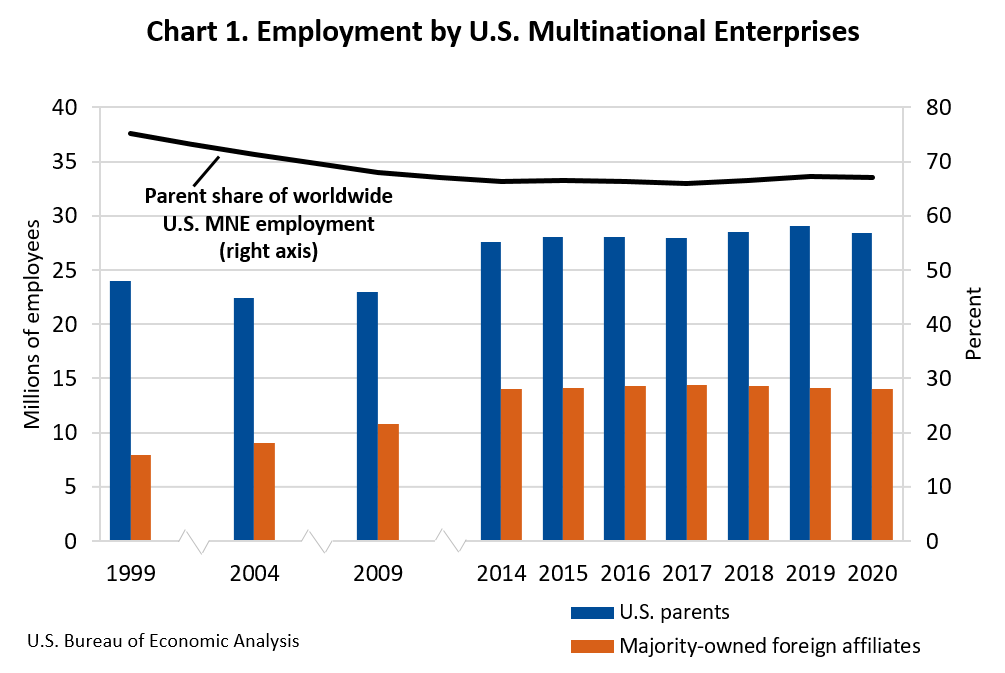
Worldwide employment by U.S. multinational enterprises (MNEs)
decreased 1.8 percent to 42.4 million workers in 2020 (preliminary) from
43.2 million workers in 2019 (revised), according to statistics
released today by the U.S. Bureau of Economic Analysis (BEA) on the
operations and finances of U.S. parent companies and their foreign
affiliates.
Employment in the United States by U.S. parents decreased 2.2 percent
to 28.4 million workers in 2020. U.S. parents accounted for 67.0
percent of worldwide employment by U.S. MNEs, down from 67.3 percent in
2019. Employment abroad by majority-owned foreign affiliates (MOFAs) of
U.S. MNEs decreased 1.0 percent to 14.0 million workers and accounted
for 33.0 percent of employment by U.S. MNEs worldwide.
U.S. parents accounted for 23.1 percent of total private industry
employment in the United States in 2020, up from 22.1 percent in 2019 as
total private industry employment fell more than U.S. parent
employment. Employment by U.S. parents was largest in manufacturing and
retail trade. Employment abroad by MOFAs was largest in the United
Kingdom, India, Mexico, China, and Canada.
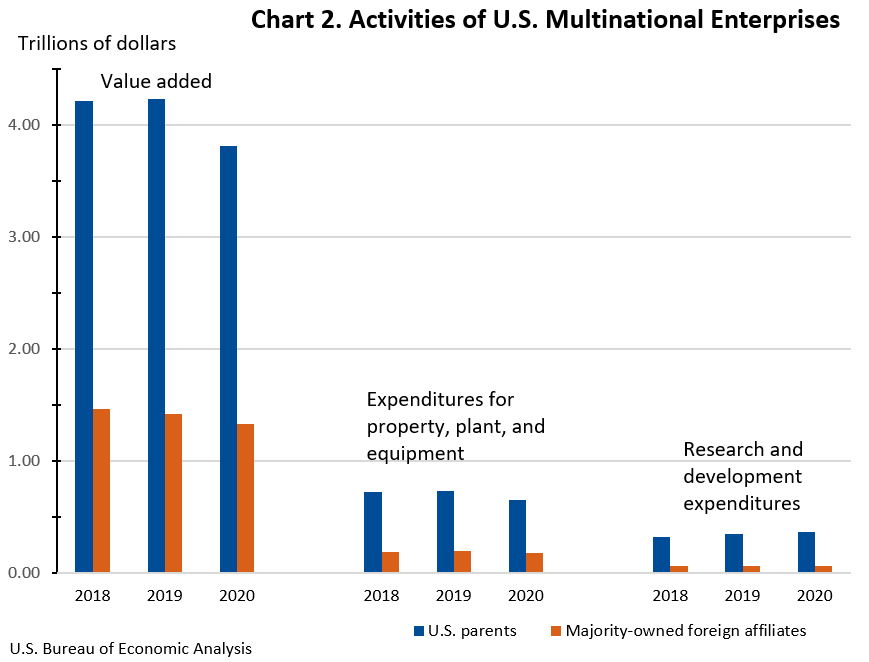
Worldwide current-dollar value added of U.S. MNEs decreased 9.0
percent to $5.1 trillion. Value added by U.S. parents, a measure of
their direct contribution to U.S. gross domestic product, decreased 9.9
percent to $3.8 trillion. U.S parents accounted for 20.8 percent of
total U.S. private-industry value added, down from 22.6 percent in 2019.
MOFA value added decreased 6.4 percent to $1.3 trillion. Value added by
MOFAs was largest in the United Kingdom, Canada, and Ireland.
Worldwide expenditures for property, plant, and equipment of U.S.
MNEs decreased 9.7 percent to $833.1 billion. Expenditures by U.S.
parents accounted for $651.9 billion, and MOFA expenditures accounted
for $181.2 billion.
Worldwide research and development expenditures of U.S. MNEs
increased 3.2 percent to $420.2 billion. U.S. parents accounted for
expenditures of $361.2 billion, and MOFAs accounted for $59.1 billion.
Additional statistics on the activities of U.S. parent companies and
their foreign affiliates including sales, balance sheet and income
statement items, compensation of employees, trade in goods, and more are
available on BEA’s website.
More industry detail for U.S. parents and more industry and country
detail for foreign affiliates are also available on the website.
Coronavirus (COVID–19) Impact on the 2020 Activities of U.S. Multinational Enterprises
Most of the key indicators included in the U.S MNE statistics
decreased in 2020 resulting in part from the impact of COVID–19. The
full economic effects of the COVID–19 pandemic cannot be quantified in
the statistics because the impacts are generally embedded in source data
(BEA direct investment surveys) and cannot be separately identified.
The response rates for the surveys were consistent with those in periods
before the pandemic. No special adjustments to BEA’s imputation and
estimation procedures were necessary.
Updates to the statistics
Statistics for 2019 were revised to incorporate newly available and
revised source data. Preliminary statistics for 2019 were released in
November 2021 and highlighted in “Activities of U.S. Multinational Enterprises in 2019” in the December 2021 Survey.
Table A. Updates to Statistics on 2019 Activities of U.S. Multinational Enterprises[Billions of dollars, except as noted]
U.S. Parents
MOFAs
Preliminary
estimate
Revised
estimate
Preliminary
estimate
Revised
estimate
Number of employees (thousands)
29,297.3
29,075.7
14,610.6
14,153.8
Value added
4,234.5
4,231.6
1,437.0
1,416.2
Expenditures for property, plant, and equipment
738.9
731.2
205.0
191.7
Research and development expenditures
350.2
349.0
58.2
58.3
Next release: November 17, 2023
Activities of U.S. Multinational Enterprises, 2021
.jpg)
.jpg)
 "Former
members of Amy Coney Barrett’s secretive faith group, the People of
Praise, are calling on the US supreme court justice to recuse herself
from an upcoming case involving gay rights, saying Barrett’s continued
affiliation with the Christian group means she has participated in
discriminatory policies against LGBTQ+ people.
"Former
members of Amy Coney Barrett’s secretive faith group, the People of
Praise, are calling on the US supreme court justice to recuse herself
from an upcoming case involving gay rights, saying Barrett’s continued
affiliation with the Christian group means she has participated in
discriminatory policies against LGBTQ+ people..jpg)



.png)
.jpg)
.jpg)


.jpg)