Thursday, December 08, 2022

ARIZONA MIRROR: Headline Story


The distribution of billions of dollars of federal COVID-19 relief funds in Arizona, like many other states, was marred by fraud, mismanagement and lack of oversight, according to a new report issued last week by the Arizona Auditor General. 

New report highlights myriad issues with federal COVID relief spending in Arizona

BY:  - DECEMBER 7, 2022 4:47 PM

While the report didn’t uncover any bombshell new findings, it did bring together all in one place the failings of several Arizona state departments in administering the distribution of the money and overseeing organizations to which it awarded the funds. 

In all, the federal government awarded Arizona $77.8 billion in pandemic relief from March 2020 through February 2022, though the report focuses only on the funds spent during the 2021 fiscal year, which ran from July 2020 through June 2021.

The various state departments charged with overseeing the distribution of the funds meant to lessen the impact of the COVID-19 pandemic said that inadequate staffing and staff turnover were major contributors to their lack of oversight. .  

The office had to return an untold amount of unspent funds to the federal government from the Education Stabilization Fund because they were not disbursed or spent within a required timeframe. As of June, 30, 2021, it had more than $18 million in unspent ESF money. The office didn’t monitor some recipients’ activities or compliance with award terms for the fund, meaning that it may have to repay $164,221. 


The office also failed to report information to the government about $28.9 million in awards. 

Ducey’s office did not respond to a request for comment. . ."

READ MORE 


Comedian-Turned-Politician is Times Person of The Year 2022


A comedian-turned-politician who was elected to lead Ukraine in 2019, Zelenskyy has worked ceaselessly since Russia’s invasion on Feb. 24 to inspire his country’s resistance and marshal international support for Ukraine.


apnews.com

Zelenskyy and 'spirit of Ukraine' named Time person of year

2 minutes

LONDON (AP) — Time Magazine on Wednesday named Ukrainian President Volodymyr Zelenskyy its person of the year, awarding him the accolade “for proving that courage can be as contagious as fear.”

Editor-in-chief Edward Felsenthal said the choice of Zelenskyy — alongside “the spirit of Ukraine” — was “the most clear-cut in memory.”

“Whether the battle for Ukraine fills one with hope or with fear, the world marched to Volodymyr Zelensky’s beat in 2022,” he said. . .

Felsenthal said Zelenskyy’s decision when the war started “not to flee Kyiv but to stay and rally support was fateful.”

“For proving that courage can be as contagious as fear, for stirring people and nations to come together in defense of freedom, for reminding the world of the fragility of democracy — and of peace — Volodymyr Zelensky and the spirit of Ukraine are TIME’s 2022 Person of the Year,” he added.

The magazine also highlighted people said to embody the spirit of Ukraine. They include engineer Oleg Kutkov, who helped keep Ukraine connected; Olga Rudenko, editor of the Kyiv Independent; and British combat surgeon David Nott.

Time’s annual selection has sparked debate and sometimes controversy since it began in 1927. The 2021 person of the year was Elon Musk, the tech, telecoms and space magnate who recently bought Twitter. In 2020, the title went to U.S. President Joe Biden — at the time president-elect — and Vice President Kamala Harris." READ MORE

JEREMY SCAHILL: The War Caucus Always Wins | The Intercept 07 December 2022


NOTE: "...Noting recent moves by Congress to increase munitions production, the U.S. Army’s top weapons buyer, Doug Bush, said, “I think we’re closer to a wartime mode, which has been something I’ve been working on to build.”


The NDAA authorizes $800 million in new military aid to Ukraine, which is separate from the supplemental funding measures the U.S. has implemented since Russia’s invasion. The unprecedented flow of weapons to Ukraine has included a substantial transfer of weapons from the U.S. stockpile, amounting to approximately $10 billion worth of weapons. 


U.S. lawmakers have used this fact to push for expanding the scope of not only weapons procurements to “replenish” the arsenal, but also to maintain the pipeline of weapons to Ukraine and European-allied nations through at least the end of 2024. The defense industry position is that such multiyear acquisitions are preferable to emergency surge-demand scenarios, in part because such contracts allow for a long-term expansion of production facilities and increased workforce. It appears that Congress is heading in that direction.

theintercept.com

The War Caucus Always Wins

Jeremy Scahill
16 - 20 minutes

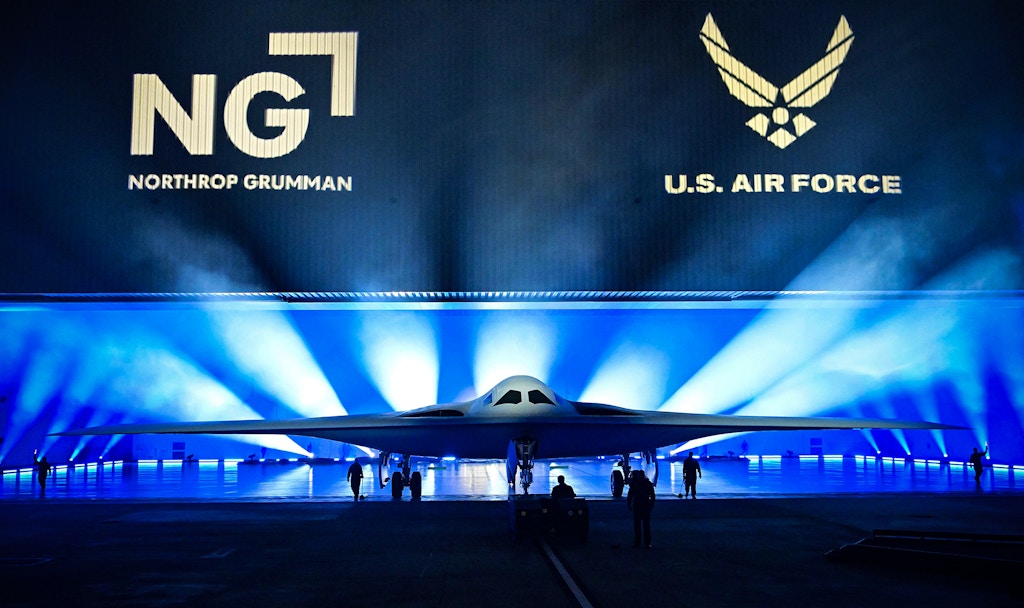
The B-21 Raider is unveiled during a ceremony at Northrop Grumman's Air Force Plant 42 in Palmdale, California, December 2, 2022. The high-tech stealth bomber can carry nuclear and conventional weapons and is designed to be able to fly without a crew on board and is on track to cost nearly $700 million per plane.

The B-21 Raider is unveiled during a ceremony at Northrop Grumman’s Air Force Plant 42 in Palmdale, Calif., on Dec. 2, 2022. The high-tech stealth bomber can carry nuclear and conventional weapons; it’s designed to be able to fly without a crew on board and is on track to cost nearly $700 million per plan

Photo: Frederic J. Brown/AFP via Getty Images 

"The dominant political story

emanating from Washington, D.C., these days centers around the battles between the Trumpist movement and the bipartisan “adults in the room” caucus — the Democratic Party and fragments of the Republican Party consisting of lawmakers and politicians who have affirmed the legitimacy of President Joe Biden’s 2020 election victory. Often obscured by the media focus on this clash is the enduring influence of a long-standing faction of the U.S. power structure: the bipartisan war caucus. Throughout the Trump and Biden administrations, the U.S. has been on an escalating trajectory toward a new Cold War featuring the prime adversaries from the original, Russia and China. The ratcheted-up rhetoric from U.S. politicians — combined with Russia’s invasion of Ukraine, the tensions between China and Taiwan, and Beijing’s major advancements and investments in weapons systems and war technology — has heralded a bonanza for the defense industry.

Congress will soon vote on a record-shattering $857 billion defense spending bill that authorizes $45 billion more than Biden requested. Included in the National Defense Authorization Act of 2023, finalized on December 6, is the establishment of a multiyear no-bid contract system through which Lockheed Martin, Raytheon, Boeing, and other weapons manufacturers are being empowered to expand their “industrial base” and business. Lawmakers determined that “providing multi-year procurement authority for certain munitions programs is essential,” in part because it will “provide the defense industrial base with predictable production opportunities and firm contractual commitments” to “increase and expand defense industrial capacity.”

The NDAA authorizes $800 million in new military aid to Ukraine, which is separate from the supplemental funding measures the U.S. has implemented since Russia’s invasion. The unprecedented flow of weapons to Ukraine has included a substantial transfer of weapons from the U.S. stockpile, amounting to approximately $10 billion worth of weapons. U.S. lawmakers have used this fact to push for expanding the scope of not only weapons procurements to “replenish” the arsenal, but also to maintain the pipeline of weapons to Ukraine and European-allied nations through at least the end of 2024. The defense industry position is that such multiyear acquisitions are preferable to emergency surge-demand scenarios, in part because such contracts allow for a long-term expansion of production facilities and increased workforce. It appears that Congress is heading in that direction. . .

While the legislation specifically refers to Russia’s invasion of Ukraine, it could also apply to officially designated adversaries such as China, Iran, Cuba, or North Korea. The NDAA authorizes more than $2.7 billion in new funds to “boost munitions production capacity.” Undersecretary of Defense for Acquisition and Sustainment William LaPlante recently said the Pentagon has already put into contract $4 billion worth of deals “to replenish our inventories of equipment we have sent to Ukraine.”

The war industry is clearly elated. “We spend a lot of money on some very exquisite large systems and we do not spend as much on the munitions necessary to support those,” said Raytheon’s CEO Gregory Hayes at the recent Reagan National Defense Forum. “We have not had a priority on fulfilling the war reserves that we need to fight a long-term battle.” Politico reported that discussions at the forum, which featured defense company CEOs, members of Congress, and U.S. military officials, identified China as the greatest “long-term threat.” But the China focus “was eclipsed by the need to kick into much higher gear to tackle a problem that many here didn’t imagine just a year ago: a hot proxy war with Russia in Ukraine that has sent the Pentagon and the defense industry scrambling.” Noting recent moves by Congress to increase munitions production, the U.S. Army’s top weapons buyer, Doug Bush, said, “I think we’re closer to a wartime mode, which has been something I’ve been working on to build.”

In pushing their case for expanding the weapons acquisitions process, some lawmakers are striking somber notes about the danger of depleting the U.S. arsenal. “Our nation’s ability to defend itself should never suffer because of bureaucratic policies and red tape,” declared Sen. Marco Rubio, R-Fla. “As the United States continues to lead the global military aid response to Ukraine amid Putin’s unprovoked war, it has become increasingly critical that we simultaneously ensure the sustainment of our defensive weapons stockpile while also providing the materials our allies and partners need to defend themselves,” said Sen. Jeanne Shaheen, D-N.H., who spearheaded the no-bid procurement legislation. Sen. Thom Tillis, R-N.C., asserted that the “lethal aid provided to Ukraine has diminished U.S. stockpiles and left defense contractors with uncertainty on timing and orders for backfill, negatively affecting their ability to quickly ramp up production.” Sen. John Cornyn, R-Texas, said the legislation would ensure that “helping our allies and partners doesn’t diminish our ability to protect ourselves.”


There is no actual shortage of defensive weapons in the U.S.

This rhetoric is largely a parlor game. There is no actual shortage of defensive weapons in the U.S. The “stockpile” is based on U.S. war-gaming theory and preparation for various imagined future wars and simultaneous campaigns. Ultimately, this NDAA would represent the latest narrative triumph for the hawks who falsely complained that Bill Clinton and the Democrats had gravely endangered America by “gutting” defense spending in the 1990s. Declaring war against the threats posed by nation states like Russia and China is a far better vehicle to sell large-scale defense spending than Osama bin Laden or the Islamic State group, in part because it justifies massive expenditures on the most expensive weapons systems.

While Russia’s invasion of Ukraine remains a central focus, the appetite for countering China’s own expansive weapons and technology development is on track to grow for years to come. The 2023 NDAA expands military support for Taiwan with a five-year package worth up to $10 billion in financing to purchase U.S. weapons, as well as a contingency fund of up to $100 million a year through 2032 to maintain a munitions stockpile. It also provides for running “wargames that allow operational commands to improve joint and combined war planning for contingencies involving a well-equipped adversary in a counter-intervention campaign” and exercises that “develop the lethality and survivability of combined forces against” China. Under the NDAA, the Pentagon would develop a plan “to expedite military assistance to Taiwan in the event of a crisis or conflict.” All of this is aimed at maintaining “the capacity of the United States to resist a fait accompli that would jeopardize the security of the people on Taiwan” by deterring China from using force to “invade and seize control of Taiwan before the United States can respond effectively.”

... In its October 12 National Security Strategy, the White House claimed that “Russia’s strategic limitations have been exposed following its war of aggression against Ukraine” and designated China as “the only competitor with both the intent to reshape the international order and, increasingly, the economic, diplomatic, military, and technological power to advance that objective.” It asserted that China “presents America’s most consequential geopolitical challenge.” While noting that “Russia poses an immediate and ongoing threat to the regional security order in Europe and it is a source of disruption and instability globally,” the White House report said Russia “lacks the across the spectrum capabilities of” China.

“This Isn’t Just Another Airplane”

On the evening of Friday, December 2, in a ceremony attended by senior U.S. officials, members of Congress, and industry executives, Northrop Grumman unveiled the Pentagon’s next-generation nuclear-capable strategic bomber, the B-21 Raider. The first new stealth bomber produced in more than 30 years, the Raider “will form the backbone of the future Air Force bomber force.” The $700 million bat-winged aircraft will be capable of both manned and unmanned operations, and a first flight is scheduled for 2023. The Pentagon reportedly plans to build at least 100 of the warplanes, with an estimated cost of $32 billion, including research and development, through 2027.

Defense Secretary Lloyd Austin spoke with an almost religious reverence for the nuclear bomber as a large tarp was pulled from its body in a sort of baptismal ceremony at Air Force Plant 42 in Palmdale, California. “This isn’t just another airplane. It’s not just another acquisition. It is a symbol and a source of the fighting spirit that President Reagan spoke of,” Austin said. “It’s the embodiment of America’s determination to defend the republic that we all love.”

...[.   ]  The Biden White House has shown no sign of pumping the brakes on Ukraine spending and arms transfers. Biden also has made clear he intends to push ahead with the aggressive U.S. military buildup in preparation for future conflict with China, a position with widespread backing across the aisle. With a divided Congress, the 2024 elections looming, and the Trump question hovering over it all, a lot of the Democrats’ legislative agenda will be tough to implement after the new year. But the short and long-term future looks bright for the Russia and China hawks, the defense industry, and its Democratic and Republican patrons on Capitol Hill. On these matters, bipartisanship remains alive and well. The House could vote on the NDAA as soon as this week, and the Senate is expected to swiftly follow suit to get the bill to Biden’s desk."

READ More 


Re: Global Affairs . . ."as long as it takes"____________?

 Once again. . .it's MEDIA SPIN in the conclusion of a recent survey report:
"While Americans are divided on supporting Ukraine for as long as it takes, support for the current US policies of assisting Kyiv economically and militarily is still solid. The influence of perceptions of which side is being successful on the battlefield illustrates the important role that media spin can play in affecting public views about the situation on the ground and, in turn, on continued backing for US support to Ukraine." (See below)

22 hours ago · TIME's Editor-in-Chief explains why Volodymyr Zelensky and the Spirit of Ukraine was chosen as the 2022 Person of the Year.

✓ RESPONSIBLE STATECRAFT: "Pro-war bias

That lack of coverage is all the more stark in comparison to a hawkish think tank. The Center for Strategic and International Studies (CSIS), heavily funded by the US governmentarms dealers and oil companies, is a consistently pro-war think tank: A FAIR investigation (Extra!10/16) of a year’s worth of CSIS op-eds and quotes in the New York Times failed to find any instance of the CSIS advocating for curtailment of US military policy.
 
 
responsiblestatecraft.org

Ukraine hits targets deep inside Russia in break with Biden administration - Responsible Statecraft 


Connor Echols
3 minutes

responsiblestatecraft.org

Hawkish experts dominate mainstream Ukraine coverage - Responsible Statecraft

John Kempthorne
7 - 9 minutes

 
globalaffairs.org

Growing US Divide on How Long to Support Ukraine

8 - 10 minutes

Nearly half of Americans (47%) now say Washington should urge Kyiv to settle for peace as soon as possible.

At the end of November, the United States authorized its latest assistance package to Ukraine, valued at $400 million to bolster the country’s security and defense in the war against Russia, now beginning its 10th month. A just-completed November 18-20 Chicago Council survey finds that large majorities of Americans continue to support US assistance to Ukraine, both economically and with military equipment. But as the fighting drags into winter, the overall US public is now divided on whether the United States should support Ukraine as long as it takes or if it should urge Kyiv to settle for peace as soon as possible.

Key Findings

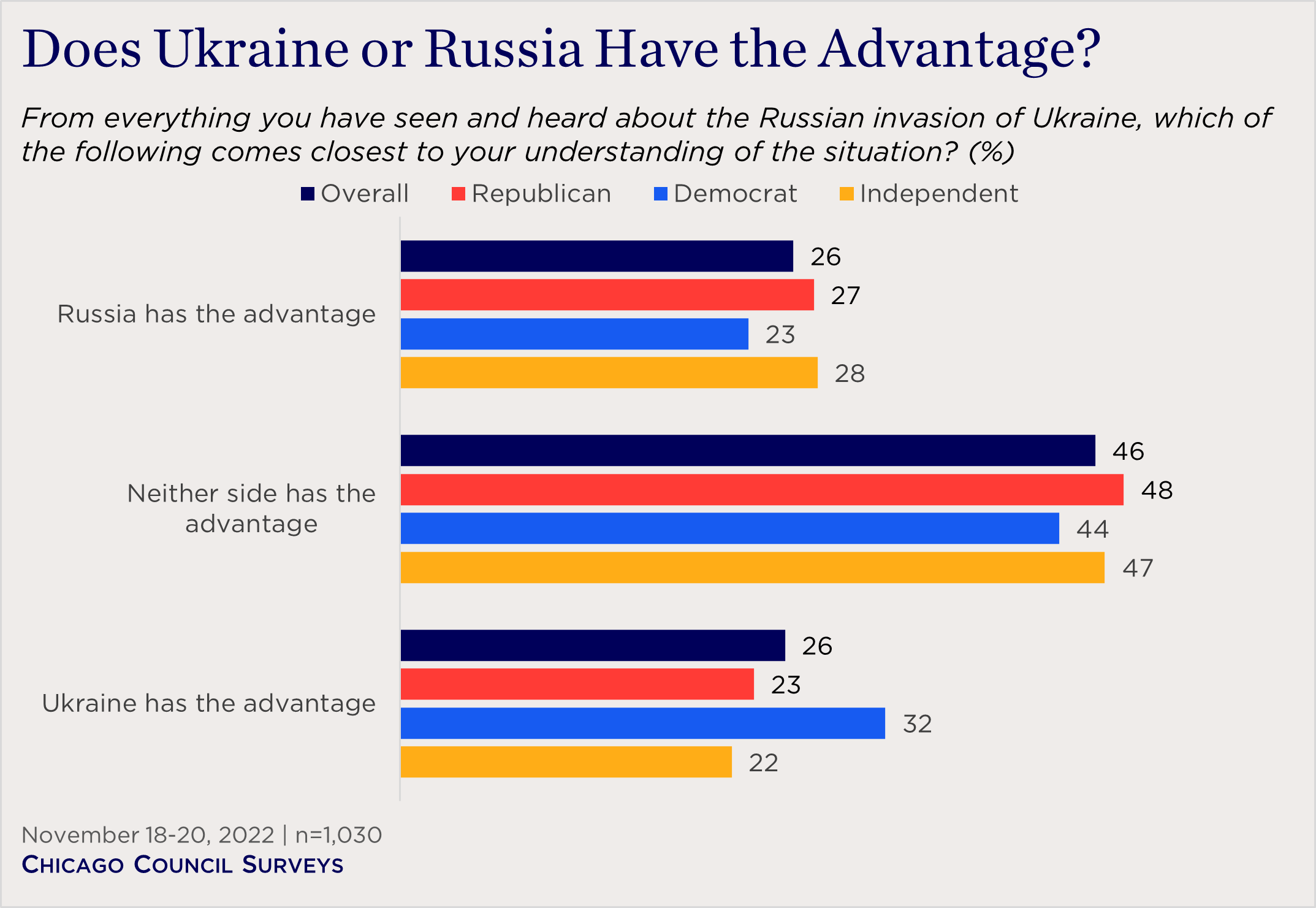
  • An equal percentage of Americans say Russia (26%) and Ukraine (26%) has the advantage in the current conflict. But a plurality (46%) believes that neither country has the advantage.
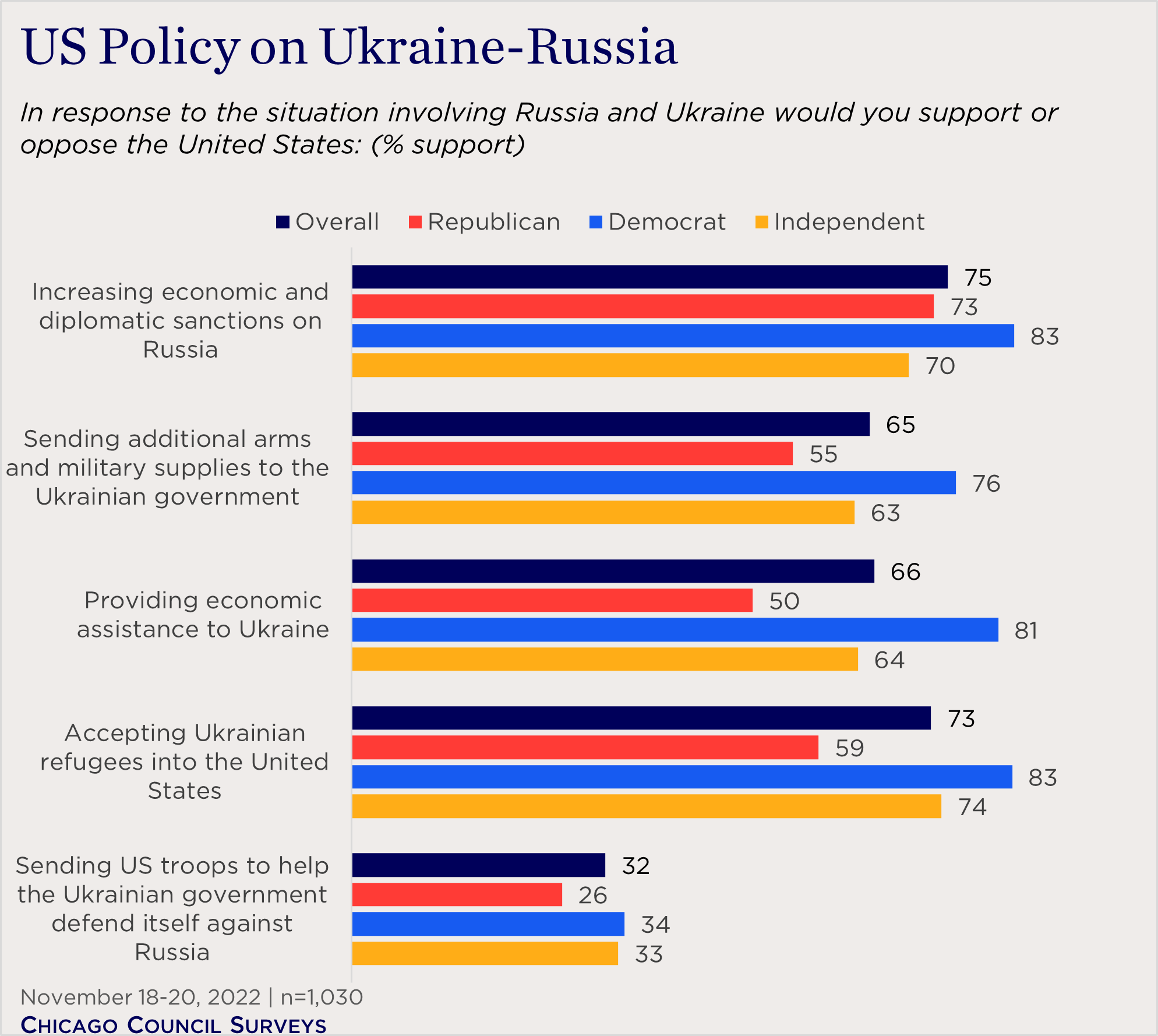
  • Solid majorities of Americans continue to support supplying Ukraine with arms (65%) and economic aid (66%), accepting Ukrainian refugees (73%), and sanctioning Russia (75%).
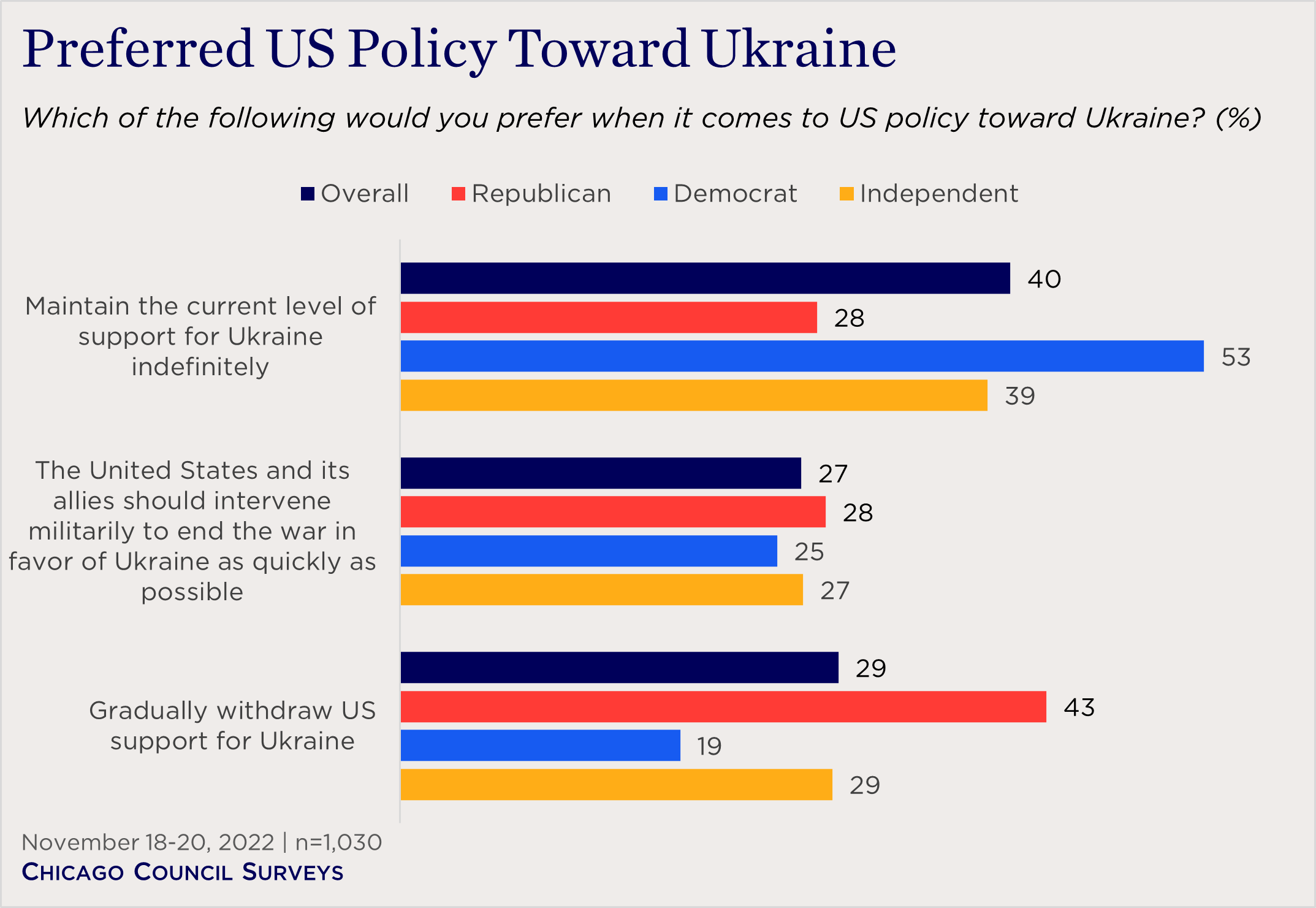
  • A plurality believes the United States should maintain its current level of support for Ukraine indefinitely (40%). Nearly three in 10 each say that the United States should intervene militarily to tip the advantage to Ukraine and end the war as soon as possible (27%)or that the United States should gradually withdraw support for Ukraine (29%).
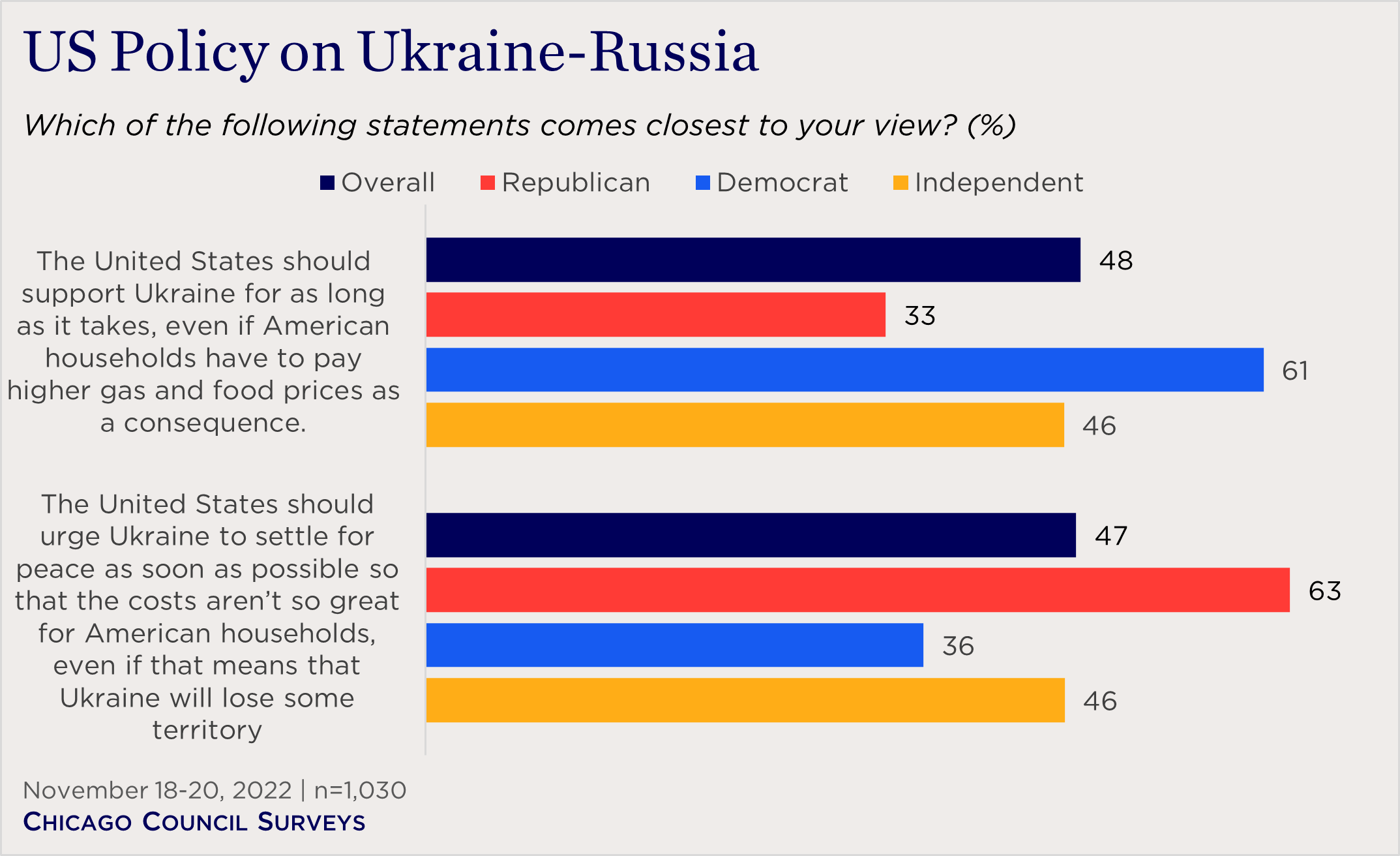
  • Separately, Americans are now closely divided on whether Washington should support Ukraine “as long as it takes” (48%, down from 58% in July 2022) or whether Washington should urge Ukraine to settle for peace as soon as possible (47%, up from 38% in July).
  • Perceptions of who is winning have a great bearing on support for Kyiv.

Neither Ukraine nor Russia Seen as Having the Advantage

At the recent NATO summit of foreign ministers in Bucharest, NATO chief Jens Stoltenberg said Ukraine could expect further Russian attacks because “Russia is failing on the battlefield.” Ukrainian counteroffensives put Moscow on the back foot in some areas of the country.

But . The Chicago Council survey shows that as many Americans think Russia has the advantage in the current conflict as think Ukraine does (26% each). Democrats are more likely to say Ukraine has the advantage (32%, compared to 23% of Republicans and 22% of Independents). But an overall plurality (46%) believes that neither Ukraine nor Russia has the advantage.1

"bar chart showing views on whether Ukraine or Russia has the advantage"

There are some hints that media sources could affect these views. For example, 26 percent of Americans who trust Fox News the most for accurate information say Ukraine has the advantage, compared to higher percentages of those who most trust MSNBC (48% say Ukraine has the advantage), NBC (36%), public television (33%), and CNN (32%).2

Perceptions of who is winning versus losing are important because they have a bearing on support for various policies. In an October University of Maryland poll, Americans who thought Ukraine was succeeding and Russia was losing were more willing to pay higher energy prices and tolerate increased inflation. There are similar relationships in the Council survey, as the following analysis illustrates 

Public Supports Existing US Policies on Ukraine 

In addition to the $400 million defense package, US Secretary of State Antony Blinken announced $53 million in assistance to support Ukraine’s electrical system to help it recover from Russia’s bombardment of energy grid. Americans favor continued assistance to Ukraine, with majority support for supplying the country with arms (65%) and economic aid (66%), accepting its refugees (73%), and sanctioning Russia (75%).  

But, Republican support for aid to Ukraine has declined notably over the course of the year. A smaller majority of Republicans now support the United States giving military aid (55%, down from 68% in July and 80% in March) and economic assistance (50%, down from 64% in July and 74% in March). Meanwhile, Democratic and Independent support for these policies has shown relatively little decline since March. One-third of Americans overall support sending US troops to Ukraine (32%, down from 38% in July) (see Appendix Figures A-E). 

"bar chart showing partisan support for US policy on Ukraine-Russia"

Those who sense that Ukraine has the advantage in the war support each of these policies at above average levels, with the exception of sending US troops to help Ukraine defend itself. Those who sense that Russia has the advantage are slightly more likely (36%) to support sending troops than those who think Ukraine (30%) or neither side (32%) has the edge in the conflict. 

Americans Divide Along Party Lines on Approach to Ukraine Conflict 

The Chicago Council survey tested American tolerance for continued support for Ukraine in various questions. When asked whether the United States should support Ukraine at current levels indefinitely, intervene militarily to decisively end the war, or gradually withdraw US support for Ukraine, a plurality prefers to continue the current levels of support indefinitely (40%). This is also the preferred approach for a narrow majority of Democrats (53%) and a plurality of Independents (39%). Republicans tend to prefer to gradually withdraw US support (43%). 

"bar chart showing partisan preferences on US policy toward Ukraine"

Besides partisan identification, perceptions on who is thought to be winning the war are a key factor in these responses. A majority of those who think Ukraine has the advantage say the United States should continue the current level of assistance indefinitely (56%). On the other hand, those who think Russia has the advantage are more likely than others to prefer that the United States gradually withdraw its support for Ukraine (36%) or intervene militarily to bring the war to an end (33%).  

Fewer Say United States Should Support Ukraine “As Long As It Takes” 

A separate question asked in July and November finds that Americans are now divided over whether the United States should support Ukraine for as long as it takes or urge Kyiv to settle for peace. Half now (48%)compared to 58 percent in Julysay the United States should support Ukraine for as long as it takes, even if American households have to pay higher gas and food prices as a consequence. A similar proportion, 47 percentup from 38 percent in Julysay the United States should urge Ukraine to settle for peace as soon as possible so the costs aren’t so great for American households, even if that means Ukraine will lose some territory (Appendix Figure F). 

"bar chart showing partisan views on US policy on Ukraine-Russia"

Last July, the data revealed sharp partisan divisions on this question, with Republicans more split than Democrats in support (see Appendix Figure G). In the November reading, six in 10 Democrats (61%) continue to favor supporting Ukraine even at cost to the United States, down from seven in 10 last July (69%). Republican opinion, however, has shifted more dramatically. Today, only a third of Republicans (33%) say the United States should back Ukraine for as long as it takes, down from 50 percent this summer. Instead, a majority of Republicans favor pushing Ukraine to settle for peace to reduce costs to American households (63%, up from 46% in July 2022).  

Corroborating the patterns above, a large majority of those who think Ukraine has the advantage in the current conflict say the United States should support Ukraine for as long as it takes (71% vs. 48% overall). By contrast, a majority of those who think Russia has the advantage think the United States should pressure Ukraine to settle for peace as soon as possible (60% vs. 47% overall).  

Conclusion 

While Americans are divided on supporting Ukraine for as long as it takes, support for the current US policies of assisting Kyiv economically and militarily is still solid. The influence of perceptions of which side is being successful on the battlefield illustrates the important role that media spin can play in affecting public views about the situation on the ground and, in turn, on continued backing for US support to Ukraine. "

RELATED CONTENT 

6 hours ago · View All releases on Ukraine ... United States government organization ... war on Ukraine and to support Ukraine's energy sector against Russian attacks.
Petro Poroshenko discusses the war in Ukraine, what's at stake, and prospects for Russia-Ukraine diplomacy. Virtual Event by Petro Poroshenko November 21, 2022. 

NATO Secretary General: ''Russia trying to freeze Ukraine conflict'' ... 2022 Meeting of NATO Ministers of Foreign Affairs, Bucharest - Programme. 

Special Update on the War in Ukraine: Read about the events which have led to the ... Join America's discussion program on global affairs Great Decisions .
Examining how Ukraine can be best supported to end the Russian invasion, ... internal dynamics in key policy areas, as well as its international relations.
Ukraine Is on the Edge of a Complete Blackout. As winter deepens, half of the country's energy system is already destroyed—and the other half is under ...
... weaknesses of U.S. and Western policy toward Russia, Ukraine, and Eurasia ... joint effort with the Chicago Council on Global Affairs and is supported, ...
Latest news and information from the World Bank and its development work in Ukraine. Access Ukraine's economy facts, statistics, project information, ...
Topics include ethical responses to the invasion; the perils of escalation; humanitarian aid; sanctions; moral emotions; and much more. The series features ...
2 days ago · ... think Washington should urge Ukraine toward a swift peace settlement, according to the Chicago Council on Global Affairs survey.
Russia in Global Affairs offers an international platform for publication in English and Russian of the results of individual and collective research in ...


Xc

Wednesday, December 07, 2022

So, One day ago President Joe Biden was in Arizona Bragging About TSMC Chips (and $40B FDIC)


 One day ago, President Joe Biden is so proud of Taiwan Semiconductor Manufacturing Co.'s new facility that he went to Arizona to celebrate it. 


NOTE:  Unfortunately, Mr President, it won’t be a game changer.
It may indeed be the case that TSMC’s $40 billion spending bill is the largest foreign direct investment, but that’s still not enough to ensure the US builds itself a self-sufficient semiconductor industry. It just buys bragging rights."


This week TSMC is lauding the fact that 3nm will hit Arizona in 2026, whereas that same technology is scheduled to be unveiled in Taiwan next year. In other words, the US will still be behind by two to three years, or one to two generations of chip technology. No less important is capacity. TSMC’s Arizona fabs will produce 600,000 wafers annually. That sounds impressive, but it’s really not

Opinion
Tim Culpan

Sorry USA, $40 Billion Won’t Buy Chip Independence

Opinion
Tim Culpan
Tim Culpan is a Bloomberg Opinion columnist covering technology in Asia. Previously, he was a technology reporter for Bloomberg News.

"President Joe Biden is so proud of Taiwan Semiconductor Manufacturing Co.’s new facility that he went to Arizona to celebrate it. A $40 billion figure tends to attract heads of state and corporate chieftains, with the chip factories TSMC is building there being hailed as the largest foreign direct investment in US history.

“Apple had to buy all the advanced chips from overseas,” Biden said at the plant outside Phoenix on Tuesday. “Now, they’re going to bring more of their. . ." READ MORE


17 hours ago · Taiwanese chipmaker TSMC on Tuesday said it would more than triple its planned investment at its new Arizona plant to $40 billion, among the ...


www.washingtonpost.com

Sorry, USA, $40 Billion Won’t Buy Chip Independence

Tim Culpan | Bloomberg
6 - 7 minutes

"President Joe Biden is so proud of Taiwan Semiconductor Manufacturing Co.’s new facility that he went to Arizona to celebrate it. A $40 billion figure tends to attract heads of state and corporate chieftains, with the chip factories TSMC is building there being hailed as the largest foreign direct investment in US history.“Apple had to buy all the advanced chips from overseas,” Biden said at the plant outside Phoenix on Tuesday. “Now, they’re going to bring more of their supply chain here at home. It could be a game changer.”

Unfortunately, Mr President, it won’t be a game changer. 

Everything announced by TSMC this week was in line with long-term plans for the site. The amount of land it acquired indicates six distinct chip fabs. The first was announced in May 2020 and scheduled to begin operations in 2024. A $12 billion figure was put on that first installment, which was a bit of a misnomer because it also included operational costs over nine years, not just the big-ticket capex number usually cited. 


This week comes news of the second factory, which will start manufacturing in 2026, with the total budget now climbing to $40 billion. Expect announcements for third, fourth and maybe fifth plants in coming years.

Also keep an eye out for upgrades to the technology that will be deployed. Much was made of news that TSMC would manufacture at the 4 nanometer node (dubbed N4) in Arizona. At that time, 7nm was the most advanced available. A smaller metric means better technology, but thanks to Moore’s Law, industry advancements occur rapidly. The company’s timeline meant N4 would be available in Taiwan this year, two years before it would reach the US.

This week TSMC is lauding the fact that 3nm will hit Arizona in 2026, whereas that same technology is scheduled to be unveiled in Taiwan next year. In other words, the US will still be behind by two to three years, or one to two generations of chip technology. 


No less important is capacity. TSMC’s Arizona fabs will produce 600,000 wafers annually. That sounds impressive, but it’s really not. The Taiwanese company topped 14.2 million last year and is on track to churn out 15.4 million 12-inch wafers loaded with chips this year. If it keeps the same average capacity growth of 8.1% it achieved over the past five years, Arizona will account for just 2.85% of its 21 million annual global output in 2026.

That’s a drop in the bucket, not a game changer.

US companies accounted for 64% of TSMC’s revenue last year. Apple Inc. alone contributed 26%. Taking into account higher prices for newer technologies and the fact that Apple is the key buyer of advanced nodes, Bloomberg Opinion estimates the iPhone maker bought as much as 20% of TSMC’s capacity. To supply just Apple, the Taiwanese firm would need to expand its US footprint by a further seven times if the Cupertino company was to fully source its chips from home soil. That’s just not going to happen. 

Then there are all the other US companies  — such as Nvidia Corp., Qualcomm Inc. and Advanced Micro Devices Inc. — that want to show off American-made chips. To entirely satisfy the US appetite for chips from local facilities, TSMC would need to spend around $1 trillion.

TSMC’s latest announcement offers something for everyone. Biden is selling it as a vote of confidence in the nation’s high-tech workforce, ignoring the fact that TSMC founder Morris Chang has poured cold water on the US ability to compete.

“There’s a lack of manufacturing talents to begin with,” Chang told The Brookings Institution earlier this year. “We did it at the urging of the US government, and we felt that we should do it.”

Apple Chief Executive Officer Tim Cook was quite transparent in his enthusiasm for TSMC’s new fabs. The company develops its own semiconductor designs and sends them to factories in Hsinchu, Taichung and Tainan in Taiwan for manufacturing. As previously predicted, Arizona serves as a marketing win for the Californian company: “Now, thanks to the hard work of so many people, these chips can be proudly stamped ‘Made in America,’” he said.

Proponents of this project, and of government incentives used to secure these factories, will note that even a small amount of leading-edge chipmaking on home soil is better than nothing. That’s somewhat true, but it also leaves the US exposed to tensions between China and Taiwan.


Research, development, planning and operations will all remain in Taiwan. Should Beijing decide to attack, those functions will cease at least temporarily, if not permanently. This would mean cutting TSMC Arizona off from all the crucial know-how it needs to run the minuscule capacity it has on US soil. With the chip industry moving at break-neck speed, it wouldn’t be long before thousands of jobs and billions of dollars in infrastructure in Arizona would be at the mercy of a war 7,000 miles away. 

It may indeed be the case that TSMC’s $40 billion spending bill is the largest foreign direct investment, but that’s still not enough to ensure the US builds itself a self-sufficient semiconductor industry. It just buys bragging rights."

More From Bloomberg Opinion:

• Apple’s US Chip Move Is as Much Marketing as Tech: Tim Culpan

• Why a Jailed Media Tycoon Rattles Beijing: Matthew Brooker

• Being the Next China Won’t Stop India’s Slowdown: Andy Mukherjee

✓ This column does not necessarily reflect the opinion of the editorial board or Bloomberg LP and its owners.

Tim Culpan is a Bloomberg Opinion columnist covering technology in Asia. Previously, he was a technology reporter for Bloomberg News.

More stories like this are available on bloomberg.com/opinion