Monday, December 12, 2022

SNOWMAGEDDON! Whoever said Weather is boring


California is hit by huge 'bowling ball' storm that's brought FORTY-EIGHT inches of snow, as forecasters say it could dump blizzards as far east as Minnesota: East Coast also braced for extreme weather

A winter storm is moving across the entire country over the coming days from the West to the Northern Plains and then into the Northeast. Several feet of snow will continue to pile up in California's Sierra with blizzards in the Northern Plains likely starting on Monday. There could also be a significant amount of snow dumped in parts of the Northeast later in the week. The storm is particularly powerful after the jet stream moved further south than is normal driving the weather system eastwards across the country.

www.dailymail.co.uk

A winter storm is expected to hit the Northeast through Monday

Vanessa Serna

Prepare for Snowmageddon! Winter storm is expected to hit the Northeast Monday with forecasters warning upstate New Yorkers to brace for between six and TEN inches of the white stuff 

, updated


  • Snow is expected to hit the Northeast through Monday with higher elevations anticipating up to 10 inches
  • Winter Weather Advisories have been sent out to areas, including Northeastern Pennsylvania, upstate New York and northwest Connecticut 
  • The snowfall may extend into larger cities - where snow hasn't fallen since March

Some states in the Northeast are expected to see their first snowfall of the season with some areas getting a snow blanket of up to 10 inches through Monday.

Northeastern Pennsylvania, upstate New York, northwest Connecticut, northwest New Jersey, New England, and western Massachusetts have all received Winter Weather Advisories as residents can expect large amounts of snowfall.

While the snow might stick more in the suburban areas of the states, northern New York City might also see a sheet of snow as well as the mid-Hudson Valley. . ." READ MORE

Jonathan Bernstein on Kyrsten Sinema...Parties matter more than you think.

 That's right? Is she trying to pull off "a Mcmullin?? (that ill-fated Utah strategy used by a fellow Democrat-turned-Indepent).


www.bloomberg.com

Sinema Misses the Point About Party Politics

Jonathan Bernstein
1 minute

"Arizona Senator Kyrsten Sinema declared herself a Marxist on Friday. Not Karl; Groucho. As in, “I refuse to join any club that would have me as a member.” She felt compelled to leave the Democrats, she explained, because of the “broken partisan system” and said that she had “joined the growing numbers of Arizonans who reject party politics.” 

Declaring herself an independent might not make a huge difference within the Senate if she continues, as she said she will, voting and behaving the same way on the job. It’s too soon to conclude how it will affect her re-election chances in 2024 if she runs, or whatever else she plans to do." READ MORE 

RELATED CONTENT 

Nov 12, 2022 · SALT LAKE CITY (AP) — Utah Democrats' decision to back an independent rather than nominate a member of their own party to take on Republican ...
 
Sep 7, 2022 · PROVO, Utah (AP) — Campaigning at a park filled with 19th-century pushcarts on a state holiday honoring Utah's early Mormon pioneers, Evan ...

The independent U.S. Senate candidate who won the official backing of Utah’s Democratic Party in this year’s midterm election harks back to Utah’s pioneer days as he explains his quest to unseat two-term Republican Sen. Mike Lee.

“When our ancestors arrived, the only way to make this harsh but very beautiful place work in order for them to survive and thrive was to work together,” said McMullin, who casts his candidacy as an opportunity to ”unite Americans across party lines to protect democracy.”

To defeat Lee, McMullin’s idealized call for cross-party unity will have to do a lot more than just win over Democrats and a few disgruntled conservatives. . ." READ MORE

apnews.com

McMullin loss in Utah raises independent candidacy questions 


By SAM METZ
5 - 6 minutes

SALT LAKE CITY (AP) — Utah Democrats’ decision to back an independent rather than nominate a member of their own party to take on Republican Mike Lee transformed the state’s U.S. Senate race from foregone conclusion to closely watched slugfest.

Independent Evan McMullin, an anti-Trump former Republican best known for his longshot 2016 presidential bid, attracted millions in outside spending in his campaign against Lee. He forced the second-term Republican to engage with voters more than in prior elections and emphasize an independent streak and willingness to buck leaders of his own party.

Ultimately, though, it wasn’t even close. Lee is on his way to a double-digit win.


That’s spurring a debate: Did Democrats’ strategy create a blueprint to make Republicans campaign hard, compete for moderates and expend resources in future races? Or does the sizeable loss prove that Republicans’ vice grip is impenetrable in the short term, no matter the strategy?

The answers could contain lessons for both red and blue states unaccustomed to competitive elections.


Some Democrats say supporting McMullin was worth it — it shifted the political conversation, made the race competitive and forced Lee to spend almost double what he spent in his 2016 campaign. But other Democrats say the strategy hurt down-ballot candidates who didn’t have a strong top-of-the-ticket contender to help boost them.

“Building my bench in that sense is going to be so much harder. How do I convince candidates, going forward, that the Democratic Party will support them?” said Katie Adams-Anderton, Democratic Party chair in Utah’s second largest county.

Utah is among the fastest growing states, and Democrats hope they will be able to compete as the electorate becomes younger and more urban. Yet Republicans currently hold both Senate seats and all four congressional seats, occupy every statewide office, and this week expanded their supermajorities in the Legislature..." READ MORE

12 hours ago · The partisan system actually makes lawmaking easier, and voters benefit when they can distinguish between Republicans and Democrats. 

www.axios.com

Sinema's mutually assured destruction

Josh Kraushaar
4 - 5 minutes

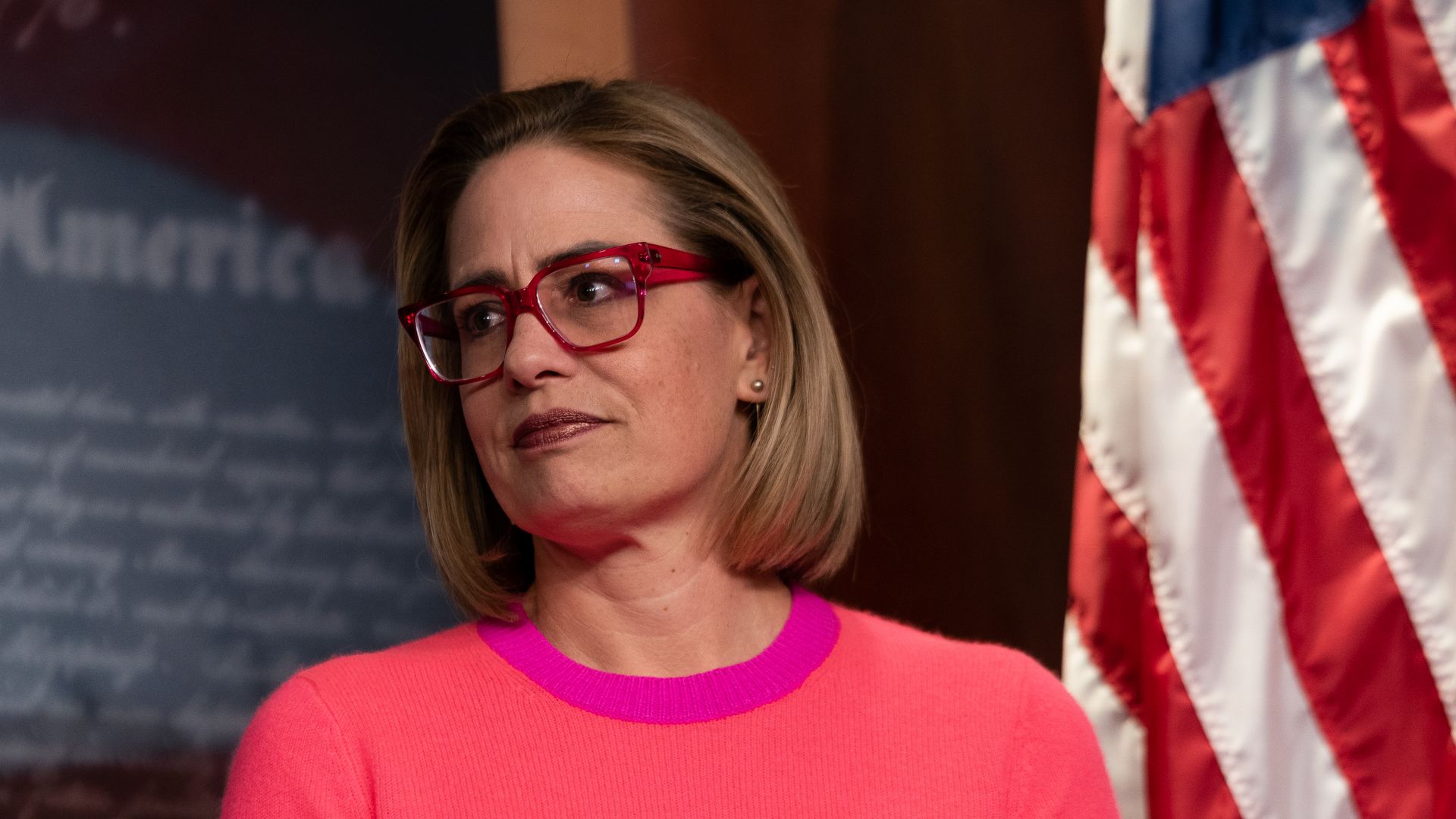
Kyrsten Sinema

Photo: Elizabeth Frantz for The Washington Post via Getty Images

Arizona Sen. Kyrsten Sinema's stunning decision to become an independent has triggered the possibility of a blue-on-purple civil war that could cost Democrats a must-win Senate seat in 2024.

The big picture: In the last three elections, Democrats have won unlikely victories in traditionally red Arizona because a critical mass of independents and moderate Republicans couldn't stomach MAGA-aligned GOP nominees.

  • Sinema would have had difficulty winning a primary. But she can win a general election — and might even be the favorite — if no Democrat of consequence runs.
  • But if moderate and progressive Democrats split, her move risks handing the Senate seat to a Republican nominee — potentially a right-wing candidate like Kari Lake.

What to watch: The White House and Democrats' Senate campaign arm will have two crucial decisions to make:

  1. If Sinema runs for re-election, will they endorse her independent candidacy, preempting a serious Democratic challenger?
  2. Or will they rally behind a Democrat like Rep. Ruben Gallego, risking a messy general election that could hand her seat over to a Republican?

If Democrats take the first path, Sinema will be treated like Sen. Angus King, a Maine independent who caucuses with the Democrats and draws only nominal Democratic opposition in his campaigns.

  • Utah Senate candidate Evan McMullin also ran competitively as an independent this year, and his candidacy was tacitly embraced by Democrats.

If Democrats take the second path, party leaders will work all-out to oppose her re-election (assuming she runs).

  • But it's tough to see how Democrats hold the seat if both Sinema and Gallego are on the general election ballot.
  • Sinema isn't conservative enough to secure support from most Republicans, and she'd likely split enough Democratic votes to allow a GOP candidate to win with a plurality.
  • In other words, Sinema is essentially daring Democrats (and Gallego) to get in, knowing it comes with the threat of mutually assured destruction.

What they're saying: "I know this will probably disappoint folks, but I'm actually not even thinking about electoral politics or talking about that at all right now," Sinema said coyly when asked about her 2024 plans on CNN. . .'" READ MORE

3 days ago · The Arizona senator won't say whether she's running for reelection but said in an interview she doesn't expect a change in how the Senate ...
2 days ago · Sen. Kyrsten Sinema announced she will no longer be a member of the Democratic Party, raising questions about how independent politicians ...
3 days ago · Insiders suspect Sinema becoming an independent will be far less consequential in Congress than her reelection campaign.
3 days ago · Sen. Kyrsten Sinema said on Friday she was leaving the Democratic Party and registering as an independent just days after Senate Democrats ...

Sunday, December 11, 2022

Lab-Grown Humans


14-day embryo from www.youtube.com
Duration: 0:41
Posted: 3 days ago

theconversation.com

Stem cell research community drops 14-day limit on human embryo research

Françoise Baylis
7 - 9 minutes

The International Society for Stem Cell Research (ISSCR), which bills itself as “the voice of the stem cell research community,” has announced that it no longer endorses the prevailing international standard limiting human embryo research to 14 days after fertilization.

Human embryo research has long been a thorny ethical issue because of competing views about the moral status of the developing embryo. Some people argue that human embryos have the moral status of persons and are considered protectable human life — that embryos should not be used for research, especially research that results in their destruction.

Other people reject such claims, highlighting the potential scientific and therapeutic benefits of research involving human embryos. These benefits include investigation of human development, cancer cell growth, congenital diseases and the causes of miscarriages. Applications of this research include developing contraceptives, diagnosing genetic diseases, treating infertility and other maladies.

The earlier ISSCR guidelines from 2016 prohibit the cultivation and use of embryos beyond 14 days.

The updated guidelines announced May 26 eliminate this prohibition. Instead, the ISSCR recommends that “national academies of science, academic societies, funders and regulators” engage the public in conversation about the scientific, societal and ethical issues associated with the 14-day limit, and whether this should be extended depending on the research objectives.


Promotional image for podcast


A history of the 14-day rule

The 14-day rule, also known as the 14-day limit, “became a standard part of embryo-research oversight through the convergence of deliberations of various national committees over decades.”

Today, different countries have different rules more or less closely aligned with one of the competing perspectives on the moral status of human embryos. Some countries — such as Austria, Germany, Italy, Russia and Turkey — do not permit research involving human embryos.

Other countries — including Canada, China, India, Japan, Spain and the United Kingdom — permit limited human embryo research up to (and not beyond) 14 days. Still other countries permit such research without stipulating any kind of time limit, for example, Brazil and France.

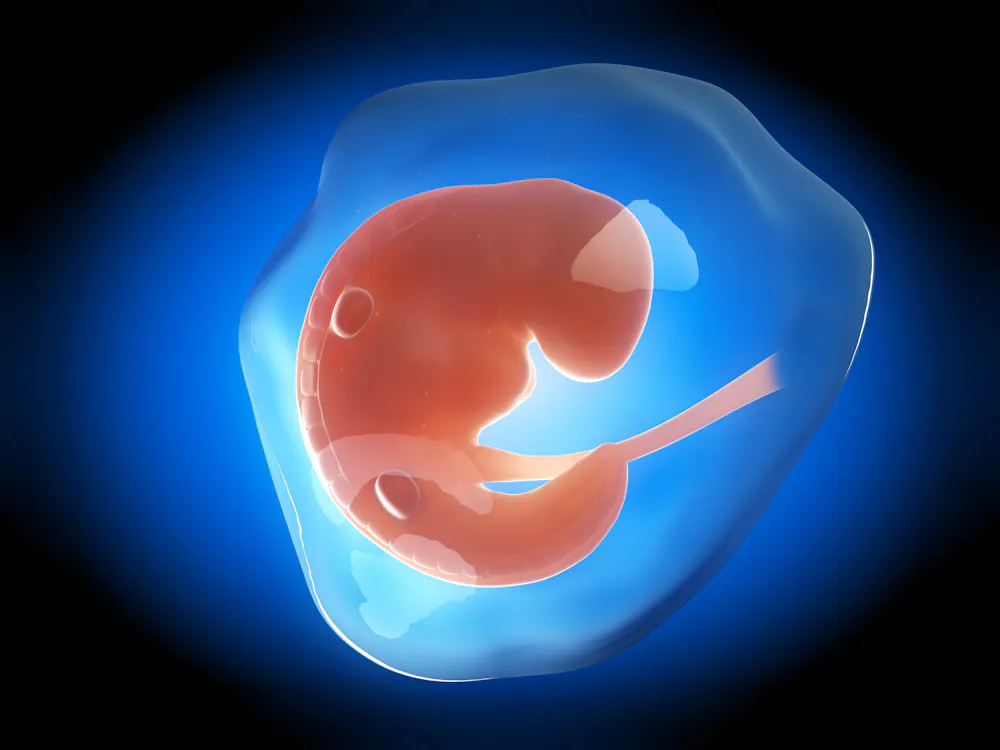
An illustration of a foetus floating in a bubble on a blue background

A 3D illustration of a one-month-old fetus. The primitive streak is the precursor to the spinal cord. (Shutterstock)

In 1979, following extensive public consultation, the Ethics Advisory Board of the United States Department of Health, Education and Welfare issued a report in support of limited human embryo research. The board concluded that research involving human embryos should be allowed, provided the embryos were not “sustained in vitro beyond the stage normally associated with the completion of implantation (14 days after fertilization).”

Five years later, also following extensive public consultation, the Warnock Report of the Committee of Inquiry into Human Fertilisation and Embryology in the U.K. reached a similar conclusion. The emphasis in this report, however, was on a different biological phenomenon: the appearance of the primitive streak (a precursor to the brain and spinal cord), which appears on the 14th or 15th day after fertilization.

The first national law entrenching the proposed ethical limit of 14 days was introduced in the U.K. in the Human Fertilisation and Embryology Act of 1990. Since then other countries (but not the U.S.) have followed suit and introduced similar legislation.

In Canada, the Assisted Human Reproduction Act of 2004 stipulates that no person shall knowingly “maintain an embryo outside the body of a female person after the 14th day of its development following fertilization or creation, excluding any time during which its development has been suspended.”

Until now, the ISSCR guidelines have been in lockstep with laws, regulations and guidelines endorsing the 14-day limit. No more.

Merits of the prohibition

The decision to jettison the established 14-day rule is a mistake. There is good reason to recommend public discussion and debate on the merits of this rule. There is no legitimate reason, however, for this discussion to focus narrowly on extending the research time limit. For example, an equally legitimate public conversation could be had about shortening instead of lengthening the time frame for permitted research.

More importantly, there is no legitimate reason to have removed the 14-day rule in advance of any public engagement that might endorse the existing limit or advocate an alternative policy. Doing so changes the facts on paper and potentially also in practice.

For example, countries without relevant legislation, regulations or guidelines risk becoming havens for ethically controversial human embryo research beyond 14 days.

Indeed, the authors of the 2021 ISSCR guidelines boast that in jurisdictions where there is no legislation or where there are “substantial gaps and ambiguities” in the legislation “carefully constructed guidelines can play a critical role, for scientists and clinicians conducting research and treating patients.” The revised guidelines can no longer play this role for embryo research beyond 14 days.

Changing science, limits

Until recently, researchers were not able to maintain the human embryo in the lab beyond 14 days, and so the established limit had no practical effect. But in 2016, two research teams — one at the University of Cambridge in the U.K. and the other at Rockefeller University in the U.S. — succeeded in maintaining human embryos in vitro for 12 to 13 days. They could have continued their experiments, but ended them in accordance with the 14-day rule.

The research conducted in the U.K. referenced the relevant legislation as the reason for concluding the experiments. The research conducted in the United States, where there is no relevant legislation, explicitly referenced the ISSCR guidelines.

Since then, debate in academic circles about the merits of the 14-day rule have intensified. Now that it is possible to overcome the technical limitations, some are intent on shifting the ethical limitations.

One suggestion is to “keep the 14-day rule in place and have a special petition to make an exception.” Another suggestion is to extend the time limit to 28 days to allow researchers to learn more about embryonic developmental processes.

My suggestion, as an ethicist who works at the intersection of policy and practice, is to have project specific time limits based on the minimum amount of time required to address the stated research objectives. This could mean that some human embryo research would not be allowed to continue to day 14, while other research might be allowed to continue beyond day 14.

Research categories with different time limits might be described in international or national research ethics guidelines and entrenched in national legislation. Alternatively, national regulations and guidelines might only stipulate the general intent, and project-specific decision-making might be at the discretion of a national specialized research ethics committee.

These suggestions for ethical limits on human embryo research — and others — require the public’s input. And while it is good to see the ISSCR promote public engagement, it is disappointing that this support should come at the price of the established international norm.

SLINGING BULLSHIT: J.D. Hayworth fills up a lot of ink in The East Valley Tribune

SPOILER: No, J.D. gives readers no beef.  But J.D. does get one thing right:  we know B.S. when we see it.  And he has made a career of slinging it.


www.themesatribune.com

Letter to the Editor

2 minutes

Reader wonders ‘where’s the beef’ in election column

"Reading Foghorn Leghorn’s, er, J.D. Hayworth’s latest column, I thought of the old commercial line, “where’s the beef?”

J.D., in his usual bloviating fashion, eventually gets around to his purpose:  something fishy happened with the governor’s race.

His candidate, the one he describes as a ”rising star,” lost in a close one.  J.D.smells a rat.  The tabulating machine problem, the fact the Hobbs didn’t recuse herself, add up to another rigged election.

Yet J.D. provides zero proof of either voter fraud or suppression.  And he doesn’t explain how while Lake was crushed in Maricopa County, Rep.Dave Schweikert won.  

Why give him a victory if the vote was rigged?  J.D. doesn’t say.  Nor does he say why a Republican Recorder and a Republican Board of Supervisors conspired to elect a Democrat.  Nor does he explain why the AG election is so close.  Nor does he explain why other counties gave Hobbs a majority of the vote.

No, J.D. gives readers no beef.  But J.D. does get one thing right:  we know B.S. when we see it.  And he has made a career of slinging it."

-Mike McClellan

Handle with care


20 hours ago · LEAKED: "EVERYONE Will Be TERRIFIED In 37 Days" - Mohamed El Erian. No views 48 seconds ago. Gold IRA Blueprint. Gold IRA Blueprint. 3.61K subscribers.


The 24 Hours of Hikes That End Year of Fighting Inflation

Simon Kennedy
8 - 10 minutes

(Bloomberg) -- Sign up for the New Economy Daily newsletter, follow us @economics and subscribe to our podcast


The world’s biggest central banks will this week wrap up the most aggressive year for interest-rate hikes in four decades with their fight against inflation still not over even as their economies slow.

The US Federal Reserve on Wednesday is set to raise its key rate by 50 basis points to a range of 4% to 4.5%, the highest since 2007, and to signal more increases in early 2023.

A day later, the European Central Bank and the Bank of England are likely to follow with half-point moves. And higher borrowing costs are also in the cards in Switzerland, Norway, Mexico, Taiwan, Colombia and the Philippines.

The year ends much differently than it started. Back in January, most policymakers were acknowledging they were wrong to have bet 2021’s inflation surge would soon fade, but still assuming they could restrain prices with a steady constriction of policy.

Instead, multiple metrics show how an acceleration in global inflation to around double-digits forced them to squeeze hard:

  • Bank of America Corp. has spotted around 275 rate hikes this year, enough for one every trading day, with just 13 cuts

  • More than 50 central banks have executed once-rare 75 basis-point increases, some joining the Fed in doing so repeatedly

  • A Bloomberg Economics gauge of global rates is projected ending the year at 5.2%, up from 2.8% in January

Although signs are mounting that inflation has peaked in most places, the big question now is what happens in 2023.

The worst case is inflation proves stubborn and recessions begin, creating a stagflationary nightmare for central banks. The best hope is consumer-price growth retreats fast enough to enable policymakers to stop jacking up rates and consider reducing them to boost growth.

While many investors expect a pivot at some point, Fed Chair Jerome Powell and ECB President Christine Lagarde, both of whom will speak this week, say their focus remains on tackling inflation even if doing so hurts demand and hiring.

  • For more, read Bloomberg Economics’ full preview

Federal Reserve

While the Fed is expected to begin tempering the pace of monetary policy tightening this week with a half-point hike, the target rate for overnight bank lending will continue to be lifted in early 2023.

Another 50 basis point boost would amount to 4.25 percentage points worth of interest-rate increases over 2022, a year that saw inflation soar to a four-decade high and left policy makers scrambling.

Fed officials, who conclude their two-day policy meeting Wednesday, will get one final peak at a key inflation metric when the government on Tuesday issues the November consumer price index. Economists project 0.3% increases in the overall and core measure that excludes food and fuel. On an annual basis, both gauges are seen moderating.

  • US WEEK AHEAD: Subdued CPI to Justify Fed Slowing Rate Hikes

European Central Bank

The ECB will probably hike rates by 50 basis points, after inflation in the euro area slowed for the first time in 1 1/2 years last month. Yet with consumer-price growth still at 10%, a third consecutive 75 basis-point move can’t be completely excluded and some of the more hawkish rate setters have suggested they’d back such a step. The Governing Council’s decision will also be influenced by new quarterly economic forecasts, which will likely see a downgrade in growth and upgrade in inflation projections for 2023.

Additionally, policymakers are scheduled to decide on the key pillars of their strategy to unwind debt of nearly €5 trillion ($5.2 trillion). The actual process — known as quantitative tightening or QT — won’t start until next year, with economists expecting it to kick off in the first quarter.

  • ECB PREVIEW: Heated Debate Shifts to QT From Size of Rate Hikes

Bank of England

The BOE is widely expected to boost its benchmark lending rate a half point to 3.5%, which would be the highest since 2008. With inflation at a 41-year high of 11.1% and consumers increasingly expecting elevated prices for the next few years, policy makers led by Governor Andrew Bailey have said they will act forcefully to prevent a wage-price spiral.

A darkening outlook for the economy makes this month’s decision more difficult than the last. A recession is now underway and expected to last into 2024, and households are suffering from the tightest cost-of-living squeeze on record. Energy prices are at least six times higher than usual, and colder-than-normal weather is buffeting the UK for the first time since last winter.

  • BOE PREVIEW: Downshifting to 50 Bps as Rifts Emerge on Rate Path

Swiss National Bank

Switzerland is also dealing with soaring inflation, yet at 3% — less than a third of that in the surrounding euro area — SNB policymakers will likely opt for a half-point move instead of repeating September’s oversized 75 basis-point step.

The strong franc — for years a thorn in the side of SNB President Thomas Jordan — is now supporting the economy as it allows the Swiss to avoid imported inflation. The central bank is still likely to reiterate that it’s willing to intervene in currency markets if needed.

  • Read more: Swiss Inflation Stays at 3%, Supporting SNB Hike This Month

Norges Bank

Norway’s central bank set to raise its key rate by 25 basis points as inflation data for last month showed a slowdown in both headline and underlying price growth. Those numbers have allowed speculation about bigger increases in borrowing costs to retreat, with some analysts becoming more convinced that the December hike will be the last in the cycle.

Other recent data releases highlighting the gloomiest economic outlook since the financial crisis have also underpinned that view, even as Norges Bank’s latest estimates from September indicate a peak rate of 3% over the course of winter, projecting an additional quarter point hike early next year.

  • Read more: Norway Inflation Slows From Three-Decade High in Rate Relief

Mexico & Colombia

The central banks of Mexico and Colombia this week bring the curtain down on an unprecedented year for monetary policy in Latin America.

Should the week’s two decisions line up with forecasts, Latin America’s big five inflation targeting central banks will have raised rates by a cumulative 30.75 percentage points in 2022, setting a new annual mark by way of 40 rate hikes, four pauses and no cuts.

Mexico’s central bank, known as Banxico, is forecast to raise its key rate for a 13th straight meeting to 10.50% with a half-point hike. While headline inflation has peaked and is heading back to the 3% target, core readings remain over 8%. The consensus among analysts has Banxico’s terminal rate at 11% after additional tightening in early 2023.

On Friday, look for Banco de la República to deliver a third straight 100 basis-point hike and 11th straight overall to put the key rate at 12%. Economists see this as the end of the hiking cycle though some analysts put the top 100 basis points higher at 13%.

  • For more, read Bloomberg Economics’ full Week Ahead for Latin America

Elsewhere in the Global Economy

The Hong Kong Monetary Authority will move in lockstep with the Fed, due to the currency peg, meaning another likely increase in rates, while central banks in the Philippines and Taiwan are also predicted to hike.

The Bank of Russia is expected to hold rates steady on Friday, with its latest round of easing ending as inflation risks grow. The Kremlin is touting the smaller-than-expected GDP contraction this year, but the central bank has warned that new G-7 restrictions on oil sales could hit output as they kick in next year.

Beyond central banking, markets will be watching data out of China, where retail sales, investment and industrial output numbers due Thursday are set to show a deepening in the economy’s struggles in November as Covid Zero restrictions — now being eased — weighed on activity.

  • For more, read Bloomberg Economics’ full Week Ahead for Asia

--With assistance from Vince Golle, Robert Jameson, Malcolm Scott, Craig Stirling, Ott Ummelas and Gregory L. White.

Most Read from Bloomberg Businessweek

ICE Barbie and Alleged Lover Face Ax as Trump Purges Goons

The Daily Beast: The Latest in Politics, Media & Entertainment News   ICE Barbie and Alleged Lover Face Ax as Trump Purges Goons CLEANIN...