Saturday, April 15, 2023

Back-and-Forth...and so it goes; New Types of Cyber-Weapons

Unbelievable... these guys are so good! They find things out, they find out everything...Russians spying against NATO and USA?

What will they find out next? Isn't it amazing ???? They really find out everything !

Russia accuses NATO of launching 5,000 cyberattacks since 2022

 
  • April 14, 2023
  •  
  • 12:19 PM
  •  
  • 3

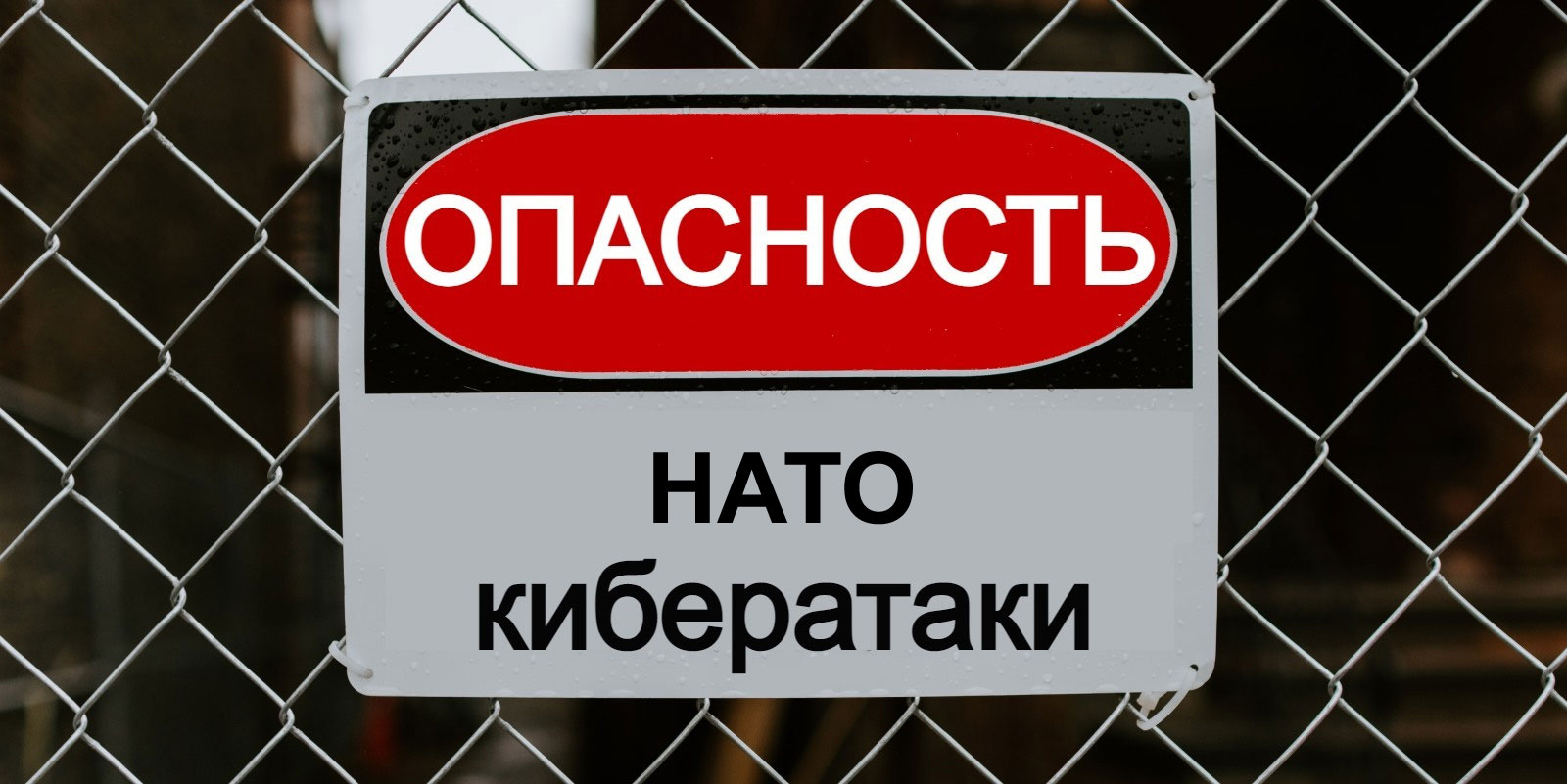
Russian sign warning of NATO cyberattacks

"The Federal Security Service of the Russian Federation (FSB) has accused the United States and other NATO countries of launching over 5,000 cyberattacks against critical infrastructure in the country since the beginning of 2022.

The agency says it has taken timely measures to prevent these attacks from causing any negative consequences to Russia.

Furthermore, the FSB claims that these attacks originate from Ukrainian territories, which are used for masking the true origin and identity of the perpetrators. At the same time, the attacks also involve the deployment of "new types of cyber-weapons."

"In the analysis of identified computer threats, data were obtained indicating the use of Ukrainian territory by the United States and NATO countries for conducting massive computer attacks on civilian objects in Russia," reads the machine-translated FSB statement.

"Currently, the network infrastructure of Ukraine is used by units of offensive cyber operations of Western countries, allowing them to secretly use new types of cyber weapons."

The FSB claims that despite many of the attacks being presented as activities by the "IT Army of Ukraine," it was able to discern the involvement of pro-west hacker groups such as "Anonymous," "Sailens," "Goast clan," "Ji-En-Ji," "SquadZOZ," and others.

The timing of this statement from FSB is suspicious, as Poland's Military Counterintelligence Service and its Computer Emergency Response Team linked APT29 state-backed Russian hackers to widespread attacks against several EU and NATO countries just yesterday.

Detections point to Chinese APTs

Meanwhile, Rostelecom's CERT team has also published a report about cyberattacks targeting Russian infrastructure between March 2022 and March 2023.

In that report, Rostelecom claims that 20% of all detected attacks can be attributed to sophisticated APT groups, 38% are cases of hacktivism, and another 38% are ransomware attacks.
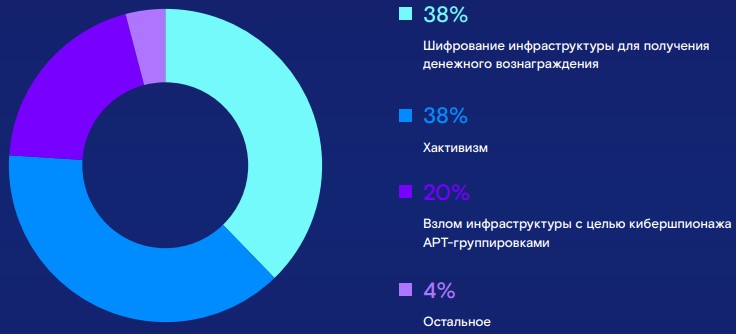
Attack types targeting Russian organizations
Attack types targeting Russian organizations (Rostelecom)

In 72% of the detected cases, the network intruders leveraged known vulnerabilities for initial access, while the time for reaching their ultimate goal has now been reduced to an average of seven days.

"The activity of state-owned APT groups has grown, which since the beginning of the special military operation have become more active in infrastructure, expanding the range of goals," reads machine-translated Rostelecom's report

Interestingly, the four hacking groups reported by Rostelecom's analysts as having the most significant activity against Russian entities during the mentioned period are APT27, APT41, APT10, all three believed to be of Chinese origin, and the Lazarus Group, who are North Koreans.

Four APTs targeting Russia the most
Four APTs targeting Russia the most (Rostelecom)

This directly contradicts FSB's statement about a massive wave of thousands of attacks launched by NATO-backed hacking collectives.

Rather, the country's largest telecommunications provider reports that the most significant volume of cyberespionage attacks comes from Russia's own alleged allies."

Related Articles:

Russian hackers linked to widespread attacks targeting NATO and EU

CISA warns of Zimbra bug exploited in attacks against NATO countries

Winter Vivern hackers exploit Zimbra flaw to steal NATO emails

STALKER 2 game developer hacked by Russian hacktivists, data stolen

Ukraine says Russian hackers backdoored govt websites in 2021

Russian hackers linked to widespread attacks targeting NATO and EU

 
  • April 13, 2023
  •  
  • 10:27 AM
  •  
  • 2

Russian bear

"Poland's Military Counterintelligence Service and its Computer Emergency Response Team have linked APT29 state-sponsored hackers, part of the Russian government's Foreign Intelligence Service (SVR), to widespread attacks targeting NATO and European Union countries.

As part of this campaign, the cyberespionage group (also tracked as Cozy Bear and Nobelium) aimed to harvest information from diplomatic entities and foreign ministries.

"At the time of publication of the report, the campaign is still ongoing and in development," an advisory published today warns.

"The Military Counterintelligence Service and CERT.PL recommend all entities which may be in the area of interest of the actor to implement mechanisms aimed at improving the security of IT Security systems in use and increasing the detection of attacks."

The attackers have targeted diplomatic personnel using spear phishing emails impersonating European countries' embassies with links to malicious websites or attachments designed to deploy malware via ISO, IMG, and ZIP files.

Websites controlled by APT29 infected victims with the EnvyScout dropper via HTML smuggling, which helped deploy downloaders known as SNOWYAMBER and QUARTERRIG and designed to deliver additional malware, as well as a CobaltStrike Beacon stager named HALFRIG.

SNOWYAMBER and QUARTERRIG were used for reconnaissance to help the attackers evaluate each target's relevance and determine whether they compromised honeypots or VMs used for malware analysis.

"If the infected workstation passed manual verification, the aforementioned downloaders were used to deliver and start-up the commercial tools COBALT STRIKE or BRUTE RATEL," a separate malware analysis report released today reads.

"HALFRIG, on the other hand, works as a so-called loader – it contains the COBALT STRIKE payload and runs it automatically."
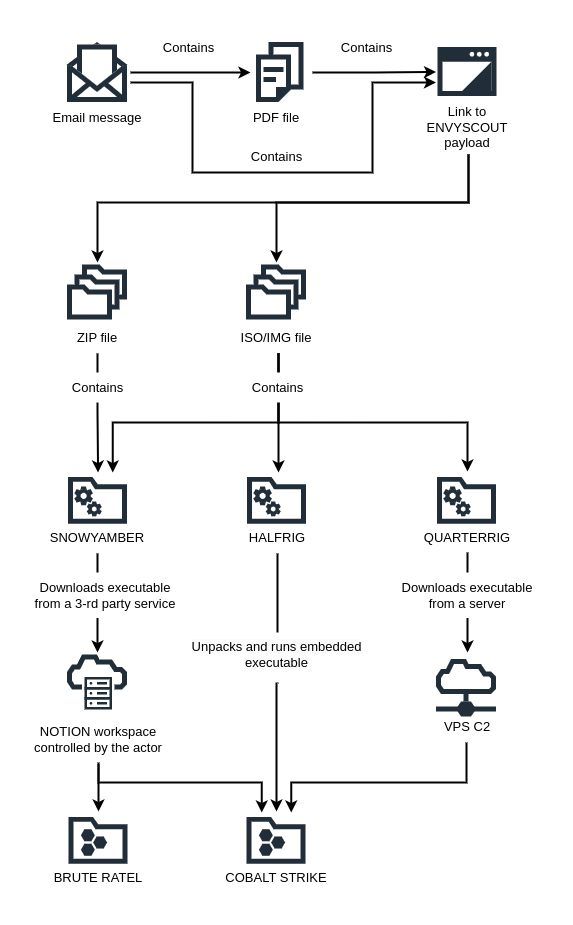
APT29 attack flow
Attack flow (CERT Polska)

APT29 is the Russian Foreign Intelligence Service (SVR) hacking division which was also linked to the SolarWinds supply-chain attack that led to the compromise of multiple U.S. federal agencies three years ago.

Since then, the hacking group has breached other organizations' networks using stealthy malware that remained undetected for years, including a new malware tracked as TrailBlazer and a variant of the GoldMax Linux backdoor.

> Unit 42 has also observed the Brute Ratel adversarial attack simulation tool being used in attacks suspected to be linked to the Russian SVR cyber spies.

> More recently, Microsoft reported that the APT29 hackers are using new malware capable of hijacking Active Directory Federation Services (ADFS) to log in as anyone in Windows systems.

> They've also targeted Microsoft 365 accounts in NATO countries in attempts to access foreign policy information and orchestrated a wave of phishing campaigns targeting governments, embassies, and high-ranking officials across Europe."

Related Articles:

Russia accuses NATO of launching 5,000 cyberattacks since 2022

CISA warns of Zimbra bug exploited in attacks against NATO countries

Winter Vivern hackers exploit Zimbra flaw to steal NATO emails

Russia’s Rostec allegedly can de-anonymize Telegram users

Microsoft shares tips on detecting Outlook zero-day exploitation 

Friday, April 14, 2023

THE NATION MAGAZINE Next Week April 17/24, 2023, Issue


Play it again, Sam...(Gizmodo just hours ago + more)

Interviewer Lex Fridman, an AI researcher at MIT, asked Altman for his thoughts on the recently released and widely circulated open letter demanding an AI pause. In response, the OpenAI founder shared some of his critiques. “An earlier version of the letter claimed OpenAI is training GPT-5 right now. We are not, and won’t for some time,” Altman noted. “So in that sense, [the letter] was sort of silly.”. . Even in Thursday’s MIT interview, not everything the controversial entrepreneur said rang true.

Asked if OpenAI will continue to be transparent going forward, Altman said “we certainly plan to continue doing that.” Except the question itself is a misleading softball. OpenAI, which was once a truly open source, non-profit organization, has become an increasingly closed-off, for-profit corporation. GPT-4, especially, is a black box. The company has not released any information on the training data its most recent chatbot was fine tuned on. Nor has it shared any information on GPT-4's architecture, construction, or other true inner workings.

gizmodo.com

OpenAI's Sam Altman Says There's No Chat GPT-5 to Worry About...Yet 

Lauren Leffer
4 - 5 minutes

"Sam Altman has squashed rumors that OpenAI is already working on ChatGPT-5, just a month after the company’s release of its GPT-4. Currently, there is no GPT-5 in training, Altman said while speaking virtually at an event at the Massachusetts Institute of Technology.

(Warning! Microsoft Wants ChatGPT to Control Robots Next)

TAKEN-AWAY: ". . .Regardless where you stand on the call for a six-month AI-moratorium though, Altman’s answer to the open letter is, ultimately, something of a non-answer."

RELATED CONTENT 

www.theverge.com

OpenAI’s CEO confirms the company isn’t training GPT-5 and “won’t for some time”

By James Vincent
5 - 6 minutes

"In a discussion about threats posed by AI systems, Sam Altman, OpenAI’s CEO and co-founder, has confirmed that the company is not currently training GPT-5, the presumed successor to its AI language model GPT-4, released this March.

Speaking at an event at MIT, Altman was asked about a recent open letter circulated among the tech world that requested that labs like OpenAI pause development of AI systems “more powerful than GPT-4.” The letter highlighted concerns about the safety of future systems but has been criticized by many in the industry, including a number of signatories. Experts disagree about the nature of the threat posed by AI (is it existential or more mundane?) as well as how the industry might go about “pausing” development in the first place. . .

You can watch a video of the exchange below:

GPT hype and the fallacy of version numbers

Altman’s comments are interesting — though not necessarily because of what they reveal about OpenAI’s future plans. Instead, they highlight a significant challenge in the debate about AI safety: the difficulty of measuring and tracking progress. Altman may say that OpenAI is not currently training GPT-5, but that’s not a particularly meaningful statement.

Some of the confusion can be attributed to what I call the fallacy of version numbers: the idea that numbered tech updates reflect definite and linear improvements in capability. It’s a misconception that’s been nurtured in the world of consumer tech for years, where numbers assigned to new phones or operating systems aspire to the rigor of version control but are really just marketing tools. “Well of course the iPhone 35 is better than the iPhone 34,” goes the logic of this system. “The number is bigger ipso facto the phone is better.”

Because of the overlap between the worlds of consumer tech and artificial intelligence, this same logic is now often applied to systems like OpenAI’s language models. This is true not only of the sort of hucksters who post hyperbolic 🤯 Twitter threads 🤯 predicting that superintelligent AI will be here in a matter of years because the numbers keep getting bigger but also of more informed and sophisticated commentators. As a lot of claims made about AI superintelligence are essentially unfalsifiable, these individuals rely on similar rhetoric to get their point across. They draw vague graphs with axes labeled “progress” and “time,” plot a line going up and to the right, and present this uncritically as evidence.

This is not to dismiss fears about AI safety or ignore the fact that these systems are rapidly improving and not fully under our control. But it is to say that there are good arguments and bad arguments, and just because we’ve given a number to something — be that a new phone or the concept of intelligence — doesn’t mean we have the full measure of it.

Instead, I think the focus in these discussions should be on capabilities: on demonstrations of what these systems can and can’t do and predictions of how this may change over time.

That’s why Altman’s confirmation that OpenAI is not currently developing GPT-5 won’t be of any consolation to people worried about AI safety. The company is still expanding the potential of GPT-4 (by connecting it to the internet, for example), and others in the industry are build awwing similarly ambitious tools, letting AI systems act on behalf of users. There’s also all sorts of work that is no doubt being done to optimize GPT-4, and OpenAI may release GPT-4.5 (as it did GPT-3.5) first — another way that version numbers can mislead.

Even if the world’s governments were somehow able to enforce a ban on new AI developments, it’s clear that society has its hands full with the systems currently available..." READ MORE


Mar 18, 2023 · OpenAI CEO Sam Altman warns that other A.I. developers working on ChatGPT-like tools won't put on safety limits—and the clock is ticking.
Missing: Chat | Must include:Chat
Mar 31, 2023 · The ChatGPT King Isn't Worried, but He Knows You Might Be. Sam Altman sees the pros and cons of totally changing the world as we know it.
Mar 16, 2023 · The CEO behind the company that created ChatGPT believes artificial intelligence technology will reshape society as we know it.
Missing: 5 | Must include:5
Mar 31, 2023 · Mr. Altman said he delayed the release of the latest version of its model, GPT-4, from last year to March to run additional safety tests. Users ...
Mar 19, 2023 · Altman's warning comes just days after OpenAI released the latest version of its language AI model, GPT-4. Soon after the latest version was ...
Mar 18, 2023 · Altman said in an interview that he thinks ChatGPT will change the way people live. But he also said that he is afraid of how the AI's ...

There are deals

Reactions + Comments 

naoEntendo (profile) says:

no specs, most likely SMR drive

I realize that techdirt makes a little bit pushing various things, but this particular item doesn’t even describe what it is. Most external HDDs are SMR (shingle magnetic recording) a terrible technology that makes drives way too slow to be useful and causes them to fail much sooner.

In this day and age, folks should probably be using a SSD, USB stick, or even a micro SD card for amounts under 1TB or a fast CMR (conventional magnetic recording) HDD once you get into the 5+TB range.

As a technology focused sight, you are doing your readers a disservice pushing devices that aren’t even fully described, most likely to hide how poor of a product they are.

Hopefully techdirt, you will do a better job vetting the products you push in the future. 

Ehud Gavron (profile) says:

Or... USB stick delivered tomorrow with 30 days return and a full 512GB not 500GB.

Upgrade to a USB stick that barely sticks out of your device, needs no cable, delivers all 512GB (not 500GB), and can be in your hands tomorrow with AMZ Prime instead of in 10 days like this one. Same price but with free 1 day shipping courtesy of Prime.

Check AMZ for “SanDisk 512GB Ultra Fit USB 3.1 Flash Drive.” I’m all in supporting TD… but not by encouraging obsolete hw.

Daily Deal: 500GB Ultra-Slim Portable External Hard Drive

from the good-deals-on-cool-stuff dept

The easy-to-use, ultra-portable, and durable external hard drive gives you the freedom to save your files on any device that has available storage space, from computers to tablets and more. This external hard drive can be used with your computer for data backup or moved to another device for cross-platform file compatibility. With USB 3.0 technology it’s fast and easy to use – simply plug it into your computer or laptop via a single USB cord and transfer files at high speed without needing software or installation on your computer. It’s on sale for $33.

Note: The Techdirt Deals Store is powered and curated by StackCommerce. A portion of all sales from Techdirt Deals helps support Techdirt. The products featured do not reflect endorsements by our editorial team.

Filed Under:

Mohamed El-Erian value investing | "we are facing a huge economic accident" [running time 08:20]


 • Video   

The Future of Liberal Democracy in Europe


President, German Marshall Fund of the United States; CFR Member


RELATED

Europe’s political crisis and the Future of Liberal Democracy

As anti-elite sentiment rises across Europe, governments are struggling to respond to a new political environment. What will replace the old political order, a revival of liberal democracy or a crisis of governability?

Guests

Douglas Carswell, MP for Clacton

Ivan Krastev, Chair of Board, Centre for Liberal Strategies

Chaired by

Mark Leonard, Director, ECFR

The economic and financial crisis has struck at the same time as a crisis in the authority and legitimacy of the institutions of representative democracy.  As anti-elite sentiment rises across Europe, governments are struggling to respond to a new political environment.  What will replace the old political order, a revival of liberal democracy or a crisis of governability?

Douglas Carswell, argues foe optimism.  He thinks the West is on the cusp of dramatic changes driven by the failure of her elites and new technology. Carswell predicts a future of iDemocracy where collectivism without government is possible in a way that was previously unimaginable. In his mind, the rise of technology and the death of Big Government will give the West a new lease of life.

In contrast, Ivan Krastev, argues that Europe's citizens are being disenfranchised by the five emancipatory revolutions — the Woodstock-to-Wall-Street social and political revolution of the 1970s and 1980s; the “end of history revolutions of 1989; the “digital revolution” of the 1990s; the demographic revolution; and the political brain revolution that is unfolding in front of our eyes, – that initially deepened our democratic experience, making us freer than ever before. He argues that these revolutions fractured collective purpose, created inequality, made us skeptical of those in power, and left us feeling ineffective in creating change. 

Douglas Carswell is the Member of Parliament for Clacton. Author of the influential book The End of Politics and the Birth of iDemocracy, Douglas is an advocate of political reform and helped establish the Direct Democracy campaign. He also co-wrote “Direct Democracy; an agenda for a new model party”, which the Spectator magazine described as “One of the founding texts for the new, revitalised Toryism written by some of the brightest young Conservative thinkers”.

Ivan Krastev is a political scientist and the author of In Mistrust We Trust: Can Democracy Survive When We Don't Trust Our Leaders?. Alongside his work for the Centre for Liberal Strategies where he chairs the Board, he is a permanent fellow at the Institute for Human Sciences (IWM) Vienna. He is a member of the Board of the European Council on Foreign Relations.  

Mark Leonard is co-founder and Director of ECFR. He recently co-wrote an essay on The New Political Geography of Europe.


Imperialst Rhetoric, Tom Horn to Defuse Tensions, Gold Tops $5,000 in Demand Frenzy, . . .Japan Bond Crash

         Stephen Maturen/Getty Images Trump, Democrats Hurtle Toward Shutdown After Minnesota Killing A fatal shooting by Border Patrol agen...