Wednesday, May 03, 2023

FRESH OFF THE TWITTER-SPHERE!


Mohamed A. El-Erian
Thanks ... and this after #FederalReserve Chair Powell again pushed back against such early rate cuts. I do not recall in my career the persistence of such a large gap between repeated #Fed policy guidance and what the markets price in. Regardless of who ends up… Show more
Quote Tweet
Lisa Abramowicz
@lisaabramowicz1
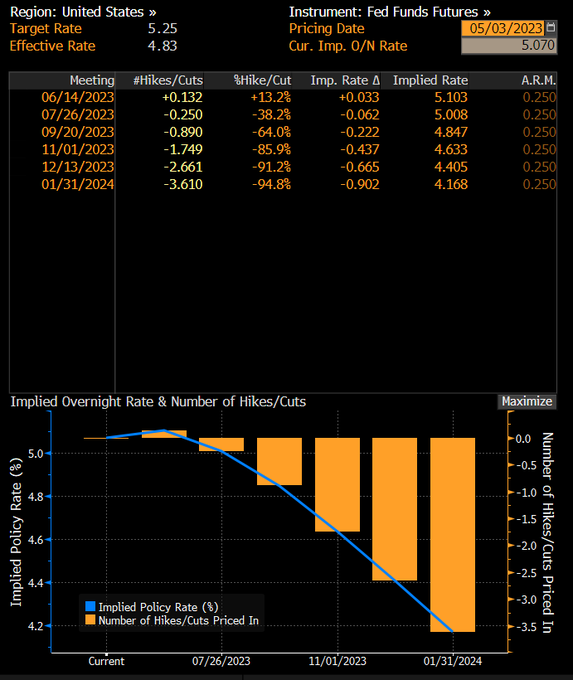
The market is saying the Fed just raised rates for the last time in this rate-hiking cycle, and the next move will be a cut, and could come as soon as September.
Image
16
98

The Geography of Gun Violence Here in The United States...it's fractured by culture

The Geography of U.S. Gun Violence 

Colin Woodard·Data Journalist
April 21, 2023
31 - 39 minutes


America’s regions are poles apart when it comes to gun deaths and the cultural and ideological forces that drive them.

By Colin Woodard

"Whenever you happen to read this article a chilling mass shooting has probably been in U.S. headlines recently. . .


www.salon.com

Conservative America has far more gun deaths than liberal America, study finds

Matthew Rozsa
7 - 9 minutes

"A horrific recent trend of mass shootings has severely polarized Americans on the topic of firearms. At the center of this heated controversy lies the policy question of gun control: Should the government impose restrictions on firearms and other dangerous weapons to protect the public?

Conservatives turn to the Second Amendment to argue that the Constitution's right to bear arms is sacred; liberals will argue that conservatives are misinterpreting the Second Amendment and that gun control policies have been proven to save lives. The conservative rejoinder to gun control, of course, is that good people with guns can protect the public from bad people with guns.

Yet several recent studies have revealed the exact opposite: In regions dominated by pro-gun politicians, the number of gun deaths is far higher than in areas controlled by pro-gun control politicians.

The pattern of blue regions being safer than red regions held even when analyzing the two most common specific types of gun-related deaths, suicides and homicides.


Foremost among these studies is one produced by the Nationhood Lab at Salve Regina University's Pell Center for International Relations and Public Policy, and first reported on in Politico.

  After analyzing gun violence statistics from America's different cultural regions from 2010 to 2020, the authors found that the areas with the highest rates of gun deaths were consistently those run by Republican politicians.

> Compared to a national rate of 11.4 gun deaths per 100,000 people, the Deep South had 15.6, Greater Appalachia had 13.5, New France (including the heavily French areas of Louisiana) had 19.8 and the Spanish Caribbean (the heavily Latino areas of Florida) had 11.6. Similarly the First Nation (referring to the heavily indigenous areas of Alaska) had 27.6 (by far the largest of any region studied) and the Far West had 12.2.

This is a stark contrast to those regions in the predominantly Democratic Northeastern, Mid-Atlantic and Midwestern states: 

> Yankeedom, consisting of New England, upstate New York and the northern parts of the Midwest, has a rate of 8.6 gun deaths per 100,000 people; the "New Netherlands," which consists of New York City and its metropolitan area, has a rate of 3.8; the Left Coast has 9; Greater Polynesia, or Hawaii, has 3.5; El Norte, or the American Southwest, has 10; and both the Midlands and Tidewater regions, which include the Delaware River valley and Chesapeake Bay areas as well as parts of Virginia, then stretching through the Ohio River Valley and other parts of the Midwest, have rates of 10.9.

 (It is important to note that some of these regions are much more highly populated than others.) All of those gun death rates are lower than the national average of 11.4 gun deaths per 100,000 people.

"The Deep South is the most deadly of the large regions at 15.6 per 100,000 residents followed by Greater Appalachia at 13.5," explained Colin Woodard, director of the Nationhood Lab, in his Politico article breaking down the significance of the results. "That's triple and quadruple the rate of New Netherlands — the most densely populated part of the continent — which has a rate of 3.8, which is comparable to that of Switzerland. Yankeedom is the next safest at 8.6, which is about half that of Deep South, and Left Coast follows closely behind at 9."


Listen to the southern right talk about violence in America and you’d think New York City was as dangerous as Bakhmut on Ukraine’s eastern front.

In October, Florida’s Republican governor Ron DeSantis proclaimed crime in New York City was “out of control” and blamed it on George Soros. Another Sunshine State politico, former president Donald Trump, offered his native city up as a Democrat-run dystopia, one of those places “where the middle class used to flock to live the American dream are now war zones, literal war zones.” In May 2022, hours after 19 children were murdered at Robb Elementary in Uvalde, Texas, Republican Gov. Greg Abbott swatted back suggestions that the state could save lives by implementing tougher gun laws by proclaiming “Chicago and L.A. and NeAw York disprove that thesis.” 

In reality, the region the Big Apple comprises most of is far and away the safest part of the U.S. mainland when it comes to gun violence, while the regions Florida and Texas belong to have per capita firearm death rates (homicides and suicides) three to four times higher than New York’s. On a regional basis it’s the southern swath of the country — in cities and rural areas alike — where the rate of deadly gun violence is most acute, regions where Republicans have dominated state governments for decades.

If you grew up in the coal mining region of eastern Pennsylvania your chance of dying of a gunshot is about half that if you grew up in the coalfields of West Virginia, three hundred miles to the southwest. Someone living in the most rural counties of South Carolina is more than three times as likely to be killed by gunshot than someone living in the equally rural counties of New York’s Adirondacks or the impoverished rural counties facing Mexico across the lower reaches of the Rio Grande.

. . .

For gun suicides, which is the most common method, the pattern is similar: New Netherland is the safest big region with a rate of just 1.4 deaths per 100,000, which makes it safer in this respect than Canada, Sweden or Switzerland. Yankeedom and Left Coast are also relatively safe, but Greater Appalachia surges to be the most dangerous with a rate nearly seven times higher than the Big Apple. The Far West becomes a danger zone too, with a rate just slightly better than its libertarian-minded Appalachian counterpart.

When you look at gun homicides alone, the Far West goes from being the second worst of the large regions for suicides to the third safest for homicides, a disparity not seen anyplace else, except to a much lesser degree in Greater Appalachia. New Netherland is once again the safest large region, with a gun homicide rate about a third that of the deadliest region, the Deep South.

We also compared the death rates for all these categories for just white Americans — the only ethno-racial group tracked by the CDC whose numbers were large enough to get accurate results across all regions. (For privacy reasons the agency suppresses county data with low numbers, which wreaks havoc on efforts to calculate rates for less numerous ethno-racial groups.) The pattern was essentially the same, except that Greater Appalachia became a hot spot for homicides.

The data did allow us to do a comparison of white and Black rates among people living in the 466 most urbanized U.S. counties, where 55 percent of all Americans live. In these “big city” counties there was a racial divergence in the regional pattern for homicides, with several regions that are among the safest in the analyses we’ve discussed so far — Yankeedom, Left Coast and the Midlands — becoming the most dangerous for African-Americans. Big urban counties in these regions have Black gun homicide rates that are 23 to 58 percent greater than the big urban counties in the Deep South, 13 to 35 percent greater than those in Greater Appalachia. Propelled by a handful of large metro hot spots — California’s Bay Area, Chicagoland, Detroit and Baltimore metro areas among them — this is the closest the data comes to endorsing Republican talking points on urban gun violence, though other large metros in those same regions have relatively low rates, including Boston, Hartford, Minneapolis, Seattle and Portland. New Netherland, however, remained the safest region for both white and Black Americans.

The data suppression issue prevented us from calculating the regional rates for just rural counties, but a glance at a map of the CDC’s smoothed county rates indicates rural Yankeedom, El Norte and the Midlands are very safe (even in terms of suicide), while rural areas of Greater Appalachia, Tidewater and (especially) Deep South are quite dangerous.

So what’s behind the stark contrasts between the regions?

www.politico.com

Gun Violence Is Actually Worse in Red States. It’s Not Even Close.

21 - 26 minutes

POLITICO illustration/Source: Nationhood Lab at Salve Regina University

Colin Woodard is a POLITICO Magazine contributing writer and director of the Nationhood Lab at Salve Regina University’s Pell Center for International Relations and Public Policy. He is the author of six books including American Nations: A History of the Eleven Rival Regional Cultures of North America.

"Listen to the southern right talk about violence in America and you’d think New York City was as dangerous as Bakhmut on Ukraine’s eastern front.

In October, Florida’s Republican governor Ron DeSantis proclaimed crime in New York City was “out of control” and blamed it on George Soros. Another Sunshine State politico, former president Donald Trump, offered his native city up as a Democrat-run dystopia, one of those places “where the middle class used to flock to live the American dream are now war zones, literal war zones.” In May 2022, hours after 19 children were murdered at Robb Elementary in Uvalde, Texas, Republican Gov. Greg Abbott swatted back suggestions that the state could save lives by implementing tougher gun laws by proclaiming “Chicago and L.A. and New York disprove that thesis.”

In reality, the region the Big Apple comprises most of is far and away the safest part of the U.S. mainland when it comes to gun violence, while the regions Florida and Texas belong to have per capita firearm death rates (homicides and suicides) three to four times higher than New York’s. On a regional basis it’s the southern swath of the country — in cities and rural areas alike — where the rate of deadly gun violence is most acute, regions where Republicans have dominated state governments for decades. . ."


". . .To understand violence or practically any other divisive issue – be it Covid-19 vaccinations or political contests or attitudes about the threats to the republic — you need to understand the historical settlement patterns that created our rival regional cultures and the distinct ideologies and values they carried with them. We’ve created a synopsis which you can quickly read here at Nationhood Lab – it gives a thumbnail sketch of the 11 regional cultures and their origins — but their story is told in detail in American Nations: A History of the Eleven Rival Regional Cultures of North America.

Using the regions so-defined, Nationhood Lab calculated the gun death, homicide and suicide rates for the period 2010 to 2020 using data as collected by the U.S. Centers for Disease Control. The results, crunched and mapped with our data analysis partners Motivf, are stark. Here are the results for overall gun deaths – both suicides and homicides — during the 11-year period: 


. . .

The author also noted that the pattern of blue regions being safer than red regions held even when analyzing the two most common specific types of gun-related deaths, suicides and homicides. For gun-related suicides, the New Netherlands was the safest of the highly populated regions (1.4) while Greater Appalachia and the Far West were the deadliest (9.2 and 8.8, respectively); for gun-related homicides, the New Netherlands was the safest highly populated region (2.3) while the Deep South was the least safe highly populated region (6.8).

This is not the first study to suggest a correlation between political leadership that regulates guns and fewer gun-related deaths. In a study published by the journal JAMA Surgery, researchers analyzed two decades worth of gun-related deaths by county by dividing the counties they studied based on how rural or urban they were. They found that during the first decade of the 21st century, "the two most rural county types had statistically more firearm deaths per capita than any other county type, and by the 2010s, the most urban counties—cities—were the safest in terms of intentional firearm death risk."

It is important to note that these statistics often refer to suicides and not homicides. Indeed, the JAMA Surgery study revealed that between 2001 and 2010, America's most rural counties had 25 percent more overall firearm deaths than America's most urban counties and a 54 percent higher rate of gun suicides, but a 50 percent lower rate of gun homicide deaths. They also pointed out that during the 1990s, researchers had not noticed any difference in total intentional firearm deaths between America's most urban and rural counties. This divide only became apparent in the 21st century and appears to be increasing, "with rural counties bearing a great deal more of the burden."

Over the last few decades there have been a number of gun control studies, and over time they have fleshed out a statistical consensus on the efficacy of gun control laws. Studies have established a correlation between lowered violent crime rates and laws like prohibiting firearms to those associated with domestic violence, mandatory waiting periods, forcing those banned from owning firearms to surrender them and imposing child-access prevention laws. Similarly, studies have repeatedly linked drops in suicide rates to child-access prevention laws, minimum age requirements and mandatory waiting periods. Increases in violent crime, tragically, were linked to concealed-carry laws and stand-your-ground laws.

PLEASE NOTE: The challenge in analyzing all of this data is that establishing correlation (that two variables are consistently connected to each other in statistics) is very differAent from establishing causation (that one variable's results caused the other variable's results).

"Studying these laws are difficult compared to say studying the impact of a single law related to child booster seats, or bicycle helmets, or seat belt laws," Dr. Eric Fleegler, who has extensively written about firearms legislation and teaches pediatrics and emergency medicine at Harvard Medical School, told Salon in January. "They're using, 'Hey, we had a change in something, a law, and we look to see if there's a change in something, some outcome fatalities, and we say, 'Yes, these things correlate with each other.' The causation is a much more challenging thing."

Fed Chair: Federal Reserve implements quarter-point rate rise and signals potential pause

Who said that? 


Press Release

May 03, 2023

Federal Reserve issues FOMC statement

For release at 2:00 p.m. EDT

Economic activity expanded at a modest pace in the first quarter. Job gains have been robust in recent months, and the unemployment rate has remained low. Inflation remains elevated.

The U.S. banking system is sound and resilient. Tighter credit conditions for households and businesses are likely to weigh on economic activity, hiring, and inflation. The extent of these effects remains uncertain. The Committee remains highly attentive to inflation risks.

The Committee seeks to achieve maximum employment and inflation at the rate of 2 percent over the longer run. In support of these goals, the Committee decided to raise the target range for the federal funds rate to 5 to 5-1/4 percent. The Committee will closely monitor incoming information and assess the implications for monetary policy. In determining the extent to which additional policy firming may be appropriate to return inflation to 2 percent over time, the Committee will take into account the cumulative tightening of monetary policy, the lags with which monetary policy affects economic activity and inflation, and economic and financial developments. In addition, the Committee will continue reducing its holdings of Treasury securities and agency debt and agency mortgage-backed securities, as described in its previously announced plans. The Committee is strongly committed to returning inflation to its 2 percent objective.

In assessing the appropriate stance of monetary policy, the Committee will continue to monitor the implications of incoming information for the economic outlook. The Committee would be prepared to adjust the stance of monetary policy as appropriate if risks emerge that could impede the attainment of the Committee's goals. The Committee's assessments will take into account a wide range of information, including readings on labor market conditions, inflation pressures and inflation expectations, and financial and international developments.

Voting for the monetary policy action were Jerome H. Powell, Chair; John C. Williams, Vice Chair; Michael S. Barr; Michelle W. Bowman; Lisa D. Cook; Austan D. Goolsbee; Patrick Harker; Philip N. Jefferson; Neel Kashkari; Lorie K. Logan; and Christopher J. Waller.

For media inquiries, please email media@frb.gov or call 202-452-2955.

Implementation Note issued May 3, 2023


Video for El erian
Duration: 5:16
Posted: 2 days ago
13 hours ago · ... in Chair Powell's press conference. This includes The assessment of the economic outlook; The implications of the #banking tremors; ...


Wired: The Secrets of Aging Are Hidden in Your Ovaries | Emily Mullin

✓ Unraveling these mysteries could mean extending a person’s reproductive years—and potentially lifespan—by delaying menopause. 

✓ Researchers might not have figured out how to slow reproductive aging yet, but they’ve spurred interest in a long-overlooked organ and opened a new avenue of inquiry that could have implications for how everyone ages—not just people with ovaries.

www.wired.com

The Secrets of Aging Are Hidden in Your Ovaries 

Emily Mullin 
(Illustration: KATERYNA KON/Getty Images)
12 - 15 minutes

"The ovary is a time machine. It travels to the future, reaching old age ahead of the rest of the body. At birth, each ovary contains around a million follicles—tiny, fluid-filled sacs that hold immature eggs. But the decline of these follicles is immediate and unceasing. By puberty, only about 300,000 remain. By age 40, the vast majority are gone. And by 51, the average age of menopause in the United States, virtually none are left. 

Humans are an oddity in this regard. Most mammals remain fertile up to the end of their lives; the only species known to experience menopause naturally are humans and some whales. In humans, the loss of hormones during menopause sets off a cascade of negative health effects: Bones get brittle; metabolism slows; and the risk of cardiovascular diseasediabetes, stroke, and dementia increases. Paradoxically, women live longer than men on average but spend more of their older years in poor health

Jennifer Garrison has a hunch that the ovaries are the culprit. “That cocktail, that orchestra of chemicals that the ovaries make, is really important to overall health,” says Garrison, an assistant professor at the Buck Institute for Research on Aging in Novato, California. “When it goes away at menopause, it has a dramatic effect.” On the other hand, having working ovaries for longer seems to carry longevity benefits. One study of 16,000 women found that later menopause made it more likely someone would live to age 90

Despite the fact that half the world’s population experiences ovarian aging—including cisgender women and trans and nonbinary people—longstanding gender bias in science means it has remained an understudied field. But that’s starting to change. . .

To work out how fast ovaries age, you need to look at a lot of cells. At Columbia University in New York, geneticist Yousin Suh and her colleagues have been collecting and analyzing cells taken from the ovaries of women in their twenties and those in their late forties and early fifties who haven’t yet gone through menopause. What they found shocked them. Cells from the ovaries of middle-aged women often resembled cells in other tissues from people in their seventies and older. 

In cell type after cell type, Suh’s team found unmistakable signatures of aging. They saw damaged DNA and dysfunctional mitochondria—the energy powerhouses within cells. Communication between cells broke down. They stopped dividing. A key regulator of cell growth and metabolism, called mTOR, was also overactive. Too much mTOR is associated with cancer and aging, and drugs that suppress it are used to slow tumor growth. For Suh, it was “crystal clear” evidence that the ovary is aging faster than the rest of the body at the molecular and cellular levels. Suh and her team posted their findings online last year, and the paper is currently undergoing peer review.

The mTOR discovery was particularly intriguing. Blocking the protein has already been shown to increase lifespan in flies, worms, and mice. Now Suh wonders if the same benefits could extend to human ovaries. . ." 

About the reporter


Emily Mullin is a staff writer at WIRED, covering biotechnology. Previously, she was an MIT Knight Science Journalism project fellow and a staff writer covering biotechnology at Medium's OneZero. Before that, she served as an associate editor at MIT Technology Review, where she wrote about biomedicine. Her stories have also... Read more

READ MORE

Who Wants to Live Forever?

Research is underway to answer one of humankind’s oldest questions: how to transcend the limits of aging.

City of Nogales, AZ, Regular Meeting May 2, 2023

Leaked Chinese Hypersonic Drone Will Change Naval Warfare: WZ-8

Falcon Heavy fairing's fiery re-entry is 'hottest' yet for SpaceX - Spectacular view!