Thursday, May 11, 2023

Trump Turns CNN Town Hall into Tabloid Trash | via Puck

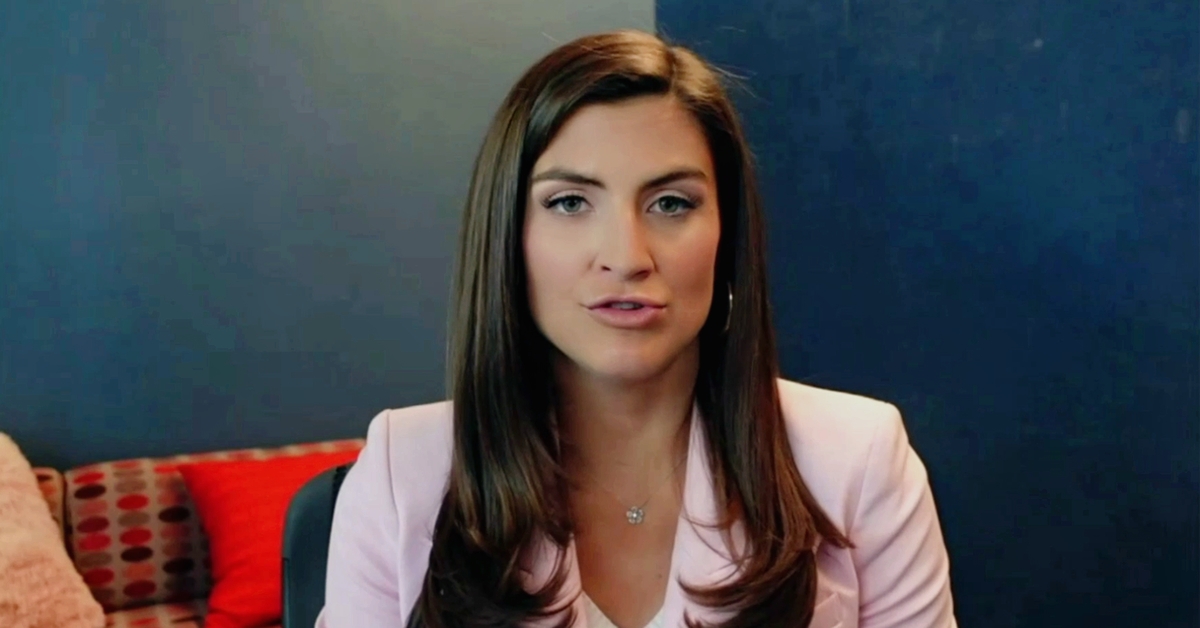
...and here we have the new primetime news Anchor/Star "It girl" Kaitlan Collins 

American journalist who served as the chief White House correspondent for CNN until 2022. She currently hosts CNN This Morning alongside Poppy Harlow. Previously, she was the White House correspondent for the website The Daily Caller. 

https://en.wikipedia.org/wiki/Kaitlan_Collins

Early life and education

Kaitlan Collins was born in Prattville, Alabama.[1][4] Her father, Jeff Collins, is a mortgage banker.[5] Collins has described her upbringing as "apolitical," and has stated that she does not recall her parents voting or expressing strong opinions about political candidates.[1]

Collins graduated from Prattville High School and went on to attend the University of Alabama. She initially chose to major in chemistry, like her sister, before majoring in journalism.[1] She earned a Bachelor of Arts in political science and journalism in May of 2014.[4][1] Collins was a member of the Alpha Phi sorority.[4]

In 2018, the group Log Cabin Republicans unearthed some tweets from her time at Alabama in 2011. Collins used the slur fag and expressed that she did not know "if I wanna room with a lesbian." She apologized for the tweets, saying, "When I was in college, I used ignorant language in a few tweets to my friends. It was immature but it doesn’t represent the way I feel at all."[6][7][8]

Career

After graduating from college, Collins moved to Washington, D.C.[3] In June 2014, she was hired by website The Daily Caller as an entertainment reporter. After covering the 2016 presidential election, the Daily Caller named her its White House correspondent in January 2017, and she began covering the Trump administration.[9][3]

While she was still with The Daily Caller, Collins was invited to make several appearances on CNN. At a White House correspondent event in spring 2017, she met network president Jeff Zucker and thanked him for having her on despite the ideological nature of her current employer. Collins was subsequently interviewed and hired to join the White House team at CNN in July 2017.[9][3] She traveled with President Trump to at least half a dozen countries.[9][10]

Collins was involved in a notable incident with the Trump administration on July 25, 2018, when she attended a photo op in the Oval Office as the day's pool reporter. As the event concluded, Collins asked Trump a series of questions about Vladimir Putin and Trump's former attorney Michael Cohen. Trump ignored her questions.[9][11] Collins was subsequently barred from a Trump administration press conference in the White House Rose Garden that afternoon[12] and was told by senior White House officials that such questions were "inappropriate for that venue."[13][14] Trump's press secretary Sarah Sanders said that Collins had "shouted questions and refused to leave,"[13] while Trump's advisor Kellyanne Conway said that the action was about "being polite."[15] 


CNN FINDS ITS NEW PRIMETIME STAR? 


CNN Will Reportedly Offer Kaitlan Collins the 9 p.m. Slot and a New Contract
1089 comments 

Kaitlan Collins Explains The Biggest Difference Between Trump And Biden White Houses

CNN CEO Chris Licht plans to offer Kaitlan Collins a new contract and the 9 p.m. time slot at the network, Puck News reported on Wednesday.

"Dylan Byers reported the news just hours before Collins is set to host a 90-minute town hall in New Hampshire with former President Donald Trump. It is Trump’s first town hall of the 2024 presidential campaign and his first appearance on the network in years.

“Kaitlan’s offer is not contingent on her performance at tonight’s town hall, but, given the Trump X-factor, those 90 minutes have the potential to modify, accelerate, or stifle the arc of her career,” Byers said. “At the very least, her performance tonight will set the tone for a new Collins era at CNN, which, barring any fuck-ups, will run at least through the 2024 presidential election.”

Before joining CNN in 2017, Collins worked for the conservative Daily Caller, which was founded by Tucker Carlson.

Since becoming network chief in February 2022, Licht has put the kibosh on opinion programming that former boss Jeff Zucker cultivated at the network in former stars such as Chris Cuomo and Don Lemon, the latter of whom was fired last month after butting heads with Collins on CNN’s morning show both on air and off it. Licht has sought to move the network toward the center and serve up less partisan fare.

“For Licht, it will also mark the beginning of a formal primetime strategy, rather than the fly-by-the-seat-of-his-pants mish-mash of low-rated town halls, specials and talk shows with no consistent star anchor,” Byers added. 

“Licht now needs to place his bets and define CNN’s place in the broader 2024 landscape. There’s a lot riding on tonight, and there’s a lot riding on Kaitlan.”

x

MEDIA

CNN to offer Don Lemon’s former co-host Kaitlan Collins primetime slot: report

CNN plans to offer former chief White House correspondent Kaitlan Collins the primetime 9 p.m. timeslot and a new contract, a report said Wednesday.

Collins — a former co-host with Don Lemon and a favorite of CNN CEO Chris Licht  — could find herself in the role as soon as next week, according to a report by Puck News.

The report came just hours before Collins was set to moderate a 90-minute town hall event with former President Donald Trump in New Hampshire as Trump seeks the GOP nomination for the 2024 presidential election.

The event, which is expected to be widely watched nationwide, will thrust the impressive 31-year-old CNN “It girl” into the spotlight, according to Puck News.

“Kaitlan’s offer is not contingent on her performance at tonight’s town hall, but, given the Trump X-factor, those 90 minutes have the potential to modify, accelerate, or stifle the arc of her career,” Puck News’ Dylan Byers told Mediaite.

Kaitlan Collins co-anchors CNN This Morning weekday mornings from 6-9am ET. She also serves as the chief correspondent for the show. Previously, she served as ...
Education: The University of Alabama
3 hours ago — Kaitlan Collins, in a White Suit, Takes on Trump. Amid a night of verbal parrying, the CNN host made another statement.

Wednesday, May 10, 2023

COMMERCIAL SPACE STATION: A Habitable "Haven-1" Space Station in LEO (Low-Earth Orbit)

VAST AMBITIONS —

Vast says it will launch its first space station in 2025 on a Falcon 9

"We have a clear path for how we're going to get there."

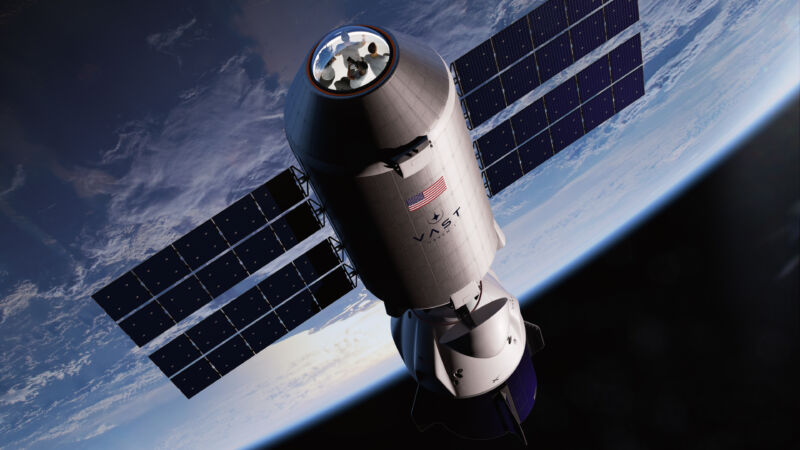
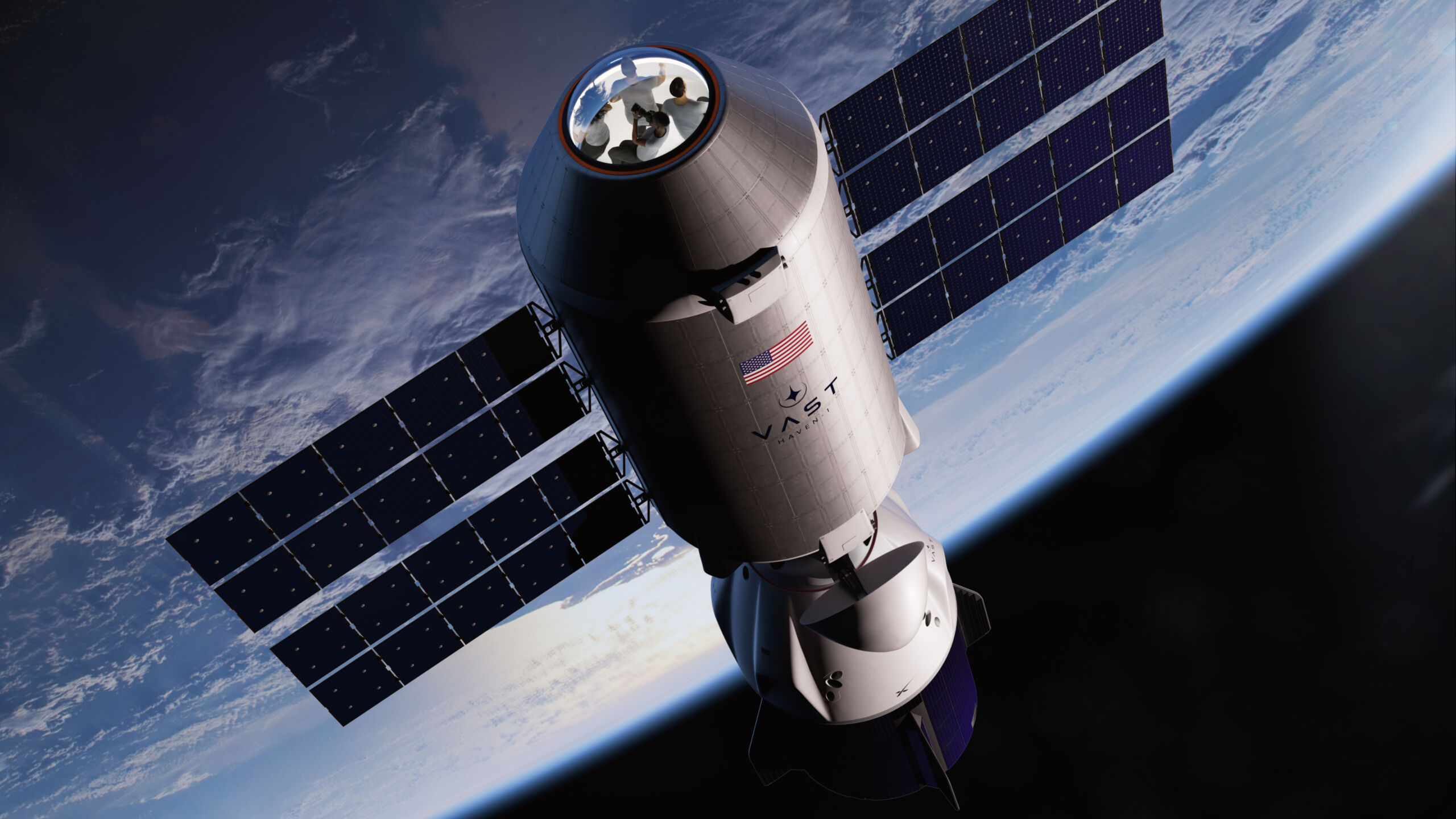
A rendering of a Crew Dragon spacecraft attached to the Haven-1 space station.
Enlarge / A rendering of a Crew Dragon spacecraft attached to the Haven-1 space station.
Vast

A private space station company, Vast, announced on Wednesday that it intends to launch a commercial space station as soon as August 2025. After deploying this "Haven-1" space station in low-Earth orbit, four commercial astronauts will launch to the facility on board SpaceX's Crew Dragon vehicle.

The California-based company says this crew will then spend about 30 days on board the Haven-1 space station before returning to Earth. As part of Wednesday's announcement, Vast said those four crewed seats are now up for sale, as are those for a second mission that will launch no earlier than 2026.

"It's a super aggressive schedule," Jed McCaleb, the founder of Vast, said in an interview with Ars. "But we have a clear path for how we're going to get there."

Getting to orbit fast

McCaleb founded Vast in 2021 to develop the world's first space station with artificial gravity. The company's plans are ambitious, and launching a habitable space station by 2025 would indeed represent a remarkably fast development time.

However, Vast has some credibility, both because of the funding McCaleb is able to pump into the company and because it has signed up several important technical advisers who had long careers at SpaceX, including Hans Koenigsmann, Will Heltsley, and Yang Li. An early pioneer in blockchain technology, McCaleb created Mt. Gox, the first major Bitcoin exchange. He is estimated by Forbes to be worth $2.4 billion and has vowed to invest more than $300 million into Vast Space as it seeks to develop space stations.

The partnership with SpaceX is the key to making this mission happen. Not only will the 3.8-meter-wide Haven-1 module launch inside a Falcon 9 rocket, but part of its life-support systems will also be provided by the Crew Dragon spacecraft when the vehicle is docked.

The Dragon spacecraft will remain powered on the entire time it is attached to Haven-1, providing some of the consumables such as air or water and other services needed to keep humans alive. By leaning on SpaceX and its experience developing these life support systems for Dragon, Vast will attempt to develop a space station on a quicker timeline.

McCaleb said the program has support from the leadership at SpaceX—which is important, as that company devotes much of its time and energy to developing the next-generation Starship rocket.

"A commercial rocket launching a commercial spacecraft with commercial astronauts to a commercial space station is the future of low-Earth orbit, and with Vast, we’re taking another step toward making that future a reality," said Tom Ochinero, senior vice president of commercial business at SpaceX, in a statement. "The SpaceX team couldn’t be more excited to launch Vast’s Haven-1 and support their follow-on human spaceflight missions to the orbiting commercial space station."

Doing so safely

In terms of crew safety, Vast intends to launch the space station into a 500-km orbit at the same inclination as the International Space Station. There, the module will be tested for a few weeks to ensure that everything is working. The first crew will then launch to Haven-1, and, should there be any problems during the stay, Dragon will be ready to depart almost immediately.

Vast's announcement comes as NASA is hoping that private companies will begin to offer habitation for its astronauts in low-Earth orbit. The space agency is planning to decommission the aging International Space Station by about 2030, after which time the agency plans to lease crew time on commercial space stations.

Presently, NASA is funding the development of four commercial space stations in low-Earth orbit; the stations are being built by Axiom Space, Blue Origin, Nanoracks, and Northrop Grumman. All four of these stations remain in the design or preliminary development phases, and all face questions about funding, commitment, or technology challenges.

In short, the competition remains open, and there is time for other entrants to obtain NASA funding in future years for commercial space stations.

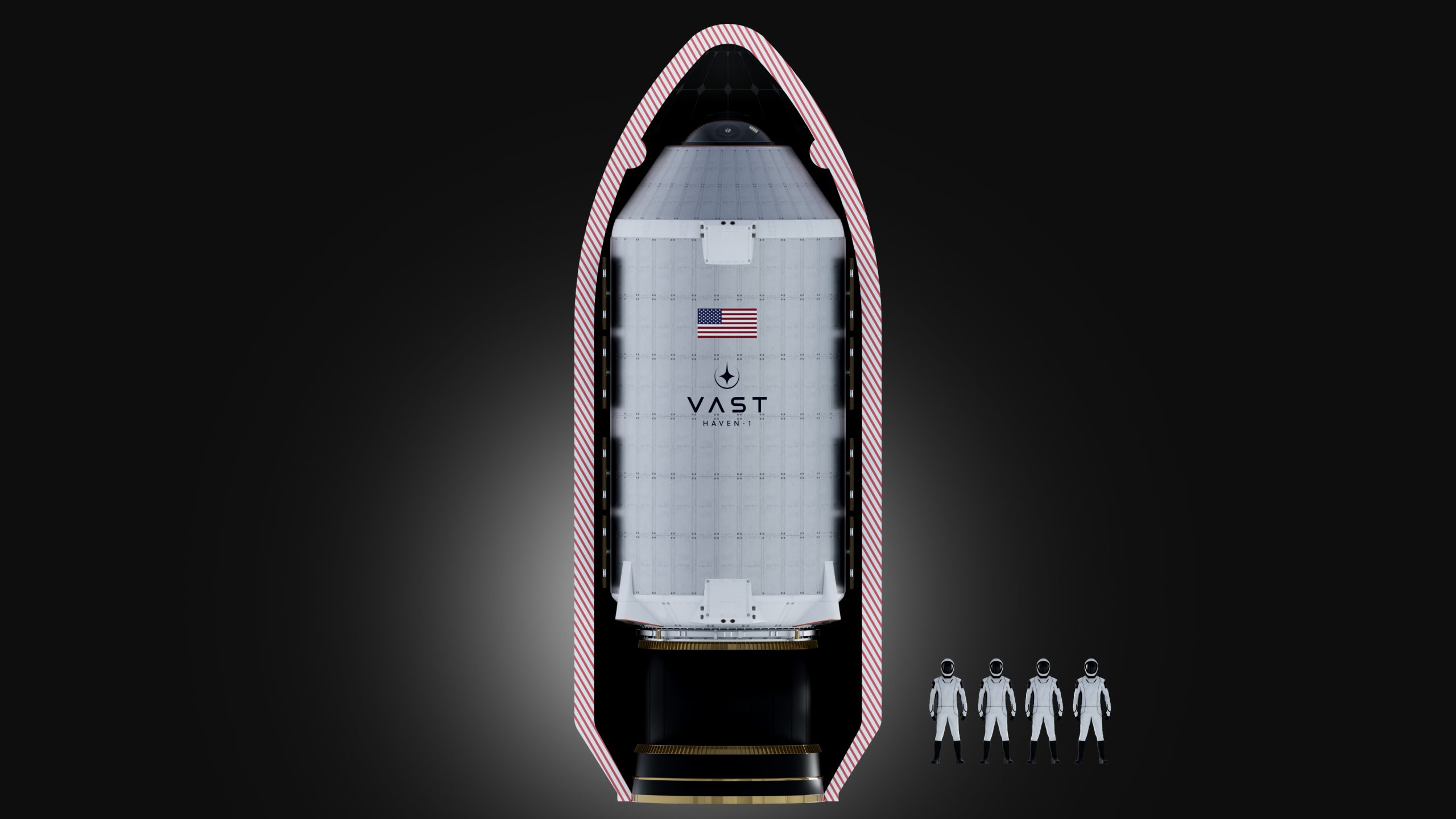
Vast's space station as seen inside the payload fairing of a Falcon 9. With people for scale.
Enlarge / Vast's space station as seen inside the payload fairing of a Falcon 9. With people for scale.
Vast

Vast intends to go after some of this funding, and it potentially has some advantages in the competition. A station with artificial gravity may have some attractiveness to NASA, and McCaleb has deeper pockets than most of the other ventures outside of Blue Origin, which is backed by Amazon founder Jeff Bezos.

To meet NASA's needs, Vast is planning to launch a larger "Starship-class module" by around 2028. This will be nearly twice as large as Haven-1, with a seven-meter diameter, and it will launch atop SpaceX's Starship rocket. (The International Space Station modules are 4.2 meters in diameter.) Vast has published a roadmap of its plans all the way out to the 2040s.

McCaleb said Vast opted to start with the smaller Haven-1 station so that it could start flying sooner on proven SpaceX rockets and demonstrate to its customers and NASA the viability of its hardware in actual flight-like conditions.

The company is planning some artificial gravity experiments on Haven-1—it should be able to reach approximately lunar gravity, or one-sixth that of Earth's gravity. It is hoping for a more robust artificial gravity setup with the Starship module later this decade.

Eric Berger is the senior space editor at Ars Technica, covering everything from astronomy to private space to wonky NASA policy, and author of the book Liftoff, about the rise of SpaceX. A certified meteorologist, Eric lives in Houston. 

Karl Bode on TechDirt: Here we are again DYSFUNCTION JUNCTION

CC Low Income Broadband Program A Huge Windfall For Monopolies Causing The Broadband Affordability Problem We’re Pretending To Fix

from the dysfunction-junction dept

"During the COVID crisis, the FCC launched the Emergency Broadband Benefit (EBB program), giving lower income Americans a $50 ($75 for those in tribal lands) discount off of their broadband bill. Under the program, the government gave money to ISPs, which then doled out discounts to users if they qualified.

But (and I’m sure this will be a surprise to readers), reports are that big ISPs erected cumbersome barriers to actually getting the service, or worse, actively exploited the sign up process to force struggling low-income applicants on to more expensive plans once the initial contract ended. Very on brand.

The EBB was rebranded the Affordable Connectivity Program (ACP) as part of the Infrastructure Bill (the payout to the general public was dropped to $30 a month). And, once again, not at all surprisingly, the FCC discovered that “dozens” of U.S. broadband providers were ripping the program off to the tune of millions of dollars across Alabama, Ohio, Oklahoma and Texas.

At the same time, many of these monopolies have found the program to be big windfall for the very same companies that have historically fought tooth and nail against broadband competition, driving up consumer costs. A Senate inquiry last week found that Charter (Spectrum), for example, has seen more than a billion dollars funneled through its coffers via both programs:

Several of these companies have a very rich history of significant subsidy fraud. And I strongly suspect accounting reviews in a few years will find no shortage of dubious behaviors, especially given what we’ve seen already.

To be clear: I’ve spoken to several communities who say this program genuinely has reduced broadband costs for low income residents seeking access to an essential utility. While we get hung up on broadband coverage, data suggests that broadband affordability is the biggest barrier to broadband adoption. A $30 a month savings is a big deal for lower and middle income households.

Here’s the problem though: a regulatory agency with a history of poorly tracking broadband subsidies, failing to track broadband coverage, or standing up to telecom monopolies, is funneling billions of dollars through the pockets of companies that not only have long histories of fraud, but also have intentionally driven up the cost of broadband service via decades of lobbying and dirty pool aimed at crushing all meaningful competition.

We’re paying giant telecom monopolies to temporarily lower high prices they’re directly responsible for.

At the same time, the FCC and federal lawmakers generally lack the political backbone to actually embrace things like antitrust reform. They’re comically incompetent at measuring the impact of monopolization, crafting policies that directly address monopolization, or even acknowledging that telecom monopolies exist and are the biggest contributor to high consumer broadband costs.

But they are very good at throwing billions of dollars at companies with a long, rich history of ripping off subsidy programs, then turning a blind eye to the resulting mess. And while the ACP genuinely will help some folks with temporarily lower broadband bills (money is expected to run out in a year or two), it’s a band aid for the actual problem that federal policymakers lack the backbone to actually address.

On the other end, you’ve got Republicans and Libertarians pointing to this dysfunction as justification for government doing absolutely nothing whatsoever about our broadband monopoly problem, which isn’t the answer either. Leaving companies like AT&T or Comcast in a market space with neither competition nor competent regulatory accountability genuinely hasn’t worked out well for anybody.

Combined, it doesn’t take long to realize why telecom monopolies have easily ripped off U.S. consumers and taxpayers for decades, with very little in the way of meaningful reform.

Filed Under: 
Companies: chartercharter spectrum

6 Comments 

Google is changing it looks | Gizmodo


1  This article is part of a developing story. Our writers and editors will be updating this page as new information is released. Please check back again in a few minutes to see the latest updates. Meanwhile, if you want more news coverage, check out our techscience, or io9 front pages. And you can always see the most recent Gizmodo news stories at gizmodo.com/latest.

Everything Google Announced About AI, Bard, and PaLM 2 at I/O 2023

Google is sticking AI into Search, its Workspace apps, Maps, and more. It's also updated its language model.

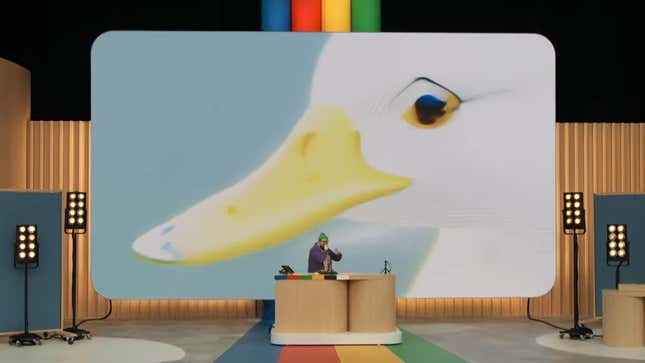
Google showed off its text-to-image generator along with music from Dan Deacon at Google I/O 2023

Music artist Dan Deacon constantly joked about a ‘duck with lips’ before the start of Google I/O 2023. His performance included AI-generated content from Google’s new text-to-video models.
Screenshot: Google / Gizmodo

"Before Google’s latest I/O event could even begin, the tech giant was already trying to stake a claim for its new AI. As music artist Dan Deacon played trippy, chip tune-esque electronic vocals to the gathered crowd, the company displayed the work of its latest text-to-video AI model with a psychedelic slideshow featuring, people in office settings, a trip through space, and mutating ducks surrounded by mumbling lips.

The spectacle was all to show that Google is bringing out the big guns for 2023, taking its biggest swing yet in the ongoing AI fight. At Google I/O, the company displayed a host of new internal and public-facing AI deployments. CEO Sundar Pichai said the company wanted to make AI helpful “for everyone.”

What this really means is—simply—Google plans to stick some form of AI into an increasing number of user-facing software products and apps on its docket.

Google’s sequel to its language model, called PaLM 2

Google unveiled its latest large language model that’s supposed to kick its AI chatbots and other text-based services into high gear. The company said this new LLM is trained on more than 100 languages and has strong coding, mathematics, and creative writing capabilities.

The company said there are four different versions of PaLM, with the smallest “Gecko” version small enough to work on mobile devices. Pichai showed off one example where a user asked PaLM 2 to give comments on a line of code to another developer while translating it into Korean. PaLM will be available in a preview sometime later this year.

PaLM 2 is a continuation of 2022’s PaLM and March’s PaLM-E multimodal model already released earlier this year. In addition, its limited medical-based LLM caled Med-PaLM 2 is supposed to accurately answer medical questions. Google claimed this system achieved 85% accuracy on the US Medical Licensing Examination. Though there’s still enormous ethical questions to work out with AI in the medical field, Pichai said Google hopes Med-PaLM will be able to identify medical diagnoses by looking at images like an X-ray.

Google’s Bard upgrades

Google’s “experiment” for conversational AI has gotten some major upgrades, according to Google. It’s now running on PaLM 2 and has a dark mode, but beyond that, Sissie Hsiao, the VP for Google Assistant and Bard, said the team has been making “rapid improvements” to Bard’s capabilities. She specifically cited its ability to code or debug programs, since it’s now trained on more than 20 programing languages.

Google announced it’s finally removing the waitlist for its Bard AI, letting it out into the open in more than 180 countries. It should also work in both Japanese and Korean, and Hsiao said it should be able to accept around 40 languages “soon.”

Hsiao used an example where Bard creates a script in Python for doing a specific move in a game of Chess. The AI can also explain parts of its code and suggest additions to its base.

> Bard can also integrate directly into Gmail, Sheets, and Docs, able to export text directly to those programs. Bard also uses Google Search to give images and descriptions in its responses.

> Bard is also gaining connections to third-party apps, including Adobe Firefly AI image generator.

AI in Google Search

Google’s bread and butter, Search, is going to integrate the company’s AI to create a “snapshot” to users’ queries. These AI-generated summaries appear at the top of a page on the browser version of Google Search, while a set of links relating to the AI-generated text appear on the right.

Users can click to expand that view, where each line of text gets its own set of links exploring the topic in greater detail. The company said this can act as a “jumping off point” for users and their searches while still giving them access to official sources as well as users’ blogs.

The AI snapshot also works when people search for products, as it displays prices and commentary on a search. For example, a search for “good bike for a 5 mile commute with hills” will generate a few bullet points about design and motor assistance, then rank a number of different brands based on those criteria.

The system also works on mobile, through a “Converse” tab sitting alongside Video, Images, News, and so on. On Android, the snapshot takes up most of the screen while the expanded search results are pushed down to the bottom. All of users’ previous prompts remain above, and users can scroll up to find previous results. Users who continue to scroll down on the page can see more links like a regular Search results.

Google is still calling this an “experiment” with AI in Search. The availability is limited, and there’s currently a waitlist on the new Search Labs platform for those who want to access this new AI in search and to use the AI to help with coding.

Even More AI in the Workspace apps and Gmail

Google has already talked up adding AI content generation in Gmail and Google Docs, but now the company said it’s expanding the so-called “Workspace AI collaborator” to add even more generative capabilities in its cloud-based apps. These generative AI and “sidekick” features are being released on a limited basis, but will be handed out to a more broad userbase later this year.

Much like Microsoft announced with its own 365 apps earlier this year, Google’s adding generative AI into its office-style applications. Aparna Pappu, the VP of Google Workspace, said in addition to the limited deployment of a “help me write” feature on Gmail and Docs, the company is adding new AI features to several Workspace apps, including Slides and Sheets. The spreadsheet application can generate generic templates based on user prompts, such as a client list for a dog walking business.

.Google announced its new “Help me write” feature, which uses an AI to generate a full email response based on previous emails. Users can then iterate on those emails to make them more or less elaborate. Pichai used the example of a user asking customer service for a refund on a canceled flight. This is on top of long-existing content generation abilities in Gmail like Smart Compose and Smart Reply.

For Slides, users can now use text-to-image generation to add to a slideshow. The generator creates multiple instances of an image, and users can further refine those prompts with different styles.

In Gmail, the AI “sidekick” can automatically summarize an email thread and can find cite earlier documents relating to that conversation. As far as Docs goes, the existing AI is getting more elaborate. It now suggests extra prompts based on generated text, and it can now add in AI-generated images directly within Docs. This also works within Slides, letting users generate speaker notes based on AI-generated summaries of each individual slide.

New Magic Editor AI features in Google Photos

Google showcased new updates to its Magic Eraser feature, now calling a suite a AI-based editing features “Magic Editor.” Along with removing extraneous people, items, or other elements of a picture, the company said users will be able to transform objects inside each photo. The company showed how users might go about removing a bag strap or displacing an object, even the photo subject, to a different location in an image.

Gif: Google

Photos users should also be able to punch up elements of an image, such as the lighting or the clouds in the sky. Google said these updates will help those elements blend “seamlessly” into the rest of the image.

All Pixel phones should gain early access to Magic Editor later this year, though the company explicitly said things might not be as clean-looking as their promotional videos.

AI Will Soon Make Google Maps Even More Immersive

Gif: Google

With the help of Google’s new AI tools, Google Maps will soon be getting a much more elaborate Immersive View feature (which previously focused on landmarks) that relies on the billions of images that have been captured for Street View, as well as satellite imagery, to let users further explore a suggested route. It almost turns route planning into an interactive video game, giving cyclists a birds eye view of the bike lanes they’ll be relying on. Drivers will be able to preview intersections, and even the amount of parking available around their destination. The previewed route even shows what the weather will be like depending on the time of day, so you’ll not only know every last turn ahead of time, but what you should be wearing.

Immersive View for routes will be available in the coming months for cities including “Amsterdam, Berlin, Dublin, Florence, Las Vegas, London, Los Angeles, New York, Miami, Paris, Seattle, San Francisco, San Jose, Tokyo, and Venice.”

Gif: Google

On the developer side of things, Google is introducing a new “Aerial View API” allowing app makers to add more immersive points-of-interest that include detailed, 3D overhead views allowing users to see not just the specific locale, but the area around it, too. One great use of this API is for realtor or apartment hunting apps, allowing prospective buyers or renters to see the surrounding neighborhood and what amenities are nearby such as parks, or even access to major roads.

Google is also making the “high-res, 3D imagery behind Google Earth” available to developers as part of an experimental new release allowing app makers to make similarly immersive experiences, without needing to source their own satellite imagery or 3D model generation. In a blog post today, Google suggests it would potentially be a great tool for tourism, allowing 3D maps of national parks to be easily created, complete with 3D mountains, trees, and rivers, allowing potential tourists to see a destination in more detail before planning a trip, or as a way to enhance the experience of an architectural landmark, by introducing interactive overlays with interesting facts about the site and its history."