Community Driven Reporting on the ongoing war in Ukraine - Videos, Photos, Discussions, this subreddit aims to cover both sides of the narrative and allows intelligent discussions. CreatedMar 20, 2022
This sub is to exchange civil arguments and discussions about this war, not to vent nor to circle jerk, not to fight ourselves. This is by far the #1 reason we ban people.
Wiki
What to downvote
Don't downvote. Downvote leads to echochambers. Upvote what you like and ignore the rest.
What user flairs mean
Blue (Pro Russia) means you are more pro-Russia government than pro-Ukraine government in this war. It doesn't mean you 100% support the government. It means that given the choice you'd rather Zelensky surrender than Putin surrender.
Yellow (Pro Ukraine) means the same for the Ukrainian government.
Grey (neutral, or whatever you write) means you don't care who wins and favour neither side.
Bot can flair users automatically
The bot will flair users with no flair (flair hidden = no flair) if they say certain words attributed to one side like "I'm neutral" or "Ruskies". This auto-assigned flair will be marked with an asterisk (*) at the end. The bot can be wrong for example "if you think I'm neutral you are wrong" will result in neutral flair too. People can change their flair manually at any time. Harassment or personal attacks due to flair are forbidden (Rule 1).
Bot can colour some custom flairs
Some entries get automatically coloured (after you comment), like "Pro Putin" grey flair gets coloured blue. If your entry gets coloured the wrong colour (e.g: "not pro KGB" would be coloured blue because you say "pro-KGB" in it), then you need to change your flair because if Bot doesn't understand it's a hint your flair is unnecessarily complicated (try "anti <whatever>" instead).
Someone has a wrong flair!
Maybe they are confused, or maybe they troll. There are no rules about flair they can flair themselves whatever they want because we don't want to be policing that. But they look like a troll and mods tend to be biased against people like that and more likely to sanction them for other offences. Do not call them out as it's harassment, just ignore them and let us deal with it in time.
In the future, if advanced fabrics can be developed, then perhaps wearable electronic devices integrated into shirts, pants, underwear and hats will be able to track indicators of frailty to assess risk of age-related disease, monitorcortisol levelsto track stress levels, or even detect pathogens as part of a global pandemic monitoring network.
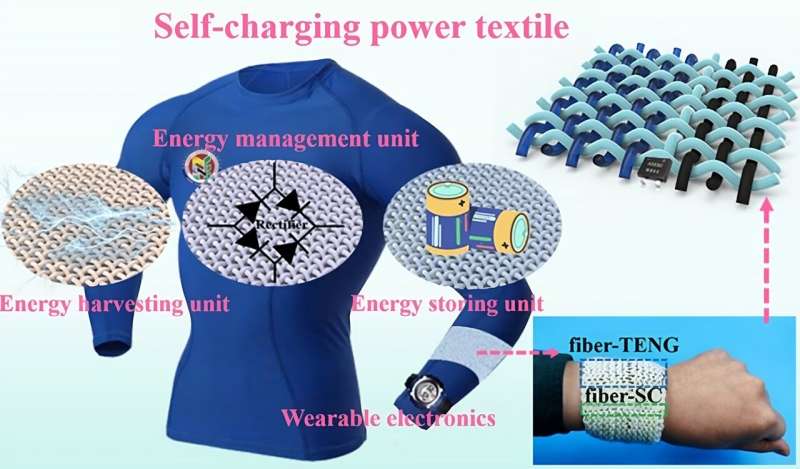
Wearable textile captures energy from body movement to power devices
by Tsinghua University Press
Credit: Nano Research Energy (2023). DOI: 10.26599/NRE.2023.9120079
"Nanoscientists have developed a wearable textile that can convert body movement into useable electricity and even store that energy. The fabric potentially has a wide range of applications from medical monitoring to assisting athletes and their coaches in tracking their performance, as well as smart displays on clothing.
The research team responsible for the textile describe how it works in a paper published in Nano Research Energy.
From smart watches to cordless headphones, people already have access to a wide range of wearable electronic devices. A range of health, sport and activity monitors are now integrated into smartphones.
But the accuracy of such sensors remains limited due to the handful of locations on or near the body that they can be placed, and restricted to a small window of applications compared to the ambitions of many health and sporting specialists have for such technology.
In the future, if advanced fabrics can be developed, then perhaps wearable electronic devices integrated into shirts, pants, underwear and hats will be able to track indicators of frailty to assess risk of age-related disease, monitor cortisol levels to track stress levels, or even detect pathogens as part of a global pandemic monitoring network.
To take wearable electronics to this next level, to integrate health monitors, sport sensors, navigation systems and activity trackers into clothing in a way that is lightweight, unobtrusive and less cumbersome still requires some major breakthroughs in advanced textiles.
One of the challenges of existing wearable electronics comes from limitations in the flexibility and thus wearability of the components that supply energy to the devices. In addition, energy supply units need to be easily integratable with the devices and, in an era of increased environmental awareness, sustainable. On top of all this, existing energy storage technologies have very limited capacity. Batteries and supercapacitors can store energy, but they cannot produce energy spontaneously without an external power source.
"Batteries are also just not very comfortable to wear," said Feifan Sheng, lead author of the paper and nano systems specialist with the Beijing Institute of Nanoenergy and Nanosystems at the Chinese Academy of Sciences. "So the development of wearable and self-charging power supplies is crucial."
Professor Dong's team of nanoscientists produced what they call a "fiber-TENG," a flexible, knittable, wearable structure that takes advantage of the triboelectric effect, in which certain materials become electrically charged after coming into frictional contact with another, different material. Commonplace static electricity for example involves the contact-induced electrification of tribolelectric effect.
The fiber-TENG consists of three layers: a polylactic acid layer (a type of polyester commonly used in 3D printing), a reduced graphene oxide layer (a highly affordable type of graphene), and a polypyrrole layer (a polymer already widely used in electronics and medicine).
When the fiber-TENG is subjected to mechanical deformation, such as bending or stretching by the person wearing a piece of clothing knitted from the textile, the triboelectric charges generated by the contact between the polylactic acid and reduced graphene oxide layers can be collected by the polypyrrole layer. This process generates an electrical output that can be used as a power generation unit.
Key to the development of the fiber-TENG was a novel process used to prepare the graphene oxide fiber for use in a coaxial fiber-shaped supercapacitor (fiber-SC)—the energy storage facility integrated into the textile. A coaxial structure provides great stability when bending and twisting.
The process involves adding the active materials (those that can store and release electrical energy) onto the surface of reduced graphene oxide (rGO) fibers. First, the researchers produced the rGO fibers via an application of hydroiodic acid. Then, they add two active materials, manganese dioxide (MnO2) and polypyrrole (PPy), onto the surface of the rGO fibers using a process called electrodeposition—a method of depositing a material onto a surface by applying an electric current.
This created a negative electrode material called rGO-PPy-MnO2 that is used in the fiber-SC. A positive electrode material was then made by uniformly coating multi-walled carbon nanotubes (MWCNTs) with polyvinyl alcohol and phosphoric acid electrolyte on the surface of the rGO-PPy-MnO2.
Testing their fiber-TENG textile, the researchers found that it enjoys high energy density and lengthy stability over charge and discharge cycles, enhancing its promise in delivering wearable energy generation and storage.
The team now want to start exploring potential uses of their textile in real-world applications. For this, they will need to optimize the design and fabrication process of the power textile, and to investigate its performance under different conditions, as well as develop a scalable manufacturing process workable in commercial operations beyond the lab.
More information: Feifan Sheng et al, Wearable energy harvesting-storage hybrid textiles as on-body self-charging power systems, Nano Research Energy (2023). DOI: 10.26599/NRE.2023.9120079
The Palm Jebel Ali was cancelled amid the 2008 credit crisis, leaving hundreds of investors in limbo
"Dubai’s ruler has approved a new development plan for the largest of the city’s famous palm-shaped artificial islands, the Palm Jebel Ali project, which was put on hold in the aftermath of the 2008 financial crisis.
Part of the Dubai 2040 Urban Master Plan, Palm Jebel Ali will feature over 80 hotels and resorts, providing approximately 35,000 families with luxury beachside living. It is estimated to add 110 kilometers (68.35 miles) to the emirate’s coastline, according to media reports.
“Palm Jebel Ali will further strengthen our urban infrastructure and consolidate the city’s emergence as one of the world’s leading metropolises. This new ground breaking project reflects our strategic development plan centered on raising the quality of life and happiness of residents,” Sheikh Mohammed bin Rashid Al Maktoum stated on Wednesday.
The ambitious project’s revival comes amid a rebound in the property market of Dubai, the UAE’s commercial capital. Demand in the seaside emirate has been hitting record highs lately due to an influx of newcomers, which has sent real estate prices soaring.
Dubai aims to double the size of its economy over the next decade and become one of the “top 3 economic cities around the world.”
Still, there remain hundreds of investors who bought homes on Palm Jebel Ali that never got built. Some of those investors were offered to swap for alternative properties, others were offered refunds for amounts collected by the developer until it stopped working on the project in 2009. There is reportedly also an opportunity to reinvest cash in the revived Palm Jebel Ali. In that case, however, investors will receive only partial compensation as prices on the island are expected to be much higher than when the original project was launched two decades ago.
For the most part, Diablo 4 follows the same style of gameplay that players have come to know and love in the Diablo series. While Diablo 4 still features the traditional isometric style of dungeon crawling and loot hunting, it does add its own unique features into the mix. One exciting new feature is Strongholds.
Strongholds are like outdoor dungeons. For one reason or another, a group of enemies has taken the area over. Once players clear out the opposition and reclaim the space, Strongholds change into a new space that will either become a Waypoint to fast travel to or unlock additional content for players to engage with. There are only three Strongholds in Scosglen, but the rewards make them worth doing.
One of the first Strongholds that players will likely encounter is the Tur Dulra Stronghold. This Stronghold is located northwest of Firebreak Manor along the coast. The objective of this Stronghold is to release the three druid spirits being held captive and tortured by demons. Once the druids have been released, the boss will spawn nearby.
Once this Stronghold has been beaten, players will unlock a Waypoint, three vendors, two side quests, and two dungeons. In addition, players who are druids will have a side quest to clear Tur Dulra. This is followed up by another side quest that unlocks the Spirit Boon mechanic for druids. Finally, completing this Stronghold (or any, for that matter) will reward players with 100 Renown.
Hope's Light
This Stronghold is at the north most edge of Scosglen. At Hope's Light, the objective is to reach the top of the lighthouse and investigate why it is unlit. Players will have to jump along a winding series of islands and wrecked ships to reach the top. Along the way, players will have to deal with Elites and also finding a missing winch to form a path to the top of the lighthouse.
The boss near the top is not particularly difficult, but players will want to stay out of the puddles and quickly deal with adds (additional enemies) as they spawn. The reward for clearing Hope's Light is 100 Renown and it also unlocks the Flooded Depths dungeon.
Moordaine Lodge
The third and final Stronghold in Scosglen is the Moordaine Lodge. The Moordaine Lodge is north of Tirmair. For this Stronghold, players must investigate the hunting grounds and discover what happened to the hunters there. Start by going to the lodge and then search for three bodies scattered across the hunting grounds. Just before finding the third body, the boss will attack but will retreat when it reaches 75% health.
Of the Stronghold bosses Fionnir, the boss of Moordaine Lodge, is the most difficult of the trio. During the first phase, Fionnir starts as a werewolf. When the second phase begins, he turns into a human and casts spells. During the final phase, Fionnir turns into a werebear and unleashes a storm of earth spells and tornadoes while adds constantly spawn and harass players.
The best way to beat Fionnir is to stay out of the tornadoes that spawn, move out of his others spells, and constantly be on the move to avoid getting killed. Once players beat the Moordaine Lodge, they will unlock the Ferals' Den and Twisted Hollow dungeons.
Diablo 4 releases on June 6th for PC, PlayStation 4, PlayStation 5, Xbox One, and Xbox Series X/S. Early Access is available now.
Iran recently proposed forming a joint navy with Saudi Arabia and other Gulf states in a move that could have major geopolitical significance if it came to pass. So, how likely is this alliance? And how could it shape Middle Eastern and global politics?