
Wayne Schutsky
VERIFIEDEditor @theyellowsheet /occasional appearances in @azcapitoltimes Exes: @scottsdaleprog2 and @evtnow
They normally mate to reproduce, like most other reptiles, and lay eggs that later hatch.
.jpg)
But now, it appears that they can reproduce asexually if need be.

More information: Warren Booth et al, Discovery of facultative parthenogenesis in a new world crocodile, Biology Letters (2023). DOI: 10.1098/rsbl.2023.0129
While OneWeb now has enough satellites for global services with 634 spacecraft in LEO, including a technology demonstrator for a second-generation system, it expects to finalize the ground stations needed for worldwide coverage by the end of this year.

The maritime service announcement came a day after the operator said it is expanding a distribution partnership with Hughes Network Systems, a OneWeb investor via parent company EchoStar, to provide global inflight connectivity (IFC) once its LEO services are available for airlines next year.
Hughes, which already provides IFC services via geostationary satellites, has developed an electronically steered antenna for the partnership designed to connect a plane to satellites in LEO and geostationary orbit (GEO). . .Hughes engineered OneWeb’s gateways and is a distribution partner for the operator’s fixed satellite services in the United States and India. The company also distributes OneWeb’s connectivity solutions to the U.S. Department of Defense.
We’ve done all we can we’re willing to do to make schools safer. We’ve added more cops, something that sounds like safety but just means we’ve offloaded school discipline to people trained in the art of violence. We’ve locked more doors, added more machinery, and opened up our students to all sorts of pervasive surveillance.
The biggest threat in the US is guns. Guns are easy. Guns allow people to kill without having to generate much physical effort. The UK has clamped down on guns, but still finds itself dealing with plenty of violence, mostly of the knife variety.
Let’s let the Brits train our AI. Maybe that way we can catch weapons that aren’t guns before they’re wielded against children.
Evolv Technology is a security firm that wants to replace traditional metal detectors with AI weapons scanners.
Instead of simply detecting metal, Evolv says its scanner “combines powerful sensor technology with proven artificial intelligence” to detect weapons.
Cool shit, non?
Non. Non, indeed.
However, a BBC investigation last year revealed that testing had found the system could not reliably detect large knives – after Evolv’s scanner missed 42% of large knives in 24 walk-throughs.
That information was passed on to Evolv. BBC testers told Evolv to inform its clients that its AI failed to detect knives almost 50% of the time. Its clients — at that time — included stadiums across the US, as well as the Manchester Arena in the UK.
Despite this, the company has been expanding into schools, and now claims to be in hundreds of them across the US.
But that fact shouldn’t be used to excuse a company’s unwillingness to inform current and potential customers of its shortcomings.
And Evolv knows it’s falling down on the job. That knowledge isn’t deterring it from pitching its products while it attempts to find a solution. In fact, it appears Evolv isn’t looking for solutions. It’s just asking its copywriters to create more absolutional sales pitches.
Following a high-profile stabbing in a New York school utilizing Evolv’s tech, Evolv began rewording its pitch pages on its website to distance itself from its previous promises of impervious defense to something much more vague and more in line with the sales pitches of cop tech, which have moved away from the term “non-lethal” following deadly deployments of their products to phrases that actively distance these tech purveyors from legal liability, like “less lethal.”
After the stabbing, the wording on Evolv’s website changed.
Up until October last year, Evolv’s homepage featured a headline that boasted of “Weapons-Free Zones”. The company then removed that wording, and changed the text to “Safe Zones”. It has now been changed again and reads “Safer Zones”.
But “safer” than what? Staying at home? Using plain old metal detectors? Belated attempts at plausible deniability?
The BBC has yet again asked Evolv to explain itself and inform its customers it’s not all that great at detecting certain weapons. And yet again, the company has refused to engage directly with the BBC and its investigative journalists. Instead of directly responding to this article, the company has directed people to an exonerative blog post written by its CEO, Peter George, in which the company claims the reason it won’t answer questions about its faulty tech is because it doesn’t want violent threats to children to exploit these details to thwart its obviously-faulty system.
But who needs to thwart anything? It’s pretty much a coin toss whether or not someone heading into a school will be caught with a knife. Why bother with the dissembling when you can just roll the dice on tech that claims it will keep schools free of weapons slightly less free of weapons may catch some weapons.
If that’s the best Evolv can do, it can be done better by cheaper tech sold by companies that actually know how to detect weapons, rather than claim they’re doing some sort of sci-fi shit with their over-priced scanners and then directing people to non-apologies every time it’s pointed out they’re failed to deliver on their promises."
Filed Under: ai, knives, scanning, weapons scanner
Companies: evolv

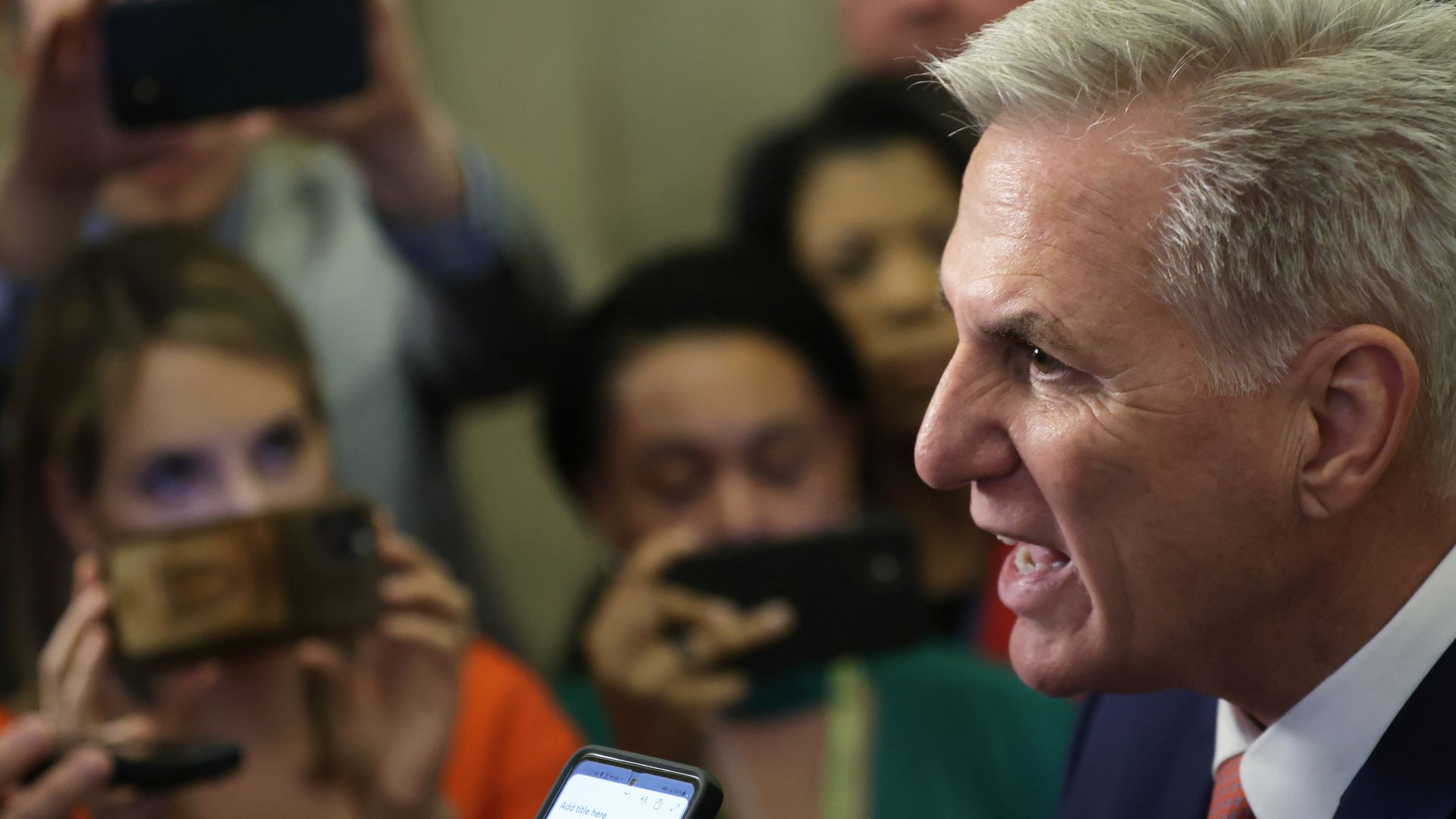
House Speaker Kevin McCarthy. Photo: Alex Wong/Getty Images.
Frustrations from establishment House Republicans spilled out into the open on Wednesday after right-wing lawmakers succeeded in blocking nearly a week’s worth of House votes.
Why it matters: The latest bout of infighting has reignited concerns about GOP leadership, all but helpless to stop right-wing agitators from hijacking the legislative process.
ANGEL ROBLES is k nown for an eclectic set list that spans multiple genres, . . He utilizes loop pedals, acoustic guitars, and backing...