Saturday, June 10, 2023

VERY NEW SITUATION: Cuba & Russia Re-Activating an Alliance


New

CC

Dozens of Russian officials have travelled to Cuba in recent months — and some former Cuban government insiders are warning that Russia might plan to again use the island as a forward base on the United States' doorstep.

This week, Cuban President Miguel Diaz-Canel went on the Spanish-language version of Russia Today to insist on Cuba's "unconditional" support for Russia.

 Cuba's Fidel Castro, center, meets with Russia's President Vladimir Putin, right, in Havana, Cuba, Friday, July 11, 2014. Putin began a Latin American tour aimed at boosting trade and ties in the region with a stop Friday in Cuba, a key Soviet ally during the Cold War that has backed Moscow in its dispute with the West over Ukraine.
Cuba's Fidel Castro, centre, meets with Russia's President Vladimir Putin, right, in Havana, Cuba on July 11, 2014. Castro died in 2016 but the Kremlin's efforts to keep Cuba in its corner have only intensified since it invaded Ukraine. (Alex Castro/The Associated Press)

"We condemn and we don't accept the expansion of NATO to the borders of Russia," he said.

Last week, for the first time ever, Cubans appeared alongside Russians fighting in Ukraine, both in the Russian Army and in the Wagner Group.

Russia says they joined as volunteers and are not part of the Cuban army.

Two men shake hands and laugh in front of Russian and Cuban flags.
Russia's Foreign Minister Sergey Lavrov, right, and Cuba's Minister of Foreign Affairs Bruno Rodriguez shake hands during a photo opportunity on the sidelines of a meeting in Havana, Cuba, Thursday, April 20, 2023. (Ramon Espinosa/Associated Press)

But it was Cuba's regular armed forces that signed a deal this month to train troops in Belarus, a close ally of Moscow heavily involved in the Ukraine war.

Vladimir Rouvinski, a Russian expert on his country's relations with Latin America at the Instituto Colombiano de Estudios Superiores de Incolda in Cali, Colombia, said the Kremlin sees Cuba as America's "near abroad."

"Russians are interested in expanding the relation with Cuba from the logic of reciprocity, in order to say to the United States, 'We're here again, and we may make some troubles for you, so pay attention to us,'" he said.

Cuba's crisis of everything

The Russians are coming as Cuba faces its worst economic crisis since Soviet subsidies ended in 1991. 

Cuban agricultural production has collapsed and it must now import 80 per cent of its food. But the pandemic cut the flow of tourists bringing the hard currency Cuba needs to buy food overseas. President Donald Trump's tightening of restrictions on U.S. remittances to Cuba further reduced the Cuban government's reserves.

Over the past few weeks, Russian oligarchs have signed agreements with Havana covering a wide range of commercial interests: supplying wheat to Cuba; investments in its sugar and rum industries; revitalizing ports, urban infrastructure and hotels. Russia has agreed to help restart Cuba's steel industry and, more importantly, supply the country with oil.

"The Cuban government does not have a strong position," former Cuban diplomat-turned-dissident Miriam Leiva said from Havana. "It depends on the Russian government giving it oil, food and money. They are even allowing Cuban land to be leased for the first time, for Russian investors.

"There's a very big commitment from the president personally to support the Russian invasion of Ukraine and the war. This distances us from the international community and leaves us isolated."

A woman stands in Red Square in Moscow.
Miriam Leiva in Moscow in 1989. As a Cuban diplomat, she worked extensively with the USSR and East Bloc allies until the Soviet Union collapsed. (Miriam Leiva)

Leiva, a former Communist Party member who worked in the Soviet Union and East Bloc countries during her time in Cuba's Ministry of Foreign Relations, said the new Russia can't afford to subsidize Cuba as the old Soviet Union did — but the new Cuba is so weak it has to take whatever it can get.

"Cuba's sovereignty is being compromised with all the prerogatives that are being offered to the Russians," she said. 

Those prerogatives include Havana allowing Russia to change Cuba's laws to protect its investments.

"The right the Cuban people don't have, the right to determine our laws and our constitution, is being given away to others," she said. "What we Cubans cannot do, the others are going to do. That's the difficult and sad situation."

The Cuban government did not respond to questions posed by CBC News.

Ukraine the catalyst

The collapse of the Soviet Union in 1991 gave Ukraine independence and launched an economic crisis in Cuba that moderated but never really ended.

The dormant relationship between Havana and Moscow began to revive in 2014, when Russia turned to Cuba for diplomatic support for its annexation of Crimea.

Havana obliged and in turn received forgiveness of 90 per cent of its debts with Russia — over $40 billion, a sum Cuba was in no position to repay anyway.

A frigate enters the port of Havana.
The Russian Navy frigate Admiral Gorshkov arrives at the port of Havana, Cuba on June 24, 2019. Russian President Vladimir Putin sent the frigate, armed with the country's latest hypersonic weapons, on a trans-ocean cruise in a show of force as tensions with the West escalated over Ukraine. (Ramon Espinosa/Associated Press)

That same year, Russia said it would reopen its old spying station at Lourdes, Cuba, a facility Russian President Vladimir Putin closed as a cost-saving measure in 2002.

But not much actually changed until early last year, when Russia was secretly preparing to invade Ukraine. It was Russian Deputy Defence Minister Sergei Ryabkov who brought up the idea of sending Russian troops to Cuba or Venezuela — a clear attempt to convince the West not to interfere in Moscow's plans for Ukraine.

One month later, Russian tanks rolled into Ukraine, a move Cuba immediately blamed on NATO. The next day, the Cuban government effectively warned Cubans not to question that position when it arrested a dissident who tried to lay a bouquet of flowers on the steps of the Ukrainian embassy.

As the war began to turn sour for Russian forces, Cuba's situation was also worsening, said Cuban ex-diplomat Juan Antonio Blanco.

The former member of the Communist Party's Central Committee for foreign relations said he became disillusioned when the party rejected reforms following the collapse of the Soviet Union. He ended up in exile in the U.S.

He said Cuba's multiple crises reached a desperate state by October with the accelerating collapse of Cuba's energy grid.

A plain-clothed police officer throws a woman to the ground during an anti-government protest in Havana, Cuba, Saturday, Oct 1, 2022. Although the democratic left is ascendant in Latin America, the Cuban Communist Party faces unprecedented challenges to its one-party rule. (AP Photo/Ramon Espinosa)
A plainclothes police officer throws a woman to the ground during an anti-government protest in Havana, Cuba on Oct 1, 2022. (Ramon Espinosa/The Associated Press)

"That was the final straw. All the indicators were in crisis," said Blanco. "They realized suddenly that those [power] plants have run out of time and have to be replaced. They don't have the money to replace them. It's about $10 billion (US).

"They saw that protests were rising throughout the island. Either they get resources from somewhere or they would have to put away all that they know for the last 60 years.

"Like in 1991, they didn't want to go the democratic way. They decided to make another transition."

Blanco said Cuba's rulers were not interested in following the Chinese or Vietnamese post-Communist models of free-market capitalism under an authoritarian government. "They are more inclined to copy the Russian model of a dictatorship with a market that is controlled by oligarchs," he said.

Capitalist innovations shock Marxists

The scale of Cuba's capitulation to Russian demands has caused shock in some international Marxist circles.

Russian investors in Cuba have demanded and secured tax preferences, the right to repatriate profits and the power to hire and fire Cuban workers at will.

"Now the Russians come to Havana," said Blanco. "And they say, 'Well, we're ready to help, but you would have to change your constitution, change your laws, revise this or revise that.'

"In less than a week, they're calling for the parliament to check everything out and see how they're going to accommodate the Russians."

A man is arrested during a demonstration against the government of Cuban President Miguel Diaz-Canel in Havana, on July 11, 2021.
Rolando Remedios is arrested during a demonstration against the government of Cuban President Miguel Diaz-Canel in Havana, on July 11, 2021. (Yamil Lage/AFP via Getty Images)

For Rolando Remedios, who was arrested in the protests against one-party rule that broke out across Cuba on July 11, 2021, the return of the Russians suggests the Cuban Communist Party believes it has no alternative if it wants to hold on to power.

"They are offering these incentives to Russian companies that Cubans do not receive, despite knowing that Russians will become more influential over Cuban affairs," he told CBC News from Havana.

"They'd rather empower a foreign power than empower the Cuban people."

Havana's goal: avoid total collapse

The war in Ukraine still drives the alliance.

Cuba abstained from the historic March 2 United Nations vote that saw 141 countries condemn the Russian invasion. By the fall, it had moved to a more openly pro-Russian position — voting with Russia and five other countries to block Ukrainian President Volodomyr Zelenskyy from addressing the UN General Assembly, supporting the Russian annexation of four regions of Ukraine, and voting against a motion calling for Russia to pay reparations to Ukraine.

Also in the fall, Russian Foreign Minister Sergei Lavrov began to talk publicly about another scenario like the Cuban Missile Crisis of 1962.

Fidel Castro speaks with Nikita Khrushchev.
Cuban leader Fidel Castro speaks with Soviet Premier Nikita Khrushchev as Raul Roa, Castro’s foreign minister, looks on. The trio met during a UN assembly in New York, two years before the Cuban Missile Crisis permanently soured relations between Cuba and the U.S. (Prensa Latina/Associated Press)

Blanco, who maintains contacts on the island, said Putin sent a personal messenger to Raul Castro — officially retired but widely seen as the real power in Cuba — at some point around that time. Two weeks later came a formal visit by President Miguel Diaz-Canel to Moscow. Following that visit, an army of Russian officials and oligarchs began to descend on Cuba.

Since March, the island has hosted not only Lavrov, but also Nikolai Patrushev — who has headed Russia's Security Council for 15 years — Deputy Prime Minister Dmitry Chernyshenko, Rosneft CEO Igor Sechin and Boris Titov, an oligarch with a presidential commission who led a delegation of Russian business leaders that signed agreements for 30 projects in Cuba.

"Today's Russia is not the Soviet Union" and Cubans know they can't expect assistance on the scale they received during the Cold War, said Rouvinski. The Cuban regime's goal, he said, is "to avoid the total collapse of the Cuban economy that's on the horizon."

The Cuban Communist Party brings value to the alliance.

The Kremlin's Ukraine war diplomacy — its efforts to foster support for the war among allies and client states — is heavily focused on developing countries in Africa, Latin America and Asia. Cuba currently holds the presidency of the Group of 77, the successor to the Non-Aligned Movement that unites 134 countries, including virtually the entire global South.

"That provides them with a manoeuvrability within the UN and multilateral organizations to serve the purposes of Russia," said Blanco, who headed Cuba's office for the Non-Aligned Movement. "They have also been very effective in promoting Russian disinformation in Spanish in all of Latin America and Spain."

The pending arrival of Russian banks in Cuba could help Russian businesses evade sanctions imposed by countries that don't sanction Cuba, such as EU member states, Japan and Canada.

But the two former Cuban diplomats who spoke with CBC News said they fear that Russia will demand bigger sacrifices from Cuba.

Missile diplomacy

In recent days, Lavrov and Kremlin-controlled television have been hinting at a reprise of the Soviet Union's first armed foray into the Western hemisphere — when it secretly placed nuclear missiles in Cuba in 1962.

Rouvinski said Russia is in Cuba to send a message.

"The message is mostly directed to the United States and the Western allies, saying if things get really bad in Ukraine, we may go forward and place some kind of strategic equipment on the island," he said.

Rouvinski said he doesn't expect an exact replay of the events of 1962.

"One of the things (the Cubans) learned," he said, "is that they were excluded by the Soviet Union and the United States from any negotiation about the fate of the Soviet missiles on the island. The decisions were taken without them and this is something they don't want to repeat."

'No option but to react'

Blanco agreed the Cuban side likely would draw the line at permitting land-based missile launchers on the island.

"I think the Russians are going to manage a way to have a permanent presence without establishing a military base in Cuba," he said.

"They may send a ship, or a nuclear submarine. They send it in August, in September that leaves and then another one comes and takes its place, and then another one and another one. And by the time that you realize it, they have normalized a rotative, flexible, permanent presence in the Western Hemisphere, 90 miles away from the United States."

A nuclear submarine travels under a bridge.
The Russian nuclear submarine Dmitry Donskoy sails under the Great Belt Bridge in Denmark on July 21, 2017, on its way to Saint Petersburg to participate in a naval parade. (REUTERS)

"Every nuclear submarine probably has more missiles, cruise missiles than all the missiles on Cuba in 1962," added Blanco, who as a young soldier in 1963 manned a Russian SA-2 Desna missile battery as part of a joint Russian-Cuban unit.

"The worse that the war [in Ukraine] will go for the Russians, the more likely this kind of military scenario in Cuba."

Rouvinski agreed. "This could trigger a very dangerous development because the United States would have no options but to react to this," he said.

Saving face

No one CBC News spoke to believes that Russia is really trying to start a war with the U.S. It may instead be trying to find a face-saving way out of the war it already started with Ukraine.

Rouvinski said Cuba has symbolic value — especially for a leader like Putin who plays on Soviet-era nostalgia. 

"Vladimir Putin was building this image of a new Russia, that it's again a great power that can have a global reach," he said. "And Cuba resonated very well with these messages because many Russians did not know details about what has happened in Cuba, but were aware of Cuba as the place that is important in terms of strategic competition with the United States."

Blanco said he can envision a scenario where Putin portrays the new Russian presence in Cuba as a strategic counterweight to NATO's presence in former Soviet republics such as Latvia.

"If the war really turns ugly for Russia, more ugly than it already is," he said, "then he can always say, 'Well, you know what, I don't have to fight this war anymore because the origin of the war, as I claim, was that they were getting closer to our border. And now we are close to their border.'"

Blanco said Russia also could use Cuba as a bargaining chip to convince NATO to deny Ukraine membership, or to pressure the alliance into withdrawing its forces from Russia's border.

Although it wasn't revealed publicly at the time, the 1962 Cuban missile crisis ended with just such a quid pro quo. In return for Soviet leader Nikita Khrushchev's nuclear withdrawal from Cuba, U.S. President John F. Kennedy agreed to remove Jupiter nuclear missiles the U.S. had placed near Russia in Turkey.

For now, ordinary Cubans again find themselves bystanders on the margins of a great power competition, and can only speculate on what it all might mean.

"Russia's in a very difficult position," said Leiva. "But it's precisely when it's in a difficult position that it's most dangerous.

"Hopefully, it doesn't lead us into a crisis. But in any case, their presence here in Cuba creates a very new situation."

10 Jun, 2023 06:07

Cuba makes proposal to Russian-led economic alliance

Havana wants to set up an industrial park with the Eurasian Economic Union, the prime minister has said
Cuba makes proposal to Russian-led economic alliance


"Cuba is interested in creating a Eurasian Economic Union (EEU) industrial park in the island’s special economic zone, the country’s prime minister, Manuel Marrero Cruz, announced on Friday.

The proposed industrial park may be established in the Mariel province on a 50-hectare (123-acre) plot of land, including a port, 45km (27 miles) away from Havana. The Caribbean nation has offered to lend the plot to the EEU for 50 years, with an opportunity to prolong the deed.

Speaking at a meeting of the EEU intergovernmental council, Marrero Cruz said that the creation of this platform could be a “demonstration of joint efforts to create production chains leading to the kind of interregional integration that we strive for in a multipolar world.”

The Russia-led EEU currently brings together five post-Soviet countries, namely Armenia, Belarus, Kazakhstan, Kyrgyzstan and Russia. Cuba has been actively cooperating with the bloc for several years already, becoming a full-fledged observer at the EEU back in 2020.

Cuba first came up with the idea last year, suggesting that establishing this industrial park would make the Cuban market more accessible for companies from the EEU nations and open up the markets of other Latin American countries.

Under the proposed initiative, the economic group will be able to set up manufacturing at the industrial park, make direct investments, strike up deals, and so forth.

Several companies from Russia and Belarus are already represented at Mariel. Foreign entrepreneurs operating in the special economic zone are provided with tax and customs preferences designed to encourage investment and the localization of production in Cuba.

Moscow and Havana have been close economic partners since the days of the Soviet Union, and saw bilateral trade triple last year. Trade turnover between Russia and Cuba has surged ninefold in the first four months of the year, compared to 2022, according to official data released this week.
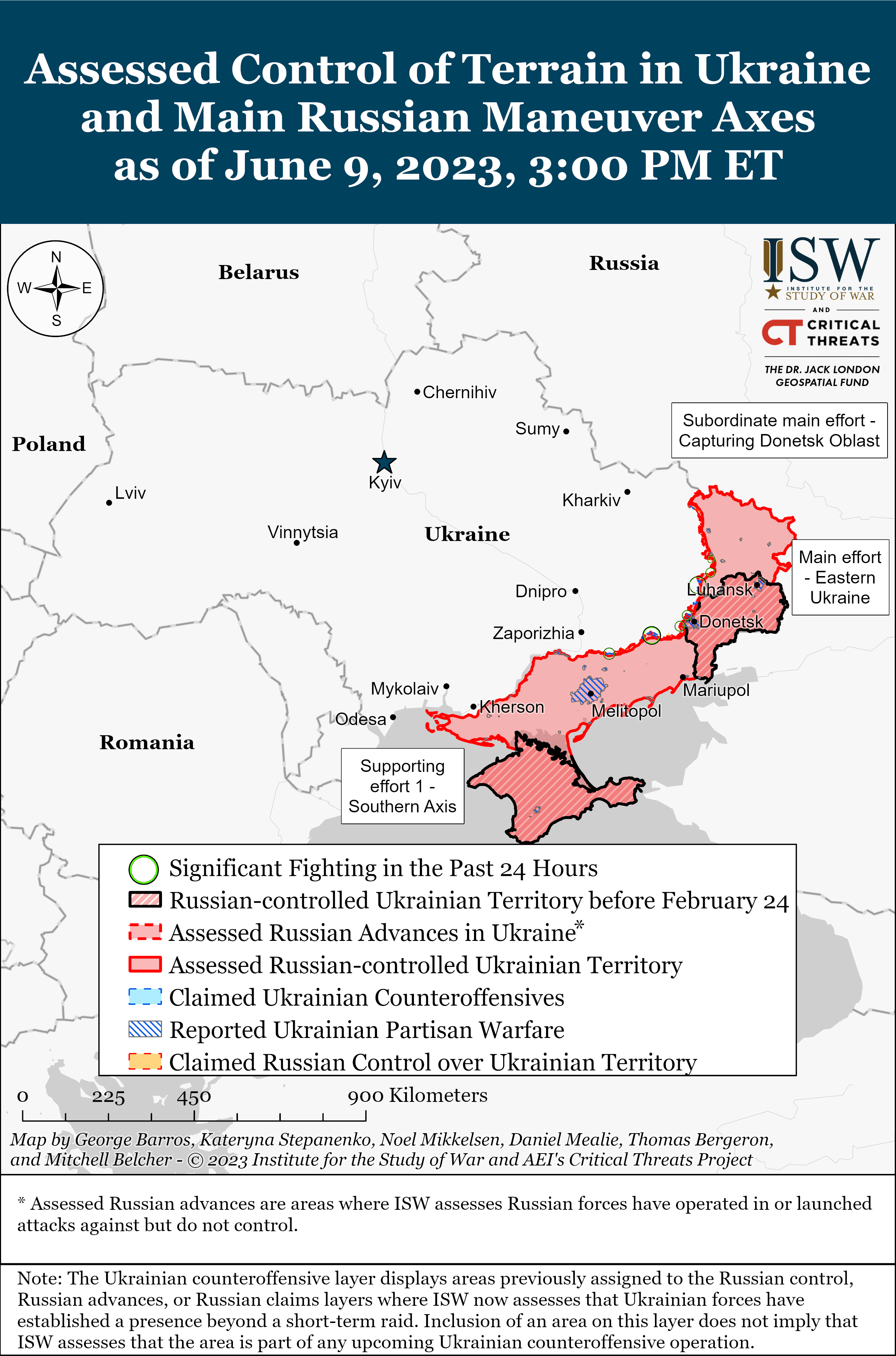
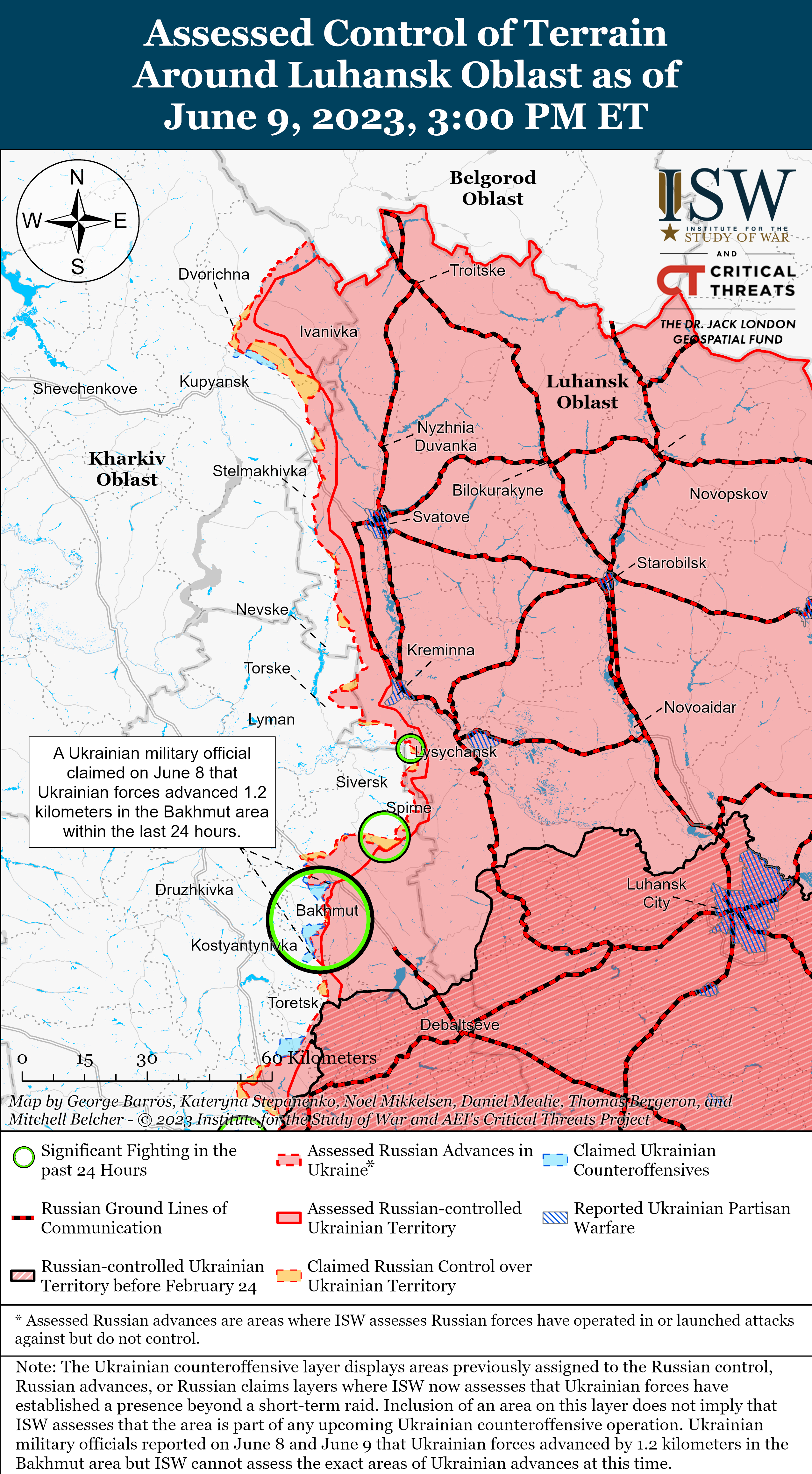
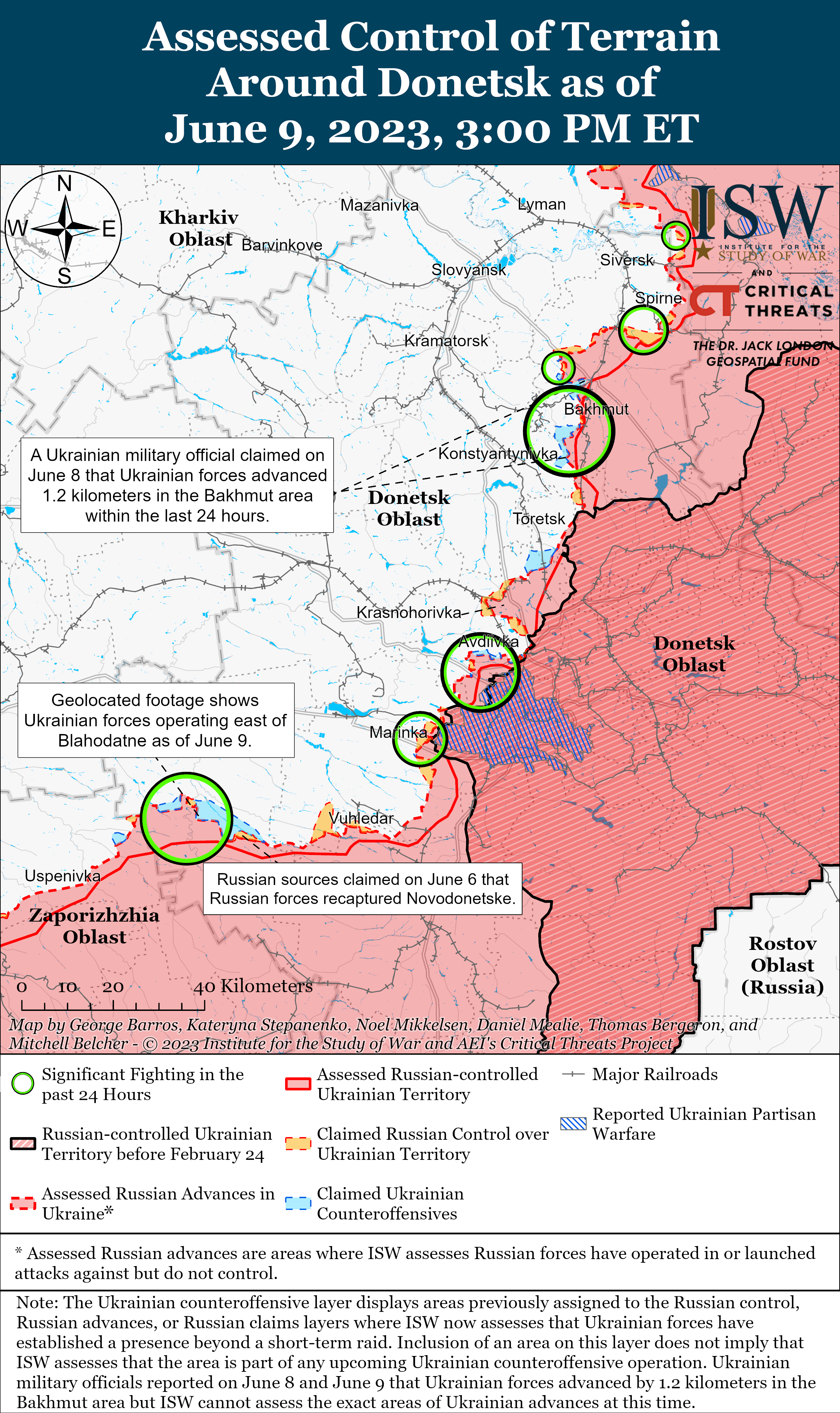
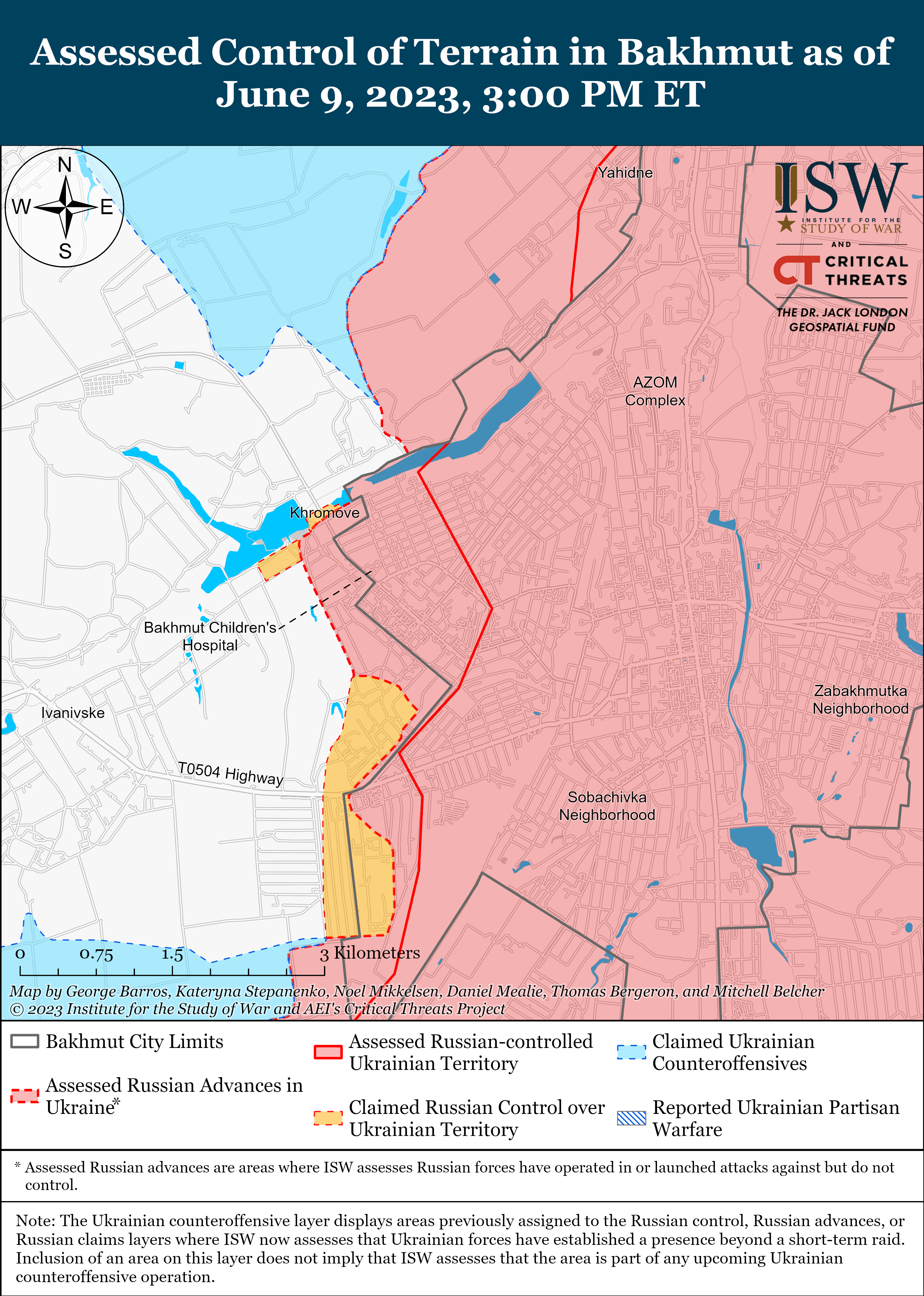
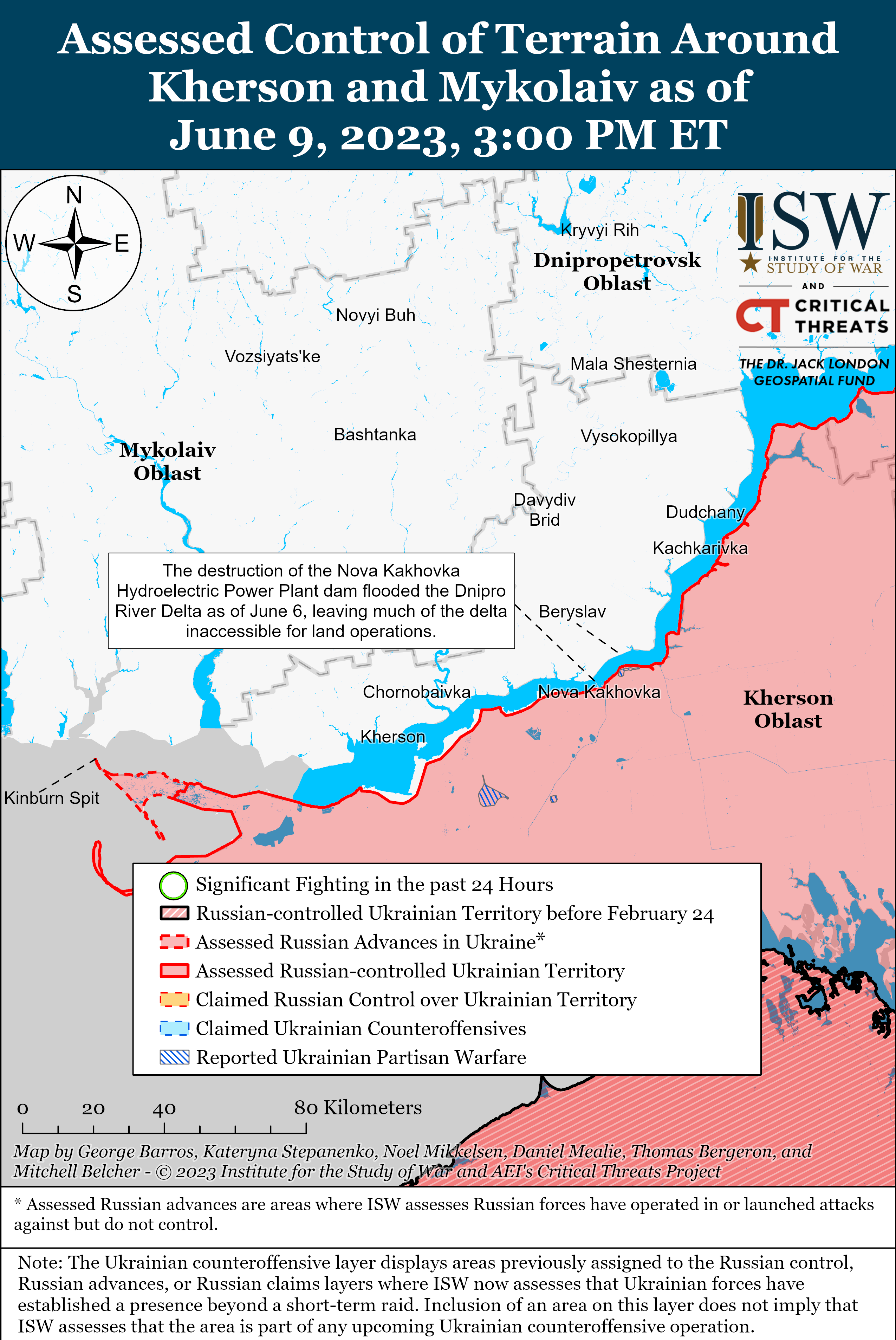
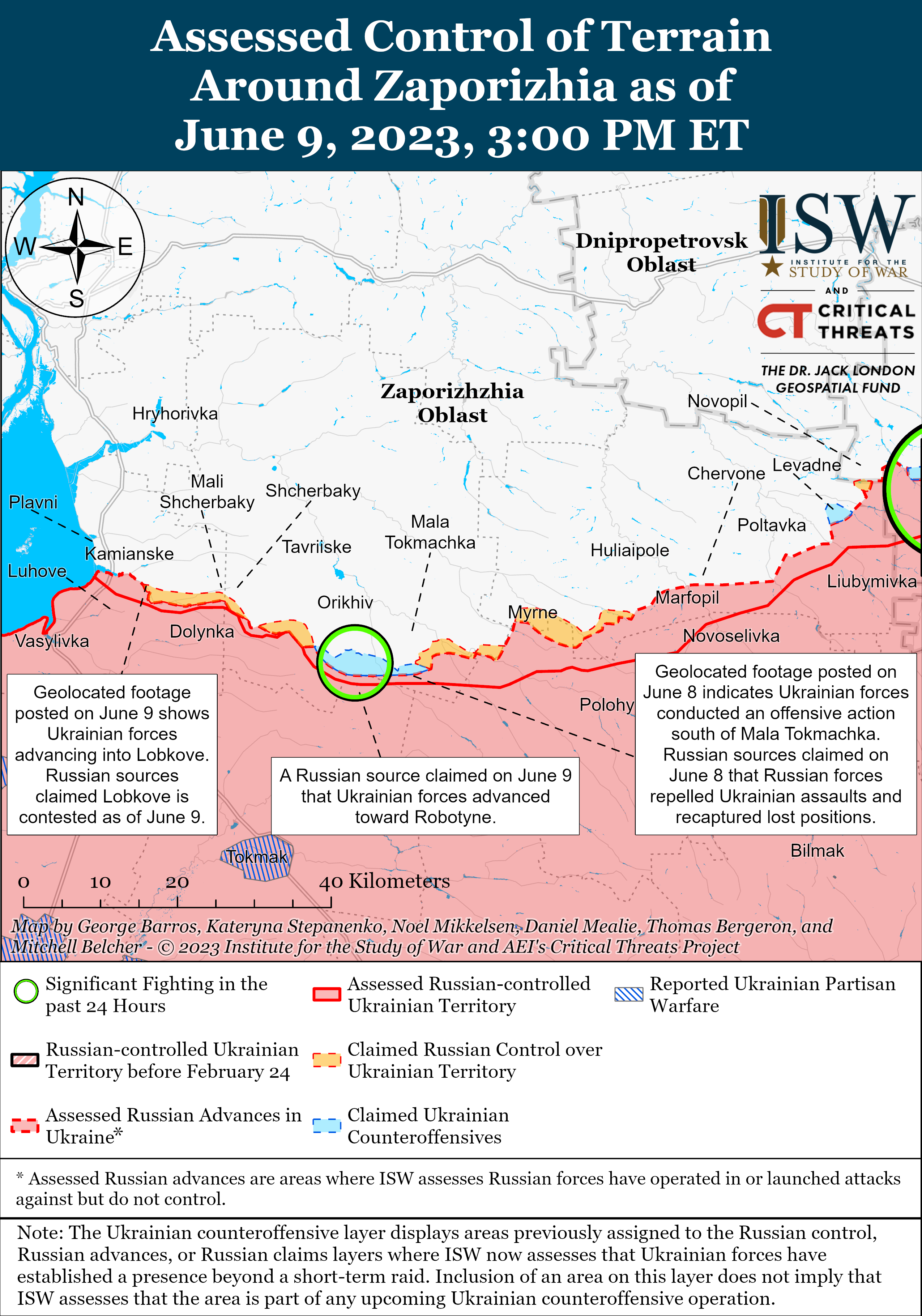
Maps on Assessed Control of Terrain in Ukraine and Main Russian Maneuver Axes

The Critical Threats Project and the Institute for the Study of War are publishing a summary of the methodology of our map for those who would like to learn more about the tradecraft for mapping conventional military operations from the open source.

Previous versions of these static maps are available in our past publications.  

Recent Updates


Russian Offensive Campaign Assessment, June 9, 2023

Ukrainian forces continued counteroffensive operations in least four areas of the front on June 9. The Russian Ministry of Defense (MoD) claimed that Russian forces repelled limited and localized Ukrainian ground attacks in the Kreminna area.[1] Ukrainian officials stated on June 9 that Ukrainian forces advanced 1.2 kilometers in continued offensive operations near Bakhmut on June 8.[2] Ukrainian forces continued limited counteroffensive operations in western Donetsk Oblast near the Donetsk-Zaporizhia Oblast border on June 9, and made tactical gains in the area.[3] Ukrainian forces also continued ground attacks in western Zaporizhia Oblast overnight from June 8 to 9 and during the day on June 9, and a Russian source suggested that Ukrainian forces made incremental gains during the attacks.[4]

Russian President Vladimir Putin acknowledged on June 9 that the Ukrainian counteroffensive recently began and noted that Ukrainian forces still have offensive potential, a departure from previous Kremlin efforts to downplay Ukrainian counteroffensives.[5] Putin stated that fighting has been ongoing for five days and claimed that Ukrainian forces “did not reach their aims in any area of combat” after committing “strategic reserves.”[6] Putin claimed that Ukrainian forces suffered significant losses and attributed Russian successes to superior Russian military equipment and personnel. Putin added that the Russian military command is “realistically” assessing the current situation and “will proceed from these realities.” Putin’s discussion of the Ukrainian counteroffensive is a notable departure from his previous distanced approach to discussing battlefield realities and may indicate that the Kremlin is learning from its previous failed approach to rhetorically downplay successful Ukrainian counteroffensives in 2022. ISW previously reported on May 2 that the Kremlin reportedly adopted a new information policy directing officials to not downplay the prospects of a Ukrainian counteroffensive and focus on the Russian fight against Western-provided weapon systems.[7]

Contrarily, much of the Russian information space prematurely claimed that the Ukrainian counteroffensive has failed after Russian forces damaged more Western-provided Ukrainian military equipment on June 9. Battlefield footage shows damaged or destroyed Western-provided infantry fighting vehicles and tanks in western Zaporizhia Oblast, though the number of Ukrainian vehicles several Russian sources claimed Russian forces destroyed are highly inflated.[8] Ukrainian forces previously lost military equipment in the same location on June 8.[9] Some prominent Russian ultranationalists claimed that damaged or destroyed Western-provided equipment indicated that Ukrainian forces failed to launch a large-scale counteroffensive.[10] Russian nationalists are widely celebrating the 58th Combined Arms Army (Southern Military District), despite Russian forces only executing basic defensive operations that should not be so unusual as to deserve wide praise. One Kremlin-affiliated milblogger claimed that Ukrainian offensive activity is in the decline, while a retired Russian general expressed gratitude to elements of the Russian 58th Combined Arms Army and proclaimed these elements as heroes despite battles continuing along different frontlines.[11] Another Russian milblogger claimed that a counteroffensive can only last up to 10 to 15 days, implying that Ukrainian counteroffensive will soon culminate.[12] However, other ultranationalists warned that Ukrainian forces have not yet carried out the main offensive and noted that Russian forces are reinforcing the second echelon in anticipation of Ukrainian breakthroughs.[13] A Wagner-affiliated milblogger condemned the excessive enthusiasm around the destruction of Ukrainian military equipment, noting that Western kit is not “some kind of magic.”[14] Many Russian ultranationalists appear to be overcorrecting for their previous fears of the Ukrainian counteroffensive.[15]

Ukrainian officials directly acknowledged that Ukrainian forces expect to suffer equipment losses during counteroffensive operations. Ukrainian Deputy Defense Minister Hanna Malyar stated on June 9 that losses are expected during combat operations and that “military equipment that cannot be destroyed” has yet to be invented.[16] Malyar added that Russian sources are heavily amplifying footage of Ukrainian equipment losses for informational effects.[17] The Economist reported that Ukrainian forces are using critical Western equipment in areas of the frontline where Ukrainian forces have recently suffered equipment losses.[18] ISW previously assessed that Ukrainian forces appear to have committed only a portion of their available reserves for current counteroffensive operations, and that the existing reports of damaged Western-provided equipment are not a definitive measure of current Ukrainian combat power.[19] Available footage of Ukrainian equipment losses additionally indicates that many of these armored vehicles have been rendered immobile, but not outright destroyed, and are likely recoverable by Ukrainian forces.[20] The footage also suggests that the Ukrainian crews of these armored vehicles, who are far more valuable than the vehicles themselves and can remount new or repaired vehicles, likely survived and withdrew once the vehicles became immobilized.[21]

The Russian command structure responsible for areas of southern Ukraine is unclear and likely overlapping. The Russian Ministry of Defense (MoD) published a video statement on June 8 from the commander of the Russian grouping in the Zaporizhia operational direction, Colonel General Alexander Romanchuk, wherein he reported details about Ukrainian assaults in southern Ukraine.[22] Romanchuk is reportedly the Deputy Commander of the Southern Military District (SMD), although his level of responsibility for southern Ukraine remains unclear.[23] A Russian colonel previously claimed that Russian Airborne Forces (VDV) commander Colonel General Mikhail Teplinksy also played a decisive role in commanding Russian forces that repelled recent Ukrainian assaults in southern Ukraine.[24] Teplinsky is rumored to be deputy theater commander and responsible for the Zaporizhia, Kherson, and southern Donetsk operational directions.[25] It is unclear if Romanchuk would report to Teplinsky or SMD Commander Colonel General Sergey Kuzovlev. The Russian MoD also claimed that overall theater commander and Chief of the Russian General Staff Army General Valery Gerasimov took command of Russian operations in southern Ukraine on June 5.[26] The command relations between these four officers — Romanchuk, Teplinsky, Kuzovlev, and Gerasimov — who have all been described as primarily responsible for Russian forces in this area are unclear.

Russian forces carried out missile and drone strikes across Ukraine on the night of June 8 to 9. The Ukrainian General Staff reported that Russian forces launched 16 Shahed-131/136 drones and six Kh-101/55 cruise missiles fired from two Tu-95 aircraft over the Caspian Sea and that Ukrainian air defenses shot down 10 Shahed drones and four Kh-101/55 missiles.[27] The Ukrainian General Staff also reported that Russian forces launched eight missile strikes against residential buildings in Zhytomyr Oblast.[28] Ukrainian Air Force Spokesperson Colonel Yuriy Ihnat reported that current Russian missile strikes aim to distract Ukrainian air defense systems, while Russian missile strikes in May mainly targeted Kyiv.[29]

Several independent sources reported additional evidence that an internal explosion likely destroyed the Kakhovka Hydroelectric Power Plant (KHPP) dam on June 6. Norwegian seismic monitoring center NORSAR reported that seismic data indicates that an explosion occurred on June 6 at 2:54am local time, about the same time as the collapse of the KHPP dam.[30] NORSAR seismologist Volker Oye stated that seismic data indicated a pulse of energy that was “typical of an explosion.”[31] Seismic data cannot locate the energy pulse of the explosion to a more exact location than within 20 to 30km of the KHPP, however.[32] Oye stated that it would be an “unusual coincidence” if something other than an explosion caused the energy pulse.[33] The New York Times reported that an unnamed senior White House official stated that US spy satellites equipped with infrared sensors detected an explosion at the KHPP dam before it collapsed.[34] The Wall Street Journal reported that multiple engineers and munition experts assessed that an explosive blast likely detonated at a specific point or multiple points of weakness, which destroyed the KHPP dam.[35] ISW previously reported that engineering and munitions experts that the New York Times interviewed believe that a deliberate explosion caused the KHPP dam’s collapse.[36] The preponderance of evidence suggests that a deliberate explosion damaged the KHPP dam. ISW continues to assess that the balance of evidence, reasoning, and rhetoric suggests that the Russians deliberately damaged the dam.[37]

The White House revealed on June 9 that Iran is helping Russia build a drone manufacturing factory in Yelabuga, Republic of Tatarstan, Russia, underscoring the growing military cooperation between Tehran and Moscow despite Western sanctions.[38] National Security Council spokesperson John Kirby stated on June 9 that the drone factory — which the Wall Street Journal reported in February 2023 could produce at least 6,000 Iranian Shahed-136 drones — could be operational by early 2024.[39] Kirby previously announced on May 15 that Russia is seeking to purchase new drones from Iran after expending most of its Iranian drone supply.[40] A factory producing Iranian drones in Russia would support Russia’s war effort against Ukraine. Russia could provide Iran with advanced military equipment that would modernize Iran’s air force, such as Su-35 fighter jets, attack helicopters, radars, and YAK-130 combat trainer aircraft, in return for helping construct the factory. Officials of an unspecified US ally previously stated that Iranian officials travelled to Yelabuga in January 2023 to discuss the construction of a new drone manufacturing facility in the city, reporting the same claim the facility could produce 6,000 or more drones in the coming years.[41]

Chief of the Russian General Staff Army General Valery Gerasimov discussed increasing Russian-Chinese military cooperation with Chinese Central Military Commission (CMC) Joint Staff Department Chief of Staff Liu Zhenli on June 9. Gerasimov emphasized the importance of joint military exercises within the framework of the Shanghai Cooperation Organization (SCO) and the Association of South East Asian Nations’ (ASEAN) Defense Ministers Meeting (SMOA Plus) format.[42] Gerasimov also claimed that Russian President Vladimir Putin and Chinese President Xi Jinping confirmed that Russian–Chinese strategic cooperation is at “the highest level.”[43]

Key Takeaways

  • Ukrainian forces continued counteroffensive operations in least four areas of the front on June 9, making further gains around Bakhmut and in Western Donetsk.
  • Russian President Vladimir Putin acknowledged on June 9 that the Ukrainian counteroffensive recently began and noted that Ukrainian forces still have offensive potential, a departure from previous Kremlin efforts to downplay Ukrainian counteroffensives.
  • Contrarily, much of the Russian information space prematurely claimed that the Ukrainian counteroffensive has failed after Russian forces damaged more Western-provided Ukrainian military equipment on June 9.
  • Ukrainian officials directly acknowledged that Ukrainian forces expect to suffer equipment losses during counteroffensive operations.
  • The Russian command structure responsible for areas of southern Ukraine is unclear and likely overlapping.
  • Russian forces carried out missile and drone strikes across Ukraine on the night of June 8 to 9.
  • Several independent sources reported additional evidence that an internal explosion likely destroyed the Kakhovka Hydroelectric Power Plant (KHPP) dam on June 6.
  • The White House revealed on June 9 that Iran is helping Russia build a drone manufacturing factory in Yelabuga, Republic of Tatarstan, Russia, underscoring the growing military cooperation between Tehran and Moscow despite Western sanctions.
  • Chief of the Russian General Staff Army General Valery Gerasimov discussed increasing Russian-Chinese military cooperation with Chinese Central Military Commission (CMC) Joint Staff Department Chief of Staff Liu Zhenli on June 9.
  • Russian and Ukrainian forces conducted limited and localized ground attacks south of Kreminna.
  • Russian forces continued ground attacks near Bakhmut and on the Avdiivka-Donetsk City line.
  • Ukrainian forces continued limited ground attacks on the administrative border between Donetsk and Zaporizhia oblasts and in western Zaporizhia Oblast.
  • Russia continues to evade international sanctions and has reportedly restored access to key Western microchips and electronics that Russia needs to produce military equipment.
  • A Ukrainian report states that Russian authorities may be preparing evacuations from northern Crimea.
  • Russian President Vladimir Putin announced on June 9 that Russia will begin deploying tactical nuclear weapons to Belarus in July 2023, and this is not an escalation from Putin’s prior nuclear weapons rhetoric.

CLASSIC ART MEMES Zara Zentira