Hanauer is an entrepreneur and a venture capitalist, the founder of the public-policy incubator Civic Ventures, and the host of the podcast Pitchfork Economics.
Like many of the virus’s hardest hit victims, the United States went into the COVID-19 pandemic wracked by preexisting conditions. A fraying public health infrastructure, inadequate medical supplies, an employer-based health insurance system perversely unsuited to the moment—these and other afflictions are surely contributing to the death toll. But in addressing the causes and consequences of this pandemic—and its cruelly uneven impact—the elephant in the room is extreme income inequality.
How big is this elephant? A staggering $50 trillion. That is how much the upward redistribution of income has cost American workers over the past several decades.
This is not some back-of-the-napkin approximation. According to a groundbreaking new working paper by Carter C. Price and Kathryn Edwards of the RAND Corporation, had the more equitable income distributions of the three decades following World War II (1945 through 1974) merely held steady, the aggregate annual income of Americans earning below the 90th percentile would have been $2.5 trillion higher in the year 2018 alone. That is an amount equal to nearly 12 percent of GDP—enough to more than double median income—enough to pay every single working American in the bottom nine deciles an
Google has broken ground on a new data center in the Mesa area of Phoenix, Arizona. Local press reports the search and cloud giant has begun work on the $1 billion project, previously known as “Redhawk.”
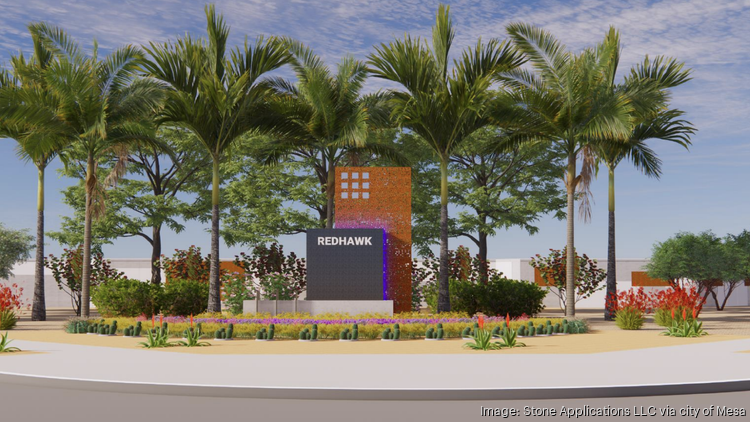
– Stone Applications via City of Mesa
The facility, which has been in the works since 2019, will span 750,000 square feet (70,000 sqm) once fully built out on 187 acres of farmland on the northwest corner of Elliot and Sossaman roads. The first 288,530 sq ft (26,805 sqm) phase is reportedly due live in July 2025, and set for full build-out across three phases by 2030.
In a statement, Google said data centers, including the one built in Mesa, will power the company's tools like Search, Gmail, Maps, and 'ongoing artificial intelligence innovation'.
“We are pleased to see Google making this tremendous investment in Mesa’s Elliot Road Technology Corridor as they break ground on their cutting-edge, air-cooled data center campus,” Mesa's economic development director Bill Jabjiniak told Business Journal.
“Mesa’s investment in critical infrastructure has made it possible for quality technology companies and advanced manufacturers to locate and thrive, strengthening Mesa’s economy by bringing high-paying jobs and substantial investments.”
Google previously applied for tax breaks for the project using the name 'Stone Applications, LLC'.
The company purchased the land in a 25-year government property lease excise tax (GPLET), agreement with with city of Mesa.
The company only filed its design plans with the city last month.
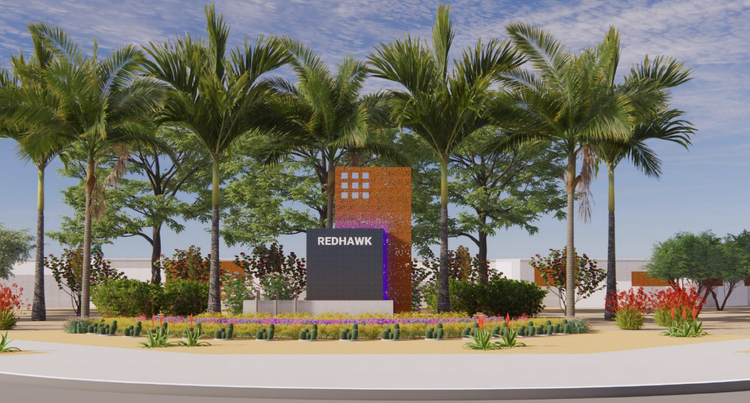
A conceptual rendering of the entry way to Google's $1 billion data center campus in Mesa. The project was referred to its code name "Red Hawk" throughout a recent meeting in the city of Mesa
STONE APPLICATIONS LLC VIA CITY OF MESA
By Ron Davis – Reporter , Phoenix Business Journal
Preview this article 4 min
A city of Mesa panel considered plans for the first phase of a Google data center planned on 185 acres in the city, and feedback will go directly to the city's planning director. Here's the first insight into what's coming.