Ukraine’s armed forces estimate 6,260 Russian deaths in the week of November 20-26, an average of almost 1,000 a day – the result of relentless Russian attacks in the east.
The latest loan brings the total in ‘emergency financing’ Kiev has been lent or promised tomore than $38 billion
Ukraine will receive a $1.2 billion loan from the World Bank which is being guaranteed by the government of Japan, the lender reported.
The money will be used to support 29 social aid programs for “the most vulnerable people in Ukraine” under a project to invest in Social Protection for Inclusion, Resilience, and Efficiency (INSPIRE).
The project is “an integral part of the international support package for Ukraine to meet its financing needs through 2024,” according to the World Bank.
With today’s announcement, the World Bank has now facilitated over $38 billion in emergency financing to support Ukraine, including commitments and pledges from lenders including: the US, Japan, the United Kingdom, Norway, the Netherlands, Spain, Germany, Canada, Switzerland, Sweden, Denmark, Austria, Finland, Iceland, Ireland, Indonesia, Lithuania, Latvia, Belgium and the Republic of Korea.
The money to be lent by the World Bank came in line with Kiev’s expectations.
Earlier in November, Ukrainian Prime Minister Denis Shmigal said it expected to obtain $1.1 billion from the World Bank.
He added that the country also hopes to get €162 million ($177 million) in financial support from the European Investment Bank as part of programs to restore Ukraine, while $190 million and $70 million would be allocated by Norway and Switzerland, respectively.
EU military aid for Ukraine had reached €27 billion euros (some $28.8 billion) since the beginning of the conflict and is constantly growing, marking a record high in the bloc's history.
Military assistance has included ammunition, air defense systems and tanks, Ukrinform news agency reported last month.
Earlier in November, in a bid to ease the mounting financial pressures confronted by Ukraine, President Vladimir Zelenskyy made an appeal to Western supporters for urgent financial help. Expressing his concerns regarding the nation’s economic stability, Zelenskyy stressed the need for immediate support to enhance the country’s financial resilience.
“If you can’t support us financially, please give us a loan and we’ll pay you back,” Zelensky said.
According to the World Bank, Ukraine's economy is likely to grow by 3.5% this year after contracting by 29.1% in 2022.
Ukraine's repeated calls for more money and weapons have only become louder and longer since the start of the conflict, with some voicing worries that the country’s supporters are getting tired of helping.
In October, billionaire Elon Musk who provided Ukraine with Starlink satellite services mocked Ukraine’s President Vladimir Zelensky, using a meme to scoff at the president’s calls for more Western aid. “When it’s been 5 min and you haven’t asked for a billion dollars in aid,”read Musk’s message.
Neither side is ready to give up, and neither can win in the medium term, but negotiations could come next year.
Ukraine has most recently asked for F-16 fighter planes, which some NATO members have agreed to supply, but it is doubtful these will be a stalemate-breaker either, say experts.
“Even if they get F-16s, they won’t be able to use them effectively because these planes need thousands of hours [of training] in flight to become operational,”Andreas Iliopoulos, a former deputy commander of the Hellenic Army, told Al Jazeera. “They won’t be effective until 2025.”
“I think all this is a Ukrainian effort to continue to claim Western help and stave off fatigue and the pressure to negotiate,” said Grivas.
Ukraine’s allies banned Russian oil, gold, diamonds, lumber and other lucrative exports to starve the Russian economy, but Russia sold its oil at discounted rates to China, India and other markets. Sanctions also attempted to stop the flow of capital and sensitive technologies to Russia. But Russia has been manufacturing weapons and buying artillery shells and drones from pariah states that share its hatred of the United States – Iran and North Korea.
Last August, Ukrainian intelligence estimated Russia had about 585 missiles of various types left, but planned to build more than 100 a month.
This month, the Ukrainian military said, Russia had stockpiled more than 800 missiles in Crimea alone and was preparing to fire them.
Time for negotiations? . . . . . . . . . . . . . . . . .
Japanese experimental nuclear fusion reactor inaugurated
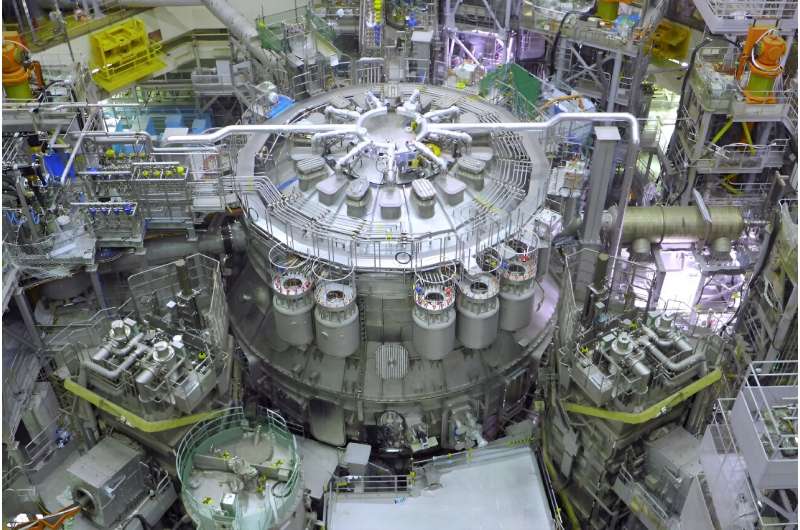
The world's biggest experimental nuclear fusion reactor in operation was inaugurated in Japan on Friday, a technology in its infancy but billed by some as the answer to humanity's future energy needs.
The world's biggest experimental nuclear fusion reactor in operation was inaugurated in Japan on Friday, a technology in its infancy but billed by some as the answer to humanity's future energy needs.
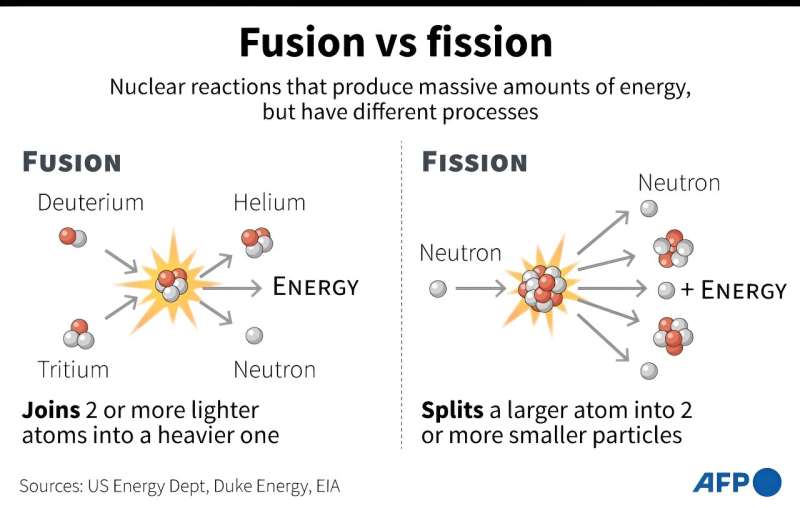
Fusion differs from fission, the technique currently used in nuclear power plants, by fusing two atomic nuclei instead of splitting one.
The goal of the JT-60SA reactor is to investigate the feasibility of fusion as a safe, large-scale and carbon-free source of net energy—with more energy generated than is put into producing it.
The six-story-high machine, in a hangar in Naka north of Tokyo, comprises a donut-shaped "tokamak" vessel set to contain swirling plasma heated up 200 million degrees Celsius (360 million degrees Fahrenheit).
It is a joint project between the European Union and Japan, and is the forerunner for its big brother in France, the under-construction International Thermonuclear Experimental Reactor (ITER).
The ultimate aim of both projects is to coax hydrogen nuclei inside to fuse into one heavier element, helium, releasing energy in the form of light and heat, and mimicking the process that takes place inside the Sun.
Researchers at ITER, which is over budget, behind schedule and facing major technical problems, hope to achieve nuclear fusion technology's holy grail, net energy.
Graphic comparing nuclear fusion vs fission, two physical processes that produce massive amounts of energy and yield millions of times more energy than other energy sources.
Sam Davis, deputy project leader for the JT-60SA, said the device will "bring us closer to fusion energy". "It's the result of a collaboration between more than 500 scientists and engineers and more than 70 companies throughout Europe and Japan," Davis said at Friday's inauguration. EU energy commissioner Kadri Simson said the JT-60SA was "the most advanced tokamak in the world", calling the start of operations "a milestone for fusion history". "Fusion has the potential to become a key component for energy mix in the second half of this century," Simson added. The feat of "net energy gain" was managed last December at the National Ignition Facility at Lawrence Livermore National Laboratory in the United States, home to the world's largest laser. The US facility uses a different method to ITER and the JT-60SA known as inertial confinement fusion, in which high-energy lasers are directed simultaneously into a thimble-sized cylinder containing hydrogen. The US government called the result a "landmark achievement" in the quest for a source of unlimited, clean power and an end to reliance on carbon-emitting fossil fuels that cause climate change as well as geopolitical upheaval. Unlike fission, fusion carries no risk of catastrophic nuclear accidents—like that seen in Fukushima in Japan in 2011—and produces far less radioactive waste than current power plants, its exponents say.
NOVEMBER 30, 2023
Discovery of planet too big for its sun throws off solar system formation models
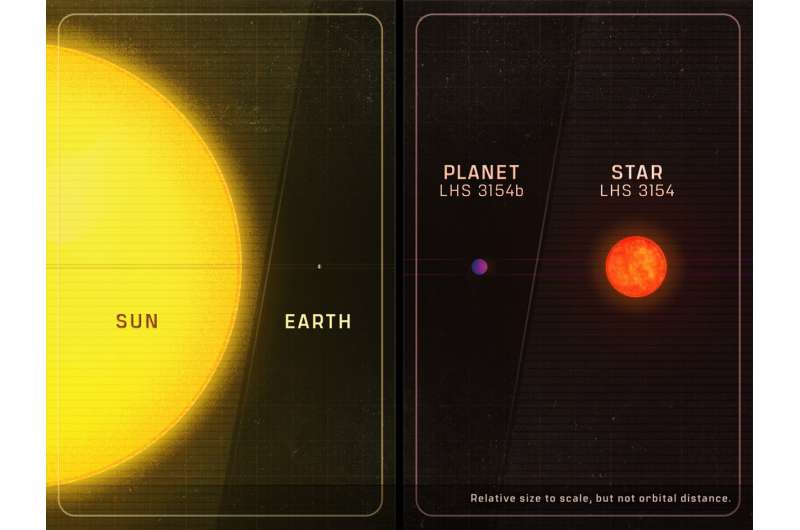
An artistic rendering of the mass comparison of LHS 3154 system and our own Earth and sun. Credit: Penn State University
The discovery of a planet that is far too massive for its sun is calling into question what was previously understood about the formation of planets and their solar systems, according to Penn State researchers.
In a paper published in the journal Science, researchers report the discovery of a planet more than 13 times as massive as Earth orbiting the "ultracool" star LHS 3154, which itself is nine times less massive than the sun. The mass ratio of the newly found planet with its host star is more than 100 times higher than that of Earth and the sun.
The finding reveals the most massive known planet in a close orbit around an ultracool dwarf star, the least massive and coldest stars in the universe. The discovery goes against what current theories would predict for planet formation around small stars and marks the first time a planet with such high mass has been spotted orbiting such a low-mass star.
"This discovery really drives home the point of just how little we know about the universe," said Suvrath Mahadevan, the Verne M. Willaman Professor of Astronomy and Astrophysics at Penn State and co-author on the paper. "We wouldn't expect a planet this heavy around such a low-mass star to exist."
He explained that stars are formed from large clouds of gas and dust. After the star is formed, the gas and dust remain as disks of material orbiting the newborn star, which can eventually develop into planets.
This video is an artistic representation of a newly discovered system, LHS 3154, which contains a planet far more massive for its sun than current models would predict. Credit: Abigail Hope Minnich
"The planet-forming disk around the low-mass star LHS 3154 is not expected to have enough solid mass to make this planet," Mahadevan said. "But it's out there, so now we need to reexamine our understanding of how planets and stars form."
The researchers spotted the oversized planet, named LHS 3154b, using an astronomical spectrograph built at Penn State by a team of scientists led by Mahadevan. The instrument, called the Habitable Zone Planet Finder or HPF, was designed to detect planets orbiting the coolest stars outside our solar system with the potential for having liquid water—a key ingredient for life—on their surfaces.
While such planets are very difficult to detect around stars like our sun, the low temperature of ultracool stars means that planets capable of having liquid water on their surface are much closer to their star relative to Earth and the sun. This shorter distance between these planets and their stars, combined with the low mass of the ultracool stars, results in a detectable signal announcing the presence of the planet, Mahadevan explained.
"Think about it like the star is a campfire. The more the fire cools down, the closer you'll need to get to that fire to stay warm," Mahadevan said. "The same is true for planets. If the star is colder, then a planet will need to be closer to that star if it is going to be warm enough to contain liquid water. If a planet has a close enough orbit to its ultracool star, we can detect it by seeing a very subtle change in the color of the star's spectra or light as it is tugged on by an orbiting planet."
Located at the Hobby-Eberly Telescope at the McDonald Observatory in Texas, the HPF provides some of the highest precision measurements to date of such infrared signals from nearby stars.
"Making the discovery with HPF was extra special, as it is a new instrument that we designed, developed and built from the ground-up for the purpose of looking at the uncharted planet population around the lowest mass stars," said Guðmundur Stefánsson, NASA Sagan Fellow in Astrophysics at Princeton University and lead author on the paper, who helped develop HPF and worked on the study as a graduate student at Penn State.
"Now we are reaping the rewards, learning new and unexpected aspects of this exciting population of planets orbiting some of the most nearby stars."
The instrument has already yielded critical information in the discovery and confirmation of new planets, Stefánsson explained, but the discovery of the planet LHS 3154b exceeded all expectations.
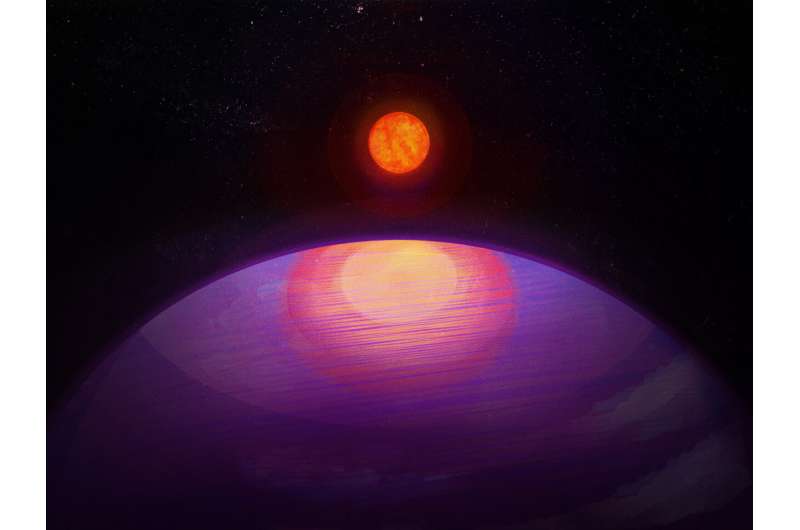
Artistic rendering of the possible view from LHS 3154b towards its low mass host star. Given its large mass, LHS 3154b probably has a Neptune-like composition. Credit: Penn State
"Based on current survey work with the HPF and other instruments, an object like the one we discovered is likely extremely rare, so detecting it has been really exciting," said Megan Delamer, astronomy graduate student at Penn State and co-author on the paper. "Our current theories of planet formation have trouble accounting for what we're seeing."
In the case of the massive planet discovered orbiting the star LHS 3154, the heavy planetary core inferred by the team's measurements would require a larger amount of solid material in the planet-forming disk than current models would predict, Delamer explained.
The finding also raises questions about prior understandings of the formation of stars, as the dust-mass and dust-to-gas ratio of the disk surrounding stars like LHS 3154—when they were young and newly formed—would need to be 10 times higher than what was observed in order to form a planet as massive as the one the team discovered.
"What we have discovered provides an extreme test case for all existing planet formation theories," Mahadevan said. "This is exactly what we built HPF to do, to discover how the most common stars in our galaxy form planets—and to find those planets."
Over the past decades, environmental scientists and engineers have been trying to devise effective solutions to reduce greenhouse gas emissions and mitigate the adverse effects of climate change. This has led to the creation ...
Commonly associated with longer days and slower paces, this summer's record-smashing heat in Arizona demonstrated a concerning future for the planet's warmest season. From power outages endangering entire neighborhoods and ...
University of California, Santa Cruz Professor of Planetary Sciences Francis Nimmo recently co-authored a Science Advances paper about the internal structure of the dwarf planet Eris.
Using the MeerKAT radio telescope, astronomers from the National Radio Astronomy Observatory (NRAO) in Charlottesville, Virginia, and elsewhere have investigated a batch of 36 high latitude supernova remnants. Results of ...
Born tail first, bottlenose dolphin calves emerge equipped with two slender rows of whiskers along their beak-like snouts—much like the touch-sensitive whiskers of seals. But the whiskers fall out soon after birth, leaving ...
Research led by the Karolinska Institutet, Sweden, has found an increased risk of cardiovascular disease associated with long-term ADHD medication use. Specific associations with different medications and dosages were connected ...
Parents should speak to their babies using sing-song speech, like nursery rhymes, as soon as possible, say researchers. That's because babies learn languages from rhythmic information, not phonetic information, in their first ...
Researchers at Tufts University and Harvard University's Wyss Institute have created tiny biological robots that they call Anthrobots from human tracheal cells that can move across a surface and have been found to encourage ...






 MEDICATIONS

 ROBOTICS