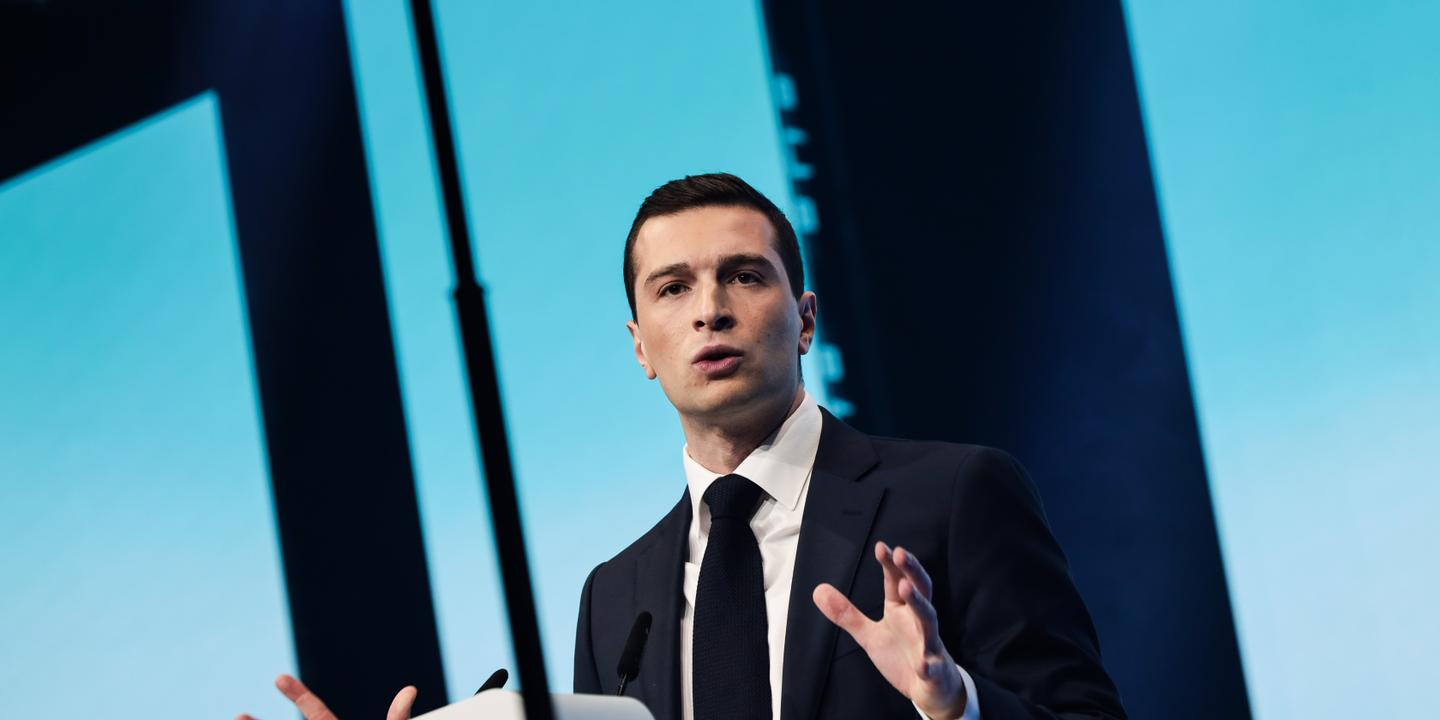
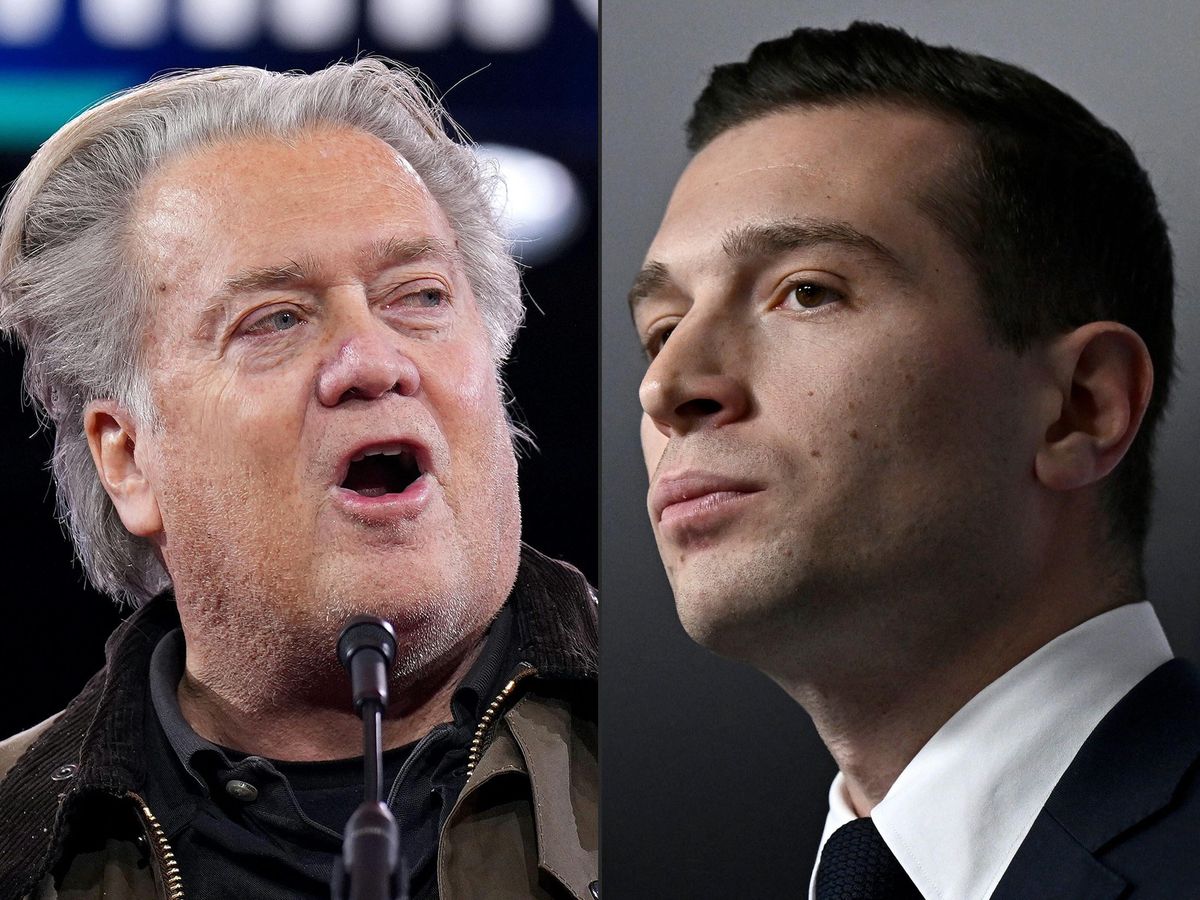
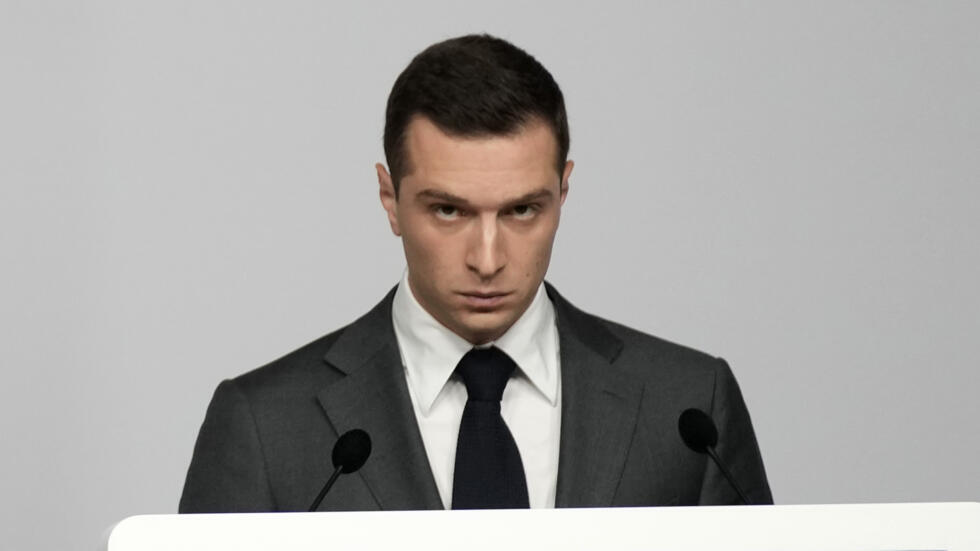
NATIONAL HARBOR, Md. — French far-right leader Jordan Bardella on
Friday canceled his planned remarks here at the Conservative Political
Action Conference after Steve Bannon, the former adviser to President
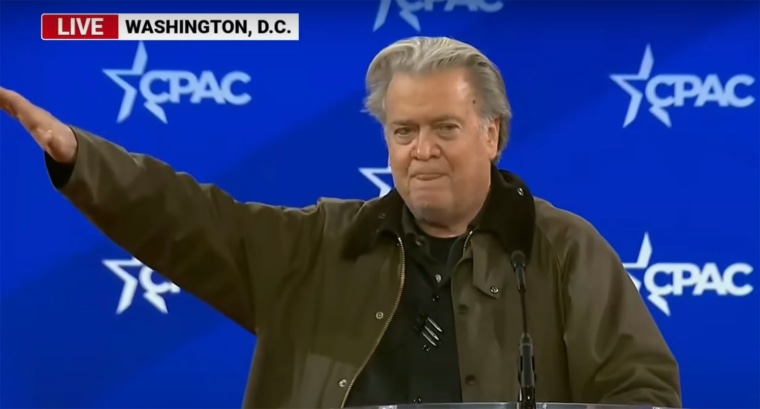
Donald Trump who is now a popular conservative podcast host, made a hand
gesture that some said appeared to be a Nazi salute.
"Yesterday,
while I was not present in the room, one of the speakers out of
provocation allowed himself a gesture alluding to Nazi ideology,"
Bardella said in a statement to French media outlets. "I therefore took the immediate decision to cancel my speech that had been scheduled this afternoon."
The
controversy comes a month after Elon Musk was accused of giving a Nazi
salute at one of Trump's inauguration events, further embroiling
conservatives in a debate about whether their leaders are intentionally
paying homage to the brutal regime responsible for the systemic murder
of millions of Jews in the 1940s.
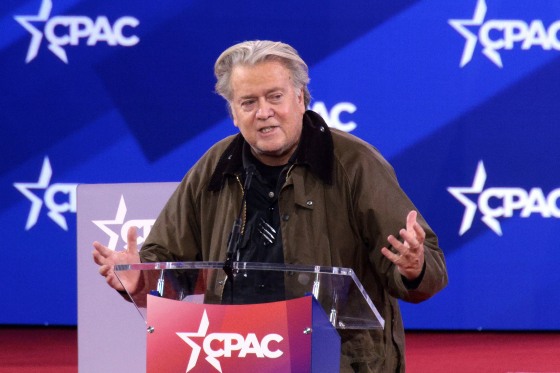
The Bannon incident occurred Thursday, as he spoke to the crowd of conservative activists.
"The
only way they win is if we retreat," Bannon said at the end of his
speech. "And we're not going to retreat.
We're not going to surrender.
We're not going to quit.
Fight, fight, fight!"
He then extended his right arm.
In an interview with NBC News on Thursday at the conference, Bannon denied that the gesture was a salute.
"I
do that all the time.
I wave to my crowd, because it's all about them,"
Bannon said, saying the controversy was a distraction from the
substance of his speech.
"The only thing it's
done is made the speech even bigger," he added.
"But the guy in France,
you need to be combat-hard.
He's just a p---y."
"MAGA will never support him. ... He's a pretty boy," Bannon added, referring to Bardella, president of France's far-right National Rally party.
"He's never going to be able to lead France if you're afraid by the mainstream media."
The National Rally did not respond to a request for comment.
At
the conference, the gesture drew a muted response from attendees. The
crowd registered no notable additional reaction to the gesture. Many
attendees in line for a meet-and-greet with Bannon on Friday had either
not watched his speech, or had seen it and thought calling it a salute
was incorrect framing or leftist-trolling.
Greg
Conte, a national socialist who attended the deadly 2017 Unite the
Right rally in Charlottesville, Virginia, said afterward in the
conference lobby that speakers like Musk and Bannon who have used the
gesture are virtue-signaling, calling the conference "zio-conservative"
and criticizing its support of Israel.
"Any 'Nazi salute' by Bannon, Musk or any other capitalist oligarch is stupid posturing," Conte said.
A far-right French leader canceled his CPAC appearance because of this gesture by Bannon.Youtube
In the face of President Trump's plans for Ukraine, leaders around the world are looking for ways to shore up their positions.
European leaders met in two emergency summits to discuss a unified response while ensuring their place at the table.
Britain's Prime Minister Keir Starmer calls this a "once-in-a-generation moment" for national security.
Trump's vision of owning Gaza also has world leaders on edge.
It was in this context that Christiane spoke with European Commission Vice President and former Estonian leader Kaja Kallas, and Jordanian Foreign Minister Ayman Safadi, onstage at the Munich Security Conference.
Throughout the entire production of It Ends With Us, a persistent and peculiar rumor circulated on the set.
According to this rumor, Justin Baldoni and It Ends With Us author Colleen Hoover shared a spiritual bond. Both were supposedly members of a small, obscure Iranian religious community known as Baha’i. It was this shared faith — or so the rumor went — that helped the 41-year-old director initially secure the rights to It Ends With Us.
None of that was true.
Justin Baldoni’s Leap of Faith
What
role did the controversial director's Baha'i religion play on the set
of 'It Ends With Us'? Did Wayfarer's missionary miscues help set the
stage for Hollywood's uncivil war?
For those who have been blissfully able to avoid the whole fracas, Blake Lively‘s December complaint with the California Civil Rights Department, which then became the basis of a lawsuit, was the opening salvo in this uncivil war.
In her lawsuit, she accused Baldoni and his partner Jamey Heath of all sorts of inappropriate behavior — including walking in on the actress while she was breastfeeding, using sexually charged language on-set and flouting industry-wide safety protocols — and then orchestrating a smear campaign against the actress for standing up to him.
Several additional lawsuits have since been filed, including two by Baldoni. He filed a $250 million libel lawsuit against The New York Times after it broke the news of Lively’s allegations, and then a second suit against Lively, her husband, Ryan Reynolds, and her publicist Leslie Sloane seeking $400 million in damages and accusing them of defamation and other contractual claims.
A judge has set a trial date of March 9, 2026.
From the outset, the Lively-versus-Baldoni feud has been framed as the
newest chapter in Hollywood’s ongoing fight for gender equality. It has
rekindled increasingly dormant debates about sexual harassment and power
dynamics. And that framing certainly could fit the facts — we’ll have
to see how it plays out in court.
But there’s also another possibility,
one that has less to do with gender equality than it does a simple
cultural misunderstanding.What if much of it — the alleged
inappropriate hugging and pre-filming praying — could be explained as a
clash between a very specific faith-driven community with its unique
mores, and a much more modern, post-#MeToo one with its own set of
beliefs and commandments?
Justin Baldoni and Blake Lively on the set of It Ends With Us on Jan. 12, 2024, in Jersey City, New Jersey.
Jose Perez/Bauer-Griffin/GC Images/Getty Images
Over the past several weeks, THR has interviewed multiple
friends and former colleagues of Baldoni, along with members of the
Baha’i community, to piece together if and how this religion might have
inadvertently contributed to the situation.
Baldoni — whose Irish
Catholic father and Ashkenazi mother both converted to the religion
before he was born and raised in California — has made no secret about
his devotion to the Baha’i faith, which is based on notions of humanity,
universalism and gender equality.
What’s also clear from talking to
people in his orbit is that Baldoni has his own unique way of
communicating and behaving, much of it informed by the tenor of his
religion. His unique mannerisms have at times come into conflict with
Hollywood’s current ethos, which in the wake of the #MeToo and Black
Lives Matter movements and the COVID pandemic has become far more rigid,
uniform and policed.. .
Because Baldoni wasn’t merely directing It Ends With Us but
also producing it through Wayfarer, the Baha’i faith was an even more
pronounced on-set presence during production.
On the first day of
filming, several members of the crew participated in a Baha’i prayer,
according to a source.
Other sources report that Baldoni frequently
would “ask God for guidance” before making big creative decisions on the
film.
Two more sources noted that there was an unusual amount of
physical contact in the form of hugging among crewmembers.
(“The faith’s
principles and ideas are interpreted and accepted in a variety of
cultural contexts,” says Heern.
“In France, followers might be more
inclined to hug. In Saudi Arabia, less so.”)
Writer Colleen Hoover, director Justin Baldoni, on set of It Ends With Us (2024).
Jojo Whilden/Sony Pictures Releasing/Courtesy Everett Collection
Lively’s suit does not explicitly mention Baha’i by name, but the
director’s religious affinities guided many decisions that had been made
on the set. According to her suit, Lively became “alarmed” when she
learned that Adam Mondschein, the unknown actor Baldoni had cast as the
doctor in an intimate scene in which Lively’s character gives birth, was
Baldoni’s “best friend.” Turns out Mondschein was more than that. He
was also a fellow Baha’i (whose biggest previous credit had been The Gate: Dawn of the Baha’i Faith).
In this sobering talk, Niall Ferguson warned of the dangers of the out-of-control public spending and debt in many parts of the Western world.
At a time when the West faces threats in the form of a new authoritarian axis, a 'Cold War II', and the looming risk of World War III, Western nations are trapped in a cycle of debt and declining productivity.





/2025/02/22/bannon-67b982bfb39a0552645898.png)