This
post originally appeared on The War Zone and was published October 8,
2019. This article is republished here with permission.
This Isn’t A Sci-Fi Prop, It’s A Doomsday Navigator For America’s Deadliest Cold War ICBM
The
Peacemaker missile’s navigation suite featured the most precise and
complex self-contained gyro system ever built. It had 19,000 individual
parts.
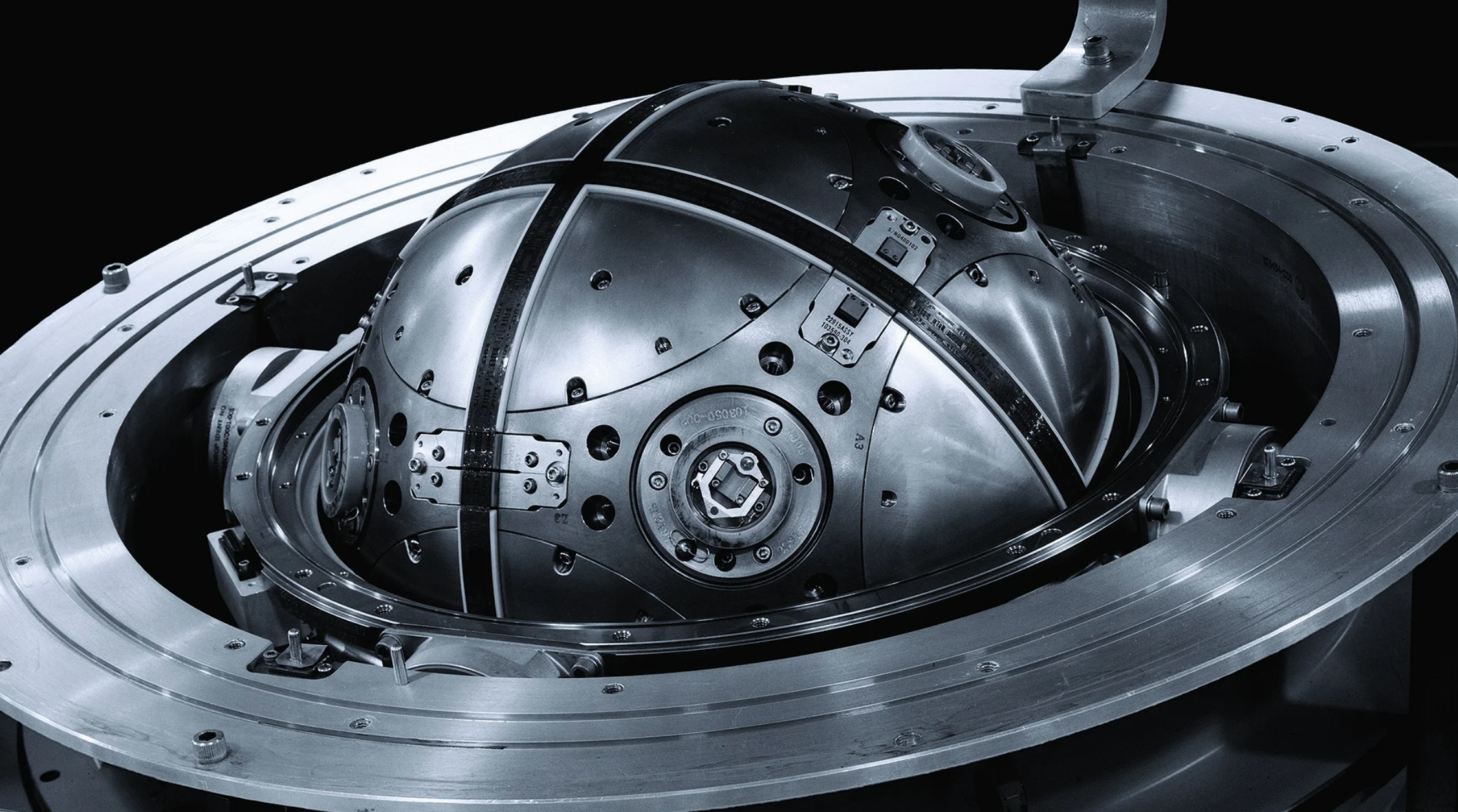
The subject in the striking image above
looks like the centerpiece prop in a high-end sci-fi flick, but it is
anything but. What you are looking at is the Advanced Inertial Reference
Sphere (AIRS) guidance system that was designed to be used as the
navigational heart of the highly-accurate LGM-118A Peacekeeper
intercontinental ballistic missile (ICBM), also known as the MX (Missile
Experimental). Peacekeeper represented the pinnacle of Cold War-era
American ICBM technology, but it came at a very high price and with a
less than favorable developmental timeline. Even though it dwarfed its
Minuteman III stablemate, and it was advanced in many ways, AIRS was by
far the most exquisite piece of technology associated with the
MX/Peacemaker program. In fact, the system's existence was a major
factor in the Peacekeeper's reason for being.
The masterful image was taken by photographer and author Martin Miller
who had taken up the task of capturing Cold War weaponry in dramatic
fashion. The photo seen in its entirety below was featured in Miller's
book Weapons Of Mass Destruction: Specters Of The Nuclear Age.
In the book, Miller describes Peacekeeper's super INS of sorts as such:
The
inertial guidance module used by the Peacekeeper missile, technically
called an Advanced Inertial Reference Sphere (AIRS). The AIRS redefined
the concept of accuracy possible for ICBMs. Rather than being
gimbal-mounted, the sphere floats in a fluorocarbon fluid within an
outer shell. The gyroscopes and accelerometers are positioned within the
sphere as are the three hydraulic thrust valves and turbopump used to
maintain stable orientation of the sphere. The labor to assemble its
19,000 individual parts was enormous

Photo by AIRS, Martin Miller
So yeah, this thing was really
something. In fact, some would argue it was among the most incredible
pieces of technology that came out of the Cold War. . .
The idea that Peacekeeper just used AIRS alone to be
able to deliver up to a dozen nuclear warheads as far as some 9,000
miles from its launch point is a technological triumph that is far
larger than it is given credit for.

A modern ring-laser gyro system. , Honeywell
Even though the fact that AIRS was even
possible helped bring Peacekeeper into existence, it also hurt its
chances at wider deployment, among a number of other major factors. Even
though it was literally the heart of the missile's concept, its extreme
complexity meant that the "operational" missiles that were deployed
starting in 1986 didn't even have an INS installed. They were useless.
It wasn't till 1988 that the missiles began to be fitted with this
critical component. . ."
Hat tip to @atomicarchive
who inadvertently prompted this interesting little journey into the
Peacekeer's past. Also, I want to give a big thanks to Martin Miller for
allowing us to share his awesome image. Make sure to check out his
website linked here.
Contact the author: Tyler@thedrive.com