Coordination of Ukraine’s joint positions with all partners continues. . .
Presidents of Ukraine and the United States
Discussed the Meeting in Alaska in a Bilateral Format and Then Together
with European Leaders
16 August 2025 - 12:40
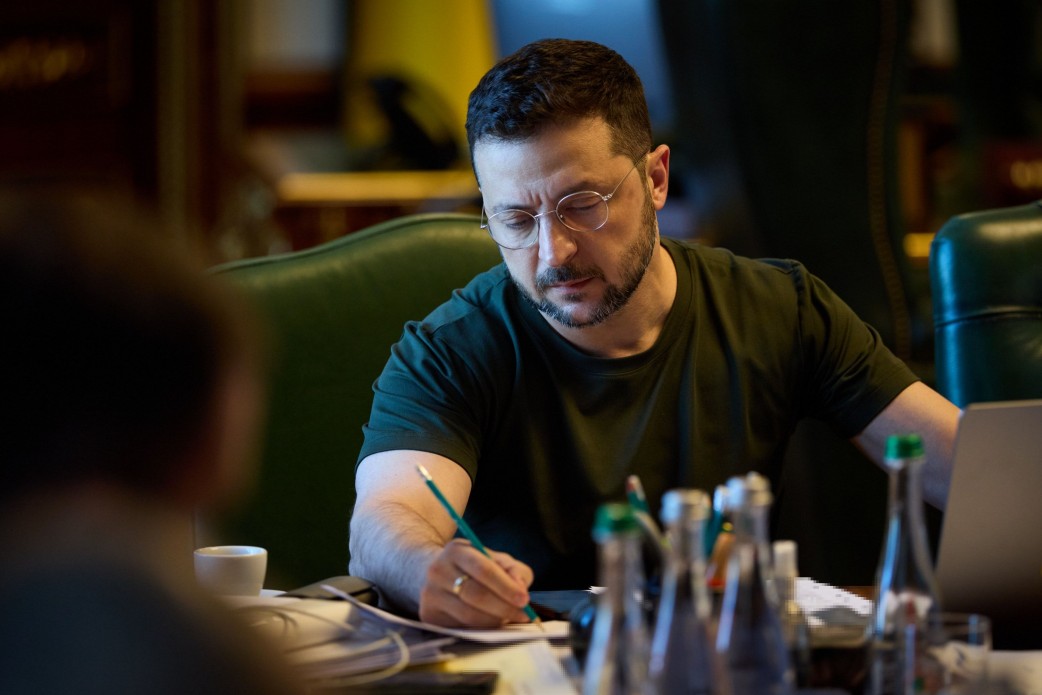
President
of Ukraine Volodymyr Zelenskyy held a phone call with President of the
United States of America Donald Trump.
The leaders first spoke in a
bilateral format for almost an hour, after which a conversation took
place that was joined by European leaders.
The participants of the conversation included:
U.S. Secretary of
State Marco Rubio,
U.S. Special Presidential Envoy Steve Witkoff,
President of France Emmanuel Macron,
President of Finland Alexander
Stubb,
Federal Chancellor of Germany Friedrich Merz,
Prime Minister of
the United Kingdom Keir Starmer,
President of the Council of Ministers
of Italy Giorgia Meloni,
President of Poland Karol Nawrocki,
President
of the European Commission Ursula von der Leyen,
President of the
European Council António Costa, and
NATO Secretary General Mark Rutte.
Volodymyr Zelenskyy emphasized that Ukraine is ready to work as productively as possible for the sake of genuine peace.

The U.S. President informed about his meeting with the Russian leader
in Alaska and the main points of their discussion.
The Head of State
noted that America’s strength has an impact on the development of the
situation.
Volodymyr Zelenskyy stressed that he supports Donald Trump’s proposal
for a trilateral meeting between Ukraine, the United States, and
Russia, since the most important and sensitive issues can only be
discussed at the level of leaders, and such a format is suitable for
this.
The Presidents of Ukraine and the United States agreed to discuss all
details more thoroughly during their meeting in Washington on Monday,
August 18.
Volodymyr Zelenskyy thanked Donald Trump for the invitation.
The Head of State noted that it is important that European partners,
together with the United States, be involved at every stage to ensure a
reliable security architecture for Ukraine.
Volodymyr Zelenskyy welcomed
the positive signals from the American side regarding participation in
these guarantees, which were also discussed during the conversation.
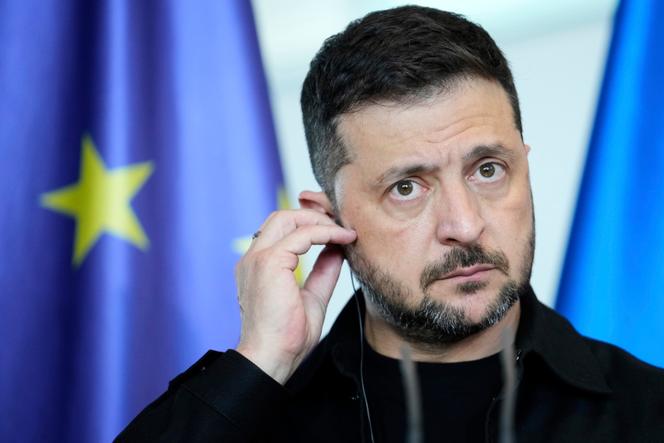
We have successes in extremely difficult areas near Dobropillia and Pokrovsk: Zelenskyy held a meeting of the Staff
Kyiv • UNN
• 14377 views
President Zelenskyy held a meeting of the Staff, where the situation at the front was discussed. The Armed Forces of Ukraine are
having success in the Dobropillia and Pokrovsk directions, destroying the occupiers.
Report by
Commander-in-Chief Oleksandr Syrskyi. Front, defense of positions,
current information on the intentions and movements of the Russian army.
We are defending our positions along the entire front line and for the
second day in a row we have successes in some extremely difficult areas
in Donetsk region – in the direction of Dobropillia and Pokrovsk
The
head of state separately noted units of the 1st Corps of the National
Guard of Ukraine "Azov", units of the 7th Corps of airborne assault
troops, units of the 38th Separate Marine Brigade named after Hetman
Petro Sahaidachny, as well as units of our 93rd Separate Mechanized
Brigade "Kholodnyi Yar".
The
destruction of the occupiers who tried to infiltrate our positions
continues. There is an important replenishment of the exchange fund for
Ukraine with Russian military personnel. The Commander-in-Chief also
reported on the actions of our units in Sumy, Kharkiv, and Zaporizhzhia
regions. I am grateful to all soldiers for their resilience
Addition
The President of Ukraine coordinated positions
with Trump and European leaders on achieving peace. Ukraine insists on
ending killings, releasing prisoners, and returning children.
Every week political cartoonists throughout the country and across the
political spectrum apply their ink-stained skills to capture the
foibles, memes, hypocrisies and other head-slapping events in the world
of politics. The fruits of these labors are hundreds of cartoons that
entertain and enrage readers of all political stripes. Here's an
offering of the best of this week's crop, picked fresh off the
Toonosphere.
Confocal microscopy image of a nine-day-old human
embryo. Specific proteins and cellular structures have been colored in
the image: OCT4 (green), which is related to embryonic stem cells; GATA6
(magenta), which is associated with early tissue formation; DAPI
(blue), which marks the DNA in the nuclei; and phalloidin (red), which
reveals the actin cytoskeleton. The scale bar corresponds to 100 µm.
Credit: Institute for Bioengineering of Catalonia (IBEC)
Researchers at the Institute for Bioengineering of Catalonia
(IBEC) in collaboration with the Dexeus University Hospital have
captured unparalleled images of a human embryo implanting. This is the
first time that the process has been recorded in real time and in 3D.
The work is published in the journal Science Advances.
Failure of the implantation process in the uterus is one of the main
causes of infertility, accounting for 60% of spontaneous abortions.
Until now, it had not been possible to observe this process in humans in
real time, and the limited available information came from still images
taken at specific moments during the process.
"We have observed that human embryos burrow into the uterus, exerting
considerable force during the process. These forces are necessary
because the embryos must be able to invade the uterine tissue, becoming
completely integrated with it. It is a surprisingly invasive process.
Although it is known that many women experience abdominal pain
and slight bleeding during implantation, the process itself had never
been observed before," explains Samuel Ojosnegros, principal
investigator of the IBEC's Bioengineering for Reproductive Health group
and leader of the study.
00:00
00:10
Video
of a human embryo. The first half shows the process of cell compaction
in the embryo. The second half shows the embryo invading the platform.
Credit: Institute for Bioengineering of Catalonia (IBEC)
To advance during implantation, the embryo releases enzymes
that break down the surrounding tissue. However, it is also known that
force is required in order to penetrate the underlying layers of the
uterus. This fibrous tissue is filled with collagen, a rigid protein that also forms tendons and cartilage.
"The embryo opens a path through this structure and begins to form
specialized tissues that connect to the mother's blood vessels in order
to feed," adds Ojosnegros.
The research team's results reveal that human embryos exert traction forces on their environment, remodeling it.
"We observe that the embryo pulls on the uterine matrix, moving and
reorganizing it. It also reacts to external force cues. We hypothesize
that contractions occurring in vivo may influence embryo implantation,"
explains Amélie Godeau, a researcher in the Ojosnegros group and
co-first author of the study. Thus, effective embryo invasion is
associated with optimal matrix displacement, highlighting the importance
of these forces in the implantation process.
Improving our understanding of the implantation process could have a significant impact on fertility rates, embryo quality and the time taken to conceive through assisted reproduction.
00:00
01:43
Credit: Institute for Bioengineering of Catalonia (IBEC)
A platform for studying implantation in the laboratory
To carry out the study, the IBEC research team developed a platform
that allows embryos to implant outside the uterus under controlled
conditions.
This enables real-time fluorescence imaging and analysis of the
embryo's mechanical interactions with its environment. The platform is
based on a gel composed of an artificial matrix formed by collagen,
which is abundant in uterine tissue, and various proteins necessary for
embryo development.
Experiments were carried out with both human and mouse embryos to
allow comparison of the two implantation processes. When the mouse
embryo comes into contact with the uterus, it exerts forces to adhere to
its surface.
The uterus
then adapts by folding around the embryo, enveloping it in a uterine
crypt. In contrast, the human embryo moves inward and penetrates the
uterine tissues completely. Once there, it begins to grow radially from
the inside out.
"Our platform has enabled us to quantify the dynamics of embryo
implantation and determine the mechanical footprint of the forces used
in this complex process in real time," concludes Anna Seriola, IBEC
researcher and co-first author of the study.
More information: Traction force and mechanosensitivity mediate species-specific implantation patterns in human and mouse embryos, Science Advances (2025). DOI: 10.1126/sciadv.adr5199