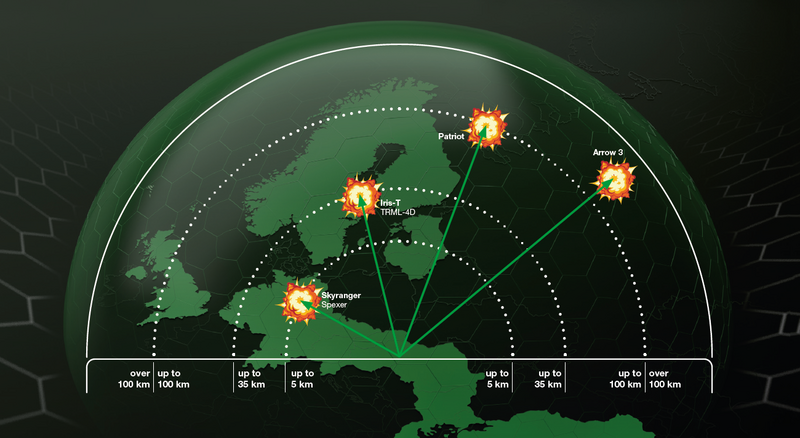
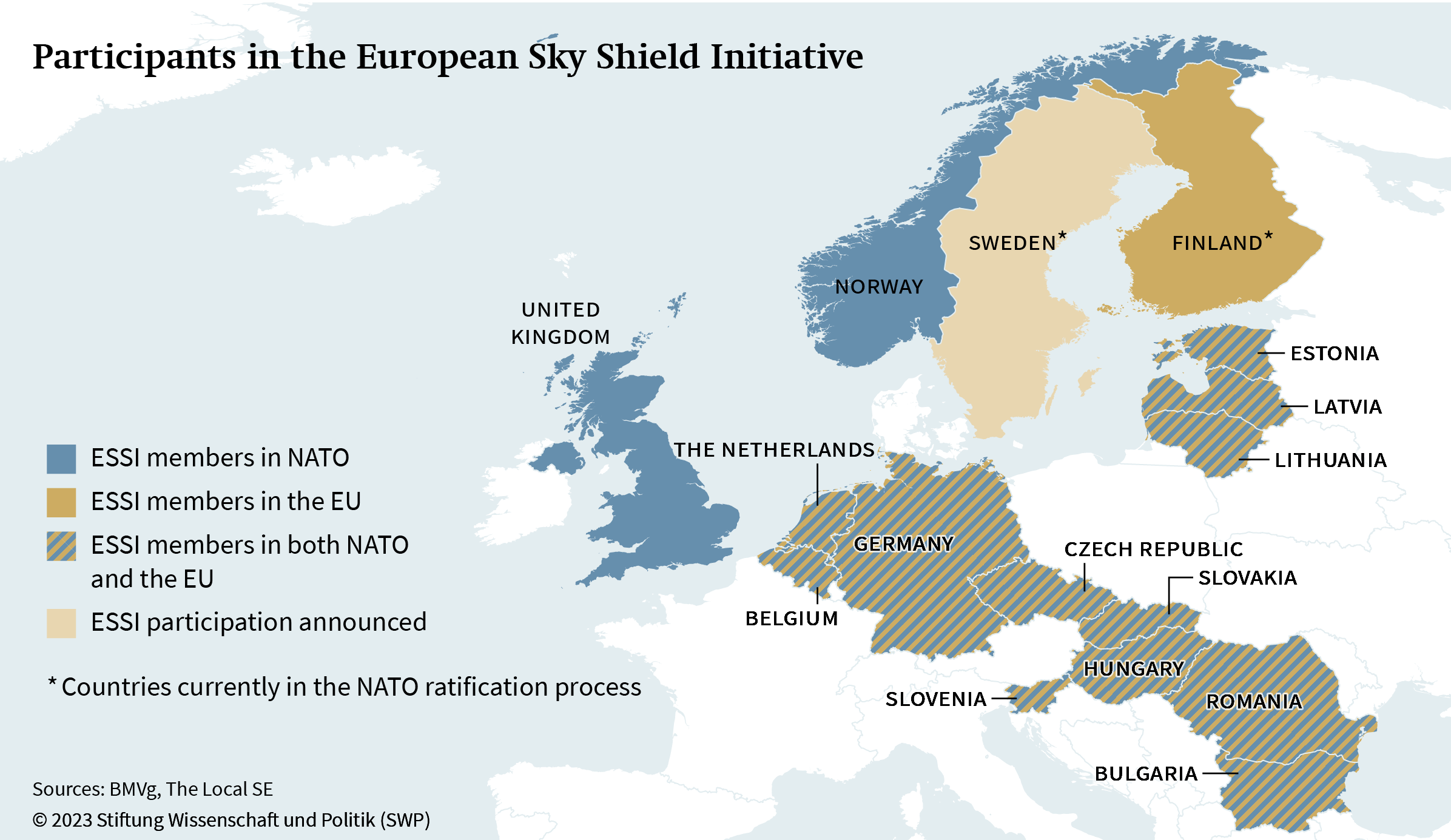
The European Sky Shield Initiative (ESSI) is a German-led multinational air defense program bringing together 21 nations to build a layered shield against Russian drones, cruise missiles, and ballistic threats.
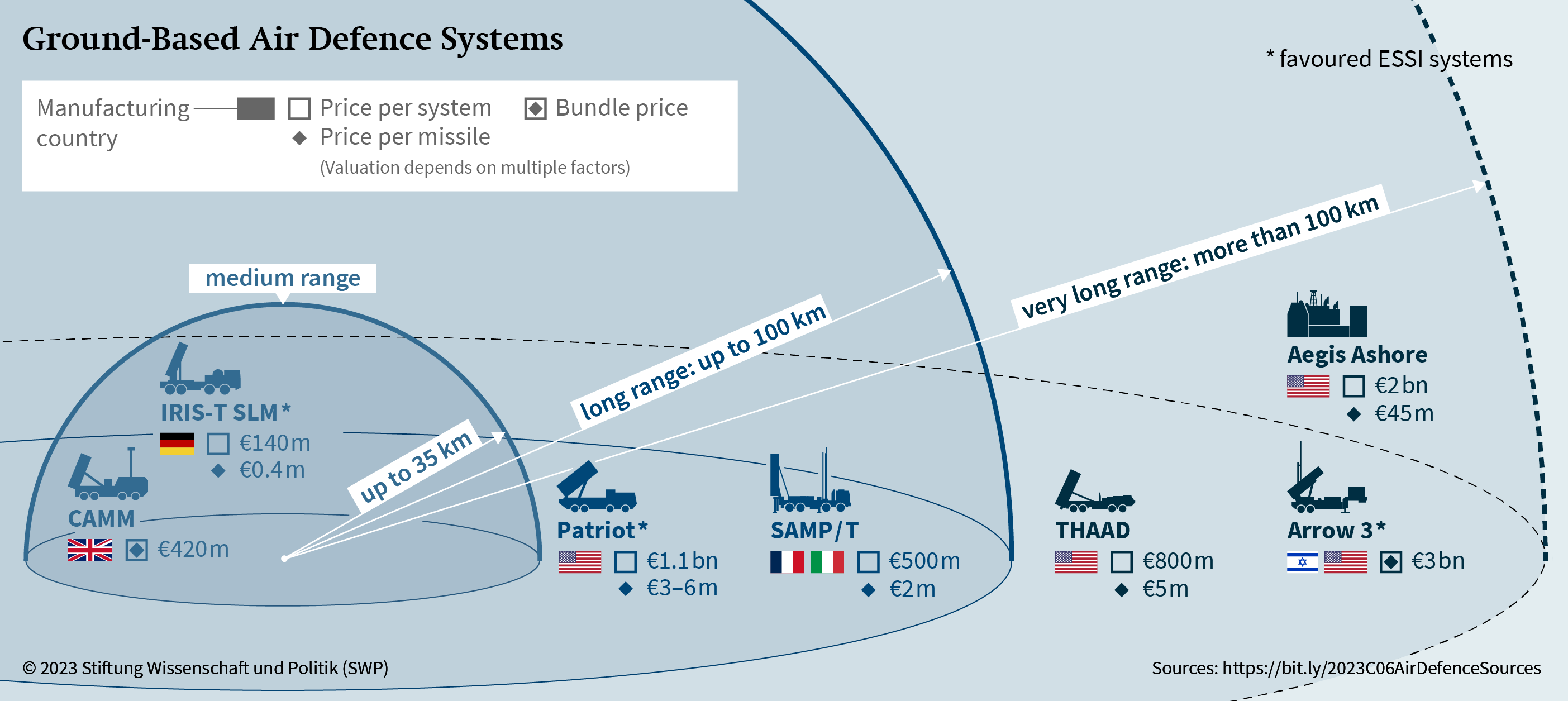
Combining Germany’s IRIS-T SLM, the U.S. Patriot PAC-3, and Israel’s Arrow-3 interceptors, Sky Shield aims to integrate short, medium, and long-range defenses into a unified NATO-controlled network, providing Europe’s most ambitious collective aerial protection since the Cold War. (Picture source: Editing Army Recognition Group)
Europe has not faced an aerial threat of this intensity since the Second World War. Russia’s sustained campaign of drone and missile strikes against Ukraine has transformed air defense from a niche procurement priority into the central organizing principle of European security.
With swarms of Iranian-designed Shahed drones pounding power stations, Kalibr and Kh-101 cruise missiles hitting cities, and ballistic Iskander missiles striking command centers, European leaders now see their own airspace as potentially vulnerable to the same saturation tactics. - Against this backdrop, the German-led European Sky Shield Initiative (ESSI) has emerged as the continent’s most ambitious defense project in decades — a multinational effort to construct a layered shield capable of countering Russia’s evolving aerial arsenal.
Responding to Russian Aerial Warfare
Russia’s aerial campaign over Ukraine has fundamentally shaped the urgency behind Sky Shield. Since February 2022, Moscow has launched an estimated 15,000 Shahed drones and over 7,000 missiles, forcing Ukraine into a permanent state of air defense readiness.
- The Ukrainian Air Force has repeatedly warned that no single system is sufficient to counter saturation attacks involving dozens of drones launched simultaneously.
European defense planners fear that NATO bases in Poland, Romania, or the Baltic states could face similar tactics in the event of escalation. A coordinated drone swarm targeting airfields or logistics hubs could overwhelm isolated national defenses.
- ESSI is designed precisely to prevent this — by linking national radars, sensors, and interceptors into a unified network, allowing multiple countries to share responsibility for intercepts and ensuring no critical gap remains open.
A senior NATO official described the logic succinctly: “Russia has taught us that aerial warfare is no longer about a handful of ballistic missiles. It is about mass, saturation, and persistence. Europe must be prepared for both the cheap drone and the expensive missile at the same time. That is the essence of Sky Shield.”
Political Ambition Meets Industrial Rivalry
Beyond the battlefield, Sky Shield is also a test of European political unity.
- Germany has positioned itself at the center of the initiative, reinforcing its role as Europe’s security guarantor.
- Yet not all allies are aligned.
- France has resisted the project, warning that it risks locking Europe into dependency on U.S. and Israeli suppliers. Paris instead promotes the SAMP/T NG system with Aster 30 Block 1NT interceptors, developed jointly by MBDA and Thales, as a homegrown European alternative.
- The SAMP/T offers a 120 km range and proven ballistic missile defense capability, already deployed by Italy and France.
- Poland has taken another path.
While supportive of NATO’s broader air defense goals, Warsaw prefers to prioritize national programs such as Wisła (Patriot-based) and Narew (CAMM missile-based), both designed to counter Russian threats specifically against Polish territory. This divergence underscores a fundamental challenge for ESSI: whether it will become a genuinely pan-European framework or remain a German-centered procurement club.
Procurement Timelines and Operational Hurdles
The effectiveness of Sky Shield will ultimately depend on timelines and interoperability. - Germany’s Arrow-3 contract is not expected to deliver operational batteries before 2029–2030, raising questions about whether the system will arrive too late to counter current threats.
- Patriots are already deployed in several European countries, but shortages of interceptors remain acute, as the U.S. production line struggles to keep pace with global demand.
- IRIS-T production is being accelerated, but Diehl Defence has only recently ramped up to full-scale manufacturing, with annual output still in the dozens rather than hundreds.
Another challenge lies in integration. ESSI envisions a command-and-control network where a radar in Finland could cue a missile launch from Germany or Italy, depending on the trajectory of a threat.
This level of interoperability requires significant upgrades to NATO’s Air Command and Control System (ACCS), as well as political agreements about who has authority to fire in a cross-border engagement scenario. Without these agreements, the Sky Shield risks becoming a collection of parallel national systems rather than a true shield.
The Stakes for Ukraine and NATO
For Ukraine, the Sky Shield carries both immediate and long-term implications. In the near term, Kyiv’s defense depends on bilateral deliveries of systems like IRIS-T, Patriot, and NASAMS. Germany has already supplied multiple IRIS-T batteries, which Ukrainian officials credit with saving thousands of lives by intercepting drones and missiles aimed at critical infrastructure. Expansion of European production lines under ESSI could increase the flow of systems to Ukraine over time, reinforcing Kyiv’s defense while simultaneously equipping NATO states.
For NATO, the initiative is a signal to Russia that escalation will not be met with disjointed national responses but with a coordinated continental shield. It is also a hedge against shifting U.S. politics. With Washington’s long-term commitment to European defense increasingly debated, Sky Shield demonstrates that Europe is preparing to assume more responsibility for its own skies.
Conclusion: Europe’s Defense Gamble
The European Sky Shield Initiative represents both Europe’s boldest gamble and its most urgent necessity. It is a gamble because it depends on unprecedented multinational integration, costly procurement programs, and political compromises that may prove difficult to sustain. It is a necessity because Russia’s war has made clear that the era of assuming uncontested European skies is over.
If successful, Sky Shield will not only provide protection against drones and missiles but also redefine Europe’s defense identity — a collective project on the scale of NATO’s Cold War integrated air defense system. If it falters, Europe risks repeating the fragmentation and duplication that have long plagued its defense efforts, leaving its airspace vulnerable in a time of heightened danger.
The choice is now clear. As one European defense minister told Army Recognition: “Every Shahed drone that strikes Kyiv today is a warning shot at Warsaw, Vilnius, and Berlin. Sky Shield is not about helping Ukraine alone. It is about making sure the next war does not reach us.”

Sep
15
China’s third aircraft carrier, Fujian, crossed the Taiwan Strait on September 12, 2025, according to Reuters. The People’s Liberation Army Navy described the passage as part of scheduled sea trials and technical testing. While Beijing downplayed the move, the symbolism of a carrier built with electromagnetic catapults transiting one of the world’s most sensitive waterways was not lost on regional observers.
Sep
15
Japan’s Ministry of Defense said on 12 September that it will send Air Self-Defense Force fighter jets to Europe and Canada for the first time. The mission is framed as a goodwill and training deployment. Four F-15J Eagles from Chitose Air Base will stage through North America before heading to the United Kingdom and Germany, then retrace their steps in early October. These are twin-engine, twin-tail air superiority fighters that form the backbone of Japan’s quick reaction alert.
Sep
15
On September 15, 2025, Rheinmetall announced its intention to acquire Naval Vessels Lürssen (NVL), marking a turning point in the company’s strategy to broaden its reach across all defence domains. As reported by Rheinmetall, the Düsseldorf-based group is preparing to integrate naval shipbuilding into its portfolio, a move that could reshape the German and European defence landscape.
Sep
15
According to information published by U.S. Pacific Fleet on September 14, 2025, the combined naval and defense forces of the Philippines, Japan, and the United States conducted a high-stakes Multilateral Maritime Cooperative Activity (MCA) inside the Philippines’ Exclusive Economic Zone (EEZ) from September 11 to 13, in a forceful demonstration of alliance resolve and rising maritime interoperability in the Indo-Pacific region.
Sep
15
On September 15, 2025, a development took place when Belarus welcomed U.S. military officers, alongside representatives from Türkiye and Hungary, to observe the ongoing Zapad-2025 joint exercises with Russia, as reported by Reuters. This unexpected move came against a backdrop of heightened regional tensions, particularly after Poland intercepted Russian drones that violated its airspace. By allowing U.S.
Sep
15
According to the Associated Press, Venezuelan authorities denounced an operation by the U.S. Navy that allegedly boarded a Venezuelan tuna boat with nine fishermen on board while it was sailing in the country’s territorial waters. The incident, reported Saturday by Foreign Minister Yván Gil, comes amid an already tense climate marked by the deployment of American naval forces in the Caribbean and increasingly confrontational rhetoric between Washington and Caracas.
Sep
15
According to the Australian Department of Defence, which announced the delivery in an official statement on 10 September 2025, the Royal Australian Navy has taken possession of the ninth Evolved Cape Class Patrol Boat, named ADV Cape Spencer. Built at Austal’s Henderson shipyard in Western Australia under Project SEA1445 Phase 1, this vessel represents another step in the ongoing program to strengthen Australia’s maritime patrol capability and secure its extensive borders.
Sep
15
According to Bloomberg on September 11, 2025, a U.S. Defense Department delegation, accompanied by Boeing executives, is expected in New Delhi next week to restart negotiations for roughly six additional P-8I maritime patrol aircraft valued at around 4 billion dollars. It puts a near-term clock on discussions that have drifted since India cleared the procurement in 2019, and it lands as Washington and New Delhi try to thaw a difficult stretch in their broader trade relationship.
Sep
15
On September 12, 2025, Belgium’s Council of Ministers approved the transfer of its four remaining Tripartite-class minehunters to Bulgaria at no purchase cost, with Sofia to fund restoration and modernization in Belgian industry. The decision fits a broader push to reinforce Black Sea mine countermeasures and to align replacement timelines as Belgium and the Netherlands field their next-generation rMCM (Replacement Mine CounterMeasure) fleet later this year.
Sep
15
Beretta Defence Technologies UK (BDT UK) has launched its Land Industrial Strategy for Project Grayburn, presenting a proposal to replace the British Armed Forces’ SA80 rifle. The announcement was made during the DSEI 2025 exhibition in London, where BDT UK set out not only the technical vision for a next-generation service rifle but also an industrial roadmap to revive domestic small arms production in Britain.
Sep
15
France has moved a small detachment of Rafale fighters to Poland following reports of drone incursions into Polish airspace earlier in the week. The announcement came from the French presidency on 12 September, and it reads like a straightforward security decision taken at speed. The context is familiar to anyone watching the eastern flank. Poland has tightened its air policing posture several times this year after suspicious cross-border activity and brief airport disruptions.
Sep
15
During the Defence and Security Equipment International (DSEI) exhibition in London, The Armored Group took the opportunity to present two new armored vehicle platforms: the BATT-S and the Terrier MLX. Both vehicles build on well-established product families, but they are introduced as fresh evolutions rather than simple upgrades.
Sep
15
On September 6, 2025, the 1st Parachute Hussar Regiment (1er Régiment de Hussards Parachutistes, 1er RHP) of the French Army announced through a video published on its official social media account that it had received its first Pegase light vehicles for special forces. The delivery“represents a new stage in the modernization of the 11th Parachute Brigade, a formation regularly deployed in crisis zones.
Sep
15
During DSEI UK 2025 in London, Barrett Firearms introduced to the international public its 30mm Squad Support Rifle System (SSRS), developed in cooperation with Mars Inc. and unveiled for the first time outside the United States. The weapon recently won the U.S. Army’s xTech Soldier Lethality Competition and secured USD 2 million in funding, confirming its relevance in the ongoing Precision Grenadier System (PGS) program.
Sep
15
On 10 September 2025, Poland intercepted and shot down several Russian drones that crossed into its airspace overnight while Moscow was striking targets in Ukraine. Polish officials called the incursions deliberate and requested an emergency meeting of the UN Security Council. NATO aircraft supported the response, which Polish leaders framed as a necessary act of air policing on allied territory. The deeper story is what those small, relatively cheap drones represent for Europe’s defenses.
Sep
15
According to information published by the U.S. 1st Marine Aircraft Wing on September 10, 2025, a squadron of U.S. Marine Corps F/A-18 Hornet fighter jets has begun arriving at Marine Corps Air Station (MCAS) Iwakuni, located southeast of Hiroshima, Japan, to replace a detachment of F-35B Lightning II stealth fighters.
Sep
15
Australia has announced an unprecedented investment of $8 billion to modernize and expand the Henderson shipyard near Perth, Western Australia, as reported by Reuters on September 13, 2025. This defense infrastructure program, part of the AUKUS security pact signed in 2021 with the United States and the United Kingdom, is designed to prepare the country for the arrival of nuclear-powered submarines in the next decade.
Sep
15
As reported by Kathimerini on September 12, 2025, Greece is reassessing the modernization of its fighter fleet as the negotiations with the United States regarding the upgrade of 38 F-16 Block 50s remain unresolved after nearly five years. The main concern in Athens is that the modernization, if completed by 2031 or 2032, could deliver a variant that is already outdated by the time it enters service.
Sep
15
At DSEI 2025 in London, Milrem Robotics has officially presented in Europe its new HAVOC 8×8 Robotic Combat Vehicle (RCV). The presentation follows the model’s first unveiling earlier this year at IDEX 2025 in Abu Dhabi. For the European debut, the HAVOC is displayed with Kongsberg’s PROTECTOR Medium Calibre Turret and a set of counter-UAS missiles from Frankenburg Technologies.
Sep
15
On 15 September 2025, Romania’s Ministry of Defence confirmed, through information first reported by the BBC, that one of its F-16 fighter jets tracked a Russian drone entering national airspace during a wave of strikes against Ukrainian infrastructure on the Danube River. It marks the second incursion into NATO territory in less than a week, after Poland said it had destroyed three drones violating its skies.
Sep
15
During DSEI UK 2025 in London, MBDA officially unveiled the SPEAR Glide, a new member of the SPEAR family of precision strike weapons designed to complement the existing turbojet-powered SPEAR. This variant emerges as a response to the growing need for affordable, mass-producible munitions that maintain effectiveness in contested environments.
Sep
15
On September 10, 2025, Ukraine’s Main Intelligence Directorate (HUR) reported that a domestically produced combat drone struck a Russian Project MPSV07 multipurpose salvage ship near Novorossiysk. According to the statement, the drone impacted the vessel in the area of the bridge, where navigation and communication equipment are located.
Sep
14
According to information published by the U.S. Air Force on September 10, 2025, American and Norwegian forces successfully tested next-generation precision maritime strike capabilities during a live-fire demonstration on September 3 in the Norwegian Sea. The event combined a U.S.
Sep
14
According to information published by the Australian Army, on September 4 and 5, 2025, the Australian Army conducted critical sea transportability trials in Townsville involving its newly acquired U.S.-built M1A2 SEPv3 Abrams main battle tanks and a suite of combat engineering vehicles.
Sep
13
The 40mm Cased Telescoped Armament System (CTAS), developed by CTA International, is rapidly redefining the role of medium-caliber weapons across manned and unmanned turret systems, offering unmatched flexibility for both land vehicles and naval platforms.
Sep
13
ST Engineering from Singapore presents its latest suite of integrated solutions at Defence Security and Equipment International (DSEI) 2025 in London, unveiling its new Light Reconnaissance Strike concept alongside the Sisu GTT articulated tracked carrier, a European-built variant of the battle-proven Bronco.
Sep
13
During DSEI 2025, a defense exhibition held in London, UK, Finnish defense communications specialist Bittium unveiled the full operational capability of its next-generation tactical communication systems, offering NATO and allied forces a battlefield-ready solution for digitalized, multi-domain operations.
Sep
13
According to information published by the Danish Ministry of Defense on September 12, 2025, Denmark has selected the Franco-Italian SAMP/T surface-to-air defense missile system as its new long-range air defense capability, beating out the United States-produced Patriot PAC-3 air defense system despite Washington’s recent approval of an $8.5 billion Foreign Military Sale package.
Sep
13
According to information released by NATO Allied Command Operations (ACO) on September 12, 2025, the Alliance has launched Eastern Sentry, a new multi-domain operation designed to reinforce NATO’s defensive posture along its Eastern flank. The decision follows repeated Russian drone incursions into Polish airspace on September 10, which led Warsaw to invoke Article 4 of the Washington Treaty and triggered urgent consultations among the Allies. Read full Defense News at this link ...
Sep
13
According to information published by the Secretary of the U.S. Air Force on September 11, 2025, and accompanied by an official image release by the U.S. Air Force, a second B-21 Raider test aircraft has successfully taken off from Palmdale, California, and flown to Edwards Air Force Base to join the U.S. Air Force’s structured flight test campaign.
Sep
13
A critical technological milestone in unmanned combat systems has been reached with the first-ever air launch of a Switchblade 600 loitering munition from a General Atomics MQ-9A Block 5 unmanned aerial system. Conducted between July 22 and 24 at the U.S. Army’s Yuma Proving Ground, the test validates a new operational capability that transforms the MQ-9A from a traditional remotely piloted strike asset into a networked, long-range launch platform for precision loitering weapons.
Sep
12
The US Air Force announced on September 11, 2025, that a second B-21 Raider test aircraft successfully conducted its first flight from Palmdale, California, before joining the test campaign at Edwards Air Force Base. This development expands the service’s ability to conduct more advanced testing after almost two years of trials with only one flying aircraft.
Sep
12
Sweden announced on September 11, 2025, its 20th support package to Ukraine, valued at approximately SEK 9.2 billion ($836 million). This package was presented by Defence Minister Pål Jonson and is structured to respond to operational requests made by Kyiv. The centerpiece of the new aid is the procurement of 18 newly built Archer 155 mm self-propelled howitzers along with 155 mm artillery ammunition, which will raise the total number of Archers available to the Ukrainian Armed Forces to 44.
Sep
12
According to H24 Info on September 10, 2025, Morocco is reported to be engaged in negotiations to acquire its first submarines, with French offers considered among the leading options. This development follows the confirmed order of ten Airbus H225M Caracal helicopters signed on September 1, 2025, which itself was part of a wider modernization drive across Morocco’s armed forces. Read full defense news at this link...
Read more...
Sep
12
On September 10, 2025, the US Defense Security Cooperation Agency (DSCA) announced a potential Foreign Military Sale to Finland of AIM-120D-3 Advanced Medium Range Air-to-Air Missiles (AMRAAMs) and related elements of support, valued at up to $1.07 billion. This step places Finland among the few European countries cleared to receive the most recent export-available AMRAAM variant, which has been progressively introduced to address obsolescence issues and meet new operational requirements.