

That would do away with the sale of scores of wildly popular THC products — as well as hundreds of thousands of jobs that make up a $28 billion industry, opponents of the provision said.
The timing is already fixed under Senate procedure. But there is extraneous language in this package that has nothing to do with reopening the government and would harm Kentucky’s hemp farmers and small businesses.”
A spokeswoman for Paul’s office noted, “Nothing has been slowed down or delayed. Not one minute.”

Some supporters of the hemp ban have claimed distributors may not be sufficiently verifying purchasers’ IDs. The White House, religious groups such as Catholic Vote, hardline conservatives and reps for the alcohol industry have also backed the hemp prohibition.
What do you think? Post a comment.
If enacted, the provision could swiftly eliminate up to 80% of revenue for hemp makers and destroy an up to $28 billion market for their products made possible by language included in Congress’ 2018 Farm Bill, according to industry insiders.
The economic fallout of as much as $1.5 billion in lost tax revenue would hit states such as Kentucky, Tennessee, North Carolina, Colorado and Oregon the hardest, said the industry reps, who have also expressed concern about the legislation giving a boost to foreign producers.

He and hemp industry insiders have blamed Sen. Mitch McConnell (R-Ky.) for the inclusion of the hemp ban after he advocated for closing a “loophole” in the 2018 Farm Bill that allowed for the unregulated sale of the products.
“I’m amenable to trying to get the bills through to get government back open,” Paul had told Hemp Industry & Farmers of America on an Oct. 28 phone call, according to audio obtained by The Post. “But I’ve also told them — and I think they believe me — that we can do this the easy way or the hard way.
“The easy way is I give my consent, and the hard way is I don’t,” he said. “And I’ve told them I’ll give my consent, but what we would like is for the bill this year to institute or call for a study of the issue done by the USDA, an 18-month study. We think they should study what’s going on in the states.”

". . .Paul, who supports regulation over prohibition, said in September 2024 that he hopes to protect the legalized hemp industry by preventing the federal government “from weighing down our farmers with unnecessary bureaucratic micromanaging.”
As many states have already implemented laws to regulate or ban consumable products containing hemp derivatives, many believe Paul’s pushback at the federal level has only delayed the inevitable. A finalized agriculture spending bill has yet to pass Congress.
“Congress never meant to legalize these products in the 2018 Farm Bill,” the 39 attorneys general wrote. “A proper interpretation of the farm bill’s hemp provision demonstrates that the entire synthetic THC industry rests on a foundation of illicit conduct. Clear direction from Congress is needed to shut down this industry before it metastasizes further into an even greater threat to public safety than it already is.”
While the bipartisan coalition said that the 2018 Farm Bill intended to provide an industrial hemp commodity for the fiber and grain markets, the legislation’s 0.3% delta-9 THC on a dry-weight basis definition established an inadvertent ambiguity that has allowed “bad actors” to exploit the American public with “dangerous drugs” through highly advanced chemical processes.
The attorneys general pointed to the often-used chemical process of converting nonintoxicating CBD from the hemp plant into intoxicating delta-8 THC. The letter writers also pointed to laboratory-created or altered compounds like delta-10 THC, THC-O, THCP and HHC, which are then infused “at high concentrations into a multitude of products that can intoxicate a person as severely as the most potent strains of cannabis sold on the illicit market.”
“In other words,” the attorneys general wrote, “industry actors have nefariously misinterpreted the farm bill’s legalization of low concentrations of hemp-derived delta-9 and the bill’s silence regarding hemp-derived THC products other than delta-9 to claim that the farm bill allows them to produce and sell various synthetic cannabinoids regardless of the chemicals’ potency and psychoactive effects.”
The attorneys general said these “Frankenstein THC” products play by their own set of rules – including age restrictions, labeling standards and testing requirements – and have led to “stark and severe” public health consequences.
Education
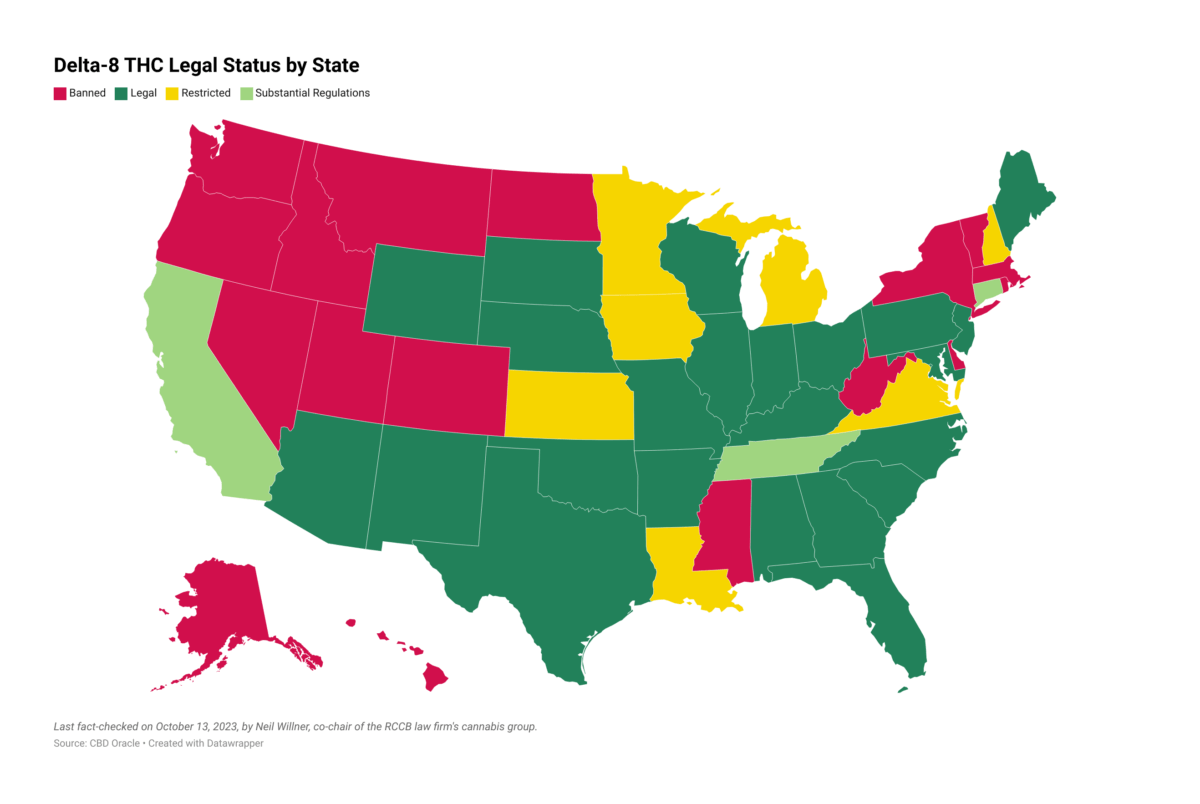
Member Blog: Where Is Delta-8 THC Legal and Where Is It Banned? CBD Oracle’s Map Has the Answers
By Brooke Gilbert
November 9, 2025
- But if you’re considering selling delta-8 THC, federal law is only a part of the picture, and at state level, you have a patchwork of different laws and regulatory schemes to contend with.
- This is why CBD Oracle, working alongside Neil Willner co-chair of the Cannabis Group at Royer Cooper Cohen Braunfeld, has produced a state-by-state map of delta-8 THC’s legality based on extensive reviews of state law.
- If you want to know what’s going on with delta-8 THC in a specific state, this is one of the best resources around to get the answer you’re looking for.
Delta-8 THC Is Legal in 22 States and 1 District With Limited Regulation
Despite the controversy surrounding delta-8 THC, it remains legal in 22 states and 1 district, with only limited regulation. This covers the following states:
- Alabama*
- Arizona
- Arkansas
- Florida*
- Georgia (?)
- Illinois
- Indiana (?)
- Kentucky*
- Maine
- Maryland* (?)
- Missouri
- Nebraska
- New Jersey
- New Mexico
- North Carolina
- Ohio
- Oklahoma
- Pennsylvania (?)
- South Carolina (?)
- Texas (?)
- Washington D.C.
- Wisconsin
- Wyoming*
Here, a * beside the state’s name means they’ve instituted age restrictions, preventing anybody aged 21 or under from buying delta-8 THC. States marked with (?) are currently involved in legal action about the status of delta-8 THC.
In the majority of these cases, state law basically follows the blueprint laid down by the 2018 Farm Bill with few or no additional rules. In fact, only a handful of states (Alabama, Florida, Kentucky, Maryland and Wyoming) have even passed laws preventing youth from buying delta-8 THC.
Legal actions are ongoing in several states, with the situation being slightly different in each. For instance, in Maryland, the hemp industry won a temporary injunction against the state, preventing the state from enforcing the provisions of House Bill (HB) 556 which relate to hemp until the action is resolved. The bill originally made it so that delta-8 THC products (and most CBD) could only be sold in licensed marijuana dispensaries, but this was deemed by the court to create a monopoly.
Delta-8 THC Is Banned in 17 States and Severely Restricted in 7 More
For every state where delta-8 THC is de facto legal, there is another state which has either banned or severely restricted the cannabinoid. In total, CBD Oracle’s analysis shows that delta-8 THC is banned in 17 states and severely restricted in 7 more. The states with bans are:
- Alaska
- Colorado
- Delaware
- Hawaii
- Idaho
- Massachusetts
- Mississippi
- Montana
- Nevada (technically could be approved for marijuana industry)
- New York (isomerization banned, could theoretically be sold in adult use)
- North Dakota
- Oregon
- Rhode Island
- Utah (possible in medical industry)
- Vermont
- Washington
- West Virginia
And there are severe restrictions – limiting all THCs to be under 0.3% for hemp products, unless otherwise noted – in the following seven states:
- Iowa
- Kansas
- Louisiana (all THCs must be under 8 mg per serving and 1% by dry weight)
- Michigan (all THCs under 0.3% and only marijuana-derived delta-8 allowed)
- Minnesota (all THCs under 0.3% and less than 5 mg per serving)
- New Hampshire
- Virginia (2 mg serving limit or >25:1 CBD:THC ratio)
Exactly how delta-8 THC is banned or restricted varies by state. For instance, while Colorado bans the “isomerization” process used to make delta-8 from CBD, Idaho basically bans anything that contains THC at all, even if it’s just CBD with trace, federally-acceptable levels of delta-9 THC. For the restricted states, most require that all THCs total to under 0.3% by dry weight, which is technically possible for a delta-8 THC product to meet, but essentially none do.
The analysis also revealed that – just like with marijuana – making delta-8 THC illegal doesn’t automatically remove it from a community. In Hawaii and Mississippi, for instance, despite state law banning delta-8 THC, it is still openly sold.
Only Three States Have Substantial Regulations on Delta-8 THC
In California, Connecticut and Tennessee, delta-8 THC is legal but has substantial regulations in place. In California and Connecticut, delta-8 THC is treated as marijuana and is sold as part of the adult use industry. This automatically institutes a wide range of requirements on the cannabinoid, including rules on testing and labeling to ensure safety and transparency for consumers.
Tennessee is the unique case here, where delta-8 THC is regulated as a “hemp-derived cannabinoid” and is legal to sell to adults aged 21 and over. Senate Bill (SB) 378 includes requirements for testing for contaminants, informative labeling and marketing which does not target youths, as well as a 25 mg serving size limit.
The Patchwork of Laws and the Future of Delta-8 THC
The key take-away for sellers of delta-8 THC is that current state regulations are a patchwork, making it very difficult to navigate for even the most responsible of companies. The product you can sell in Arizona without issues is probably not legal in Kansas, and would require batch testing and more to be sold in Tennessee.
This uncertainty may be resolved by the upcoming 2023 Farm Bill, but even this isn’t a sure thing. While the 2018 Farm Bill opened the door to a whole host of products and simply assumed (incorrectly) that the FDA would step up to regulate finished products, the new version might offer the clarity that was lacking. However, it’s just as likely that the bill will redefine “hemp” in a way that excludes delta-8 THC by default.
Pretty much the only thing you can
depend on is that you’ll need to keep a close eye on state laws in the
coming year. CBD Oracle’s map will be continuously revised to reflect
the current legal reality and help responsible hemp companies remain
compliant.
______________________________________________________________________________________
Lee Johnson
is the senior editor at CBD Oracle, and has been covering science,
vaping and cannabis for over a decade. He focuses on research-driven
deep dives into topics ranging from medical uses for CBD to industry and
user statistics, as well as general guides and explainers for
consumers.
CBD Oracle
is a cannabis consumer research company working to improve the safety
and transparency of cannabis and hemp products, which publishes in-depth
scientific, legal and consumer analyses on cannabis and cannabinoids.


- As of November 2025, there is no enacted federal THC ban that makes all THC products illegal; however, the U.S. Senate has passed legislation as part of a federal spending bill that would effectively ban nearly all intoxicating hemp-derived THC products (e.g., Delta-8 THC) by introducing new potency limits.
- The bill now heads to the House of Representatives for a vote.
- Marijuana-derived THC: Cannabis (marijuana) containing more than 0.3% Delta-9 THC by dry weight remains a Schedule I controlled substance under the Controlled Substances Act, making it federally illegal, despite many states legalizing it for medical and/or recreational use.
- Hemp-derived THC (Current Law): The 2018 Farm Bill federally legalized hemp, defined as cannabis with less than 0.3% Delta-9 THC by dry weight, which created a loophole allowing a booming, but unregulated, market for intoxicating hemp products like Delta-8 and Delta-10 THC.
- Outlaw "intoxicating" hemp products: It aims to stop the unregulated sale of products like Delta-8 THC in places like gas stations and online.
- Implement a stricter THC limit: Hemp products for human or animal consumption could have no more than 0.4 milligrams of total THC per container and no more than 0.3% total THC by dry weight.
- Restrict cannabinoid sources: Products could only contain cannabinoids naturally produced by the hemp plant, effectively banning synthetic or manufactured versions of THC.
- Potential Implementation: If passed by the House and signed into law, the ban would take effect one year later, likely in late 2026.
- Rescheduling Efforts: The Department of Justice (DOJ) has proposed moving marijuana from Schedule I to Schedule III of the Controlled Substances Act. This would recognize its accepted medical use but still keep it federally illegal (though with reduced penalties), and the process is ongoing.
- State vs. Federal Law: The federal government has generally not interfered with state-regulated cannabis programs, creating a patchwork of laws across the country.


