U.S. Central Command says American forces have conducted more than 6,000 combat sorties over Iran since Operation Epic Fury began at 01:15 on 28 February 2026 under presidential authorization. The campaign targets sites assessed to pose an immediate threat and has already struck roughly 6,000 locations across the country.
According to CENTCOM’s 12 March operational update, the strikes have also damaged or destroyed more than 90 Iranian naval vessels, including over 60 ships and more than 30 minelayers.
The operation represents one of the largest sustained U.S. air campaigns in the region in decades and appears focused on weakening Iran’s maritime capabilities and military infrastructure.
During the opening week of Operation Epic Fury, U.S. Army M142 High Mobility Artillery Rocket Systems (HIMARS) assigned to the 1st Battalion, 121st Field Artillery Regiment of the Wisconsin National Guard’s 157th Maneuver Enhancement Brigade conducted combat launches of ATACMS tactical ballistic missiles against Iranian military targets. The missiles were fired from positions in Kuwait, extending the U.S. Army's ground-based strike reach deep into Iranian territory. The operation highlights the increasing reliance on HIMARS as a precision deep-strike platform capable of engaging high-value infrastructure from standoff distances exceeding 300 kilometers. Defense officials indicate the strikes were part of a broader campaign targeting Iranian missile facilities and command nodes.
U.S. Army M142 HIMARS units from the Wisconsin National Guard launch ATACMS tactical ballistic missiles from Kuwait during Operation Epic Fury, striking Iranian military infrastructure and demonstrating the expanding role of U.S. ground-based long-range precision fires against hardened regional targets. (Picture source: U.S. CENTCOM)
The U.S aerospace company iRocket conducted a flight demonstration of the iRX-100 interceptor missile launched from an Arnold Defense 70mm rocket launcher, validating its compatibility with existing Hydra 70 launcher systems and flight performance. This Mach 2 missile is designed to intercept drones using existing Hydra 70 launcher infrastructure at up to one hundred times cheaper than large surface-to-air interceptors such as Patriot.
If the iRX-100 follows a similar production and propulsion model to Hydra 70-based weapons, such as the APKWS, one Patriot interceptor could represent the equivalent cost of roughly 100 to even up to 200 iRX-100 missiles. (Picture source: iRocket)
To
celebrate, people light bonfires, set off fireworks and send wish
lanterns floating off into the night sky. Others jump over and around
fires, chanting “My yellow is yours, your red is mine,” invoking the
replacement of ills with warmth and energy.
Authorities already
have sent threatening text messages to the public, urging them not to
take part in the festival, worried it could lead to renewed protests
against the theocracy as it faces likely the greatest challenge to its
survival since the 1979 Islamic Revolution.
Iran’s exiled Crown
Prince Reza Pahlavi, who had drawn people into the streets during
nationwide protests in January, issued a warning Monday saying Iranian
authorities “issued threats of deadly force to suppress these peaceful
celebrations and prevent the Iranian people from honoring their
heritage.”
He earlier urged demonstrations in front of Iranian embassies abroad on Tuesday.
50 min ago
Israel says it has killed the head of Iran’s Basij force
The Israeli military said Tuesday it killed Gen. Gholam Reza Soleimani in a strike on Monday.
Iran did not immediately acknowledge Soleimani’s killing.
The all-volunteer force of Iran’s Revolutionary Guard is used to suppress demonstrations in the country.
“The
Basij forces are part of the armed apparatus of the Iranian terror
regime,” the Israeli military said in its statement. “During internal
protests in Iran, particularly in recent periods as demonstrations
intensified, Basij forces under Soleimani’s command led the main
repression operations, employing severe violence, widespread arrests,
and the use of force against civilian demonstrators.”
The U.S.
Treasury listed Soleimani’s birth year as 1965. He has been sanctioned
by the U.S., the European Union and other nations over his role in
helping suppress dissent for years through the Basij.
“The Basij
organization used lethal force to suppress the November 2019 protests in
Iran, causing the deaths of and injuries to unarmed protesters and
other civilians in many cities across the country,” the EU said in
sanctioning him. “As head of the Basij organization, Gholamreza
Soleimani bears responsibility for the violent suppression of the
protests and serious human rights violations in Iran.”
Since the
war began Feb. 28, Israel has launched specific attacks targeting Iran’s
leadership, killing 86-year-old Supreme Leader Ayatollah Ali Khamenei
and other military commanders.
Killing Soleimani likely could
further strain the command and control of the Basij, which would be
crucial in putting down any uprising against the theocracy.
The Basij and other internal security forces have been a target of attack by both the Americans and the Israelis so far.
Iran and Iraq are holding talks about allowing transit of Iraq’s oil tankers through the Strait of Hormuz, Iraqi Oil Minister Hayan Abdul-Ghani said Tuesday.
The comments were carried by the country’s state-run Iraq News Agency.
The war and the virtual closure of the strait have severely impacted Iraq, where the economy depends overwhelmingly on oil.
The
news agency said Iraq’s oil production has been reduced to 1.2 million
barrels daily, down from 4.3 million barrels daily prior to the war.
12:57 AM MST
China says it is ‘in communication’ with US over Trump visit
China is communicating with the U.S. about issues
including a planned visit by President Donald Trump, a Chinese Foreign
Ministry spokesperson said Tuesday.
“China and the U.S. are in
communication on issues including the timing of President Trump’s visit
to China,” Lin Jian said in Beijing.
Trump on Monday said because of the war he proposed a delay to the trip, which was scheduled for late March to early April.
Lin added that U.S. officials clarified “the visit is unrelated to the issue of navigation in the Strait of Hormuz.”
Trump told the Financial Times that he would like to know before leaving for Beijing whether China would help secure the strait.
A
U.S. trade official on Monday walked back the statement, saying a
postponement would be unrelated to China’s help in the strait.
12:36 AM MST
Israel says it struck infrastructure in 3 Iranian cities
By ELEANOR H. REICH
The Israeli military says it conducted a “combined wave
of strikes” against infrastructure in Tehran, Shiraz and Tabriz on
Monday.
The military says the strikes in Tehran hit command centers, launch sites and air defense systems.
In Shiraz, the internal security forces’ command center and a ballistic missile site were hit.
In Tabriz, the strikes “dismantled” additional air defense systems, the military says.
12:11 AM MST
South Korea says 26 vessels stuck near Strait of Hormuz
South Korea says 26 of its vessels and 183 crewmembers remain in waters around the Strait of Hormuz.
Park
Il, spokesperson of South Korea’s Foreign Ministry, said Tuesday that
officials are in close contact with port authorities in nearby countries
to facilitate the provision of food and other supplies.
Park said they plan to take unspecified additional steps if the situation worsens.
South
Korea has been cautious about discussing support for U.S. efforts to
reopen the Strait of Hormuz after President Donald Trump urged several
governments, including Seoul, to deploy naval assets.
“The
government will maintain close communication with the U.S. side and
conduct a close and careful review of the issue, taking into account
various factors and the changing regional situation,” Park said.
12:03 AM MST
Iranian ambassador in Turkmenistan calls for US withdrawal
By ALEXANDER VERSHININ
Ali Mojtaba Rouzbehani, Iran’s ambassador in
Turkmenistan, says it will defend the Strait of Hormuz and called for
U.S. forces to withdraw.
“I have a proposal for Trump: if he wants
stability and passage through the Strait of Hormuz, he must ensure that
his military forces withdraw from the strait,” the ambassador said in
Ashgabat on Monday.
“The Strait of Hormuz is not currently closed.
But as a result of this aggression, no ships can pass through the
strait, and we will defend its stability and security,” he said.
The ambassador added that U.S. and Israeli forces “have other targets in the region.”
“They’ve
targeted water treatment plants, fuel storage facilities, and other
facilities. These ongoing threats must end,” he said.
11:41 PM MST
Iranian parliament speaker says Strait of Hormuz cannot be ‘as it was before’
The speaker of Iran’s parliament told Iranian state
television that the Strait of Hormuz cannot be “as it was before” as
Iranian fire keeps nearly all traffic out of the strategic waterway.
Mohammad
Bagher Qalibaf made the comment in an interview aired Tuesday as
Iranian fire continues to target shipping in the region.
“They are
flying, launching missiles, should we just sit back and do nothing in
response, or not? Naturally, it is our undeniable right. We must do
this,” Qalibaf said.
“Let me speak clearly, the Strait of Hormuz
has always been important, one of the world’s key strategic
chokepoints,” Qalibaf said. “But look at this strategic mistake by the
Americans and the Zionist regime, this trap they set, and the
recklessness they showed, has turned this potential into an active
reality. This is a high-risk opportunity.”
The strait typically sees 20% of all oil and natural gas traded pass through it.
Australian and New Zealand government ministers agree the Middle East war should end as quickly as possible.
Australian and New Zealand foreign and defense ministers met for annual talks Tuesday in Australia’s capital Canberra.
“We
discussed the escalating situation in the Middle East. We want this
crisis to end as quickly possible and move to a negotiated solution,”
New Zealand Foreign Minister Winston Peters told reporters at a joint
press conference after the meeting.
11:21 PM MST
Kuwait says 16 people arrested over Hezbollah links
Kuwaiti security forces arrested 16 people suspected to
have links with Hezbollah, a Lebanese militant group allied with Iran,
the state-run Kuwait News Agency reported.
The interior ministry
said in a statement late Monday that the 14 Kuwaiti and two Lebanese
suspects sought to “create chaos, and disrupt public order” during the
war, the agency reported.
The ministry did not identify the people arrested. It was not immediately clear if they had lawyers.
It
said authorities found firearms, ammunition, weapons for training and
assassinations and encrypted communication devices and drones.
The ministry said the suspects aimed to recruit others to join Hezbollah.
Kuwait has for years experienced attacks that authorities linked to Iran.
Saudi Arabia’s Defense Ministry says it has intercepted a
dozen drones on Tuesday morning over the country’s vast Eastern
Province, home to oil infrastructure.
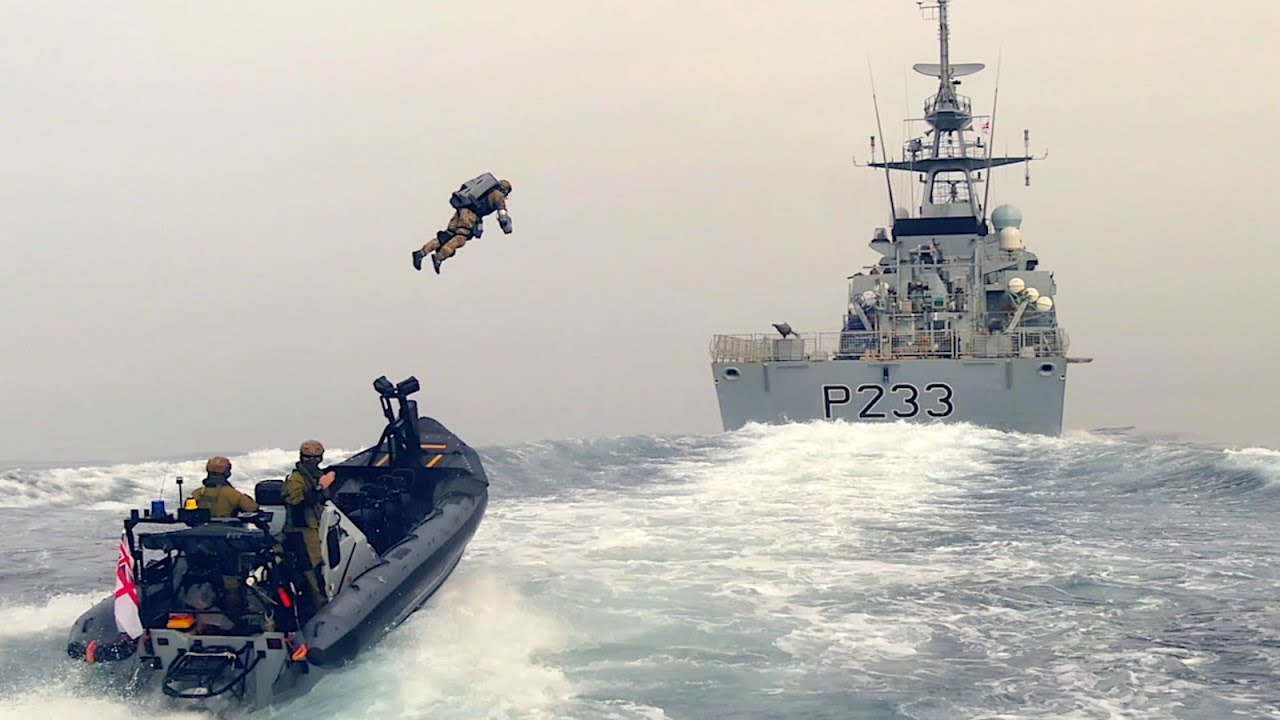
Marine personnel are conducting jetpack boarding training, practicing precision landings onto high speed vessels moving across open sea.
It looks like something from a futuristic combat movie. But this is real world military training happening right now.
Video credit to original owner.
The US military presence in the Middle East does not bring security, Iran's Parliamentary Speaker Mohammad Baqer Qalibaf told state TV, insisting that regional security needs to be established by regional countries.
"The face and order of the Middle East will
change, but not according to US plans. We, the Islamic countries of
the region, will establish regional order and security in the
economic and security dimensions,"Qalibaf said, adding that U.S. forces
need to leave the region.
“He says he has ‘defeated’ us nine times in the last two weeks. It’s becoming hilarious.”
The remark drew laughter in the Islamic Consultative Assembly (Iran’s Parliament), turning Trump’s repeated claims into a moment of public ridicule in Tehran as tensions and rhetoric between Washington and Tehran continue to escalate.
Tehran [Iran], March 17 (ANI): Speaker of the Iranian Parliament, Mohammad Baqer Qalibaf, has stated that Tehran did not anticipate the territories of its southern neighbours being utilised as a launchpad for aggression against the Islamic Republic, according to a report by the state broadcaster Press TV.
In an interview with Al-Araby Al-Jadeed media outlet, Qalibaf addressed questions regarding reactions countries in Iran's neighbourhood on Tehran's retaliatory strikes.
"Let me set aside pleasantries, it was we who did not expect the soil of our southern neighbours to be used for aggression against Iran, compelling us to defend ourselves," ---he remarked.
The Speaker criticied the presence of foreign military installations in the region, suggesting that the very "bases given to America to create security" for those nations had ultimately betrayed them and become a "source of insecurity."
According to Press TV, Qalibaf's comments come in the wake of the unprovoked conflict that began on February 28, following US and Israeli strikes that resulted in the killing of Ayatollah Seyyed Ali Khamenei and several high-ranking military commanders.
Since the outbreak of hostilities, Iran has launched extensive missile and drone operations against Israeli-occupied territories and US regional bases. Qalibaf asserted that while Washington claimed these bases were for regional safety, they were instead used to strike Iran, "forcing us to respond."
"America initiated the insecurity from the soil of these countries, and it is natural that we, in an existential war, are compelled to defend ourselves," the state broadcaster Press TV quoted him as saying. He noted that during a previous 12-day conflict, Tehran had consciously avoided involving its neighbours until Washington became a direct participant. Regarding the future of the region, Qalibaf maintained that Iran "will not return to pre-war conditions." He emphasised that while Tehran is forced to defend its territory, regional stability should be managed by local nations without "foreign interference."
Press TV reported that the Speaker expressed a readiness for permanent security pacts with neighbouring states to provide a "guarantee for both sides" and protect regional investment. However, he remained firm on the conditions for a halt in combat, stating, "We will not accept ceasefire until enemy repents." He argued that a truce is only logical if it does not merely offer the adversary a chance to "resolve its problems, such as the destruction of radars or a shortage of interceptor missiles," before resuming attacks.
He insisted that Tehran would only consider a ceasefire when the enemy showed genuine remorse and regional stability was assured.
Qalibaf further revealed that Iran had "prepared ourselves for a long war" and developed countermeasures to prevent the neutralisation of its operational abilities.
He claimed that Iran's domestic technology allows for the rapid and cost-effective production of missiles and drones, far outpacing the enemy's ability to manufacture interceptors.
Finally, addressing the transition of leadership following the killing of the former Leader, Qalibaf spoke on the message sent by the election of Ayatollah Mojtaba Khamenei.
(This content is sourced from a syndicated feed and is published as received. The Tribune assumes no responsibility or liability for its accuracy, completeness, or content.)