VIDEO


Dominic Raab quits as UK deputy PM over bullying inquiry
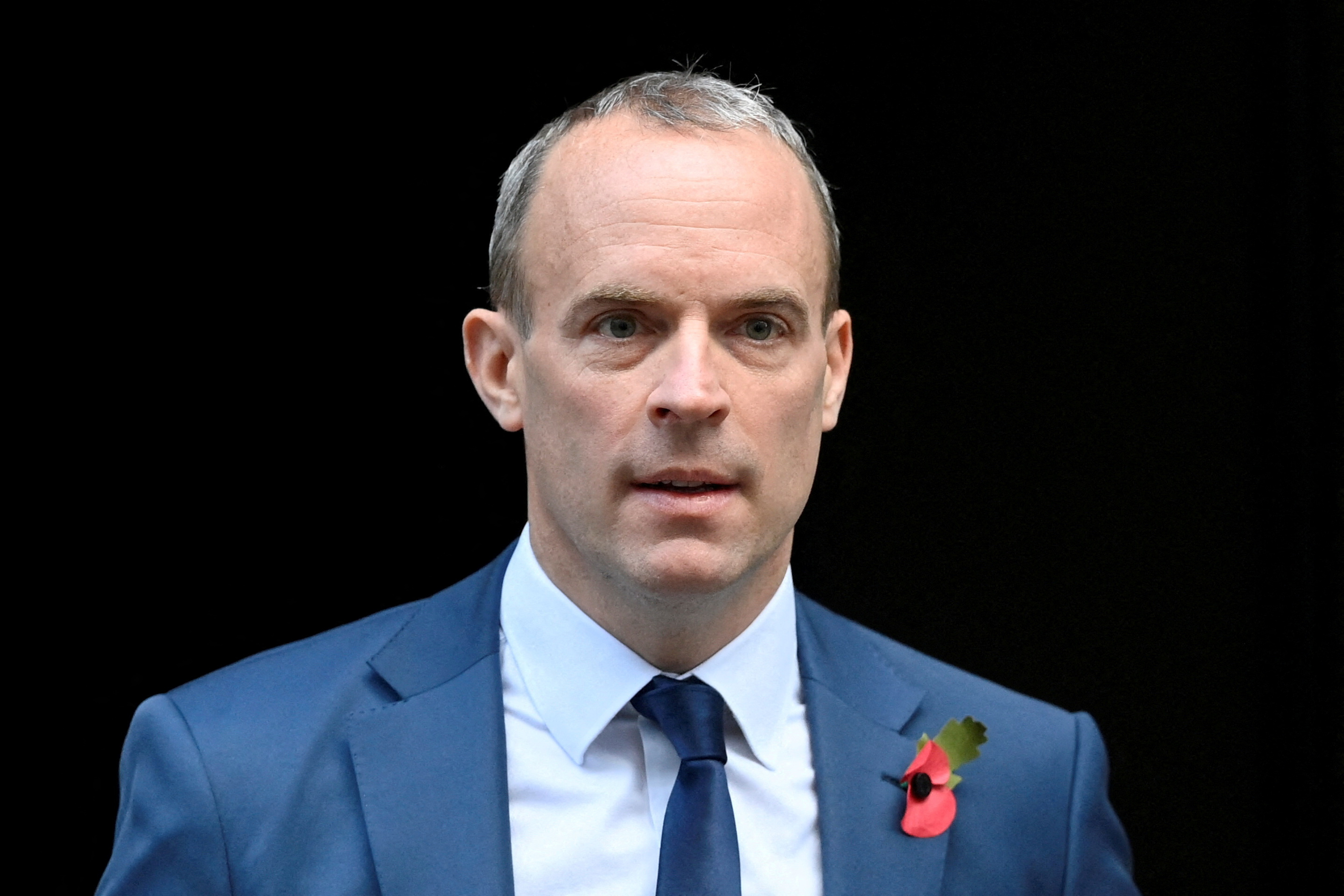
LONDON, April 21 (Reuters) - British Deputy Prime Minister Dominic Raab resigned from the government on Friday after an independent report found he had bullied officials, the latest scandal to force out one of Prime Minister Rishi Sunak's top ministers.
The loss of a third senior minister over their personal conduct in six months will damage Sunak's bid to revive his Conservative Party's fortunes before local elections in May, and is an embarrassment as Sunak promised a government of integrity when he entered Downing Street in October. . .Raab released an angry resignation letter arguing that the findings of the report, which said he had acted in a way that was "intimidating" and "persistently aggressive" while he was foreign minister, were flawed.But he went through with his promise to quit if any bullying allegations were upheld."I called for the inquiry and undertook to resign if it made any finding of bullying whatsoever," Raab said. "I believe it is important to keep my word. . .Raab went further than appropriate with his critical feedback and was insulting about work done by officials at the Ministry of Justice, the report found, adding he had been abrasive but not deliberately abusive.
'DANGEROUS PRECEDENT'
The report also found that while he had not sworn or shouted at colleagues, he had harshly criticised civil servants' work, describing work by some officials as "utterly useless" and "woeful".
"(Raab) has been able to regulate this level of 'abrasiveness' since the announcement of the investigation," Tolley said. "He should have altered his approach earlier."
Raab, 49, is part of a generation of politicians who rose to power after the Brexit vote in 2016. He was demoted as British foreign minister in 2021 after he went on holiday to Crete as the Taliban advanced towards Kabul."
READ MORE
Dominic Raab: how the Guardian revealed bullying allegations
How the story has unfolded since Ministry of Justice sources first spoke out about his behaviour
After many turbulent months at the top of government under Boris Johnson and Liz Truss, Rishi Sunak arrived in No 10 knowing he had to put the Conservatives’ days of self-immolation behind them.
On his first day in the job last October, he promised the British people that his government would display “integrity, professionalism and accountability” at every level.
The pledge has hung like a millstone round his neck ever since, with the bullying allegations against Dominic Raab, one of his closest political allies, likely to trouble him the most. Here we set out how the Guardian broke the story:
Friday 11 November 2022
Ministry of Justice sources told the Guardian that senior civil servants had been offered “respite or a route out” of the department when Raab was reappointed by Sunak the previous month, amid concerns that some were still traumatised by his behaviour during a previous stint there.
We also reported that Antonia Romeo, the permanent secretary, had spoken to Raab when he returned to the department to warn him that he must treat staff professionally and with respect.
The Guardian also spoke to a number of sources in the MoJ who claimed Raab had been “demeaning rather than demanding”, was “very rude and aggressive” and that he “wasn’t just unprofessional, he was a bully” to civil servants.
Raab came out fighting, with one source close to the minister saying he “makes no apologies” for having high standards. “He works hard, and expects a lot from his team as well as himself.”
Saturday 12 November
The following day, however, came further allegations, with the Observer reporting that concerns over Raab’s behaviour towards officials were raised inside Whitehall during his time as Brexit secretary in 2018, four years previously.
A senior source said a document outlining a “serious expression of concern” was dispatched to the Cabinet Office by a top official that alleged “unprofessional, even bullying, conduct of the minister towards his private office”. But no action was taken.
Monday 14 November
The following days brought further claims, with the Guardian revealing Raab was warned about his behaviour towards officials during his time as foreign secretary by the department’s top civil servant, who then informally reported his concerns to the Cabinet Office.
Simon McDonald, the then permanent secretary at the Foreign Office, spoke to Raab on several occasions during his tenure about how he treated staff in his private office and during meetings.
Within hours, McDonald had confirmed our reports. In an interview with LBC, he was asked whether the characterisation of Raab as somebody who could bully, and around whom bullying could happen, was a plausible one. He replied: “Yes.”
Sunak, who had already been criticised over his judgment after promoting other controversial ministers, faced repeated questions about the allegations by journalists in Bali at the G20 summit.
He responded by saying he did not recognise the characterisation of Raab and was not aware of any formal complaints, encouraging civil servants to make them official if they had concerns about his deputy they wanted to address.
Opposition parties began calling for a formal investigation, saying the reports should not be brushed under the carpet.
Wednesday 16 November
Downing Street announced Sunak would appoint an independent investigator to examine the bullying claims, after Raab requested an inquiry into two formal complaints made against him.
Raab, who said he would stay in post while the process took place, said he had always behaved properly towards staff, despite a growing list of accusations from officials.
The deputy prime minister indicated he would stand down if Sunak wanted him to, saying he would “respect whatever outcome” he decided, but vowed to “thoroughly rebut and refute” the two official complaints.
Wednesday 23 November
Sunak appointed the top employment barrister Adam Tolley KC, tasking him with investigating the complaints “in confidence” and to report back to the prime minister, who would then decide Raab’s fate.
Wednesday 14 December
Raab was facing a number of formal complaints, rather than only two, from MoJ civil servants, it was revealed.
The new complaints were understood to be from senior civil servants, with direct experience of alleged bullying and aggressive behaviour by the justice secretary. “They feel they need to stand shoulder to shoulder with more junior staff,” one source said.
Wednesday 25 January 2023
Raab was facing a much broader bullying investigation than originally anticipated with at least 24 civil servants involved in formal complaints against him, the Guardian revealed.
Sources said all but two of the formal complaints involved multiple accusers. A number of his private office staff from his first stretch at the MoJ were among those believed to have made submissions.
Officials close to the inquiry are said to have been shocked by some of the claims that emerged, including individuals being physically sick before meetings, regularly in tears and, in at least one case, left feeling suicidal as a result of the alleged behaviour.
Tuesday 31 January
All three Whitehall mandarins who worked with Raab while he was holding cabinet positions had been interviewed by the official inquiry, the Guardian reported.
Sources confirmed reports McDonald had given evidence and revealed that Romeo at the MoJ and Philip Rycroft, who ran the Brexit department while Raab was in charge, had both been witnesses.
Their testimony was believed to have focused on what warnings they gave to Raab at the time about his alleged behaviour. All three are understood to have spoken to the cabinet minister about how he treated civil servants.
Weeks later, the Telegraph reported that Boris Johnson had privately warned Raab about his conduct and given evidence to the bullying investigation.
Wednesday 1 February
The spotlight turned on to Sunak after No 10 repeatedly refused to say whether he knew of complaints about Raab’s behaviour before appointing him to cabinet.
“The prime minister was not aware of any formal complaints at the time of appointing Dominic Raab,” his spokesperson said, repeatedly refusing to say whether he had been aware of “informal” ones.
However, the Times reported that civil servants had flagged to Sunak that there had been “issues” with Raab in his previous departments before he decided to bring him back into government.
Downing Street said Sunak had not been “directly told” and that officials had not advised against the appointment.
Friday 10 February
MoJ sources said there was a sense of calm before the storm in the department’s Whitehall headquarters. Officials said they had “just been getting on with it” and “still driving ahead” with Raab’s policy priorities.
However, patience with the pace of the inquiry was starting to wear thin, with Tolley conducting lengthy interviews with complainants and witnesses.
Sunak had suggested that if Tolley concluded Raab had fallen short of the standards expected of somebody in his position, he would be sacked.
“When I’m presented with conclusive independent findings that someone in my government has not acted with the integrity or standards that I would expect of them, I won’t hesitate to take swift and decisive action,” he said. Government insiders said the inquiry still had several more weeks to run.
I hope you appreciated this article. Before you move on, I was hoping you would consider taking the step of supporting the Guardian’s journalism.
From Elon Musk to Rupert Murdoch, a small number of billionaire owners have a powerful hold on so much of the information that reaches the public about what’s happening in the world. The Guardian is different. We have no billionaire owner or shareholders to consider. Our journalism is produced to serve the public interest – not profit motives.
And we avoid the trap that befalls much US media – the tendency, born of a desire to please all sides, to engage in false equivalence in the name of neutrality. While fairness guides everything we do, we know there is a right and a wrong position in the fight against racism and for reproductive justice. When we report on issues like the climate crisis, we’re not afraid to name who is responsible. And as a global news organization, we’re able to provide a fresh, outsider perspective on US politics – one so often missing from the insular American media bubble.
Around the world, readers can access the Guardian’s paywall-free journalism because of our unique reader-supported model. That’s because of people like you. Our readers keep us independent, beholden to no outside influence and accessible to everyone – whether they can afford to pay for news, or not.
If you can, please consider supporting the Guardian today. Thank you.
Betsy Reed
Editor, Guardian US


Most viewed
Second woman claims she was raped by colleagues while working at CBI
Rightwing extremists defeated by Democrats in US school board elections
Russian plane accidentally strikes Russian city near Ukraine border leaving 20m crater
They cleaned up BP’s massive oil spill. Now they’re sick – and want justice
Are we right to be nervous about the new Lord of the Rings movies?


After many turbulent months at the top of government under Boris Johnson and Liz Truss, Rishi Sunak arrived in No 10 knowing he had to put the Conservatives’ days of self-immolation behind them.
On his first day in the job last October, he promised the British people that his government would display “integrity, professionalism and accountability” at every level.
The pledge has hung like a millstone round his neck ever since, with the bullying allegations against Dominic Raab, one of his closest political allies, likely to trouble him the most. Here we set out how the Guardian broke the story:
Friday 11 November 2022
Ministry of Justice sources told the Guardian that senior civil servants had been offered “respite or a route out” of the department when Raab was reappointed by Sunak the previous month, amid concerns that some were still traumatised by his behaviour during a previous stint there. . .
Saturday 12 November
The following day, however, came further allegations, with the Observer reporting that concerns over Raab’s behaviour towards officials were raised inside Whitehall during his time as Brexit secretary in 2018, four years previously. . .
Monday 14 November
The following days brought further claims, with the Guardian revealing Raab was warned about his behaviour towards officials during his time as foreign secretary by the department’s top civil servant, who then informally reported his concerns to the Cabinet Office. . .
Wednesday 16 November
Downing Street announced Sunak would appoint an independent investigator to examine the bullying claims, after Raab requested an inquiry into two formal complaints made against him. . .
Wednesday 23 November
Sunak appointed the top employment barrister Adam Tolley KC, tasking him with investigating the complaints “in confidence” and to report back to the prime minister, who would then decide Raab’s fate.
Wednesday 14 December
Raab was facing a number of formal complaints, rather than only two, from MoJ civil servants, it was revealed. . .
Wednesday 1 February
The spotlight turned on to Sunak after No 10 repeatedly refused to say whether he knew of complaints about Raab’s behaviour before appointing him to cabinet.
“The prime minister was not aware of any formal complaints at the time of appointing Dominic Raab,” his spokesperson said, repeatedly refusing to say whether he had been aware of “informal” ones.
> However, the Times reported that civil servants had flagged to Sunak that there had been “issues” with Raab in his previous departments before he decided to bring him back into government.
> Downing Street said Sunak had not been “directly told” and that officials had not advised against the appointment.
[ ]
Friday 10 February
MoJ sources said there was a sense of calm before the storm in the department’s Whitehall headquarters. Officials said they had “just been getting on with it” and “still driving ahead” with Raab’s policy priorities.
However, patience with the pace of the inquiry was starting to wear thin, with Tolley conducting lengthy interviews with complainants and witnesses.
Sunak had suggested that if Tolley concluded Raab had fallen short of the standards expected of somebody in his position, he would be sacked.
“When I’m presented with conclusive independent findings that someone in my government has not acted with the integrity or standards that I would expect of them, I won’t hesitate to take swift and decisive action,” he said. Government insiders said the inquiry still had several more weeks to run."


No comments:
Post a Comment