“If the U.S. says it is concerned about the consequences of coups, then U.S. military officials should speak plainly to their partners about the importance of civilian rule of the military and the legal implications coups have on U.S. assistance,” Sarah Harrison, a senior analyst at the International Crisis Group and formerly associate general counsel at the Pentagon’s Office of General Counsel, International Affairs, told The Intercept. “AFRICOM’s efforts do not seem to address this head on.”
Erica De Bruin, author of “How to Prevent Coups d’Etat: Counterbalancing and Regime Survival,” said that while Nikogosian and Sands seemed to argue that additional training was the answer, the reality is generally more complex. Often, she said, militaries are faced with situations in which human rights and civilian control are in opposition, such as presidential orders to centralize executive power or otherwise harm civilians. “In the face of such tension,” De Bruin told The Intercept in an email, “military officers often default to self-preservation — staging coups to preserve the cohesion, reputation, or material interests of the military as an institution.”
...“The fact is that the U.S. continues to respond inconsistently to coups, often looking the other way when it suits foreign policy goals.” This contradiction, De Bruin said, “encourages militaries to keep staging them.”
The four-star general in charge of U.S. Africa Command, or AFRICOM, meanwhile, told the House Armed Services Committee that only a small percentage of U.S.-trained officers overthrow their governments — while admitting he didn’t know the exact number. This prompted far-right Rep. Matt Gaetz, R-Fla., to ask, “Why should U.S. taxpayers be paying to train people who then lead coups in Africa?”
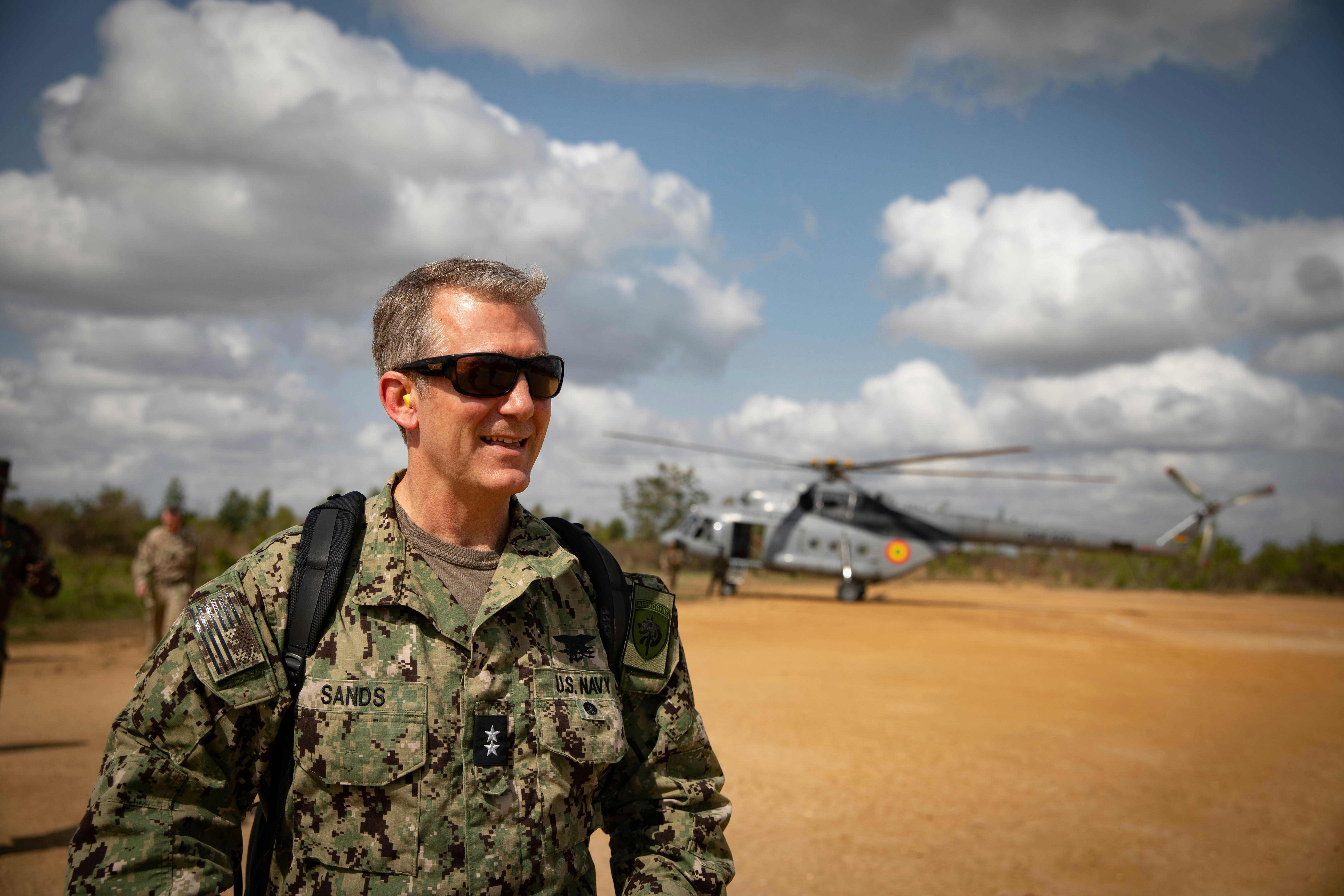
U.S. Navy Rear Adm. Milton “Jamie” Sands, a SOCAFRICA commander, visits a training site for Flintlock’s Distinguished Visitors Day near Volta, Ghana, on March 14, 2023.
Photo: Spc. Mario Hernandez Lopez/U.S. Army


No comments:
Post a Comment