The tensions between Washington and Beijing are currently centered on Taiwan and the greater Asia-Pacific, where both sides have accused each other of making escalatory moves.
Architect of Biden’s China policy to resign
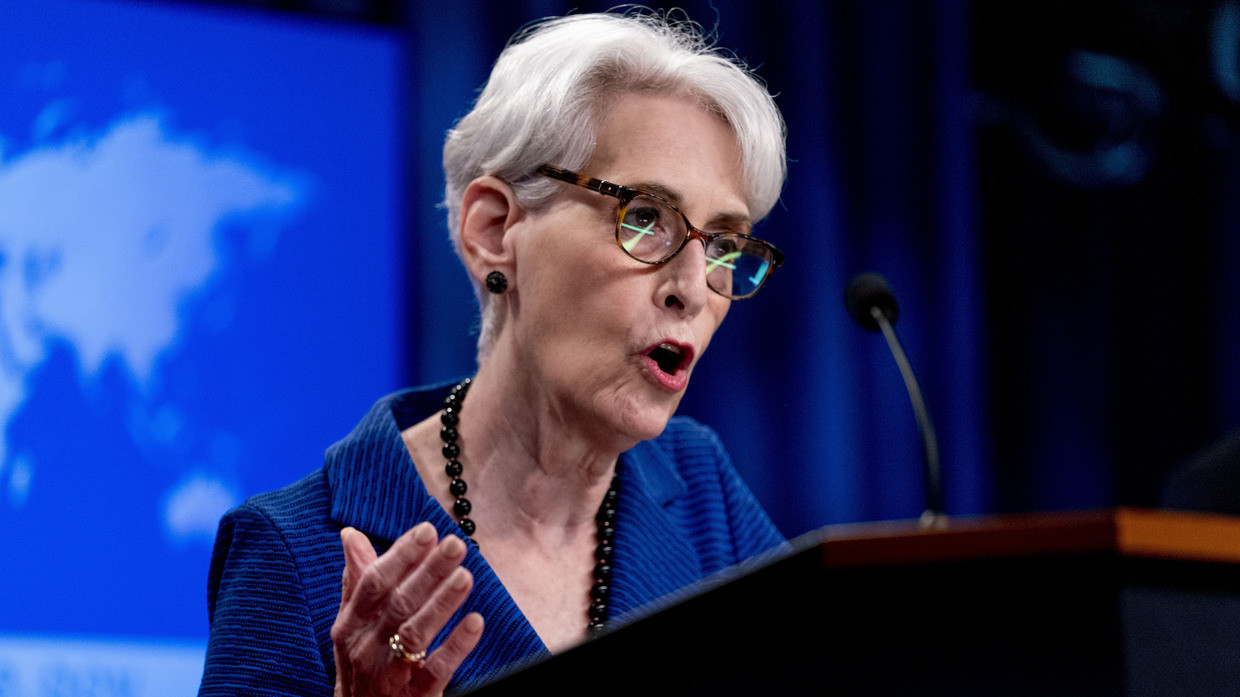
"US Deputy Secretary of State Wendy Sherman is set to retire, the State Department said on Friday. The 73-year-old official was heavily involved in devising Washington’s current strategy toward China and the broader Asia-Pacific, where it seeks to challenge Beijing on several fronts.
Secretary of State Antony Blinken hailed Sherman’s lengthy career as a diplomat in a statement announcing her resignation, saying she has “helped lead our engagement in the Indo-Pacific, the region where the history of the 21st century will be written.”
“She has deepened our bonds with our friends around the world, especially with the Republic of Korea, Japan, and the European Union. She has overseen our efforts to strengthen the [State] Department’s capabilities to manage our relationship with the People’s Republic of China, and built greater convergence with allies and partners,” he added.
In an internal memo sent out to department staffers, Sherman stated that “Diplomacy is not for the faint of heart,” urging colleagues to “have courage” and to use their power “for good.” She said her retirement would be effective at the end of next month.

With a career spanning more than three decades, several presidents and five separate secretaries of state, Sherman has been involved in a long list of important foreign policy decisions over the years. As Blinken’s deputy, her focus has largely been set on China, often acting as an official spokesperson to explain the US strategy toward the People’s Republic.
In comments to lawmakers earlier this year, Sherman warned that China is “the only competitor with the intent and means to reshape the international order,” accusing Beijing of “provocations in the South China Sea,” human rights abuses, “economic coercion,” and “threatening behavior against Taiwan,” which China considers to be part of its sovereign territory.
Since President Joe Biden took office in 2021, US relations with China have plumbed new depths.
Over the last two years, the Pentagon has ordered near-constant transits of the disputed Taiwan Strait by US warships, while a visit to Taipei by then-House Speaker Nancy Pelosi in 2022 triggered unprecedented Chinese military drills in the airspace and waters around the island. It carried out additional war games following a trip to the US by Taiwan’s leader earlier this year.
However, as Sherman prepares to leave the State Department for good, there appear to be signs of renewed diplomacy with China. Earlier this week, White House National Security Advisor Jake Sullivan held an unannounced round of talks with a senior Chinese Foreign Ministry official, the highest-level engagement between the two nations since Biden’s meeting with his Chinese counterpart, Xi Jinping, last November
US and China hold unannounced high-level talks

White House National Security Advisor Jake Sullivan had unannounced meetings with Wang Yi, the head of the Chinese Communist Party’s Foreign Affair Committee, in Vienna on Wednesday and Thursday.
In a brief statement, the White House described the meetings as “candid, substantive, and constructive discussions” on issues ranging from the Russia-Ukraine conflict to tensions in the Taiwan Strait.
AP quoted an unnamed US official as saying Sullivan told Wang that Washington is “looking to move beyond” the row sparked by the Chinese high-altitude balloon spotted over US territory last winter. The US claimed that the balloon was used for spying and dispatched a fighter jet to shoot it down in early February. Beijing said it was a weather-monitoring airship that had veered off course.
According to AP, both sides agreed this week that the balloon incident was “unfortunate” and wished to “reestablish standard, normal channels of communications.”

Bloomberg reported on Thursday that the White House had stepped up efforts to seek more meetings and calls with Chinese officials at different levels. They were reportedly also aiming for a phone call between US President Joe Biden and his counterpart, Xi Jinping. The leaders last met on the sidelines of the G20 summit in Indonesia in November.
The tensions between Washington and Beijing are currently centered on Taiwan and the greater Asia-Pacific, where both sides have accused each other of making escalatory moves.
“The US cannot keep raising the issue of communication on the one hand, while on the other, keep suppressing and containing China,” Foreign Ministry spokesman Wang Wenbin said on Thursday, replying to a reporter’s question about bilateral ties. He urged the US to “form a correct perception” of Beijing and “respect China’s red lines.”
Last month, Beijing held military drills around Taiwan after the island’s president, Tsai Ing-wen, visited the US. Beijing considers the island part of its territory and strongly opposes Taipei’s contacts with foreign officials. Washington has refrained from formally recognizing Taiwan as an independent state, but has sold weapons to the government and promised to defend the island in case of an attack from the Chinese mainland.


No comments:
Post a Comment