1 from Phys.org
SEPTEMBER 1, 2023 FEATURE
LHCb collaboration observes a doubly charged tetraquark and its neutral partner for the first time
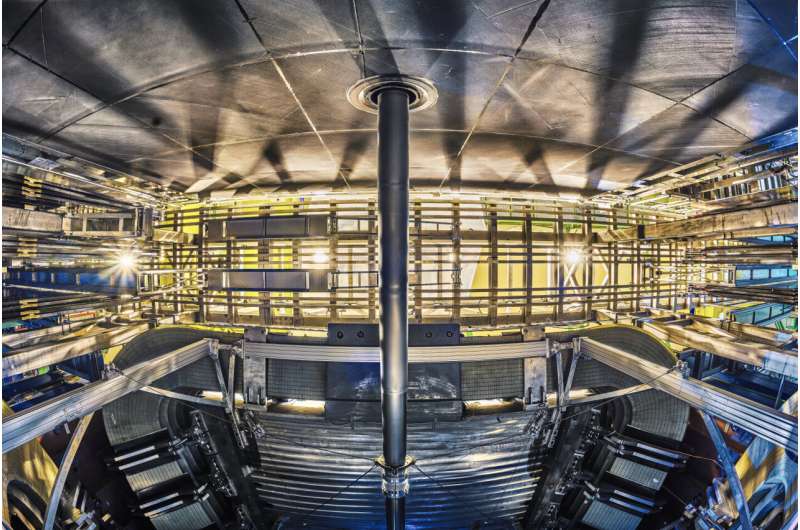
The observation of elusive, exotic particles is the key objective of countless studies, as it could open new avenues for research, while also improving present knowledge of the matter contained in the universe and its underlying physics. The quark model, a theoretical model introduced in 1964, predicted the existence of elementary subatomic particles known as quarks in their different configurations.
As part of their recent study, the researchers analyzed data collected during the LHC's first two experimental runs. These spanned across a period of two years, between 2011 and 2018.
"Symmetries are also powerful because they allow to derive similarities and relations between particles," Amhis said. "Isospin, the symmetry that related the two particles listed in this paper, says that their mass and width to be the same. This allows the combined analysis to be more sensitive to the properties of these particles than a single analysis of each isospin partner could have been."
To date, the LHCb collaboration published over 600 papers, observing several particles and physics phenomena for the first time. Most of their studies confirmed the robustness and reliability of the Standard Model of particle physics, yet some of them also led to exciting new discoveries.
During this third run, the LHCb expects to collect five times more data per year compared to previous experimental runs. Their hope is that this new data will lead to more fascinating discoveries and observations.
"The improved detector is expected to gain another factor of two in the study of hadrons in particular, for a total factor of 10," Amhis added.
"In addition, LHCb now has a much-improved system for injecting gases into the detector volume, so it can study not only proton collisions but also the collision of protons with a wide variety of nuclei. This opens yet another door to the understanding of exotic hadrons, by studying their formation in different types of collisions. In our next works, we plan to pursue all axes to gain a deeper understanding of these particles: searching for new exotic hadrons, measuring the properties of known exotic hadrons more precisely, and looking for known and new exotic hadrons in different types of collisions."
- Quarks and antiquarks (the anti-matter equivalent of quarks) are predicted to be constituents of various subatomic particles. These include "conventional" particles, such as mesons and baryons, as well as more complex particles made up of four or five quarks (i.e., tetraquarks and pentaquarks, respectively).
- "In the past decade, the LHCb experiment has done pioneering work in the discovery of so-called exotic particles," Yasmine Sara Amhis, physics coordinator of the LHCb experiment, told Phys.org,
- "The LHCb discovered the first pentaquark in 2015, and this opened the road to many other findings. The primary objective of LHCb's research into exotic particles is to discover which tetraquarks and pentaquarks exist and to map their properties, especially uncovering the other particles they decay into and their quantum numbers."
As part of their recent study, the researchers analyzed data collected during the LHC's first two experimental runs. These spanned across a period of two years, between 2011 and 2018.
- "The analysis that led to this discovery is very sophisticated and is fair to say is an example of one of the most 'difficult' studies performed within our collaboration," Amhis explained.
- "The origin name of the LHCb experiment stems from the historical primary topic of research, which focused on b-quarks and their products. The pair of tetraquarks which are reported in this paper were observed thanks to a technique called amplitude analysis. This approach replies on the quantum behavior of particles and their ability to interfere between each other."
"Symmetries are also powerful because they allow to derive similarities and relations between particles," Amhis said. "Isospin, the symmetry that related the two particles listed in this paper, says that their mass and width to be the same. This allows the combined analysis to be more sensitive to the properties of these particles than a single analysis of each isospin partner could have been."
To date, the LHCb collaboration published over 600 papers, observing several particles and physics phenomena for the first time. Most of their studies confirmed the robustness and reliability of the Standard Model of particle physics, yet some of them also led to exciting new discoveries.
- "Papers like this one show that discoveries, including some unexpected ones, remain possible," Amhis said.
- "More than 70 new hadronic particles have been discovered at the LHC, by far most of them at LHCb, As we learn more about which hadrons exist and their properties, we gain new understanding of the strong force, one of the four fundamental forces in nature, which binds quarks into hadrons.
- This understanding in turn opens new doors in searching for physics beyond the Standard Model, by reducing theoretical uncertainties associated with such searches which are caused by an imperfect understanding of the strong force."
During this third run, the LHCb expects to collect five times more data per year compared to previous experimental runs. Their hope is that this new data will lead to more fascinating discoveries and observations.
"The improved detector is expected to gain another factor of two in the study of hadrons in particular, for a total factor of 10," Amhis added.
"In addition, LHCb now has a much-improved system for injecting gases into the detector volume, so it can study not only proton collisions but also the collision of protons with a wide variety of nuclei. This opens yet another door to the understanding of exotic hadrons, by studying their formation in different types of collisions. In our next works, we plan to pursue all axes to gain a deeper understanding of these particles: searching for new exotic hadrons, measuring the properties of known exotic hadrons more precisely, and looking for known and new exotic hadrons in different types of collisions."
More information: R. Aaij et al, First Observation of a Doubly Charged Tetraquark and Its Neutral Partner, Physical Review Letters (2023). DOI: 10.1103/PhysRevLett.131.041902
Journal information: Physical Review Letters
__________________________________________________________________________________
Another from "Futurama"


No comments:
Post a Comment