Engineers develop general, high-speed technology to model, understand catalytic reactions
by Iowa State University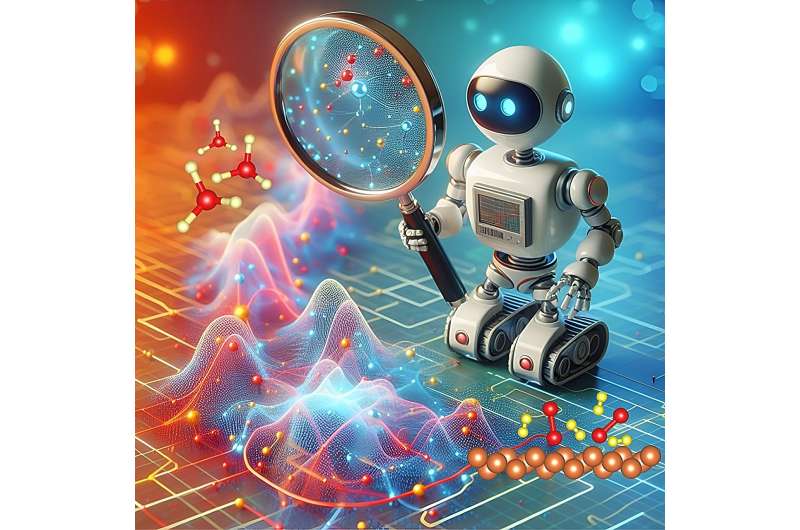 This illustration shows how artificial intelligence technology—the robot—examines a chemical reaction: From right to left, nitrogen (red) and hydrogen (yellow), with help from an iron catalyst (brown), react across a complex energy landscape to produce ammonia (red and yellow combined). Credit: Qi An.
Researchers have been studying the industrial production of ammonia for a century. But they've struggled to find ways to improve the low-yield, low-efficiency process.
Atmospheric nitrogen, with the aid of an iron catalyst, reacts with hydrogen to produce ammonia.
- That reaction produces lots of ammonia—worldwide production is 160 million tons every year. Most is used in agriculture, especially as nitrogen fertilizer.
- It's also used in many industries, including refrigeration for food and beverage production.
- We all know it as a household cleaner.

"Our developed HDRL-FP framework has the potential to contribute significantly to the optimization of this process, potentially reducing production costs and CO₂ emission, and facilitating the establishment of smaller and more widespread plants," the researchers wrote in a paper recently published online by the journal Nature Communications.
HDRL-FP is High-Throughput Deep Reinforcement Learning with First Principles. An and his collaborators and co-authors—Tian Lan and Huan Wang of Salesforce AI Research in California—say the technology is full of potential.
"Exploring catalytic reaction mechanisms is crucial for understanding chemical processes, optimizing reaction conditions, and developing more effective catalysts," they wrote.
Of rewards and atoms
An said there are two keys to the researchers' software technology: a type of machine learning called reinforcement learning and connecting the simulation process with the positions of the atoms involved.
An said reinforcement learning is like training a dog by using rewards to encourage actions.
- In reinforcement learning, computers learn from their actions while seeking appropriate rewards. In this case, the rewards are all about finding the best, most-efficient, lowest-cost reaction path.
- The researchers also built the technology to be useful for general studies of catalytic reactions. Studies start with the positions of atoms mapped on an energy landscape. That's enough—researchers don't have to start with a more specific representation of the reaction environment, including the states, actions or rewards for a particular reaction.
He said the system's calculations for the reaction producing ammonia is considered a proof-of-concept demonstration.
"This allows us to figure out the reaction mechanism," An said.
The researchers' successful peek inside that reaction "enables the investigation of complex catalytic chemical reactions automatically," they wrote, "offering a promising approach for future research and discoveries."
More information: Tian Lan et al, Enabling high throughput deep reinforcement learning with first principles to investigate catalytic reaction mechanisms, Nature Communications (2024). DOI: 10.1038/s41467-024-50531-6
Journal information: Nature Communications


No comments:
Post a Comment