

Reducing grand corruption in Ukraine:
several EU initiatives, but still insufficient results
About the report:Ukraine has been suffering from grand corruption and state capture for many years. Our audit assessed whether EU support in Ukraine was effective at fighting grand corruption. Although the EU had introduced several initiatives to reduce corruption opportunities, we found that grand corruption was still a key problem in Ukraine. We make several recommendations to improve the EU’s support, in particular that specific actions should be designed and implemented not only to target grand corruption (including the oligarchic structure), but also to help remove impediments to free and fair competition.
ECA special report pursuant to Article 287(4), second subparagraph, TFEU.
Corruption in Ukraine
04Ukraine has a long history of corruption, and faces both petty and grand corruption. Petty corruption is widespread, and is accepted as almost inevitable by a large part of the population. Citizens “often justify their participation in such petty corruption by noting that high-level officials and oligarchs are involved in graft on a much grander scale”4. Experts have estimated that huge amounts – in the tens of billions of dollars – are lost annually as a result of corruption in Ukraine5.
05Transparency International defines grand corruption as “the abuse of high-level power that benefits the few at the expense of the many, and causes serious and widespread harm to individuals and society”. In Ukraine, it is based on informal connections between government officials, members of parliament, prosecutors, judges, law enforcement agencies (LEAs), managers of State Owned Enterprises (SOEs) and politically connected individuals/companies (see Figure 1). There are around 3 500 SOEs at central level and 11 000 at municipal level6.
Figure 1
Ukrainian system facilitating grand corruption
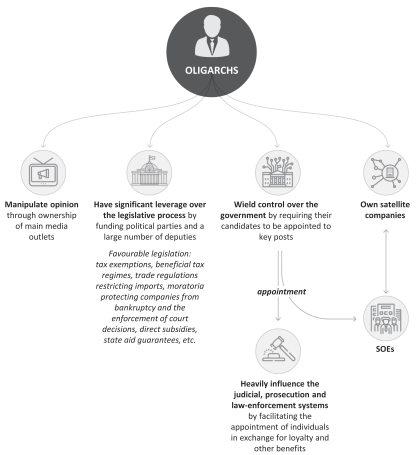
Source: ECA, based on several sources7.
“State capture” by blocks of powerful political and economic elites that are pyramidal in structure and entrenched throughout public institutions and the economy has been seen as a specific feature of Ukraine’s corruption8. Both the International Monetary Fund (IMF) and Ukraine’s government acknowledged the resistance that vested interests had shown to structural reforms9. Grand corruption resulting from weak rule of law and widespread oligarchic influence runs counter to EU values, and is a major obstacle to Ukraine’s development10. Grand or high-level corruption hinders competition and growth in the country, harms the democratic process, and is the basis for wide-scale petty corruption.
07Furthermore, investigative journalists have regularly published articles about oligarchs’ illicit financial flows (including money-laundering abroad), even in the EU11. A report estimates the cost of tax avoidance through offshores at least one billion euros annually12.
08From 2016 to 202013, the three major obstacles to foreign investment in Ukraine remained the same: widespread corruption, a lack of trust in the judiciary, and market monopolisation and state capture by oligarchs (see Figure 2). In recent years, foreign direct investment in Ukraine has remained below the 2016 level (see Annex I).
Figure 2
Major obstacles to foreign investment in Ukraine: 2016-2020
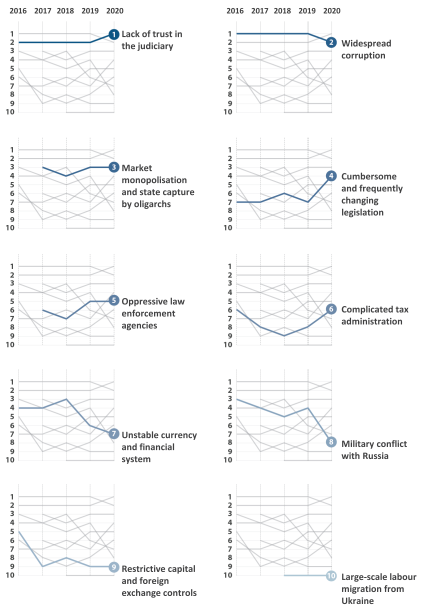
Source: ECA, based on Foreign Investor Survey 2020 EBA, Dragon Capital, CES.
Various studies, in particular by the IMF (see Figure 3), have shown a projected correlation between a reduction in widespread corruption on the one hand, and economic growth and related improvements in citizen’s lives on the other. Different stakeholders14 agree that real change cannot take place in Ukraine without tackling the influence of vested interests.
Figure 3
Reducing corruption helps to speed up economic convergence with the EU (IMF study)
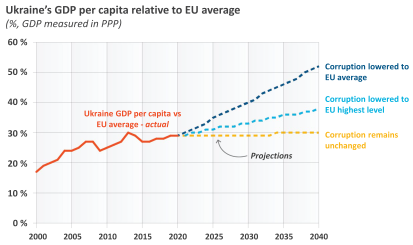
Source: ECA, based on Figure 6 of the IMF Country Report No 17/84 on Ukraine – April 2017, and IMF World Economic Outlook Database, October 2020.
EU support for Ukraine
10Ukraine is an EU Eastern Partnership15 country. The EU and Ukraine have a common goal of further economic integration and political association. The EU therefore has many priorities (good governance, the economy, trade, energy, climate change, mobility, civil society, and humanitarian assistance) that need to be addressed not only through financial cooperation but also through political dialogue. Ukraine is the second largest beneficiary country of the European Neighbourhood Instrument. Overall, the Commission has committed roughly €5.6 billion to macro-financial assistance (MFA) programmes and €2.2 billion to assistance programmes since 2014. The Commission also guarantees European Investment Bank loans of €4.4 billion. The EU is the largest donor to Ukraine16.
11The funding of the European Neighbourhood Instrument must comply with the rule of law17. This is a founding value of the EU18, and a guiding principle of its foreign policy19. Furthermore, the EU-Ukraine AA/DCFTA lists the rule of law and the fight against corruption as key elements for strengthening cooperation between the parties20.
12The European External Action Service (EEAS) and the Commission have addressed corruption in a multi-dimensional way by means of political and policy dialogue, project activities, and conditions for budget support and MFA programmes. Following the abolition of anti-corruption laws in 2010, the EU made visa liberalisation conditional upon benchmarks, including anti-corruption legislation and anti-corruption bodies21.
13The EEAS is responsible for political dialogue and, together with the Commission, for designing the strategy towards Ukraine. In response to the challenging situation in Ukraine in 2014, the Commission decided to launch “Special Measures” (support packages)22 on an annual basis from 2014 until 2017. The Commission also set up a special support group (the Support Group for Ukraine) to assist the Ukrainian authorities in carrying out the necessary economic and political reforms, in particular after the AA/DCFTA was signed. Since 2018, cooperation has been based on multi-annual programming for the 2018-2020 period.
14The EU advisory mission (EUAM)23 is a civilian mission that comes under the Common Security Defence Policy overseen by the EEAS and the member states; it became operational in Ukraine in December 2014. Its mandate is to support Ukraine in developing sustainable, accountable and efficient security services that strengthen the rule of law.



No comments:
Post a Comment