
02/26/2026
Aeva Selected by Top 5 Global Passenger OEM for Vehicle Development Program

Selection Validates Aeva’s Leadership in Perception for Advanced Automated Driving
Program Focused on Common Platform for OEM’s Global Production Vehicle Line Across Multiple Car Brands
MOUNTAIN VIEW, Calif., Feb. 26, 2026 – Aeva® (Nasdaq: AEVA), a leader in next-generation sensing and perception systems, today announced that a top 5 global passenger OEM has selected Aeva for its vehicle development program. The program focuses on the recently introduced Aeva Atlas™ Ultra 4D LiDAR sensor for the OEM’s next-generation global production vehicle platform, and will further refine sensor configuration, integration and performance validation.
The selection builds upon Aeva’s momentum as a trusted direct Tier-1 supplier to global automotive OEMs and autonomous vehicle developers, underscoring the industry’s accelerating shift toward 4D LiDAR technology for enhanced safety, performance and reliability.
“This selection by one of the world’s most respected OEMs further validates the growing interest for our perception platform and strengthens our momentum in bringing Atlas Ultra to additional production vehicle platforms,” said Soroush Salehian, Co-Founder and CEO of Aeva. “Atlas Ultra’s combination of high resolution, long-range perception, and slim design positions it well for enabling advanced automated driving on future vehicle platforms.”
Built on Aeva’s industry-leading perception platform, Atlas Ultra delivers simultaneous range and velocity detection along with high resolution at ranges up to 500 meters. Its slim form factor allows for seamless integration and high-performance sensing in highway-speed and urban automated driving applications.
Aeva anticipates a large-scale production program award opportunity following the completion of the development program.
About Aeva Technologies, Inc. (Nasdaq: AEVA)
Aeva’s mission is to bring the next wave of perception to a
broad range of applications from automated driving, manufacturing
automation and smart infrastructure, to robotics and consumer
devices. Aeva is accelerating autonomy with its
groundbreaking perception platform that integrates lidar-on-chip
technology, system-on-chip processing, and perception algorithms onto
silicon leveraging silicon photonics. Aeva 4D LiDAR sensors
uniquely detect velocity and position simultaneously, allowing automated
devices like vehicles and robots to make more intelligent and safe
decisions. For more information, visit www.aeva.com, or connect with us on X or LinkedIn.
Aeva, the Aeva logo, Aeva 4D LiDAR, Aeva Atlas, Aeries, Aeva Eve, Aeva Omni, Aeva Ultra Resolution, Aeva CoreVision, and Aeva X1 are trademarks/registered trademarks of Aeva, Inc. All rights reserved. Third-party trademarks are the property of their respective owners.
Forward looking statements
This press release contains certain forward-looking statements
within the meaning of the federal securities laws. Forward-looking
statements generally are identified by the words “believe,” “project,”
“expect,” “anticipate,” “estimate,” “intend,” “strategy,” “future,”
“opportunity,” “plan,” “may,” “should,” “will,” “would,” “will be,”
“will continue,” “will likely result,” and similar expressions. These
forward-looking statements include, but are not limited to expectations
about our product features, performance, potential applications, and the
timing of production, and market adoption. Forward-looking statements
are predictions, projections and other statements about future events
that are based on current expectations and assumptions and, as a result,
are subject to risks and uncertainties. Many factors could cause actual
future events to differ materially from the forward-looking statements
in this press release, including, but not limited to: (i) the fact that
Aeva is an early stage company with a history of operating losses and
may never achieve profitability, (ii) Aeva’s limited operating history,
(iii) the ability to implement business plans, forecasts, and other
expectations and to identify and realize additional opportunities, (iv)
market acceptance of the OEMs products, (v) the risk that the OEM may
not pursue the program as currently anticipated, (vi) unforeseen errors
or defects, (vii) the ability to ship products in a timely manner,
(viii) Aeva’s ability to scale production, (ix) market acceptance of
LiDAR technology, (x) general economic conditions and other material
risks and other important factors that could affect our financial
results. Please refer to our filings with the SEC, including our most
recent Form 10-Q and Form 10-K. These filings identify and address other
important risks and uncertainties that could cause actual events and
results to differ materially from those contained in the forward-looking
statements. Forward-looking statements speak only as of the date they
are made. Readers are cautioned not to put undue reliance on
forward-looking statements, and Aeva assumes no obligation and does not
intend to update or revise these forward-looking statements, whether as a
result of new information, future events, or otherwise. Aeva does not
give any assurance that it will achieve its expectations."



With the drives from autonomous car development, LiDAR technology has
been under the spotlight. Startups which focus on the technology have
also gained attentions from the related industry and continued to unveil
their development and updates about the technology.
Luminar, a LiDAR startup that aim to increase the accessibility of the
technology, has recruited Brent Schwarz, a veteran in the LiDAR sensor
industry who has experiences at Velodyne and established his own
company, Tyto LiDAR. As his LiDAR startup was acquired by Otto, which
was then bought by Uber, Schwarz had stayed in Uber before joining
Luminar. Through continuously strengthening its team, Luminar has begun
mass producing its LiDAR units in April 2018 and received funds from
Volvo. Currently, Luminar has contracts with 16 OEMs and is still
talking with other clients. Volvo and Toyota Research Institute are also
its clients.
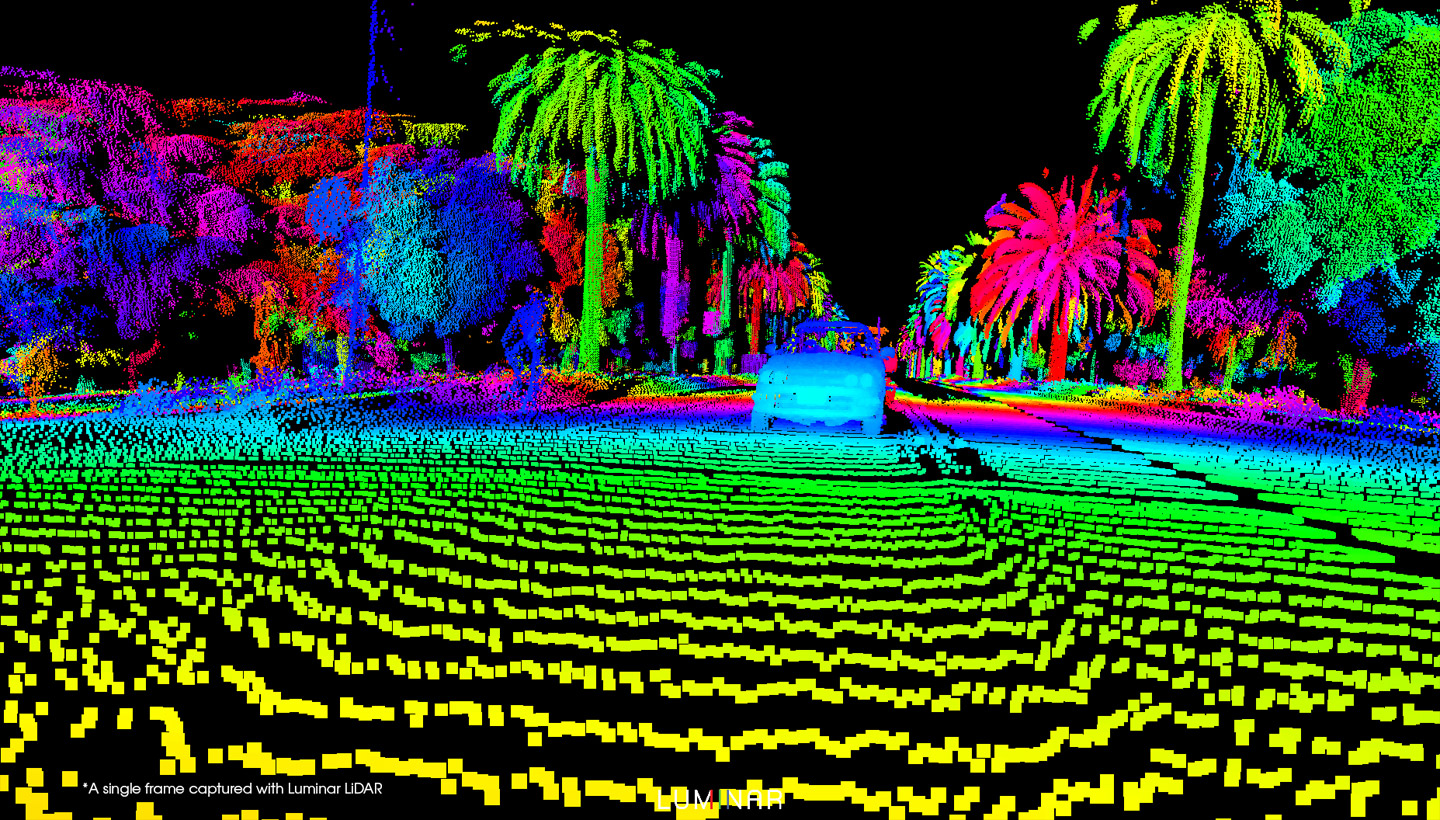
(Image: Luminar)
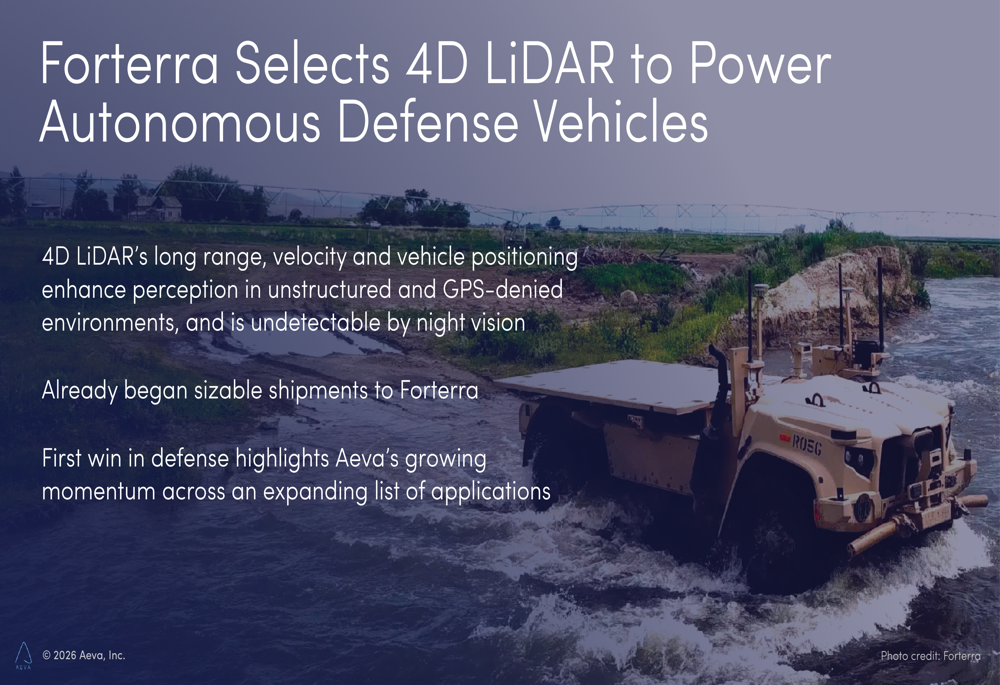
- The company has introduced its 4D LiDAR technology which is able to measure the velocity instantly with LiDAR point.
- Aeva has integrated LiDAR, radar, machine vision and motion sensors to simultaneously measure dense position and dense velocity.
- According to Aeva, the new technology can avoid physical interference such as sunlight and lead to safer AI algorithms.

[News] Innoviz Technologies Releases Expanded White Paper on the Rise of Physical AI and the Emergence of World Models
Innoviz Technologies Ltd., a leading supplier of high-performance LiDAR solutions, today released Part I of its new white paper, titled "Innoviz and the Rise of Physical AI: Bringing World Models to Life." This comprehensive white paper details how real-time, high-fidelity 3D perception enables the emerging class of physics-grounded AI systems and World Models.

February.24, 2026 - 13:45
Written by Omer Keilaf, CEO and Founder of Innoviz, the white paper
argues that artificial intelligence is entering a fundamentally new
phase. After transforming digital systems through software and large
language models, AI is now moving into the physical world, powering
vehicles, robots, infrastructure, and machines that must perceive,
reason, and act with reliable precision. This shift is often referred to
as Physical AI, and at its center is perception.
As computing power continues to accelerate, the white paper argues that
the primary bottleneck in deploying Physical AI is no longer reasoning
capability but access to high-fidelity, real-time 3D data. Cameras
capture two-dimensional projections and infer depth probabilistically,
while radar lacks spatial resolution. LiDAR, by contrast, measures
distance directly, converting photons into precise geometry.
Recent industry initiatives, such as efforts to develop Industry World
Models that embed physics, engineering principles, materials behavior,
and validated industrial knowledge, illustrate how AI is evolving beyond
text-trained models into science-grounded systems that must remain
synchronized with real-world conditions. Keeping these models aligned
with reality will likely require continuous streams of rich, real-time
3D data.
Innoviz's automotive-grade LiDAR solutions, including platforms such as
InnovizSMART and InnovizSMARTer, are designed to deliver
high-throughput 3D-sensing that can help keep next-generation World
Models updated with live spatial information from vehicles, robots,
industrial environments, and smart-city infrastructure.
"AI systems that interact with the physical world should not rely on
estimation alone. The emergence of World Models marks the beginning of a
new computing era—one rooted in physics, geometry, and validated
real-world data. We believe Innoviz is well-positioned to help bring
these models to life by serving as the high-fidelity, real-time
perception layer required for safe and scalable Physical AI," said Omer
Keilaf, CEO and Founder of Innoviz.
The white paper, "Innoviz and the Rise of Physical AI: Bringing World Models to Life", is available for download on Innoviz website.
TrendForce 2026 Infrared Sensing Application Market and Branding Strategies
Release: 01 January 2026
Format: PDF / EXCEL
Language: Traditional Chinese / English
Page: 168




No comments:
Post a Comment