Russia aware of foreign Black Sea gas pipeline sabotage plot – Putin
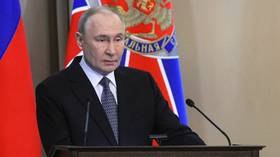
- Putin did not attribute the alleged plot to any party, saying it would be discussed during the closed-door part of the FSB board meeting.
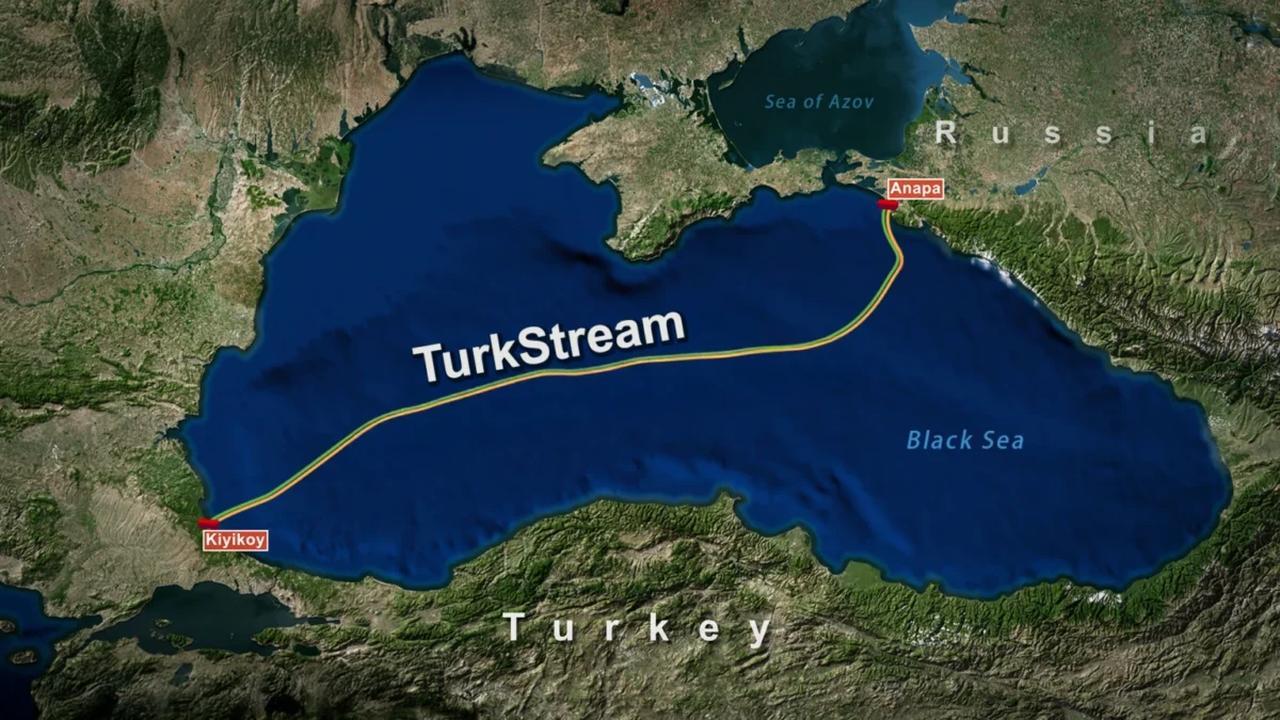
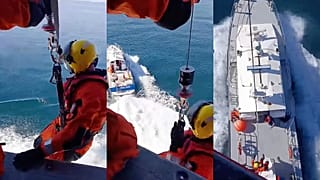
Gas and oil infrastructure in the Black Sea has repeatedly come under Ukrainian attacks amid the conflict between Moscow and Kiev. The attacks involved long-range UAV strikes against various facilities ashore, as well as repeated attempts to target Russian naval vessels patrolling the pipelines with sea drones.
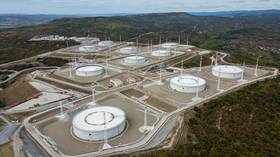
Last October, FSB chief Aleksandr Bortnikov warned that Ukraine and the UK were jointly preparing an attack on TurkStream. London and Kiev have also been plotting attacks on other critical infrastructure sites in Russia, using sea and aerial drones, as well as saboteur divers, Bortnikov said at the time.
The September 2022 bombing of the Nord Stream pipeline in the Baltic Sea is the largest-scale attack on underwater energy infrastructure in modern history. While the theory that it was carried out by a group of Ukrainian divers has become mainstream in the West, Moscow has been skeptical about that version, suggesting instead that Western state actors may have had a hand in the sabotage."



President of Russia Vladimir Putin: Comrades, Mr Bortnikov,
Yesterday, we celebrated Defender of the Fatherland Day, honouring our veterans and the servicemen currently fighting for the Motherland. Within this united, cohesive military formation are both the personnel and employees of the Federal Security Service.
The FSB makes a crucial and significant contribution to safeguarding Russia’s sovereignty and ensuring the security of our citizens. Over the past year, 2025, you and your colleagues commendably fulfilled your assigned tasks across all key areas of operation, demonstrating professionalism and effectiveness in neutralising both internal and external threats.
I would like to express my gratitude to the staff of the central office and the regional branches of the FSB for their service to Russia, their unwavering dedication, and their personal courage.
I particularly wish to acknowledge those directly involved in the special military operation – the border guards, special forces operatives, and military counterintelligence officers, as well as all colleagues and operatives working in our historical and border regions, in Donbass and Novorossiya, who are accomplishing vital tasks to ensure Russia’s security.
For their bravery, more than two thousand FSB service members were awarded state decorations last year, with four receiving the title of Hero of the Russian Federation, one of them posthumously.
I ask you to observe a minute of silence in memory of the FSB employees who lost their lives in the line of duty, our fallen comrades who gave their lives for the Motherland.
(Minute of silence.)
Thank you.
(Addressing Alexander Bortnikov.) Mr Bortnikov, as always, we discuss such matters with you; I am aware that you are in charge of this. Special attention must be accorded to the families.
Meeting participants,
Complex international environment, the sharp escalation of conflicts in a number of regions around the world, and the conduct of the special military operation require maximum composure and concentration from officers of the Federal Security Service. It is important to fully utilise the agency’s personnel and technical potential, as well as its operational and analytical capabilities, in order to promptly and effectively neutralise potential threats, and to reliably protect Russia’s national interests and ensure its stable development.
First and foremost, efforts to combat terrorism must be stepped up. The dynamics of key counterterrorism indicators are clear and dictated by the current operational situation. Having failed to inflict a strategic defeat on Russia on the battlefield, the adversary is now relying on individual and mass terror. This includes shelling of cities, sabotage of infrastructure, and assassination attempts against representatives of state and military authorities.
Yesterday’s terrorist attack at Savyolovsky Railway Station is a case in point, which, of course, requires additional work on your part, but it is already clear that this appears to be a typical case of recruitment carried out via the internet. An explosive device was handed to an individual and then remotely detonated killing the recruit and the intended target, in this case, the Interior Ministry officers. Most likely, as Mr Bortnikov and I have just discussed, that person was kept in the dark about the whole thing, and what happened to him was the result of criminal and reckless behaviour.
The adversary does not shy away from using other means. Reports have appeared in the media about their attempts, or plans, to use some kind of a nuclear component. They should know how that may end.
Our operational information should also be now carried by the media. It should probably be out today, perhaps it already is; I did not have a chance to check. It concerns a possible explosion targeting our gas pipeline systems – TurkStream and Blue Stream pipelines – along the floor of the Black Sea. They simply cannot back down. They do not know what else they can do to undermine this peaceful process aimed at settlement through diplomatic means. They are doing everything possible to stage a provocation and to derail everything that has been, let us put it carefully, achieved at this negotiation track. We will discuss this further behind closed doors.
I just mentioned that they are unable to inflict a strategic defeat on Russia – simply unable – yet they want it so much. They just cannot go on with their lives without it, or believe they cannot. They feel they must defeat Russia. They are searching for any method, any at all, anything whatsoever. They will push themselves too far and later regret it.
So, let us get back to our current work. Last year, the number of terrorist attacks increased. As in recent years, the majority of them were undoubtedly perpetrated by Ukrainian special services and their foreign handlers. At the same time, there has been a significant rise in attacks on Russian infrastructure facilities, social and administrative facilities, and residential buildings with missiles and various types of unmanned aerial vehicles.
In order to respond to such threats more promptly and effectively, a range of additional measures should be implemented, including strengthening the anti-terrorist protection of energy and transport infrastructure and public gathering places, maximising the protection of critical facilities, and, where necessary, adding extra security systems.
This work must be coordinated by the National Anti-Terrorism Committee, which marks its 20th anniversary this year. Over this period, the Committee has made a key contribution to the establishment and development of a modern counter-terrorism system in our country. This vigorous and proactive efforts are especially needed today.
Together with other law enforcement agencies, the Federal Security Service must enhance the security of officials of the Ministry of Defence, the military-industrial complex, as well as state and municipal authorities, and education and social sector personnel, particularly in our historical and border regions. This also fully applies to opinion leaders, journalists, and volunteers who are regularly threatened by the Kiev regime.
Overall, as I have previously noted, our counter-terrorism efforts must be enhanced, with a particular emphasis on pre-emptive action and systematic prevention.
Next, the management system of security agencies operating in the special military operation zone, including in the Donetsk and Lugansk people’s republics, the Zaporozhye and Kherson regions and in border areas, must continue to be improved. These bodies must be staffed with highly professional and experienced personnel capable of operating in any non-standard, complex, or dangerous situation.
Serious additional measures must be adopted to protect the state border. It is necessary to strengthen its infrastructure, enhance the combat readiness and technical equipment of border agencies, and ensure close coordination with units of the Ministry of Defence, the Russian National Guard, and the Ministry of the Interior, as well as territorial structures and relevant government authorities.
Counterintelligence units are also tasked with important tasks, such as strengthening operations in the rear areas of the special military operation zone, providing counterintelligence coverage for combat units, critical industrial facilities, infrastructure, technology, and research centres, and more actively identifying and disrupting the activities of foreign intelligence officers and the agents they recruit.
Particular focus must be placed on protecting confidential and classified information, primarily of a military and strategic nature, including data related to promising domestic defence and civilian developments. We have them, and significant achievements everyone can see and understand have already been presented. However, there are also other solutions that are still in the making.
Colleagues,
The Federal Security Service’s primary task remains combating extremism. Significant results have been achieved in this area in recent years. We must continue to rigorously suppress the criminal activities of those who propagate ideas of Russophobia, xenophobia, and religious intolerance, thereby attempting to divide our society.
This year has been declared the Year of Unity of the Peoples of Russia. Patriotism and shared responsibility for the fate of the Motherland have always united our people. We must cherish, develop, and defend these traditions, firmly responding to any attempts to undermine or weaken the foundations of Russia’s constitutional order.
In this context, special attention must be paid to ensuring the comprehensive security for the upcoming elections to the State Duma and other government bodies. It is crucial that these elections are conducted in strict compliance with the law, reflecting the genuine, sovereign will of the Russian people, and that any external interference in the electoral campaign is ruled out. Neutralising such threats is also a task for your agency, the FSB.
Among other priorities, I would highlight ensuring economic security. Amidst severe sanctions pressure, it is essential to continue efforts to protect the rights of Russian businesses and actively counter crimes in the financial and banking sectors. The effectiveness of import-export operations, the overall competitiveness of our national jurisdiction, and the improvement of investment conditions in Russia largely depend on this.
As before, a key task for the security agencies is combating corruption. Instances of misappropriation of funds allocated for state defence contracts, national projects, and the implementation of large-scale federal and regional programmes must be identified.
I would also note that year after year, statistics record a significant number of crimes in the information space, including acts of cyber-sabotage being planned by foreign intelligence services against our critically important infrastructure. In this regard, it is necessary to develop and enhance the State System for Detecting, Preventing, and Eliminating the Consequences of Computer Attacks on the Information Resources of the Russian Federation.
In strict accordance with legal norms, it is vital to continue ensuring the security of the country’s information and digital space. In collaboration with the Ministry of the Interior, the Ministry of Digital Development, and other relevant agencies, new measures to counter cybercrime must be implemented, taking into account the rapid evolution of information technologies.
Members of the board,
In my opening remarks, I have outlined only some of the key areas of activity for the security agencies. I am confident that you will continue to address all assigned tasks at the highest level and, in cooperation with colleagues from other law enforcement agencies and special services, ensure the reliable protection of the country from internal and external threats.
I place great trust in you and wish you further significant achievements in your work.
Thank you very much.
<…>




No comments:
Post a Comment