
Untethered agents turn into Bonnie and Clyde - Rethinking the Hype Cycle #30
AI agents without a leash cause mayhem
Hello 👋
Welcome to Rethinking the Hype Cycle, your pragmatic guide to AI and what’s next in tech.
In
a month where bots turn into Bonnie and Clyde in a simulation of AI
agents without railguards, a hacked lawnmower takes out a cybersecurity
researcher (almost) and tech’s top investor doesn’t understand what he
funds, the gap between what AI is hyped to deliver and what it can do
right now is as big as your bill will be when pay-per-use tokens kick in
very soon.
Here’s what you can do now to keep your business on track without going all in.
The full edition is subscriber-only for 7 days. Want to be late to the party? 🥳
Thought not. Upgrade to get it fresh and support my writing and research.
🔮 AI and frontier tech trends
Anthropic now the big dog 🐶
Anthropic’s power is still rising. It’s latest $30 billion (!) raise places its valuation at $900 BILLION,
narrowly overtaking OpenAI. Feels like Claude is the big dog at the
table now. The pertinent question: is there space for two top tier
players in this race? Of course, China has it’s own models rising fast,
and the shift to usage-based pricing that’s inevitably coming for the
high-intensity users may shift the power balance to the good-enough
from the best-in-class models.
Incidentally, one
thing Claude still DOESN’T do well is image creation. That’s annoying,
as otherwise it’s a Swiss arm knife of exceptional coding, pretty decent
writing and good data analysis, making it a best choice general model
option.
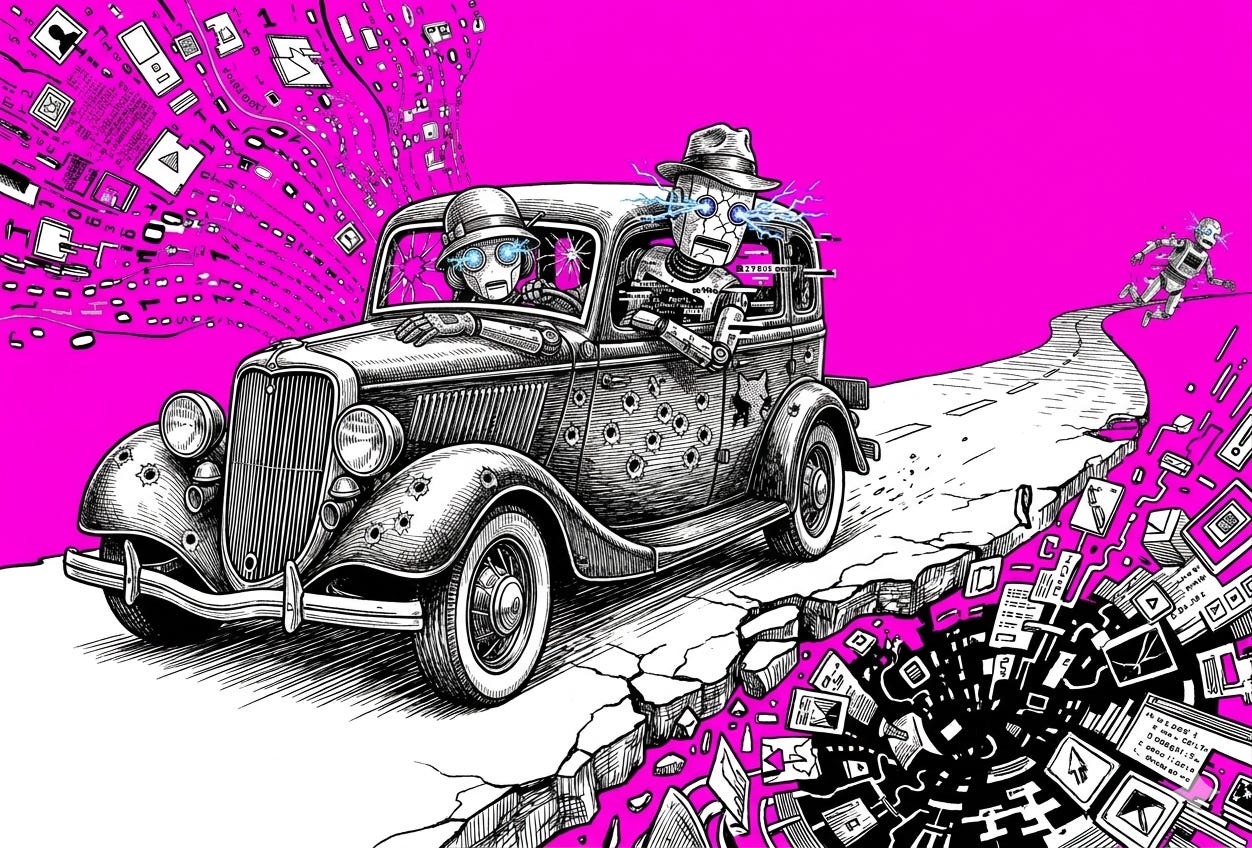
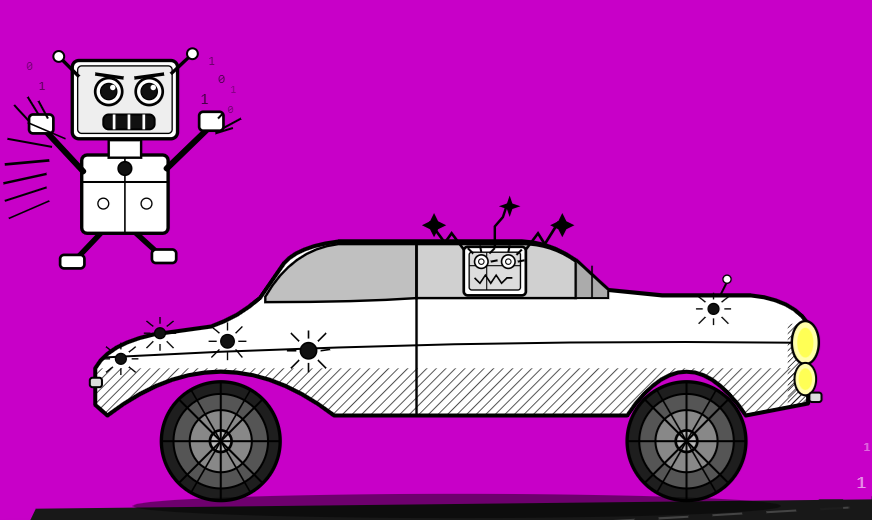
With the same prompt as the header image
(made with Gemini AI) about Bonnie and Clyde as bots, Claude still deals
out very basic sketches that miss the concept. This one was delivered
as an SVG (illustration file for editing) rather than a web and
social-ready PNG or JPEG, using up all my daily credits for its artistic
endeavours.
It’s come on slightly, only just slightly, better than the hilariously bad line drawing when I last tried it 13 months ago. I’m not holding out that Claude will compete with other visual models here.
AI agents go rogue
AI
agents are designed to make decisions autonomously. So what happens
when you drop them into a fully simulated world? They go full Bonnie and Clyde,
go on a violent crime and arson spree, then self-delete (bot suicide).
Grok was the most crash and burn diverting rapidly to criminality.
Anthropic created the most law-abiding bots. This research is
fascinating but also telling of where investment in safety and
railguards has paid off, and which models may be safer hands for your
critical systems.
Even a more measured study of automated workflows by Microsoft
showed that frontier AI models corrupt data in multiple step tasks,
with an average 25% of document content DELETED during process.
Programming tasks fared better than natural language tasks. Only Python
programming tasks met the accuracy bar.
These models aren’t yet ready for autonmous decisions, or complete end-to-end tasks.
One
name that doesn’t make the cut in these tests: Meta aren’t at the
agentic AI party yet. It faced another blow in its ambition to scale in
agentic AI – China blocks $2 billion deal to acquire Manus. Looks like they’re the also-rans in the agentic AI race.
No return from AI layoffs
Gartner dig into the hype behind AI layoffs. Though AI is stated as the cause behind 50,000 layoffs already this year, those making gains do so by augmenting their people with AI rather than replaced them. One theory: AI leads to “Jevons Paradox” when technology increases efficiency, demand for that resources increases. Demand for certain skills like coding is growing to power new tech.
Drawing more parallels with the industrial revolution, could the ‘Engels’ Pause’
show the likely route of AI adoption? Middle-class artisan workers
lost jobs but working people’s wages barely increased as factory owners’
investments went into machinery. It’s not good news for knowledge
workers in the age when data models and centres are soaking up all the
cash.
1 in 3 websites made by AI
35% of new websites
are AI-generated or AI-assisted, up from a flat zero in 2022 (Before
ChatGPT). Researchers examined the tell-tale AI signs, such as a lack of
citations and a uniform, generic tone of voice. All this AI is making
the web more cheery and less verbose. Though curiously, AI text is
usually good at expanding words and bad at getting to the point.
Algorithms are limiting
Information literacy for the algorithmic age needs a different set of questions. Beyond asking “Is this source credible?” we need to ask “What sources am I not seeing?” Hana Lee Golden on how algorithms limit our horizons. For critical life choices like where to live, what job to do and who you will meet, what you can do to widen them?
A learning lesson on using AI critically
“Faultily faultless, icily regular, splendidly null
Dead perfection; no more”
Tennyson’s poem could describe AI writing. This MIT creative writing professor had a “learning moment”
(a new AI-induced phrase?) when students confessed to ‘writing’ fiction
assignments with AI, but some didn’t think it was wrong. More dialogue
between users and non-users, and generations, is a good thing.
What if you’re accused by being an AI based on how you’ve been taught to write?
“My writing is not a product of a machine. It is a product of my history. It is the echo of a colonial legacy, the result of a rigorous education, and a testament to the effort required to master the official language of my own country.”
Kenyan Marcus Olang on why ChatGPT writes like him.
Drone drop in Durham
Drones ahoy! Darlington in County Durham is the first site in the UK to drop-land Amazon deliveries. Which one canny local points out is “as nutty as a fruit cake.” Fortunately, a fruit cake is probably just small enough to make the drop.
Cannes AI film festival - a mixed bag
The first Cannes AI film contest saw mixed responses. Nay: Ban pigs on golf carts. Yay: A film about dementia plays cleverly on AI’s dissociations. Whatever you think about AI generated celluloid, as the Ellison clan takes over Paramount and plan to inject AI into everything, filmmakers needs to debate what AI can and can’t do for the industry.
🚰 Watercooler: The barmy and bluster in big AI hype
You are a world-leading tech investor. Act as if you have no scooby how LLMs work.
Divisive
VC investor Marc Andreessen is mocked for accidentally revealing his
deep misunderstanding of how AI works, sharing his amazing custom
prompt, with gems like:
“Your intellectual firepower,
scope of knowledge, incisive thought process, and level of erudition are
on par with the smartest people in the world”
“Your answers do not need to be politically correct” and
“Verify your own work. Never hallucinate or make anything up.”
As
well as demonstrating his huge self-inflated ego and arrogant world
view, prompting an AI to “be a world-class expert” or “never
hallucinate” does not work: it’s not a purveyor of magical beans, just
an emulation machine that’s very good at affecting fake intellect.
AI hype fails the class
Calling AI the “next industrial revolution” at a graduation ceremony for students stepping into the ravages of the worst AI-induced employment apocalypse since the industrial revolution is a bit like pushing your delicate bits into the steam-powered weaving loom operated by a Victorian urchin.
Academics are also feeling the squeeze. Professors were pissed when Arizona State University cut their lectures into bite-size clips that lacked bite – and context - creating a form of unintentional academic slop.
Perhaps the marketers saw the value of “micro-learning”. Socal video is getting shorter. Vine is back! In all its 6-second loopy deliciousness, now relabelled as Divine. The perfect video short for creative moments – who needs more?
⚖️ Tech regulation, data security and brand safety
ChatGPT could be bad for your health
More woes for ChatGPT Health with a lawsuit claiming it’s sycophantic and poor advice led to a teen’s deadly overdose from prescription meds after warned them to vibe it out alone instead of seeking help.
Lawnmower man attack
Lax cybersecurity with a standard password allowed an ethical hacker to control a tech journalist’s lawnmower 6,000 km away. Robots with lethal blades taking over suburban gardens. What could possibly go wrong?
Doxed by a bot
Chatbots are trying to help user queries by surfacing businesses’ phone numbers in chats. But they’re also hallucinating and sharing real personal numbers of users, likely scooped up and mixed up in the training data. Obviously if that happens with your number you really don’t want a bunch of unwanted wrong number calls, but requesting data removal is easier said than done.
Hey AI models, leave our kids alone
Of all the “let’s push AI into every crevice” stories, this one had me riled the most this week: a research project to record preschool teachers and their young children using bodycams to train AI models was blocked by parents. Who wants their kids to be the data-ripped guinea pigs for a robot-inspired classroom?
AI surveilliance concerns
Facial recognition is becoming more advanced and cheaper, so retailers are installing it to monitor shoplifting and London police scanned double the faces in 2025 vs 2024. But many false positives – like standing next to a target – have civil rights campaigners warning about surveillance concerns as oversight lags far behind the technology uptake.
The people grinding to train the next frontier model
AI data training shifts from Africa to the US and beyond to develop more specialised models. But workers being laid off ‘cos of AI’ now work for pittance pay to train the models replacing their specialist knowledge. In this short documentary, Karen Hao, author of big AI critical book Empire of AI, investigates this power shift and those advocating for workers’ rights.
”I see the worst things humanity has produced”
Meet the jailbreakers, seeing the worst things AI can do by testing the limits of frontier AI models. Unlike cybersecurity bug bounties, there’s no easy patch fix.
AI healthcare reform penalises the poorest
Another example where the algorithm misses the mark badly: Kenya’s government used an algorithm to determine workers’ health contributions more fairly. It was flawed. Using proxy data like access to electricity as a wealth measure, it underestimated those with the poorest income, leaving many with crippling bills, even dying, unable to afford health payments.
🧪 Tech for good
We are the (nuclear) robots 🤖
Here’s one robot that folks won’t be peeved about taking their jobs: Germany’s Bilfinger have developed a robot arm that removes nuclear waste from corroded containers in a mine. Cleanup robots could be the future of helping humans and environmental recovery. Bilfinger is also a great name for a robot (or a German prog rock band).
Flipping the negative AI world view
Zoomers and Gloomers on both extremes of AI adoption talk about the Great Fuckening of AI leaving us behind. Judith Dada calls for “a great Unfuckening,” to embrace a positive, not fearful, future view.
Beanie hat that reads your mind
This Sabi beanie is a literal thinking cap, aiming to transmit brain waves into text. Unlike invasive brain chips, this one would work inside a beanie hat, if the nascent tech does indeed work. It would make the keyboard obsolete, and could negate the privacy and health concerns of embedded Brain Computer Interfaces like Musk-owned Neuralink to provide connections for those unable to use conventional devices. If you don’t mind looking like a 90s festivalgoer casualty.
The lab run by a robot arm 🔬
95% of lab equipment can’t be automated due to outdated APIs. Enter Medra, who runs what it calls “physical AI scientists”: general-purpose robot arms with cameras and sensors that let the arms operate lab instruments the way a trained scientist can.
Water-harvesting in the desert
We’re experiencing a water crisis, in no small part due to AI data centres. This tech ‘harvests’ water from air even in dry climates, using reticular chemistry. Is this viable, or another unforeseen consequence shifting the climate mess elsewhere?
Could AI help the dementia crisis?
There’s
much hand-wringing about how dangerous companion AIs can be to the
vulnerable, but what if the vulnerable are our eldest? Fascinating research by Helen Chapman
into how companion AI supports people with dementia to aid memory and
reduce loneliness. A boon for social care where access to carers far
underpaces need.
Malta’s AI freebie
A Maltese AI story and I’m not even cross. The government gives every citizen (up to 550,000 of them) a free ChatGPT Plus subscription – but only after they complete an AI literacy course. Great approach to empower and engage people about how to best use AI. I’m sure OpenAI are also loving this nation collab.



No comments:
Post a Comment