What do the PLA’s ‘Steel Rain’ shells say about its war plans for Taiwan?
New airburst munitions that shower targets with metal fragments are designed to attack personnel and lightly protected equipment
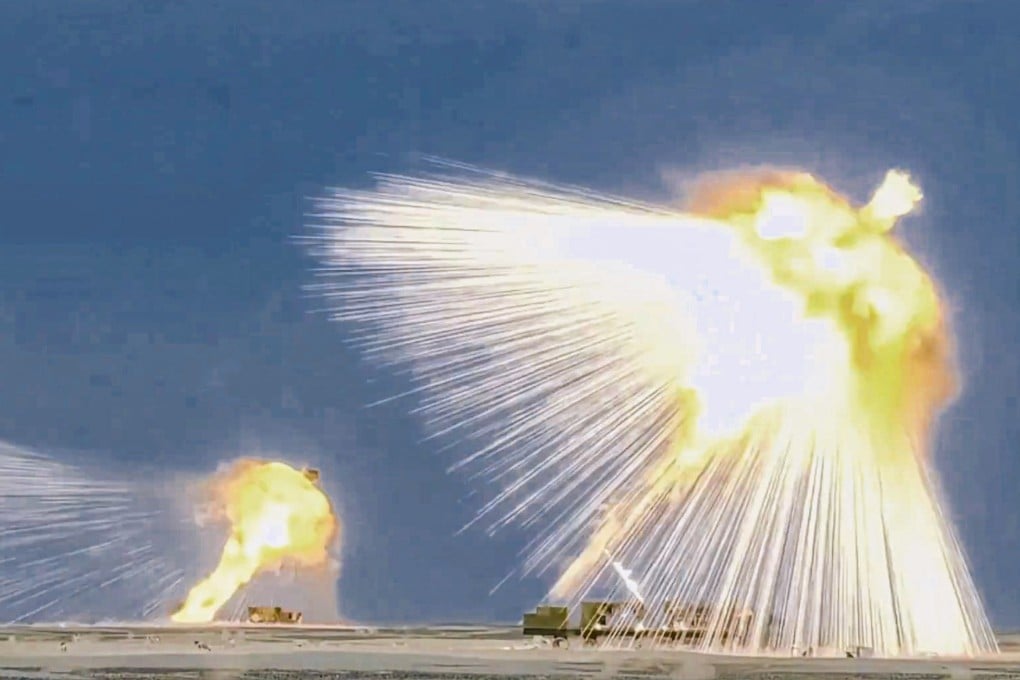
Released on Sunday by the PLA-affiliated China Military Bugle social media channel under the title “Steel Rain”, the footage shows several PHL-191-launched rockets detonating above what appears to be a desert training range, showering a wide area with high-speed metal fragments.
The video appears intended to highlight an airburst fragmentation warhead designed to attack personnel and lightly protected equipment.
- The timing of the video’s release fits a broader pattern of intensifying military signalling across the Taiwan Strait, though Beijing and its regional rivals appear to be emphasizing different aspects of a potential conflict.
During the military drill Strait Thunder-2025A in April last year, two PHL-191 launchers fired 16 precision-guided rockets at eight simulated targets, including a mock-up of Kaohsiung’s Yong’an LNG terminal.
And Justice Mission 2025 in December saw PHL-191 rockets landing inside Taiwan’s 24-nautical-mile self-defined contiguous zone – the closest PLA rockets have come to the island’s coast since the 1996 Taiwan Strait crisis.
Analysts say the footage suggests that, in a Taiwan conflict, Beijing could prioritise efforts to disrupt Taiwan’s ability to detect, communicate and respond before larger air and amphibious operations begin.
“The use of airburst rockets is notable because it signals that these particular weapons would not be used for targeting assets that Taiwan normally stores in mountains and bunkers,” said Mike Bosack, director of the Parley Policy Initiative.
“Instead, they would be used to disrupt critical infrastructure, warships, radars and air/coastal defence assets.”
That aligns with Taiwan’s long-standing emphasis on dispersing forces and protecting them in underground facilities and hardened shelters, according to Tristan Tang, a non-resident fellow at the National Bureau of Asian Research.
Under such conditions, Tang said, airburst munitions were likely to be more effective against exposed targets that must move, assemble, or operate in the open.
By scattering thousands of high-velocity fragments above ground level, the munitions are engineered to strike exposed, unarmoured targets across a wide footprint.
Tang said that, in addition to exposed military targets such as radar sites, air-defence batteries and aircraft parked in the open, rockets could be directed at peripheral nodes of critical infrastructure.
Rather than attacking heavily fortified power plants directly, strikes could target vulnerable nodes such as electrical switchyards, substations and transformers.
Such attacks could cause widespread power outages and system degradation at a far lower cost per strike.
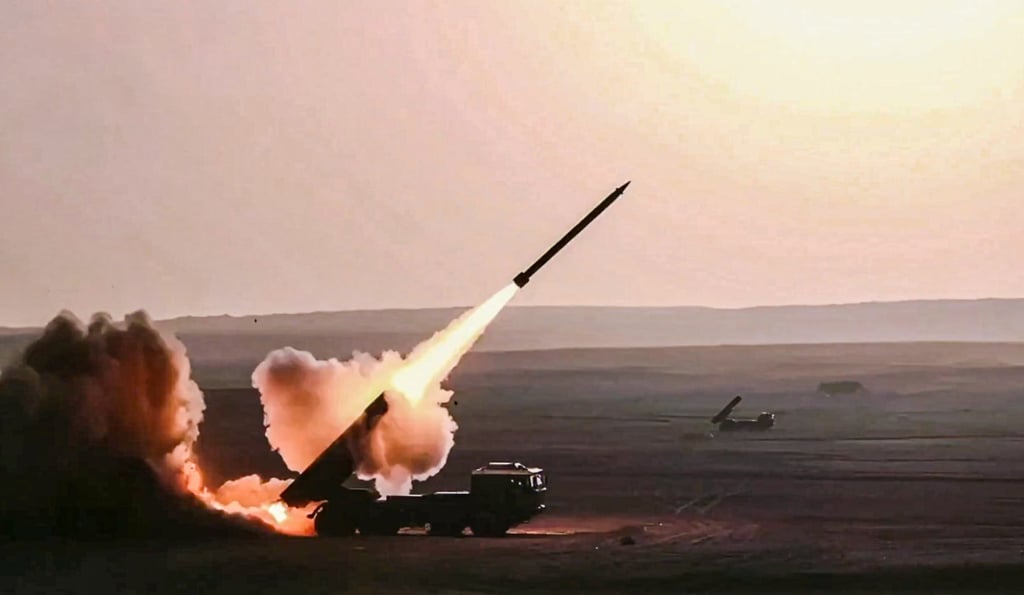
Mounted on an 8x8 truck chassis, the PHL-191 can fire a range of guided rockets and tactical missiles with reported strike ranges of between about 300km (186 miles) and 500km, placing virtually all of Taiwan within reach from launch positions along mainland China’s southeastern coast.
“Taiwan has likely mapped the possible static launch locations that would be used in any conflict, but the use of such mobile systems creates a targeting nightmare for opposing forces,” Bosack said.
As Bosack noted, the ability to launch these weapons “from a soccer field as easily as from a military base” frees the PHL-191 from reliance on vulnerable fixed infrastructure.
This complicates Taiwan’s targeting efforts and sustaining repeated salvoes during the early hours of an assault.
During the opening phase of a conflict, the priority would be to disrupt Taiwan’s ability to detect, communicate and coordinate a response, Bosack said.
“They would likely be used in the opening salvo to sow chaos among Taiwanese forces and to clear the way for other Chinese air and amphibious assaults,” he said.
“This means that radars, energy infrastructure and communications relays are likely targets here.”
If a full-scale attack was under way, however, the rockets would likely transition to a more tactical role.
According to Malcolm Davis, a senior analyst at the Australian Strategic Policy Institute, the system would support a joint island-landing campaign by suppressing coastal defenders before PLA forces advanced inland.
Tang said logistics would also become an increasingly important target, as supply convoys, fuel trucks and other support vehicles would have to leave cover and move along roads, making them vulnerable to wide-area fragmentation attacks.


No comments:
Post a Comment