Jul
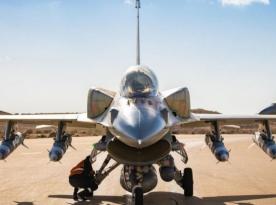
The U.S. Air Force is redeploying F-16CJ Block 50 fighters from Germany to the Middle East as operations against Iran expand, according to movements identified on July 17, 2026.
Their arrival gives U.S. commanders more aircraft specialized in finding and destroying Iranian radars and surface-to-air missile systems, helping clear routes for strike missions along the coast and deeper inland.
- The Pentagon has not disclosed the number of aircraft, their destination, or their weapons loadout.
- The squadron’s rapid return to the region signals a growing need for dedicated air-defense suppression and strike-escort capacity rather than additional general-purpose fighters. Read more...
U.S. Air Force F-16CJ Block 50 fighters are deploying to the Middle East to suppress Iranian air defenses, escort strike aircraft, and use AGM-88 anti-radiation missiles against radar and surface-to-air missile sites (Picture source: U.S. DoW).
Jul
The U.S. Navy’s Zumwalt-class destroyers are now 24 months behind schedule in gaining the Conventional Prompt Strike hypersonic missile, delaying the fleet’s first surface-launched hypersonic strike capability.
- A Government Accountability Office report published on July 17, 2026, says the first ship-based flight test has slipped to the third quarter of fiscal year 2027, pushing back certification, crew qualification, and operational deployment.
USS Zumwalt was 94% through modernization in January 2026, but the three-ship conversion effort has risen from $1.8 billion to at least $2 billion. - With only three destroyers in the class, any delay removes a third of the planned force and makes it harder to sustain a cycle of deployment, training, and maintenance.
Read more...A Zumwalt-class destroyer is shown at sea. The U.S. Navy is modernizing all three ships of the class to carry up to 12 Conventional Prompt Strike hypersonic missiles, although the program is currently running about two years behind schedule (Picture source: U.S. DoW).
The U.S. Air Force has moved its VENOM program into piloted flight testing, demonstrating that artificial intelligence can autonomously fly a modified F-16 Fighting Falcon under the supervision of a safety pilot, a milestone that brings AI-enabled combat aviation closer to operational reality. The latest trials at Eglin Air Force Base, Florida, highlight the United States' accelerating effort to field autonomous technologies to increase combat effectiveness, survivability, and decision speed in future air operations.
Read full Defense Aerospace News at this link …
 |
| A U.S. Air Force F-16 Fighting Falcon fighter jet modified for the Viper Experimentation and Next-generation Operations Model–Autonomy Flying Testbed (VENOM) program conducts autonomous systems flight testing at Eglin Air Force Base, Florida, in June 2026. (Picture source: U.S. Air Force) |
Read More The Oregon Air National Guard’s 142nd Wing released bombs from operational F-15EX Eagle II fighters at Mountain Home Air Force Base in early May 2026, marking the first weapons employment by a combat-coded F-15EX unit, the U.S. Air Force disclosed on July 17. The event showed that the aircraft has moved beyond developmental testing and can now support routine strike training through an operational wing. Across ten missions, the unit dropped 36 full-size inert bombs while qualifying aircrews, certifying weapons loaders, and generating armed sorties without safety incidents.
- The result confirms that the F-15EX can be integrated into frontline maintenance and weapons operations, strengthening its value as a high-payload platform for strike, deterrence, and future force modernization.
The Oregon Air National Guard’s 142nd Wing conducts the first bomb drops by an operational F-15EX Eagle II unit, releasing 36 inert 500- and 2,000-pound training bombs during ten missions at Mountain Home Air Force Base in May 2026 (Picture source: U.S. DoW).
INSERT:
Jul
17
Exclusive reporting by Army Recognition Group from Eurosatory 2026 in Paris reveals that the exhibition has become the benchmark for main battle tank technology in 2026, showcasing the digital capabilities expected to shape the next generation of NATO armored forces and future export markets. As European manufacturers accelerate development of AI-enabled, networked combat vehicles, they are positioning their latest platforms to compete with the U.S.
Jul
17
China’s new Type 076 amphibious assault ship Sichuan is introducing a capability that no U.S. or NATO amphibious assault ship currently possesses, combining an electromagnetic catapult and arresting gear to launch and recover fixed-wing combat drones from an amphibious platform.
Jul
17
U.S. Marines from the 11th Marine Expeditionary Unit (11th MEU) boarded the commercial tanker M/T Wen Yao in the Gulf of Oman on July 16, 2026, as part of a verification operation supporting the U.S. maritime blockade against Iran, highlighting Washington’s expanding ability to police shipping around the Strait of Hormuz. Announced by U.S. Central Command (CENTCOM) on July 17, 2026, the mission underscores a more assertive U.S.
Jul
17
Nevsky Shipyard launched the fourth Project 23130 replenishment oiler, the Aleksei Shein (904), in Shlisselburg on July 14, 2026, marking the third serial vessel produced under a December 17, 2020 contract for the Russian Navy. The medium sea tanker is structurally designated for the Baltic Fleet to support surface ships and submarines operating out of Baltiysk and Kronstadt into the North Atlantic and Arctic corridors.
Jul
17
On July 15, 2026, Auriga Space and the U.S. Army Combat Capabilities Development Command Armaments Center signed a three-year Cooperative Research and Development Agreement to evaluate electromagnetic launchers for counter-drone operations. The joint initiative integrates Auriga's existing electromagnetic accelerator infrastructure with the military's weapon qualification and range-testing facilities at Picatinny Arsenal.
Jul
17
Mack Defense announced on July 14, 2026, that the U.S. Army had ordered 115 additional M917A3 Heavy Dump Trucks for the Army National Guard, expanding its ability to rebuild routes, airfields, and logistics hubs under demanding conditions. Each protected 8×8 truck can carry up to 27 tons of aggregate, earth, rubble, or paving material, giving Guard units more capacity to restore mobility and sustain operations after combat damage or disasters.
Jul
17
The United Kingdom will replace its armoured battlegroup in Estonia with a Mobile Anti-Armour Force (MAAF) from April 2027, increasing its deployed contingent to around 1,200 personnel. The move aligns Britain's NATO posture with the realities of high-intensity warfare, emphasizing mobility, precision strike capabilities, drones, and networked targeting.
Jul
17
EDGE has signed an agreement to acquire 100 percent of Brazilian aerospace engineering firm AKAER, expanding the Emirati defense group's global industrial footprint. The move strengthens EDGE's aerospace engineering capabilities while deepening its role in advanced defense technology development. The acquisition, which remains subject to customary regulatory approvals, builds on an existing partnership between EDGE and AKAER in unmanned aerial vehicle development.
Jul
17
Canada will add 190 Armoured Combat Support Vehicles to its fleet under a nearly C$2 billion investment announced by Prime Minister Mark Carney on July 16, 2026, raising the planned inventory from 360 to 550 vehicles. The expansion will give LAV 6.0-equipped units more protected support capacity while reducing reliance on older Bison and M113-derived platforms with lower commonality and different protection standards.
Jul
17
On July 15, 2026, Japan's Acquisition, Technology and Logistics Agency (ATLA) commenced the formal flight-test campaign for the XEC-2 stand-off electronic warfare aircraft at Gifu Air Base, officially transferring the platform to the Japan Air Self-Defense Force Air Development and Test Wing.
Jul
17
France has completed the first weapons-firing campaign for the H160M Guépard, with the DGA and Airbus Helicopters testing the aircraft at Cazaux, the DGA reported on July 15, 2026. The milestone moves the joint light helicopter closer to operational service by validating its ability to deliver firepower while maintaining safe and stable flight. The campaign tested the Guépard’s 12.7 mm forward-firing gun, cabin-door weapons, countermeasure dispensers and mission computer in flight.
Jul
17
The U.S. Air Force and DARPA have begun flying an F-16 under artificial-intelligence control at Eglin Air Force Base, a test effort DARPA disclosed on July 16, 2026. The VENOM program gives developers a combat-representative platform for testing autonomous air-combat software against real aircraft limits, sensors, and mission systems. During June flight operations, a safety pilot could transfer control between the cockpit and the AI agent through a dedicated switch.
Jul
17
The U.S. Department of State has authorized a potential $80.1 million Foreign Military Sale to Greece for 350 Switchblade 300 Block 20 loitering munitions, 35 Fire Control Systems, and associated dual-class support equipment. The proposed procurement establishes an accelerated delivery timeline targeting late 2026 to rapidly field organic, tactical precision-strike capabilities for the Hellenic Armed Forces' Special Warfare Command.





No comments:
Post a Comment