
Friday, December 30, 2016
Agenda: Economic Development Advisory Board Meeting Jan 3 2017
Blogger's Note: No Approved Minutes of meetings on Oct 4 and Nov 3 2016 have been published or made available to the public on the official website
http://apps.mesaaz.gov/meetingarchive/meetings?body=EDAB
Meeting Notice & Agenda
Economic Development Advisory Board
City Council Chambers 57 E. 1st Street, Lower Level
Tuesday, January 3, 2017 7:30 AM
1. Chair’s Call to Order
2. Items from Citizens Present
3. Approval of Minutes from December 6, 2016 meeting
4. Discussion on Economic Development with Councilmember elect Mark Freeman
5. Downtown Mesa Association
6. Director’s Update
7. Other Business
Next EDAB Meeting- February 7th
8. Adjournment
http://apps.mesaaz.gov/meetingarchive/meetings?body=EDAB
Meeting Notice & Agenda
Economic Development Advisory Board
City Council Chambers 57 E. 1st Street, Lower Level
Tuesday, January 3, 2017 7:30 AM
1. Chair’s Call to Order
2. Items from Citizens Present
3. Approval of Minutes from December 6, 2016 meeting
4. Discussion on Economic Development with Councilmember elect Mark Freeman
5. Downtown Mesa Association
6. Director’s Update
7. Other Business
Next EDAB Meeting- February 7th
8. Adjournment
Rogue Columnist Jon Talton Cuts Through The Hype About Phoenix

If you, dear readers, skipped over a featured post on the findings in a Millen Institute report posted on this site earlier, here's an opportunity to read the findings in the context and narrative provided by this Seattle-based reporter

Jon Tilton December 29, 2016
Back in the 2000s, Phoenix was always at or near the top of the Milken Institute's list of best-performing cities. The local-yokel boosters made much of this. In reality, the metric was based on job growth and Phoenix looked pretty good, powered by the housing boom.
What a difference does the housing crash, Great Recession, and better measurements make. A few years ago, Milken retooled its survey. Now Milken uses a wide variety of yardsticks to present a more accurate and comprehensive look at how metropolitan areas are doing.
In the new 2016 Best Performing Cities, metro Phoenix comes in at 46th.
Going deeper, Phoenix's
- five-year job growth ranked 40th;
- five-year wage and salary growth 63rd;
- short-term growth 76th;
- five-year high-tech GDP growth 56th (one-year was 110th);
- high-tech location quotient 56th
- number of highly concentrated tech industries 63rd.
At the top were Silicon Valley, Provo-Orem, Utah, Austin, San Francisco and Dallas. Among other Western peers was Seattle No. 10, Denver No. 13, and Portland No. 14. Blue "socialist" California won six of the top 25 spots among major metros. By comparison, Tucson was No. 155. Among small metros, Prescott was No. 33, Flagstaff 81, and Yuma 146. Bend, Ore., led the small metros.
Milken's emphasis on high-tech is important because this has been the sweet spot of the long recovery from the Great Recession. Cities at the headwaters of talent, innovation, and tech headquarters have done very well. For example, the hottest residential real-estate market is not in the Sun Belt but Seattle.
Another area of high performance in today's economy has been the "back to the city" phenomenon, with companies moving to vibrant downtowns to attract talented millennials and others who want a car-free lifestyle and the choices of a dense, lively city. While downtown Phoenix has made more progress, it has largely missed this gravy train. Most economic activity, and most of it low-end, is in the suburbs.
Phoenix continues to play its old game — largely without the Cold War tech industries that helped diversify the economy in the decades after World War II. Add population, build tract houses, put up spec commercial and industrial space, sell sunshine. It's not a path to prosperity or success for such a large metropolitan area. Particularly one sitting at ground zero for climate change. Even the occasional headline about "another" Silicon Valley company setting up shop "in the Valley" reveals a back-office operation seeking cheap, low-skilled workers.
So much for the performance of low-tax, little-regulation Duceynomics.
Even by Phoenix-centered metrics, the bird falls short. In the latest Emerging Trends in Real Estate, another gold-standard survey, the top cities are Austin, Dallas, Portland, Seattle, and Los Angeles. Places with, you know, real economies to support real estate. Phoenix comes in a middling 21st (Tucson 62nd).
The devastation of the housing crash was so severe that it took until 2015 for Phoenix to recover to its pre-recession peak in jobs. But there's a big difference:
Job growth has been much more restrained than in previous expansions. Only about 20,000 worked in construction as of October, compared with a peak of 33,800 in the go-go years of the 2000s.
This is the recovery. All Phoenix got was a lousy T-shirt.

Bird on Fire: Lessons from the World's Least Sustainable City
Book by Andrew Ross
"Phoenix, Arizona is one of America's fastest growing metropolitan regions. It is also its least sustainable one, sprawling over a thousand square miles, with a population of four and a half million, minimal rainfall, scorching heat, and an insatiable appetite for unrestrained growth and unrestricted property rights. In Bird on Fire, eminent social and cultural analyst Andrew Ross focuses on the prospects for sustainability in Phoenix--a city in the bull's eye of global warming--and also the obstacles that stand in the way. Most authors writing on sustainable cities look . . . "
Source: Google books
A somewhat more optimistic POV was online with this cautionary note ending with the usual euphemism 'room for improvement'
Downtown Phoenix, once an afterthought, now a residential hotspot
Artists and astute planning turned a blank slate of empty blocks into a boomtown
"While the development of a true 24-hour downtown gets near universal praise—having literally thousands of new residents downtown is a success story—many caution that the city’s traditional, developer-friendly culture may push out some of the elements that helped start this boom. In and around Roosevelt Row, Esser is seeing some of the pioneers being pushed out due to rising rents, and others point to the need for more middle-income housing amid the new high-end apartment boom. The bigger, long term challenge is getting young people, artists, and others more engaged in the community and cultural ecology of downtown Phoenix. He feels there’s still room for improvement."Curbed Nov 4, 2016
Wednesday, December 28, 2016
Meeting: You Can Attend In-Person or Conference Call > Get Informed

Stakeholder Meeting
Proposed Changes
to Arizona Emissions Bank
Dear Stakeholder,Proposed Changes
to Arizona Emissions Bank
ADEQ, in partnership with the Maricopa County Air Quality Department (MCAQD), is contemplating changes to the Arizona Emissions Bank to allow for the recovery of emission reduction credits that are not recognized by current regulations.
ADEQ and MCAQD invite you to attend a meeting regarding these changes, at which we will identify concerns, propose changes, and gather your input.
Attend the meeting in person or via conference call:
When: Thurs., Jan. 5, 2017, 10:00 a.m. to 12:00 p.m.Where: ADEQ, 1110 W. Washington St., Third Floor, Room 3175, Phoenix AZ, 85007
Conference Call: 1-877-820-7829 | Passcode: 228497#
In preparation for the meeting, please review the below materials, which include draft language from MCAQD, an example statute from Texas, and AZ's current statute and regulations.
 |
Hey! Got About 7 Minutes to Listen?
A Talk: Robert Stark interviews Charles Marohn from Strong Towns

Robert Stark and co-host Pilleater talk to Charles Marohn. Charles is a Professional Engineer (PE) licensed in the State of Minnesota and a member of the American Institute of Certified Planners (AICP). Chuck is the Founder and President of Strong Towns. He has a Bachelor’s degree in Civil Engineering from the University of Minnesota’s Institute of Technology and a Masters in Urban and Regional Planning from the University of Minnesota’s Humphrey Institute.
Topics:
How Charles’s background in urban planning exposed him to the problems of sprawl development
Charles’s books Thoughts on Building Strong Towns, Volume 1 & Volume II
The fiscal unsustainability of sprawl development
Charles’ point that the key factor in urbanism is Incremental Development
Charles’s point that cities must be viewed as ecosystems
The “build it they will come” fallacy, and how traditionally massive infrastructure projects were designed to serve existing population centers(ex.Roman Aqueducts)
How pre-automobile cities tend to be the most viable
Nassim Taleb’s Antifragile theory, and how it relates to urbanismThe Density Question, Charles point that density should neither be fetishized nor seen as inherently bad, but must take into account incremental development
How cities such as New York and San Francisco have value independent of their economies, while places like the Silicon Valley would become unviable if their industries collapsed
Zoning laws and land use regulations
The movement to Retrofit Suburbia, how it’s a step in the right direction, but has it’s limitations
How cities will contract in the future, with people living in both cities and towns, but that it’s the space in between that’s unviable
Micro Apartments
Political divides, and how when it comes to planning issues on a local level, people tend to be more pragmatic than dogmatic
The Public vs. Private sector role in infrastructure, and how Charles’s point that things that are high risk should be in the private sector, and low risk in the public sector(ex. Wall Street baillouts)
The role of the government in historic preservation and protecting the environment
Housing and affordable family formation
Audio Player
Click Here to download!
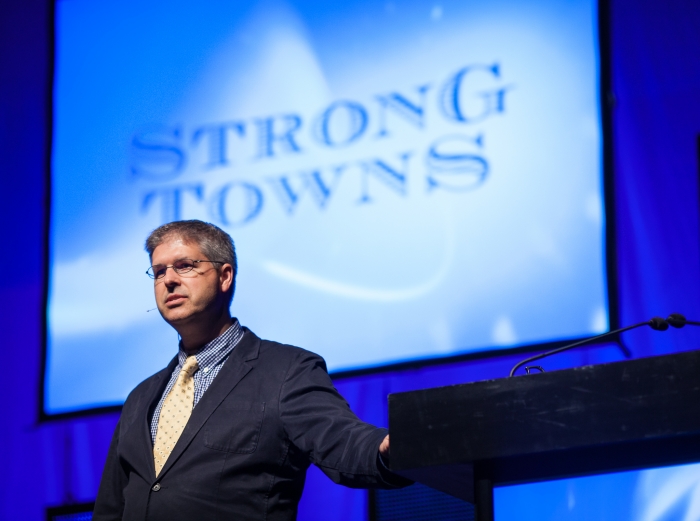
Robert Stark and co-host Pilleater talk to Charles Marohn. Charles is a Professional Engineer (PE) licensed in the State of Minnesota and a member of the American Institute of Certified Planners (AICP). Chuck is the Founder and President of Strong Towns. He has a Bachelor’s degree in Civil Engineering from the University of Minnesota’s Institute of Technology and a Masters in Urban and Regional Planning from the University of Minnesota’s Humphrey Institute.
How Charles’s background in urban planning exposed him to the problems of sprawl development
Charles’s books Thoughts on Building Strong Towns, Volume 1 & Volume II
The fiscal unsustainability of sprawl development
Charles’ point that the key factor in urbanism is Incremental Development
Charles’s point that cities must be viewed as ecosystems
The “build it they will come” fallacy, and how traditionally massive infrastructure projects were designed to serve existing population centers(ex.Roman Aqueducts)
How pre-automobile cities tend to be the most viable
Nassim Taleb’s Antifragile theory, and how it relates to urbanismThe Density Question, Charles point that density should neither be fetishized nor seen as inherently bad, but must take into account incremental development
How cities such as New York and San Francisco have value independent of their economies, while places like the Silicon Valley would become unviable if their industries collapsed
Zoning laws and land use regulations
The movement to Retrofit Suburbia, how it’s a step in the right direction, but has it’s limitations
How cities will contract in the future, with people living in both cities and towns, but that it’s the space in between that’s unviable
Micro Apartments
Political divides, and how when it comes to planning issues on a local level, people tend to be more pragmatic than dogmatic
The Public vs. Private sector role in infrastructure, and how Charles’s point that things that are high risk should be in the private sector, and low risk in the public sector(ex. Wall Street baillouts)
The role of the government in historic preservation and protecting the environment
Housing and affordable family formation
Audio Player
Click Here to download!
How Not To Be Angry all the Time
Published on Dec 28, 2016
Views: 22,000
At the root of some of our angriest moods lies a surprising emotion: optimism. If you like our films, take a look at our shop (we ship worldwide): https://goo.gl/XF9elh
Join our exclusive mailing list: http://bit.ly/2e0TQNJ
Or visit us in person at our London HQ https://goo.gl/kd4Mkg
FURTHER READING “Angry people sound like gloomy types. We certainly don’t usually think of them as optimists – and yet, beneath their gruff surface, they truly are, much to their cost…” You can read more on this and other topics on our blog TheBookofLife.org at this link: https://goo.gl/uLMl60 MORE SCHOOL OF LIFE Our website has classes, articles and products to help you think and grow: https://goo.gl/HuCT1E Watch more films on SELF in our playlist: http://bit.ly/TSOLself Do you speak a different language to English? Did you know you can submit Subtitles on all of our videos on YouTube? For instructions how to do this click here: https://goo.gl/XpwC9a SOCIAL MEDIA Feel free to follow us at the links below: Facebook: https://www.facebook.com/theschoolofl... Twitter: https://twitter.com/TheSchoolOfLife Instagram: https://www.instagram.com/theschoolof... CREDITS Produced in collaboration with: Jocie Juritz http://www.jociejuritz.co.uk/ https://vimeo.com/jociejuritz
Quakes Striking > Pressure + Heat Building In The Planet
Heads up/Be safe
Published on Dec 28, 2016
Views:5,810
All Links @ http://www.BPEarthWatch.Com
Published on Dec 28, 2016
Views:5,810
All Links @ http://www.BPEarthWatch.Com
Subscribe to:
Posts (Atom)
CARTOON CAROUSEL
Cartoon Carousel The nation’s cartoonists on the week in politics Every week political cartoonists throughout the country and across the p...

-
 Flash News: Ukraine Intercepts Russian Kh-59 Cruise Missile Using US VAMPIRE Air Defense System Mounted on Boat. Ukrainian forces have made ...
 -
A nor’easter is about to hit the Northeast in May. That’s very unusual.

