

Toplines
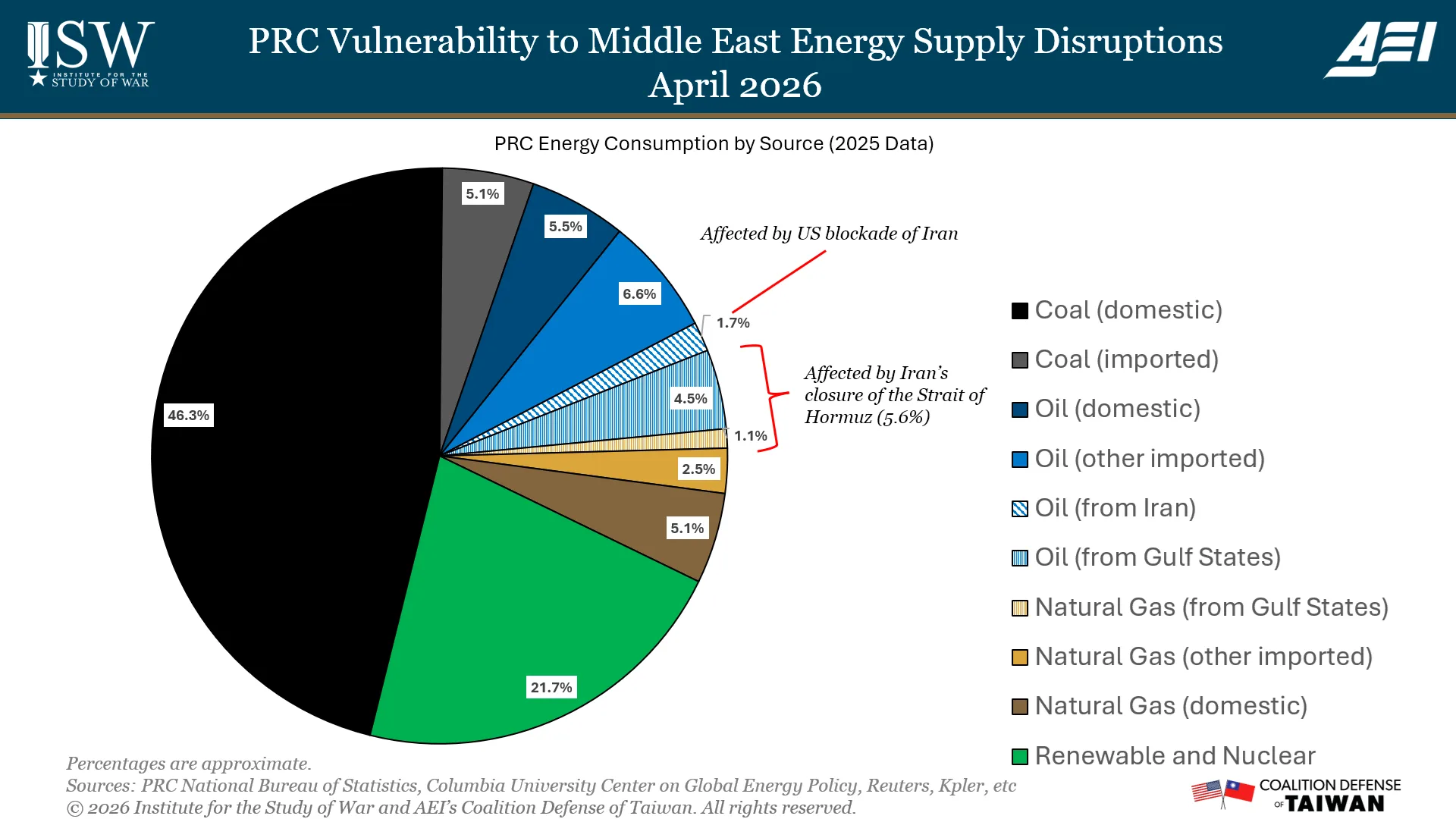
- Less than 7% of the PRC’s overall energy consumption is from Middle Eastern oil, however.[28]
- The PRC also has insulated itself from supply shocks by diversifying its energy supplies and stockpiling nearly 1.4 billion barrels of oil in December 2025.[29]
- The PRC has continued to purchase Iranian oil throughout the war by accepting imports from tankers that were already in transit or were storing oil at sea when the war began, despite the blockage of the Strait of Hormuz.[30]
- The PRC’s invocation of the anti-sanctions law, together with new April 7 and April 13 regulations on industrial and supply chain security, expands the PRC legal framework to counter foreign sanctions and other related measures and prosecute foreign companies perceived to be acting against PRC interests.[31]
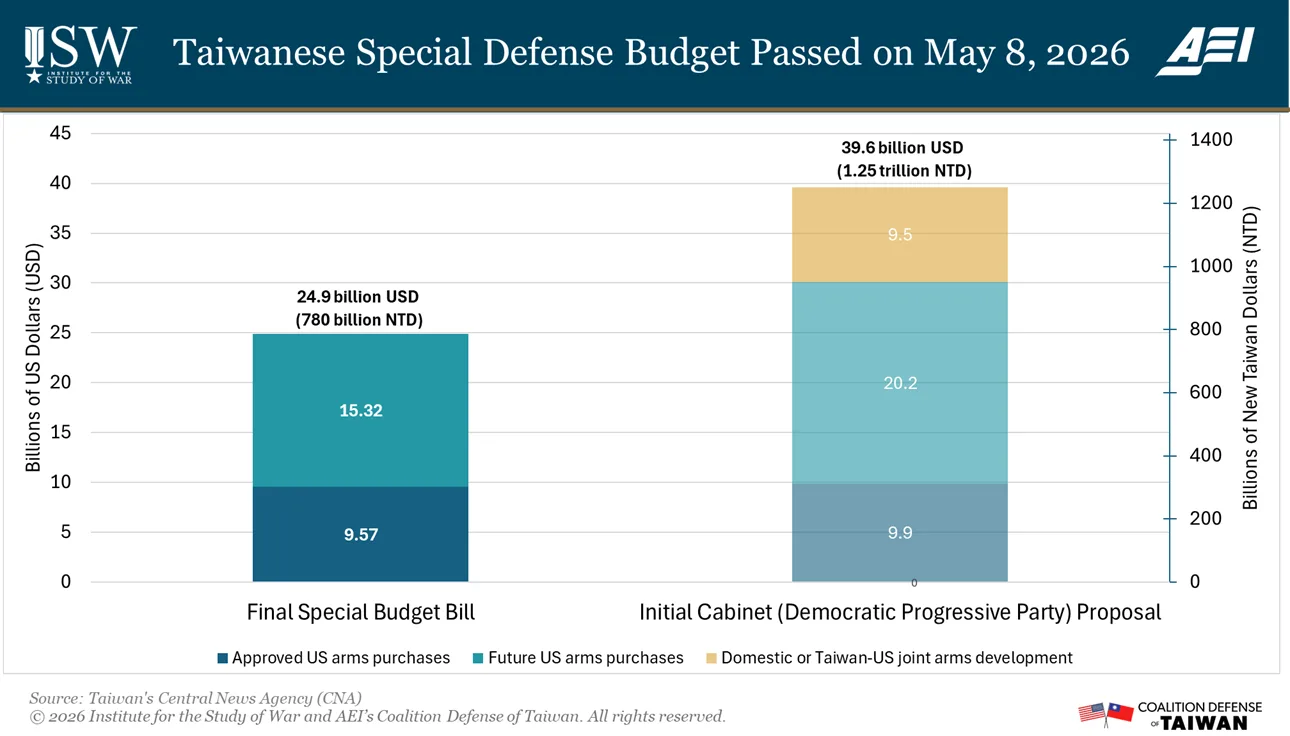
The Taiwanese Legislative Yuan (LY) passed a special defense budget totaling 780 billion New Taiwan Dollars (NTD) (roughly 25 billion USD) on May 8.
- The first round allocates 300 billion NTD for High Mobility Artillery Rocket Systems (HIMARS), M109A7 self-propelled howitzers, anti-armor drone missile systems, and Javelin and TOW anti-tank guided missiles.
- The second round will allocate 480 billion NTD for anti-ballistic missile systems, low and medium altitude air defense systems, counter-drone systems, and the replenishment of anti-tank guided missiles.[32]
- The budget lacks the funding for domestic weapons development, the ‘T-Dome’ missile defense network, and joint US-Taiwan manufacturing found in the Executive Yuan’s (EY) version.[33]
- The opposition Kuomintang (KMT) and Taiwan People’s Party (TPP) voted to pass the budget.
- The ruling Democratic Progressive Party (DPP) continued to support the EY’s 1.25 trillion NTD (roughly 40 billion USD) budget.[34]
KMT Chairwomen Cheng Li-wun met Taichung Mayor Lu Shiow-yen and Legislative Speaker Han Kuo-yu on May 7. Lu and Han favored the 25 billion USD budget over the KMT’s original proposed budget of “380 billion + N” NTD (roughly 12 billion US dollars plus an unspecified amount ‘N’ for future arms purchases) favored by Cheng.[35]
The KMT and TPP likely accepted a larger budget than their original proposals due to pressure from the United States and a desire to align with mainstream public opinion prior to the November local elections.[36]
- This smaller defense budget will limit Taiwan’s ability to invest in its domestic defense industries and key military system research.
Key Takeaways
- US-PRC Diplomacy: Diplomatic engagements between the United States and the PRC preceding next week’s summit between US President Donald Trump and CCP General Secretary Xi Jinping indicate that US-PRC trade, US arms sales to Taiwan, and the Iran war will be major topics of discussion.
- PRC-Iran Relations: Iranian Foreign Minister Abbas Araghchi visited the PRC for the first time since the Iran War began, possibly to coordinate with the PRC prior to the Xi-Trump meeting. The PRC’s stated positions suggest that it seeks an end to active hostilities and eventual reopening of the Strait of Hormuz, but is unlikely to increase its involvement in the conflict.
- PRC Economic Policy: The PRC presented seemingly contradicting guidance regarding whether PRC entities should abide by US sanctions. The PRC may be attempting to mitigate risks posed by US sanctions without projecting weakness ahead of the Trump-Xi meeting.
- Taiwanese Special Defense Budget: The Taiwanese LY passed a special defense budget totaling 780 billion NTD on May 8, despite efforts by KMT Chairwoman Cheng Li-wun to pass a smaller version of the budget plan. The 780 billion NTD budget lacks the funding for Taiwanese domestic weapons development, the ‘T-Dome’ missile defense network, and joint US-Taiwan manufacturing, however.
Cross-Strait Relations
Taiwanese President William Lai Ching-te circumvented PRC efforts to limit Taiwanese diplomatic engagement by successfully visiting Eswatini, Taiwan’s only diplomatic ally in Africa.
Taiwan’s Ministry of National Defense (MND) reported that its emergency loan program for Taiwanese military personnel has disbursed around 6.7 million US dollars since January 1. The program could hinder PRC efforts to recruit spies by exploiting financial insecurity among Taiwanese soldiers.Southeast Asia
Philippines
The 2026 Balikatan exercises focused on enhancing interoperability among US allies in the Indo-Pacific and developing a denial-based defense concept within the first island chain that integrates lessons from the war in Ukraine.
- Warships from the United States, the Philippines, Japan, Australia, and Canada conducted combined exercises focusing on anti-submarine operations, fleet air defense, and replenishment at sea in the West Philippine Sea from April 20 to May 1.[67]
- This is the first time that Japan has joined Balikatan as an active participant.[68]
- US, Philippine, and Japanese forces also practiced defending against an amphibious invasion using the United States’ High Mobility Artillery Rocket System (HIMARS) to strike surface targets at a distance.[69]
- US forces also practiced deploying unmanned surface vessels (USV) similar to the Ukrainian Magura USV from an island in the middle of the Luzon Strait, a critical waterway that the PLAN uses to operate beyond the first island chain and around Taiwan.[70]
- The exercises also practiced deploying and using the US Navy-Marine Corps Expeditionary Ship Interdiction System (NMESIS), Typhon missile system, and Japan’s Type 88 anti-ship missile, all of which could be used to deny use of the Luzon Strait to the PLAN.[71]
- A denial-based defense of the first island chain would likely significantly limit the PLAN’s ability to operate safely beyond the PRC’s immediate waters, preventing the PLAN from completely isolating Taiwan during wartime.
The PRC typically couples US and allied cooperation with increased PLA military activity and capitalizes on internal alliance tension to dissuade future cooperation.
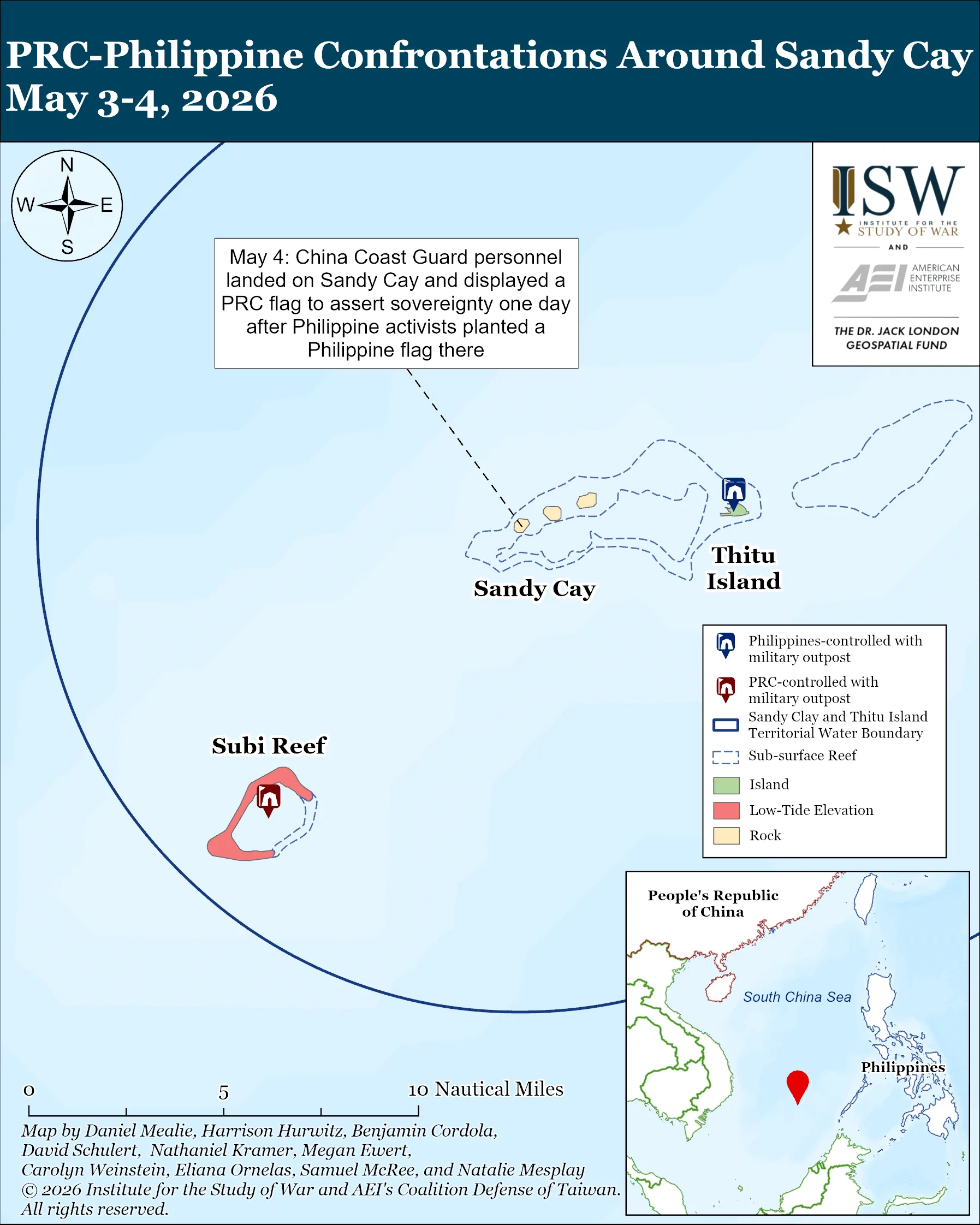
- The PRC is likely accusing the Philippines of causing ecological damage to Sandy Cay to support its territorial claims and possibly as a response to similar Philippine accusations against the PRC.
- The Philippine National Security Council accused the PRC on April 13 of using cyanide fishing to kill the fish population in Second Thomas Shoal, removing a source of food for Philippine personnel stationed in the area.[80]
The CCG, MOD, and PRC state media lodged counter-accusations that Philippine personnel on the BRP Sierra Madre were damaging the ecosystem by burning garbage and dumping it in the water.[81] The Sierra Madre is a grounded warship that the Philippine military uses as an outpost at Second Thomas Shoal. The PRC has also used the pretext of environmental protection to justify its control over Scarborough Shoal, which it seized from the Philippines in 2012. The PRC established a “nature reserve” on Scarborough Shoal in September 2025 to justify strengthened “law enforcement” against Philippine vessels trying to enter the area.[82]
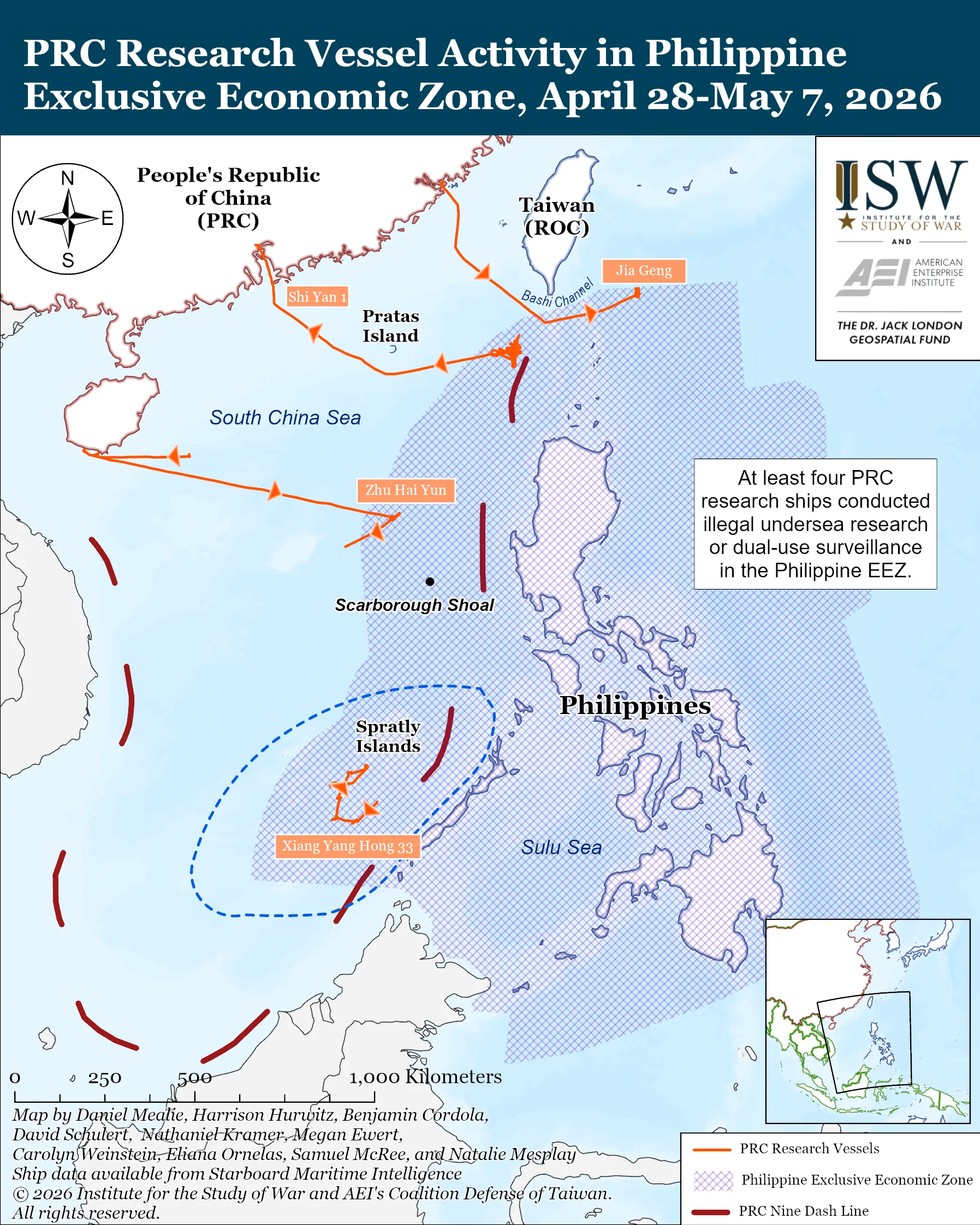
The Philippine Coast Guard (PCG) said it would drive away four PRC research vessels illegally surveying the Philippine Exclusive Economic Zone (EEZ). PCG spokesperson for the West Philippine Sea Jay Tarriela announced on May 2 that the PCG detected four PRC research vessels conducting “illegal marine scientific research” in the Philippine EEZ.[83]
PCG spokesperson for the West Philippine Sea Jay Tarriela announced on May 2 that the PCG detected four PRC research vessels conducting “illegal marine scientific research” in the Philippine EEZ.[83] The vessels included the advanced oceanographic survey ship Xiang Yang Hong 33, a research ship specializing in marine research and hydro-acoustics called Shi Yan 1, the deep-sea research ship Jia Geng, and the intelligent drone mothership Zhu Hai Yun, which all operated in different areas. Tarriela said that the PCG would send ships and aircraft to drive the research vessels away from Philippine waters.[84] The PRC’s embassy in Manila claimed that the ships’ activities were within waters under PRC jurisdiction and “beyond reproach.”[85] The UN Convention on the Law of the Sea (UNCLOS) does not permit unauthorized economic or scientific activities in other countries’ EEZs. The PRC disputes Philippines territorial claims in the South China Sea and claims its own territorial or economic rights over the majority of the sea, however.
The PRC very likely uses research vessels to improve its undersea surveillance and submarine navigation capabilities. The Jia Geng sailed through Bashi Channel between Taiwan and the Philippines and is currently surveying a seamount southeast of Taiwan that overlaps with the Philippine EEZ, according to ship-tracking data from Starboard Maritime Intelligence. The Bashi Channel is a key maritime chokepoint that the PRC will very likely seek to control during a blockade or invasion of Taiwan. The Xiang Yang Hong 33 operated from April 20 to May 5 very close to Sabina Shoal, Second Thomas Shoal, and Iroquois Reef. All three are disputed features that the PRC seeks to seize from Philippine control through a variety of coercive means. Several of the research vessels can deploy Unmanned Underwater Vehicles (UUVs) and frequently operate in the South China Sea and around Taiwan, according to Starboard data. The PRC’s “Transparent Ocean” initiative aims to build a multilayered web of sensors to enhance PLA undersea navigation and detection capabilities.[86] The PRC very likely uses ostensibly civilian research vessels to map underwater terrain, deploy undersea sensors and surveillance drones, and place navigational beacons for submarines in preparation for future conflict.
Oceania
Australian officials carried out diplomacy with the PRC, Japan, and other Indo-Pacific countries to secure Australia’s fuel and fertilizer supplies amid the Iran War. Australian Foreign Minister Penny Wong met with Japanese Foreign Minister Toshimitsu Motegi on April 28, PRC Foreign Minister Wang Yi on April 29, and South Korean Foreign Minister Cho Hyun on April 30.[87]
- The discussion centered on the provision of jet fuel, diesel, gasoline, and fertilizer to Australia, which Wong said was necessary for Australia to continue shipping them food, coal, and liquified natural gas (LNG).[88]
- Japan, the PRC, and South Korea do not have substantial natural oil resources but are major exporters of refined oil products, which they produce from imported crude oil. Wong said the PRC agreed to cooperate with Australian businesses on jet fuel shipments.[89]
- The PRC accounted for about one third of Australia’s jet fuel imports before the Iran war, but significantly curtailed its exports of jet fuel and other fuels in March and April to secure the PRC’s domestic supply.[90]
- Australia similarly announced a policy on May 7 to reserve a portion of LNG equivalent to 20 percent of its exports for domestic consumption. This will not affect existing contracts but will reduce its future exports.[91]
- Australia is a major supplier of LNG, iron ore, and other raw materials to the PRC.[92]
- Australian Prime Minister Anthony Albanese and Japanese Prime Minister Sanae Takaichi met in Canberra on May 4 and signed a joint pledge to deepen cooperation on energy security, critical minerals, and defense.[93]
- Australia supplies nearly half of Japan’s LNG, while Japan is a top five supplier of gasoline and diesel to Australia.[94]
Indo-Pacific countries are working to shore up critical energy supplies disrupted by the Iran War while avoiding overdependence on the PRC, which has increasingly leveraged economic dependencies to secure political and security concessions from trading partners.
South Asia
Pakistan
Pakistan commissioned the first of eight Hangor-class attack submarines derived from a PRC design, indicating Pakistan’s reliance on PRC military technology. The PRC could use Pakistan’s reliance on its military relationship with the PRC to support power projection efforts in the Indian Ocean.
- Pakistan commissioned the first Hangor-class submarine on April 30 in Sanya, Hainan Province, with Pakistan President Asif Ali Zardari in attendance.[96]
- The Hangor-class is likely a copy of the PRC’s Type 039A diesel-electric attack submarine equipped with air-independent propulsion, increasing the amount of time the submarine may remain submerged.[97]
- The Hangor-class is the latest example of Pakistan’s extensive military reliance on PRC-designed and produced equipment.
- Pakistan also operates the PRC’s J-10C and likely used it to score multiple aerial victories during its May 2025 conflict with India.[98]
- The PRC could similarly use Pakistan as a testing ground for the performance of the Type 039A. Pakistan also operates surface vessels derived from the PRC’s Type 054A and Type 053H3 guided missile frigates.[99]
- Approximately 80 percent of Pakistan’s arms imports from 2021 to 2025 came from the PRC.[100]
- A major limiting factor in PRC power projection is its lack of overseas bases to support long-range naval deployments.[101]
- Pakistan’s Gwadar Port is operated by a PRC state-owned enterprise and is large enough to host all PLAN major surface combatants.[102]
PRC military infrastructure in Pakistan could improve PRC power projection in the Indian Ocean and the Middle East. The PRC could use this newfound capability to secure critical sea lines of communication (SLOC) in the region that it relies on for some of its energy imports.[103] The PRC could also use enhanced power projection through Pakistan to support its ambitions in the Middle East where it has increasingly sought to represent itself as a force for peace and stability, including during the current war between the United States and Iran.[104]
Related Research


=


No comments:
Post a Comment