Friday, October 06, 2017

Sun-Earthquake Model Matches M8.1 in Mexico


Published on Oct 5, 2017
Views: 23,231

U.S. INTERNATIONAL TRADE IN GOODS AND SERVICES Aug 2017

Image result for bureau of economic analysis
FOR IMMEDIATE RELEASE AT 8:30 A.M. EDT, Thursday, October 5, 2017
NEWS
U.S. Department of Commerce * Washington, DC 20230
U.S. INTERNATIONAL TRADE IN GOODS AND SERVICES
The U.S. Bureau of Economic Analysis (BEA) has issued the following news release today:
The U.S. Census Bureau and the U.S. Bureau of Economic Analysis, through the Department of Commerce, announced today that the goods and services deficit was $42.4 billion in August, down $1.2 billion from $43.6 billion in July, revised. August exports were $195.3 billion, $0.8 billion more than July exports. August imports were $237.7 billion, $0.4 billion less than July imports. 
The full text of the release on BEA's Web site can be found at www.bea.gov/newsreleases/international/trade/tradnewsrelease.htm 
___________________________________________________________________________
 
Or you might want to take a look at
Story image for U.S. INTERNATIONAL TRADE IN GOODS AND SERVICES August 2017 from ABA Banking Journal (blog)

International Trade Balance Narrowed in August

ABA Banking Journal (blog)-Oct 5, 2017
October 5, 2017. The U.S. international trade deficit narrowed in August, falling 2.7% to $42.4 billion, according to the U.S. Census Bureau and the U.S. Bureau of ... Exports of goods increased just over $0.5 billion to $129.2 billion in August. ... Imports of services remained virtually unchanged at $44.1 billion in August.
__________________________________________________________________________
Back to the release :
The August decrease in the goods and services deficit reflected a decrease in the goods deficit of $0.9 billion to $64.4 billion and an increase in the services surplus of $0.3 billion to $22.0 billion.
Year-to-date, the goods and services deficit increased $29.1 billion, or 8.8 percent, from the same period in 2016.
Exports increased $84.9 billion or 5.8 percent.
Imports increased $114.0 billion or 6.4 percent.
__________________________________________________________________________

Related Files
Related Links
__________________________________________________________________________

Goods and Services Three-Month Moving Averages (Exhibit 2)
The average goods and services deficit decreased $1.3 billion to $43.2 billion for the three months ending in August.
     * Average exports of goods and services increased $1.0 billion to $194.9 billion in August.
     * Average imports of goods and services decreased $0.3 billion to $238.1 billion in August.
Year-over-year, the average goods and services deficit increased $1.1 billion from the three months ending in August 2016.
     * Average exports of goods and services increased $9.4 billion from August 2016.
     * Average imports of goods and services increased $10.5 billion from August 2016.
Exports (Exhibits 3, 6, and 7)
Exports of goods increased $0.6 billion to $129.2 billion in August.
Exports of goods on a Census basis increased $0.1 billion.
         * Consumer goods increased $1.0 billion. o
Pharmaceutical preparations increased $0.6 billion.
         * Capital goods increased $0.4 billion. o
Telecommunications equipment increased $0.4 billion.
         * Industrial supplies and materials decreased $1.0 billion. o Fuel oil decreased $0.7 billion. * Foods, feeds, and beverages decreased $0.4 billion. Net balance of payments adjustments increased $0.5 billion. Exports of services increased $0.2 billion to $66.1 billion in August.
         * Travel (for all purposes including education), other business services (which includes research and development services; professional and management services; and technical, trade-related, and other services), and financial services each increased $0.1 billion.
         * Transport, which includes freight and port services and passenger fares, decreased $0.2 billion. Imports (Exhibits 4, 6, and 8)
Imports of goods decreased $0.3 billion to $193.6 billion in August.
Imports of goods on a Census basis decreased $0.4 billion.
         * Industrial supplies and materials decreased $0.5 billion. o
Finished metal shapes decreased $0.2 billion. o
Copper decreased $0.2 billion.
         * Capital goods decreased $0.5 billion. o
Computer accessories decreased $0.3 billion. o
Civilian aircraft decreased $0.2 billion.
         * Automotive vehicles, parts, and engines increased $0.7 billion. o
Passenger cars increased $0.5 billion.
    Net balance of payments adjustments increased $0.1 billion.

Imports of services decreased $0.1 billion to $44.1 billion in August. * Transport decreased $0.2 billion. * Travel (for all purposes including education) increased $0.1 billion. Real Goods in 2009 Dollars – Census Basis (Exhibit 11) The real goods deficit decreased less than $0.1 billion to $61.8 billion in August. * Real exports of goods decreased $1.1 billion to $125.2 billion. * Real imports of goods decreased $1.1 billion to $187.0 billion. Revisions Revisions to July exports * Exports of goods were revised up less than $0.1 billion. * Exports of services were revised up $0.1 billion. Revisions to July imports * Imports of goods were revised down less than $0.1 billion. * Imports of services were revised up less than $0.1 billion. Goods by Selected Countries and Areas: Monthly – Census Basis (Exhibit 19) The August figures show surpluses, in billions of dollars, with South and Central America ($2.7), Hong Kong ($2.5), Singapore ($0.8), United Kingdom ($0.6), and Brazil ($0.4). Deficits were recorded, in billions of dollars, with China ($29.7), European Union ($10.9), Japan ($6.3), Mexico ($5.8), Germany ($4.8), Italy ($2.5), South Korea ($2.1), India ($1.6), Taiwan ($1.5), France ($0.8), OPEC ($0.8), Canada ($0.4), and Saudi Arabia ($0.1). * The deficit with China decreased $2.1 billion to $29.7 billion in August. Exports increased $0.8 billion to $11.6 billion and imports decreased $1.2 billion to $41.3 billion. * The deficit with the European Union decreased $1.2 billion to $10.9 billion in August. Exports increased $1.4 billion to $24.2 billion and imports increased $0.2 billion to $35.1 billion. NOTICE Effects of 2017 Atlantic Hurricanes on U.S. International Trade in Goods and Services The effects of the recent hurricanes will be embedded in source data that the U.S. Bureau of Economic Analysis (BEA) and the U.S. Census Bureau use to produce trade in goods and services statistics. However, these effects generally cannot be isolated, and, thus, BEA and the Census Bureau cannot separately quantify the impacts of the hurricanes. Some of the initial effects of Hurricane Harvey, which made landfall in southeastern Texas on August 25, 2017, are likely reflected in the source data underlying this “U.S. International Trade in Goods and Services: August 2017” report. The impacts of Hurricanes Harvey, Irma, and Maria will likely be reflected in subsequent reports until normal trade activities resume in affected areas. Goods Below is information on the collection of statistics on trade in goods by U.S. Customs and Border Protection (CBP) and possible scenarios for shipments directly impacted by the hurricanes, along with information regarding statistical procedures used to produce trade statistics. * Transactions that are cleared through a customs port are included in the trade statistics per normal procedures. However, there may be instances in which power outages or inaccessibility to buildings delay reporting by affected filers. * During port closures, export and import shipments may be diverted, amended, or canceled. Diverted import shipments may enter through another U.S. port or be transshipped through Mexico. * The Census Bureau processes any corrections as usual per Census Bureau revision policy. * Exports to and imports from a foreign country that leave or enter the U.S. customs territory in the U.S. Virgin Islands or Puerto Rico are included in U.S. international trade statistics.
     For more information, see the “U.S. Trade with Puerto Rico and U.S. Possessions” section of the Guide to Foreign Trade Statistics. For further CBP guidance, please visit CBP’s Cargo Systems Messaging Service and search “hurricane.” Census Bureau reports on trade through the Gulf Coast ports and on trade through Southeast ports are available at www.census.gov/foreign-trade/specialreports/gulfcoastports.pdf and www.census.gov/foreign-trade/specialreports/southeastports.pdf. Additional U.S. port data are available on USA Trade Online and on the International Trade API. If you have questions, please contact the Census Bureau, Economic Indicators Division, on (800) 549-0595, option 4, or at eid.international.trade.data@census.gov. Services While BEA cannot separately quantify the impacts of the hurricanes on any specific service category, there are several possible impacts of the hurricanes on U.S. trade in services. For example, transport services may be affected by port closures and by diverted shipments. Travel expenditures and other services trade may be affected to the extent that service activities are interrupted. The effects of the hurricanes on insurance services, meanwhile, are likely to be small because BEA uses normal losses, rather than actual losses, to measure insurance services. For more information, see “How are property and casualty insurance services measured in GDP?” The August trade in services statistics in this release are based on limited source data. More complete source data will be incorporated following the schedule outlined in “Revision Procedure (Goods on a BOP Basis and Services)” on page A-6 of this release. If you have questions, please contact BEA, Balance of Payments Division, at InternationalAccounts@bea.gov. NOTES: * All statistics referenced are seasonally adjusted; statistics are on a balance of payments basis unless otherwise specified. Additional statistics, including not seasonally adjusted statistics and details for goods on a Census basis, are available in Exhibits 1-20b of this release. For information on data sources, definitions, revision procedures, and scheduled release dates through December 2017, see the information section on page A-1 of this release. The next release is November 3, 2017. * For definitions of goods on a balance of payments basis, goods on a Census basis, and net balance of payments adjustments, see the information section on page A-1 of this release.

JUST BULL > Be smart: Worry | Ultra-Loose Money Policy

A Bull Market in everything > Flush with ca$h  
Asset prices are high across the board. Is it time to worry?
That's the cover story published by The Economist sent in the daily batch of news/information pieces from axios.com.
Where’s the beef?
 
 
Asset-price booms are a source of cheer, but also anxiety.
There are two immediate reasons to worry:
1. Markets have been steadily rising against a backdrop of extraordinarily loose monetary policy:
2. Signs are appearing that fund managers-desperate for higher yields-are becoming increasingly incurious
Beware of the bull > “this time is different”. It would be daft to assume that asset prices must remain high come what may. Many hazards could derail the economy and financial markets ...
READ MORE >>

Sunday, October 01, 2017

Area Development Report for 2017

This is the seventh year that Area Development has presented its 100 Leading Locations feature:
Leading Metro MSA Locations for 2017

Some 394 metropolitan statistical areas (MSAs) were ranked based on their performance in four key categories:
“Prime Workforce,”
“Economic Strength,”
“Year-Over-Year Growth"
"Five-Year Growth"
Area Development’s research desk compiled the statistics for this report. Locations were ranked according to the methodology explained herein.
This article was written by Mark Crawford, Staff Editor
These factors are, of course, all interconnected and ideally self-supporting. For example, a top-place ranking in five-year growth is often the result of positive performance in prime workforce, year-over-year economic growth, and economic strength. Larger, “big-city” MSAs tend to perform better overall than mid-size and small communities, simply because of their economic diversity and scale. They also tend to attract more worker inflow because of the opportunities and variety of lifestyles they provide
Phoenix-Mesa-Scottsdale, AZ
2017 Overall Rank: 199
2017 Midterm Growth Rank: 2222017
Economic Strength Rank: 219
Prime Workforce Rank: 143
Year-Over-Year Growth Rank: 152
Ultimately, diversity is the key for long-term growth that can offer high-paying jobs and weather economic tides.
READ MORE > takes a while to load with interactive maps for every category


PERSONAL INCOME AND OUTLAYS, AUGUST 2017

Image result for PERSONAL INCOME AND OUTLAYS, AUGUST 2017
EMBARGOED UNTIL RELEASE AT 8:30 A.M. EDT, Friday, September 29, 2017
PERSONAL INCOME AND OUTLAYS, AUGUST 2017
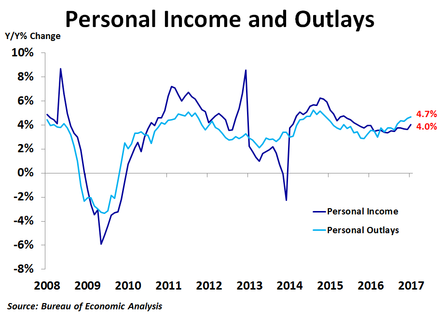
Personal income increased $28.6 billion (0.2 percent) in August according to estimates released today by the Bureau of Economic Analysis.
> Disposable personal income (DPI) increased $14.9 billion (0.1 percent) and personal consumption expenditures (PCE) increased $18.0 billion (0.1 percent).
> Real DPI decreased 0.1 percent in August and Real PCE decreased 0.1 percent.
> The PCE price index increased 0.2 percent. Excluding food and energy, the PCE price index increased 0.1 percent.

                                                                2017
                                                Apr.    May     June    July    Aug.
                                                Percent change from preceding month
Personal income:
Current dollars                                0.1     0.3     0.0     0.3     0.2
Disposable personal income:
Current dollars                                0.2     0.4     0.0     0.2     0.1
Chained (2009) dollars                         0.0     0.5     0.0     0.1    -0.1
Personal consumption expenditures (PCE):
Current dollars                                0.3     0.2     0.1     0.3     0.1
Chained (2009) dollars                         0.1     0.3     0.1     0.2    -0.1
Price indexes:
PCE                                            0.2    -0.1     0.0     0.1     0.2
PCE, excluding food and energy                 0.2     0.1     0.1     0.1     0.1

Price indexes:                                 Percent change from month one year ago
PCE                                            1.7     1.5     1.4     1.4     1.4
PCE, excluding food and energy                 1.6     1.5     1.5     1.4     1.3

> The increase in personal income in August primarily reflected an increase in government social benefits to persons and compensation of employees (table 3).
> Real PCE spending in August decreased $8.4 billion due to a decrease of $20.2 billion in spending for goods that was partially offset by a $9.2 billion increase in spending for services (table 7).
> Within goods, spending on new motor vehicles was the leading contributor to the decrease.
> Within services, healthcare spending was the leading contributor to the increase.
 
Detailed information on monthly real PCE spending can be found on Table 2.3.6U.

Personal outlays increased $16.8 billion in August (table 3).
Image result for PERSONAL INCOME AND OUTLAYS, AUGUST 2017
Personal saving was $522.9 billion in August and the personal saving rate, personal saving as a percentage of disposable personal income, was 3.6 percent (table 1).

Updates

Estimates have been updated for April through July. The change from the preceding month for current-dollar personal income and for current-dollar and chained (2009) dollar DPI and PCE -- revised and previously published -- are shown below for June and July.

                                                        Change from preceding month
                                                 June                                      July
                                Previous   Revised   Previous   Revised   Previous   Revised   Previous   Revised
                               (Billions of dollars)      (Percent)      (Billions of dollars)      (Percent)
Personal income:
Current dollars                     5.2       3.3        0.0       0.0       65.6      56.1        0.4       0.3
Disposable personal income:
Current dollars                     3.0       2.1        0.0       0.0       39.6      28.8        0.3       0.2
Chained (2009) dollars             -2.7      -3.4        0.0       0.0       23.9      13.2        0.2       0.1
Personal consumption expenditures:
Current dollars                    31.3      18.8        0.2       0.1       44.7      43.6        0.3       0.3
Chained (2009) dollars             23.0      11.8        0.2       0.1       29.3      27.2        0.2       0.2

BOX.____________________________
                                Hurricane Harvey

The August estimates of personal income and outlays reflect the effects of Hurricane Harvey that made landfall in southeastern Texas on August 25th.
BEA cannot separately quantify the total impact of the storm on personal income
and outlays because most of the source data used to estimate the components of personal income and outlays do not separately identify storm impacts.
BEA made adjustments to estimates where source data were not yet available or
did not fully reflect the effects of the storm.


For more information on the treatment of disasters within the national income and product accounts, see
How are the measures of production and income in the national accounts affected by a natural or man-made disaster?
________________________________


                                Next release:  October 30, 2017 at 8:30 A.M. EDT
                                  Personal Income and Outlays:  September 2017

Additional Information/Resources
Additional Resources available at www.bea.gov:

Stay informed about BEA developments
> by reading the BEA blog,
> by signing up for BEA’s email subscription service, or
> by following BEA on Twitter @BEA_News 

• Historical time series for these estimates can be accessed in BEA’s Interactive Data Application.
• Access BEA data by registering for BEA’s Data Application Programming Interface (API).
• For more on BEA’s statistics, see our monthly online journal, the Survey of Current Business.
• BEA's news release schedule
NIPA Handbook:  Concepts and Methods of the U.S. National Income and Product Accounts
 

BEA Release: State Personal Income: Second Quarter 2017

News Release
EMBARGOED UNTIL RELEASE AT 8:30 A.M. EDT,
Tuesday, September 26, 2017
 
State Personal Income: Second Quarter 2017
For the full release and tables, visit https://www.bea.gov/newsreleases/regional/spi/spi_newsrelease.htm
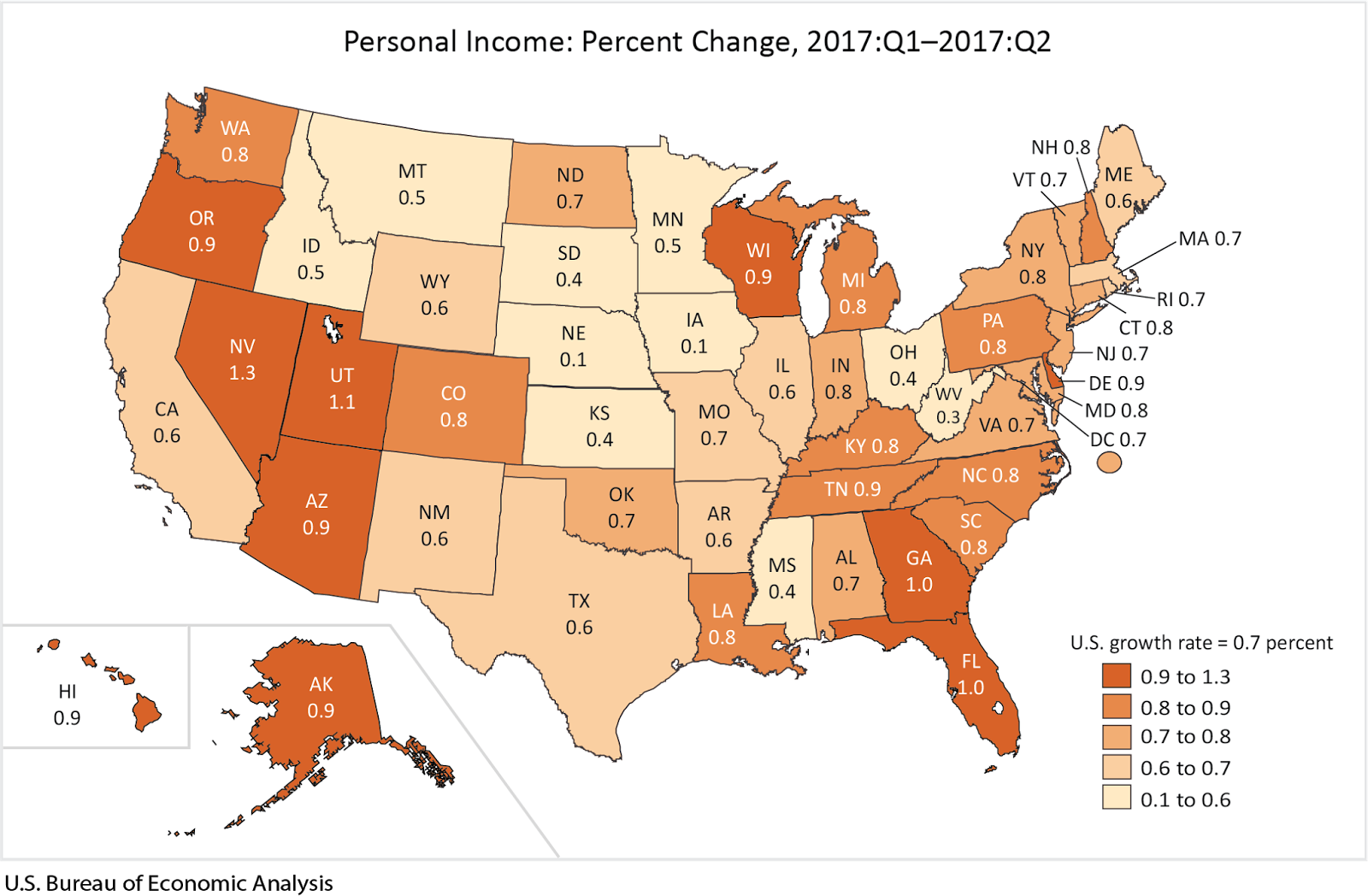
State personal income grew 0.7 percent on average in the second quarter of 2017, after increasing 1.4 percent in the first quarter, according to estimates released today by the Bureau of Economic Analysis (table 1). Each of the major aggregates of personal income–net earnings, property income, and personal current transfer receipts–grew more slowly than in the first quarter.
Personal income grew 1.3 percent in Nevada, faster than in any other state. Utah had the next fastest growth at 1.1 percent. Iowa, Nebraska, and West Virginia had the slowest growth in personal income, with each state growing less than half the rate of the nation.
Personal Income: Percent Change, 2017:Q1-2017:Q2 
Earnings. On average, earnings increased 0.8 percent in the second quarter of 2017, after increasing 1.5 percent in the first quarter. Earnings growth ranged from 1.6 percent in Nevada to -0.1 percent in Nebraska, and was the leading contributor to growth in personal income in most states (table 2).
Earnings 2017:Q1-2017:Q2 (Percent Change)
  • Growth in construction earnings was the leading contributor to above average earnings growth in Nevada and Oregon (table 3).
  • Growth in retail trade earnings was the leading contributor to above average earnings growth in Utah.
  • Growth in professional, scientific, and technical services earnings was the leading contributor to above average earnings growth in Florida.
  • Growth in information earnings was the leading contributor to above average earnings growth in Georgia and Colorado.
  • Growth in construction earnings and in finance and insurance earnings were both contributors to above average earnings growth in Rhode Island.
  • Growth in finance and insurance earnings was the leading contributor to above average earnings growth in Texas.
Farm earnings declined for the nation and in every state in the second quarter (table 4) and was the leading contributor to slow earnings growth in many states. In Nebraska, Iowa and North Dakota, the decline in farm earnings reduced earnings growth by half a percentage point or more. The slow growth in farm earnings reflects lower prices for grains and other crops.
For the nation, earnings grew in 20 of the 24 industries for which BEA prepares quarterly estimates. Earnings growth in three industries–health care and social assistance; professional, scientific, and technical services; and finance and insurance–was the leading contributor to overall growth in personal income.
Property income. Property income increased 0.8 percent in the second quarter of 2017, down from 1.3 percent in the first quarter. Property income growth ranged from 1.2 percent in Michigan to 0.4 percent in Rhode Island.
Transfer receipts. Transfer receipts grew 0.2 percent for the nation in the second quarter of 2017, down from the 1.3 percent growth in the first quarter. Growth rates ranged from 2.0 percent in Alaska to -1.1 percent in Iowa.

Updates to Personal Income. Today, BEA also released revised annual estimates of state personal income for 2014 to 2016 and revised quarterly estimates for 2014:Q1 to 2017:Q1. Updates were made to incorporate source data that are more complete and more detailed than previously available, to incorporate updated seasonal factors, and to align the states with revised national estimates that were released with the July 2017 annual update to the National Income and Product Accounts.
****
Next release: December 20, 2017, at 8:30 A.M. EST – State Personal Income: Third Quarter 2017.
_______________________________________________________________________

BEA Regional Facts (BEARFACTS), a narrative summary of personal income, per capita personal income, and components of income for each state
 

Most Powerful Corporations in the World?


Published on Oct 1, 2017
Views: 226,895
​The 2,000-kilometer quantum communication line put into use on Friday is the world's first trunk line for secure quantum telecommunications. Known as the Beijing-Shanghai Trunk Line, it connects the country's major secret communication network nodes: Beijing, Jinan, Hefei and Shanghai.

Subscribe to us on YouTube:
https://goo.gl/lP12gA

Download our APP on Apple Store (iOS): https://itunes.apple.com/us/app/cctvn...

Download our APP on Google Play (Android): https://play.google.com/store/apps/de...

Follow us on:

Facebook:
https://www.facebook.com/ChinaGlobalT...
Instagram: https://www.instagram.com/cgtn/?hl=zh-cn
Twitter: https://twitter.com/CGTNOfficial
Pinterest: https://www.pinterest.com/CGTNOfficial/
Tumblr: http://cctvnews.tumblr.com/
Weibo: http://weibo.com/cctvnewsbeijing