Sunday, February 04, 2018

Information From Sun Valley Solar Re: Renewable Solar Power

No doubt about it: Arizona is sun-rich. The Solar Industry is primed for growth and your MesaZona blogger is excited to have uploaded a post last week on a work-in-progress right here in The New Urban Downtown Mesa on East Main Street on the rooftops of El Rancho Del Sol, an inspired innovative development promoting sustainability by Eric Paine's Community Development Partners that's setting a high standard for green development from the sidewalk level spaces to the entire rooftops on two new buildings located along the line of Valley Metro's Light Rail Extension heading east beyond the Central Business District where local service from Phoenix started more than two years ago.
Just like another transit-oriented development, Encore On First, the first new multi-family construction built here in 30 years that opened in December 2013 winning a 2014 RED (Real Estate Design) Award for developers Charles Huellmantel and Todd Marshall, both have installations of Rooftop Solar generating renewable energy to supply more than 40-50% of the electricity usage in the public spaces.
Here to the right you can see an image taken just a few days ago of the rooftop solar installations by Sun Valley Solar now near completion at El Rancho Del Sol along the future path of Light Rail.
Despite New Tariffs, Four Reasons the Solar Industry Is Primed for Growth
Kyle Ritland on this source > https://www.svssolutions.com/blog
"Earlier this month, the Trump administration announced plans to implement a tariff on solar panels imported from outside the U.S. The decision was in response to a complaint filed by two solar panel providers, but the vast majority of the solar industry opposed the action. In recent months, Arizona residents have also watched as multiple utilities rolled out new rate programs that, at least on the surface, could easily be interpreted as moves to slow customers from making their own electricity out of Arizona’s most abundant natural resource.
While the implications of the tariff are still shaking out (more on that in the coming weeks), it’s worth remembering just how far the solar industry has come.
While we are certain to face more challenges and roadblocks from embedded and antiquated industries that fear a renewable future, there’s little doubt that momentum is at our back and the solar industry is healthier and more competitive than ever before.
So, to ease your troubled mind, please consider these four facts about the state of the solar industry today:

The Downtown Farmer: Introducing Local Roots Farms, Part 1

Hey!
Published on Feb 3, 2018
Views: 137
Meet the farm that's created a more resilient food system with their indoor farms. Their goal? To increase access to fresh, healthy food.

Catch the full episode of The Downtown Farmer featuring Local Roots Farms here:
http://bit.ly/2BF1439

Watch more videos from CMT now: http://bit.ly/2gJ0kWw

SUBSCRIBE now for more CMT videos: http://at.cmt.com/uXvwn

FOLLOW CMT:
Facebook:
http://at.cmt.com/pWvg304qDVA
Twitter: http://at.cmt.com/uXwGj
Instagram:
http://at.cmt.com/uXx1Q
CMT.com: http://at.cmt.com/D6Qv304qDPL
Add CMT on SNAPCHAT: CMT

CMT THE DOWNTOWN FARMER is a weekly show that takes you behind the scenes of the farm to table movement. Meet the chef and the farmers who create organic, healthy meals, from the most unpredictable locations.

Boosting AI: Artificial Intelligence Blessing or Curse?

State of Research + ethical questions
Published on Feb 3, 2018
Views: 205
The rise of artificial intelligence (AI) has been quite remarkable in the past few years. Many experts predict that, like the Internet, AI will bring huge changes to our lives and be part of almost everything we do. Vast sums of money have been put into AI start-ups in China, and many existing tech companies have opened new research labs. But amid the optimistic atmosphere, many also have concerns about the ethical questions that artificial intelligence raises.

Subscribe to us on YouTube:
https://goo.gl/lP12gA

Download our APP on Apple Store (iOS): https://itunes.apple.com/us/app/cctvn...

Download our APP on Google Play (Android): https://play.google.com/store/apps/de...

Follow us on:

Facebook:
https://www.facebook.com/ChinaGlobalT...
Instagram: https://www.instagram.com/cgtn/?hl=zh-cn
Twitter: https://twitter.com/CGTNOfficial
Pinterest: https://www.pinterest.com/CGTNOfficial/
Tumblr: http://cctvnews.tumblr.com/
Weibo: http://weibo.com/cctvnewsbeijing

WRESTLING WITH HIS FAITH Dan Reynolds on Mormon Documentary 'Believer' - Sunda...

Change from within
Published on Jan 25, 2018
Views: 2,206

What if The Whole World Suddenly Went Blind?


Published on Feb 3, 2018
Views: 110,843
What would happen if the whole world suddenly went blind and could no longer see? Would we as civilization be able to function?

WEBSITE (You can suggest a topic):
http://theinfographicsshow.com

Saturday, February 03, 2018

3-Day Global Weather Outlook & Conditions | Feb.3.2018 [HD]

Now this is what a weather report might look like is we expanded our view of the entire Planet Earth to see in HD the dynamic and interplay of patterns all over the world - too often the only way weather is shown and reported is within the continental boundaries of the United States
Published on Feb 3, 2018
Views: 3,267
Daily Sun, Earth and Space Science
http://www.Suspicious0bservers.org

The Stuff Of Legends: Unicorns Private VC-Backed Companies

From the Crunch Network
Unicorns gorge as investors dish up bigger rounds, more capital
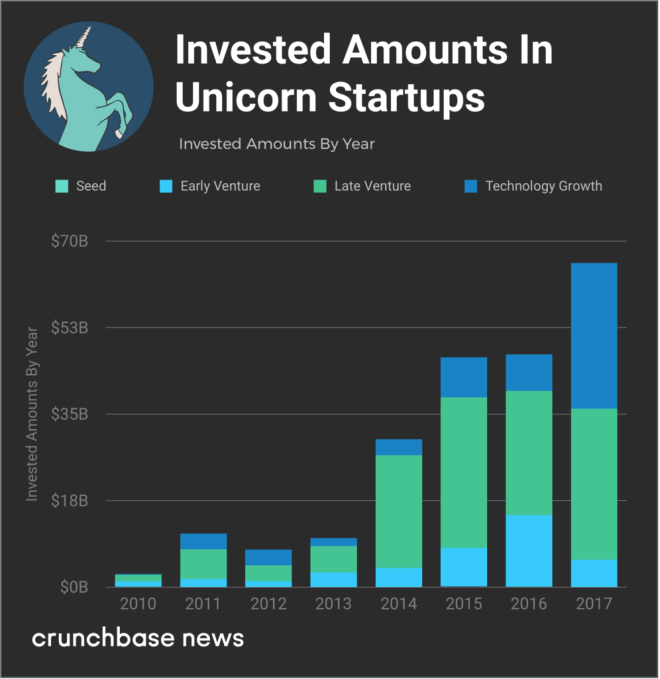
Globally, a staggering $66 billion went into unicorn companies in 2017, up 39 percent year-over-year, according to an analysis of Crunchbase data. The ride-hailing space was the single largest recipient of investor dollars, with several rivals in the space raising billions. Investors also poured copious sums into co-working, consumer internet and augmented reality.

"Newcomers also joined the unicorn club for the first time in 2017, albeit at a slightly slower pace than the preceding two years. For all of 2017, 60 new startups were added to the unicorn list. This compares to 66 newly minted unicorns in 2016 and the record-setting 2015 with 99 newcomers.
Below, we break down the leading locations for new and existing unicorns, top sectors for investment capital, exits and a few other trends affecting the space. . .
Geographic breakdown
The vast majority of unicorns are headquartered in either the U.S. or China, and that’s also the case for newcomers to the Unicorn Leaderboard.
The newcomers were a pretty diverse bunch, spanning industries from
  • agtech to enterprise software, including no-cost stock buying platform Robinhood,
  • online education provider VIPKID 
  • cryptocurrency buying and selling platform Coinbase.
Sectors
Unicorn investors showed a particularly strong appetite, however, for companies in a handful of sectors.
Ridesharing, in particular, had a strong funding year, with companies in the space taking more than 10 percent of all unicorn investment.
Bike-sharing was also big. Two new entrants onto the unicorn list came from that space: Ofo and Mobike.
Other recipients of really substantial funding rounds, even by unicorn standards, include U.S. co-working giant WeWork and China-based consumer internet players Toutiao and Koubei.
 
Exiting the board
So a lot of unicorns are raising big rounds. But is there any sign members of the group will eventually produce returns for investors?
Overall, 2017 provided some modestly positive news for unicorn exit watchers.
  • Fifteen venture-funded companies with private valuations of a billion dollars or more went public last year, more than double 2016 levels and the highest total since Crunchbase began tracking the asset class.
  • Unicorn IPOs weren’t just more common in 2017. Performance was often quite good, too. Many of last year’s newly public companies sustained market caps far higher than their last private valuations.
Lately, going public seems to be a better option for investor returns.
 
Averages point to more exits ahead
For the 45 unicorn companies that have gone public, the average time to go public has been 26 months after first being valued at $1 billion. For the 25 companies that have been acquired, the average time to get acquired is 24 months after first being valued at $1 billion.

NO CAPTAIN ONBOARD