Tough Nut-to-Crack when you realize "It’s a pretty tight-knit community of special interests" after any reasonable person who probes deeper into the fog of city finances gets sidelined plowing 'into-the-weeds' at the same time the generations-old political machine pulls all the punches it can and circles-the-wagons to try to defend questionable long-standing loyalties as well as the practices and accounting standards used by city officials to use [they say "leverage'" public funds for their own private wealth-creation while holding public office. ________________________________________________________________________
< Nothing could be more clear than this one image Former U.S. Congressman Matt Salmon, who resigned to get hired as a high-salaried lobbyist for ASU (sitting in the background) and then-Arizona State Senator Bob Worsley forced to appear in public at a Mesa City Council Study Session back in February 2018. Worsley and his holding companies had scooped up titles to eight commercial properties on Main Street before the end of 2017 that would only increase and appreciate in value if proposals to finance an ASU campus got taxpayer approval.
It wasn't until April 2018 - two months later - that federal Opportunity Zones were designated and approved to include 8 census tracts in Downtown Mesa that qualified as long-neglected, distressed and low-income areas. QUESTION: Is this acting for self-profit that uses insider information?? Then there's this concept of kind of an ongoing mastermind that can build a group and a network of folks that can collectively gain personal benefits. What are the steps that you take in order to get this off the ground?
Whether that’s a self-directed super Roth where you’re actually gonna be making investments yourself
Whether that’s a community that wants to establish a fund themselves
Whether that’s a college that wants to establish a fund or partner with somebody in order to take advantage of the Opportunity Zones
How can they can go about utilizing and leveraging their resources to create this ecosystem?
Final regulations for this new investment vehicle were only issued by the IRS and the U.S. Treasury Department less than three months at the end of 2019.
5 years ago we should have realized that Hizzoner Mesa Mayor John Giles was not the mastermind of the group and the entrenched network of closely connected "friends-and-families" He was just trying to pull off a stage-stunt at his first term in office when Mesa taxpayers REJECTED it. _________________________________________________________________________
It's now March 2020 - Almost the End-of-the-Cycle of Deceit Questions over the city's tricky financing for ASU still persist "Mesa officials detail ASU campus financing"
"Nearly two years after a split Mesa City Council approved the Arizona State University@mesacitycenter project, the innovative building continues to generate controversy._______________________________________
Councilman Jeremy Whittaker has been consistent in voting against each authorization of funds to pay for the $73. 5 million building, dedicated to movie studios and innovative technology. ASU is contributing $10 million of that price tag.
The building is under construction behind a fence on a site at Center and First Street, between Mesa City Hall and council chambers. ??????????????????????? >
HOLD ON --- The image above ^ is the actual site in real time
"Whittaker again attacked the project last week, based upon its reliance on the Enterprise Fund, which mostly includes profits from city utilities.
“I won’t support any of these projects that continue to drain our utilities,’’ Whittaker said.
“As long as the voters voted against this building, I will vote against this building.’’
Whittaker’s criticism, though not unexpected, touched off an effort by city officials to explain the project’s financing, which has evolved since Council approves it by a 5-2 vote in June 2018.
Council members Jen Duff, Dave Luna, Vice Mayor Mark Freeman and Mayor John Giles all reiterated their support in one way or another while Councilman Kevin Thompson, who voted against it initially in deference to his constituents, votedfor the latest authorization. . . "
MORE TELLING DETAILS FOR CIRCLE-THE-WAGONS
The original project envisioned for ASU was a much larger campus with financing through a sales tax increase that would have also funded hiring more police officers and firefighters.
After Mesa voters rejected that proposal, Giles, a staunch advocate of education and downtown redevelopment, came up with another plan to finance a smaller project through excise bonds backed by the Enterprise Fund.
But City Manager Chris Brady and Budget Director Candace Cannistraro described somewhat different financing as the project moves ahead.
> Brady adamantly assured Whittaker that no additional funds for the building will come from the Enterprise Fund.
> Brady said revenues from land sales in Pinal Countyand elsewhere, along with development fees such as construction sales taxes and building permit revenues generated by The Grove and The GRID redevelopment projects, will be applied to paying for the ASU building.
“It’s not just the building itself, it’s the economic activity being leveraged downtown,’’ he said.
“They have indicated that the reason they are here is because of the ASU building.’’
> Cannistraro, who frequently is questioned by Whittaker, said the building’s initial $9 million in revenues came through payments from the Enterprise Fund to the Economic Investment Fund.
She said all additional payments, including the debt service, are coming from the General Fund.
“We are doing many land sales that offset that,’’ Cannistraro said.
> Brady said the land sales and development-related revenues will go toward the principal before the city issues the excise bonds, but for a lower amount than originally planned."
OK. . . Huh?
_________________________________________________
> Brady noted that the utility revenues associated with ASU, and other development related to the university, is projected at more than $4 million while the overall economic impact is projected at nearly $10 million. . ."
>“I think what we are doing is very consistent with the will of the voters,’’ Giles said.
“The money for this is going to come from the economic activity generated many times over.’’
TIME TO PULL BACK THE CURTAINS ON THE MEETINGS OF THIS COMMITTEE - THEY HAVEN'T RECEIVED ENOUGH ATTENTION FOR FAR TOO LONG This meeting took place 3 days and lasted for well over an hour-and-a-half during a video teleconference with a presentation by the new Housing & Community Development Director Michelle Albanese who hardly appears qualified for the job she's been given. If it tells you anything, Natalie Lewis is the staff liaison. The Chairman of the committee is Frank Heredia, who was appointed and not elected to represent residents in District 3. Downtown Mesa is home to 8 distressed census tracts _________________________________________________________________________ THERE ARE NO PROVISIONS OR PLANS FOR ANY AFFORDABLE HOUSING _________________________________________________________________________
In order to encourage citizen participation, the following efforts shall be undertaken by the City
of Mesa.
1) The city shall consult with its local housing authority to elicit participation of the residents
of assisted housing in plan development and review, which is anticipated to be derived
from PHA planning activities stipulated under 24CFR part 903.
As needed and
applicable, the city will also consult with low-income residents of targeted revitalization
areas in which federal projects are anticipated.
The City shall make Consolidated Plan
information available to its local housing authority if applicable on a continuing basis for
*Revised 3/10/2020 Updated Point of Contact
any public hearings to be held under the HUD Comprehensive Grant Program or Public
Housing Agency Plan established pursuant to 24CFR Part 903. 2) The City of Mesa shall hold at least two public hearings concerning the Consolidated
Plan.
The first meeting shall be held during Consolidated Plan formulation and
preparation, while the second shall be held once the draft Consolidated Plan has been
completed.
One or both of the public meetings to be conducted by the city shall include
the following items.
> The amount of CDBG, ESG, HOME and HOPWA resources anticipated to be
made available within the City on a fiscal year basis, and the eligible range of
activities that may be undertaken concerning such federal programs.
> The amount of CDBG, ESG, HOME and HOPWA resources anticipated to benefit income qualified person residing within the City of Mesa on a fiscal year basis
> Plans by the City of Mesa to minimize the displacement of persons from the
intended uses of CDBG, ESG, HOME and HOPWA resources anticipated to be
invested during any given fiscal year.
> Perspectives on priorities and housing and community development needs in the
City of Mesa.
> Other aspects of the Consolidated Plans as applicable.
3) On or before April 10 of any given year, the City of Mesa will make available its draft
Consolidated Plan, Annual Plan and the previous year’s Comprehensive Annual
Performance Evaluation Report (CAPER) to its housing authority, selected libraries,
surrounding municipal governments (as applicable), and selected other locations for the
mandatory 30-day public comment period to end no later than the 1st of May of any given
year.
The public shall be notified of this opportunity for review and comment in
newspaper/s with general circulation in the City and shall identify the locations where the
citizens may review copies of draft Consolidated Plan and relevant Comprehensive
Annual Performance Evaluation Reports (CAPERs).
4) In early September of each year, the City of Mesa shall make available its draft
Comprehensive Annual Performance Evaluation Reports (CAPER) for the previous fiscal
year to its housing authority, selected libraries, surrounding municipal governments (as
applicable); and selected other locations for the mandatory 15-day public comment
period to end no later than September 30.
_________________________________________________________________________________
The City of Mesa Housing Authority FY2020-2025 5-Year Plan
A 45-day public comment period will begin on
Sunday, February 23, 2020 and conclude on Wednesday, April 8, 2020.
A public hearing will be held on Thursday, April 9, 2020 at 7:30 a.m.
Councilmember District 3: Francisco Heredia, Chairperson
Councilmember District 5: David Luna
Councilmember District 4: Jen Duff Staff Liaison: Liaison: Natalie Lewis City Attorney: Alfred Smith
Roll Call
1 Items from citizens present.
2 Presentations:
20-0301
Hear a presentation, discuss, and provide funding recommendations for the FY
2020/21 and prior years' available funding for Community Development Block
Grant (CDBG), HOME Investment Partnerships (HOME), Emergency Solutions
Grant (ESG), and Human Services Programs.
Hear a presentation, discuss, and provide funding recommendations for the FY 2020/21 and prior years' available funding for Community Development Block Grant (CDBG), HOME Investment Partnerships (HOME), Emergency Solutions Grant (ESG), and Human Services Programs.
Hear a presentation, discuss, and provide a recommendation on the transfer of
two City-owned properties to A New Leaf, Inc. The properties are located near
Mesa Drive and Main Street and at 217 West University Drive, and were
acquired and/or improved with CDBG program funds.
Community and Cultural Development
Committee Report
Date: March 19, 2020
To: Community and Cultural Development Committee
From: Michelle Albanese, Housing & Community Development Director
Subject: Transfer of CDBG Funded properties to A New Leaf, Inc.
Purpose and Recommendation
The purpose of this report is to discuss and seek the Community and Cultural
Development’s recommendation for the possible transfer of two City-owned properties
encumbered by federal funding to A New Leaf, Inc. Approved by resolution, the transfer
of the properties to non-profit agencies is permitted for those properties meeting the
Property Transfer Criteria policy.
Background
On January 27, 2020, Council approved, by Resolution #11450 (Exhibit A), the transfer
of the Hobson property and requested further discussion and analysis be done on the
other two properties, the Main property and the University property, in order to explore
other options for the properties and A New Leaf’s operations.
Specifically, the City
Council requested staff
1. identify the current value of each of the properties;
2. research other city-owned properties to serve New Leaf’s purposes of operation of
their programs;
3. identify available funding to acquire and rehabilitate property for New
Leaf to continue providing services and programs.
Historically, City Council has approved the transfer of ownership of many of the HUD
funded properties to the nonprofits who lease them when the nonprofits meet certain
criteria and agree to continue to provide services benefitting the community for a
specified length of time.
On August 28, 2017, City Council approved Resolution No.
11018 amending the City’s property transfer, sale and lease policy for HUD funded
properties:
“Criteria for the Disposition of City Property Encumbered by CDBG, HOME,
or NSP Funding to Nonprofit Agencies” (the “Policy”).
The Policy outlines procedures
and criteria for the City to utilize when a nonprofit agency, who is currently leasing HUD
funding encumbered property from the City, requests the property ownership be sold or
transferred to the nonprofit.
A copy of the Resolution and Policy (Resolution #11018) is
included with this Report as Exhibit B.
2
Discussion
The two properties the City Council requested additional information and discussion on
regarding the potential transfer or disposition of the properties are:
A. Main Property. Closest major cross streets are Mesa Drive and Main Street.
1. The property is utilized by A New Leaf as transitional housing for single
women who are overcoming homelessness, domestic violence and/or
learning to live independently.
2. September 2017 appraisal valued the property at $166,000. The current
area comps provided from the City’s Real Estate division indicate an
estimated value of the property at $300,000 to $325,000. This is an
approximate increase in value of $134,000 - $159,000.
B. University Property (217 W. University). Closest major cross streets are E.
University Drive and Country Club.
1. The property is utilized by A New Leaf as an information technology center
for their agency’s programs.
2. September 2017 appraisal valued the property at $350,000. The current
area comps provided from the City’s Real Estate division indicate an
estimated value of the property at $500,000 to $560,000.
This is an
approximate increase in value of $150,000 - $210,000.
At the request of City Council, staff worked with the City’s Real Estate division and
determine there are no city-owned properties that are vacant and available for use by A
New Leaf.
A New Leaf could submit a funding proposal request for CDBG funds during the open
funding process for FY 2021/2022 for the purposes of acquisition and rehabilitation of
an alternate location.
Options for Consideration
Possible options for consideration for the Main Property & University Property are:
1. Sell the Main Property & University Property for current fair market value to
someone other than A New Leaf. The sale proceeds would go back to the CDBG
program and be reallocated to other eligible CDBG activities. No funds would be
credited back to the City’s General Fund as part of the sale. The sale would most
likely trigger relocation requirements, adding additional costs to the City and/or A
New Leaf.
2. Sell the Main Property & University Property to A New Leaf for the current fair
market value and reimburse the CDBG grant per HUD regulations.
3. Transfer the property to A New Leaf, providing additional consideration for the
transfer of the Main Property & University Property, such as increasing the
continued use period, beyond HUD’s required continued use period of ten years
for each property.
4. Continue to lease the Main Property & University Property to A New Leaf.
Fiscal Impact
The Main Property & University Property were purchased and improved with CDBG
funds, making the fiscal impact to the City minimal.
However, if the Main Property &
University Property are not used or disposed of in accordance with CDBG program use
requirements, this can result in a repayment by the City to the U.S. Treasury of the then
current fair market value of the property(-ies) from the City’s general funds, representing
the amount of the CDBG funds invested in the properties.
Hear a presentation, discuss, and provide a recommendation on the transfer of two City-owned properties to A New Leaf, Inc. The properties are located near Mesa Drive and Main Street and at 217 West University Drive, and were acquired and/or improved with CDBG program funds.
HERE'S THE UPLOADED STREAMING VIDEO OF THE TELECONFERENCE Take the time to carefully watch-and-listen please - and judge for yourself what is going on here. Attention > Item 2-a:Michelle Albanese Reading from a script
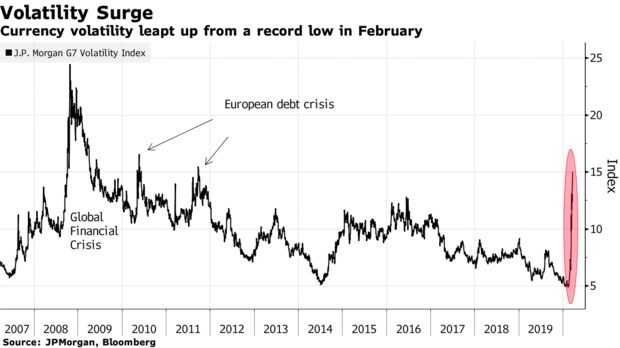
"The global rush for dollars that’s been roiling the $6.6 trillion a day foreign-exchange market has showcased a missing piece of financial-safety architecture that world policy makers never addressed in the aftermath of the 2008 crisis.
The financial system’s reliance on one keystone currency proved to be an amplifier of shocks more than a decade ago. Yet since then, the greenback’s role has climbed even further as borrowers outside of America ramped up dollar-denominated debt. That’s again adding an enormous layer of stress on markets.
“It’s precisely what the global economy does not need at this moment,” Alexander Wolf, head of Asia investment strategy at JP Morgan Private Bank and a former U.S. diplomat in China, said of a strong dollar. “It tightens financial conditions, make servicing dollar debt more expensive, and can cause pass-through inflation just when that is not needed.”
Dire Dollar Shortage Shows Failure to Fix Key Crisis Flaw By
Dollar jump to renew calls for financial-system reform: Prasad
Yuan’s comparative resilience stands out as possible takeaway
As often occurs during bouts of extreme currency fluctuation, there’s been speculation about something akin to the 1985 Plaza Accord that sought to rein in a runaway dollar. Observers discount that possibility now. But one of the key takeaways from the current episode may be that one important currency finds itself burnished: China’s yuan.
The salve for emergency dollar demand that the Federal Reserve came up with during the global financial crisis -- giving other central banks the power to deploy greenbacks abroad via swaps with the U.S. -- has been applied again. The Fed broadened the group of counterparts on Thursday, including some emerging economies, though not China or India.
Global airline share prices declined sharply in February and March 2020
Please Subscribe For More Upcoming Videos: https://goo.gl/o2jNyz
Animated Statistics, Statistics, Stats, Racing Bar Chart, Charts, Rankings
Airline stocks in freefall
Negotiations on massive $1.6 trillion-plus emergency economic package to deal with the coronavirus crisis faltered on Sunday, and House Democrats are now planning to introduce their own proposal, according to Speaker Nancy Pelosi.