Thursday, July 22, 2021
SERIOUSLY MYSTERIOUS: Elusive Bizarre "Havana Syndrome"
Must be serious when there's a new twist > "An undercover Central Intelligence Agency officer who helped hunt down Osama bin Laden will now lead the agency task force charged with investigating the mysterious health incidents that continue to plague US personnel, according to a report Wednesday from The Wall Street Journal. . ."
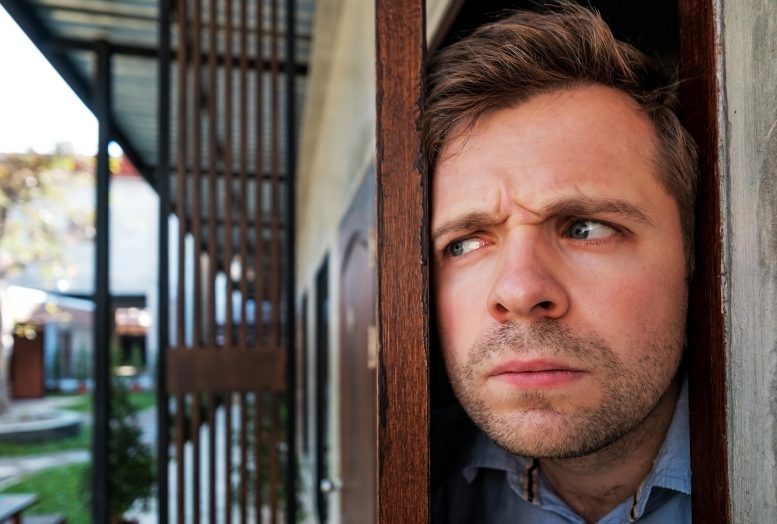
> Last week, The New Yorker first reported that, in the months since President Joe Biden took office, there have been about two dozen cases reported from Vienna, Austria. The reports were from US intelligence officers, diplomats, and other government officials. If the cases are confirmed, Vienna would have more cases than any other city so far, except for Havana.
CIA officer from bin Laden hunt to lead Havana Syndrome probe as cases rise
There may be as many as 200 cases now, including around two dozen from Vienna.
Here's more of the story by Beth Mole from ArsTechica
". . .The incidents, first reported in 2016 among US diplomats stationed in Havana, Cuba, tend to involve bizarre episodes of sonic and sensory experiences that are often described as directional. Afflicted diplomats develop symptoms including headaches, ringing in the ears (tinnitus), nosebleeds, difficulty concentrating and recalling words, permanent hearing loss, and speech problems.

Medical experts examining some of the cases have found evidence of "injury to widespread brain networks without an associated history of head trauma." That is, sufferers appear to a have a concussion without a blow to the head.
Despite years of alarming reports and investigations into the cases, the cause of the incidents and who may be behind them remain a mystery—and cases continue to mount. News of the new task-force chief comes on the heels of a report from NBC News that the latest case count may be as high as 200. And though the incidents tend to be linked to Cuba—the condition is often referred to as "Havana Syndrome"—they have now been reported from every continent except Antarctica. . .
Possible causes
A leading hypothesis among intelligence officials continues to be that the incidents are attacks, potentially carried out by Russian operatives and potentially involving some sort of covert microwave-energy device.
Late last year, a panel of experts assembled by the National Academies of Sciences concluded that the "most plausible mechanism" that explains the diplomats' experiences and symptoms is directed pulsed radiofrequency energy. Though some scientists are skeptical of the hypothesis, the expert panel and the doctors who have examined the cases say they've ruled out other leading suggestions, including a mass psychogenic illness (MPI), chemical agents, and infectious diseases.
As for the Russians being behind the attacks, that, too, still remains conjecture. Intelligence officials have said they have geolocation data that indicates Russian operatives were in the area at the time of some of the incidents. However, Russian operatives are known to keep track of US operatives, and their presence alone does not prove they were involved. The New Yorker article points out that the recent cases in Vienna may also point to Russia. The article called the city a "den of spies" and "a nexus of US and Russian espionage." In addition, the experts with the National Academies of Sciences noted that there was "significant research" in Russia on pulsed radiofrequency energy's effects on people.
Inconclusive
Though nothing is conclusive, NBC News uncovered information that the State Department's Diplomatic Security Service "helped develop and deploy small physical detection devices in Cuba and a handful of other posts" aimed at detecting pulsed microwaves. Three people with knowledge of the devices spoke to the outlet, but they declined to provide further detail, saying that it was classified. . .
___________________________________________________________________________
Vienna Is the New Havana Syndrome Hot Spot | The New ...

What Is Havana Syndrome? What We Know - WSJ

Red Alert: More Ongoing Large-Scale Attacks > Stealth Recon and Intrusions
Home and office routers come under attack by China state hackers, France warns
Compromised routers give the hackers anonymity in ongoing large-scale attacks.

“ANSSI is currently handling a large intrusion campaign impacting numerous French entities,” an ANSSI advisory warned. “Attacks are still ongoing and are led by an intrusion set publicly referred to as APT31. It appears from our investigations that the threat actor uses a network of compromised home routers as operational relay boxes in order to perform stealth reconnaissance as well as attacks.”
People who are concerned their devices are compromised should periodically restart their devices, since most router malware is unable to survive a reboot. Users should also make sure remote administration is turned off (unless truly needed and locked down) and that DNS servers and other configurations haven’t been maliciously changed. As always, installing firmware updates promptly is a good idea
The advisory contains indicators of compromise that organizations can use to determine if they were hacked or targeted in the campaign. The indicators include 161 IP addresses, although it’s not entirely clear if they belong to compromised routers or other types of Internet-connected devices used in the attacks
A graph charting the countries hosting the IPs, created by researcher Will Thomas of security firm Cyjax, shows the biggest concentration is in Russia, followed by Egypt, Morocco, Thailand, and the United Arab Emirates. . .

Hackers have used compromised home and small office routers for years for use in botnets that wage crippling denial-of-service attacks, redirect users to malicious sites, and act as proxies for performing brute-force attacks, exploiting vulnerabilities, scanning ports, and exfiltrating data from hacked targets.
____________________________________________________________________________
According to cyber security sources, the alleged group behind the incursion is Chinese government backed APT31. APT31 has also been dubbed Zirconium and Judgement Panda
"According to FireEye, APT31 has targeted myriad industries, such as “government, international financial organisation, and aerospace and defence organisations, as well as high-tech, construction and engineering, telecommunications, media, and insurance”.
RELATED CONTENT:
France warns of APT31 cyberspies targeting French organizations

Today, the French national cyber-security agency warned of an ongoing series of attacks against a large number of French organizations coordinated by the Chinese-backed APT31 hacking group. . .
Organizations that detect any of the shared IOCs in their logs pointing at an attack potentially connected to this ongoing APT31 campaign are urged to report the incident to ANSSI via email.
quick writeup from @ANSSI_FR on APT31 use of home routers as ORBs with IOCs:https://t.co/Hs4scHcTq6
— billy leonard (@billyleonard) July 21, 2021
and here is a potential early version of their router implant that we (cc @neelmehta) found in TAG:https://t.co/SAZtb9r4Wr
(also known as Zirconium and Judgment Panda) is a hacking group working at the behest of the Chinese Government known for its numerous espionage and information theft operations.
This threat has been linked in the past to the theft and repurposing of the EpMe NSA exploit years before Shadow Brokers publicly leaked it in April 2017.
Last year, Microsoft observed APT31 attacks targeting the international affairs community and high-profile individuals associated with the Joe Biden presidential campaign.
APT31 was also spotted by Google while targeting "campaign staffers' personal emails with credential phishing emails and emails containing tracking links."
Chinese cyberespionage operations under the spotlight
These attacks come after the US and its allies, including the European Union, the United Kingdom, and NATO, have formally accused China of this year's Microsoft Exchange hacking campaign.
The cyberattacks took place in early 2021 and targeted more than a quarter of a million Microsoft Exchange servers, belonging to tens of thousands of organizations worldwide.
STREAMING: Henry Kissinger: How Biden should handle China | The Economist
The uploaded video can be viewed farther down. For your interest ahead of time, here are interesting reads from earlier posts on this blog via Niall Ferguson:
1 20 September 2018
 What would be the impact on history of self-learning machines — machines that acquired knowledge by processes particular to themselves, and applied that knowledge to ends for which there may be no category of human understanding?
How the Enlightenment Ends Philosophically, intellectually — in every way — human society is unprepared for the rise of artificial intelligence
Would these machines learn to communicate with one another? How would choices be made among emerging options? Was it possible that human history might go the way of the Incas, faced with a Spanish culture incomprehensible and even awe-inspiring to them? Were we at the edge of a new phase of human history?
2

- What can the history of networks and hierarchies teach us about how technology is changing them?
- Do networks and hierarchies work harmoniously or is there an inherent conflict between one another?
- You say that these companies in Silicon Valley are decentralized, but it seems they’re very consolidated regarding capital and the concentration of data.Does social media reinforce power structures throughout history? It’s reminiscent of Marx’s philosophy that the bourgeoisie is never fixed and subject to renewal
- How did networks become so polarized through technology?
3  The global network has become dangerously unstable
By Niall Ferguson
The world today is like a giant network on the verge of a cataclysmic outage. Far from spreading truth and love, the network excels at disseminating lies and hate, because those are the things we nasty, fallen human beings like to click on.
The president of the United States tweets that his own intelligence agencies are illegally leaking classified information to The New York Times about his campaign’s communications with the Russian government, but he insists that it’s all “fake news.” (Read that again, slowly.)

You cannot understand the world today without understanding how it has changed as a result of new information technology. This has become a truism. The question is, how has it changed? The answer is that technology has enormously empowered networks of all kinds relative to traditional hierarchical power structures.
The reality is that the global network has become a dangerously unstable structure. Far from promoting equality, the network does the opposite, by allowing hyperconnected “superhubs” to emerge.

Far from spreading truth and love, the network excels at disseminating lies and hate, because those are the things we nasty, fallen human beings like to click on. If Zuckerberg seriously intends to turn Facebook into the vanguard of liberal world government, then he is on a fast track to joining George Soros at the top of Steve Bannon’s Most Hated list.
Niall Ferguson’s new book, “The Square and the Tower: The Rise and Fall and Rise of Networks,’’ will be published early next year.
================================================================
Humor: Freedom of The Press + World Press Cartoon Awards 2021
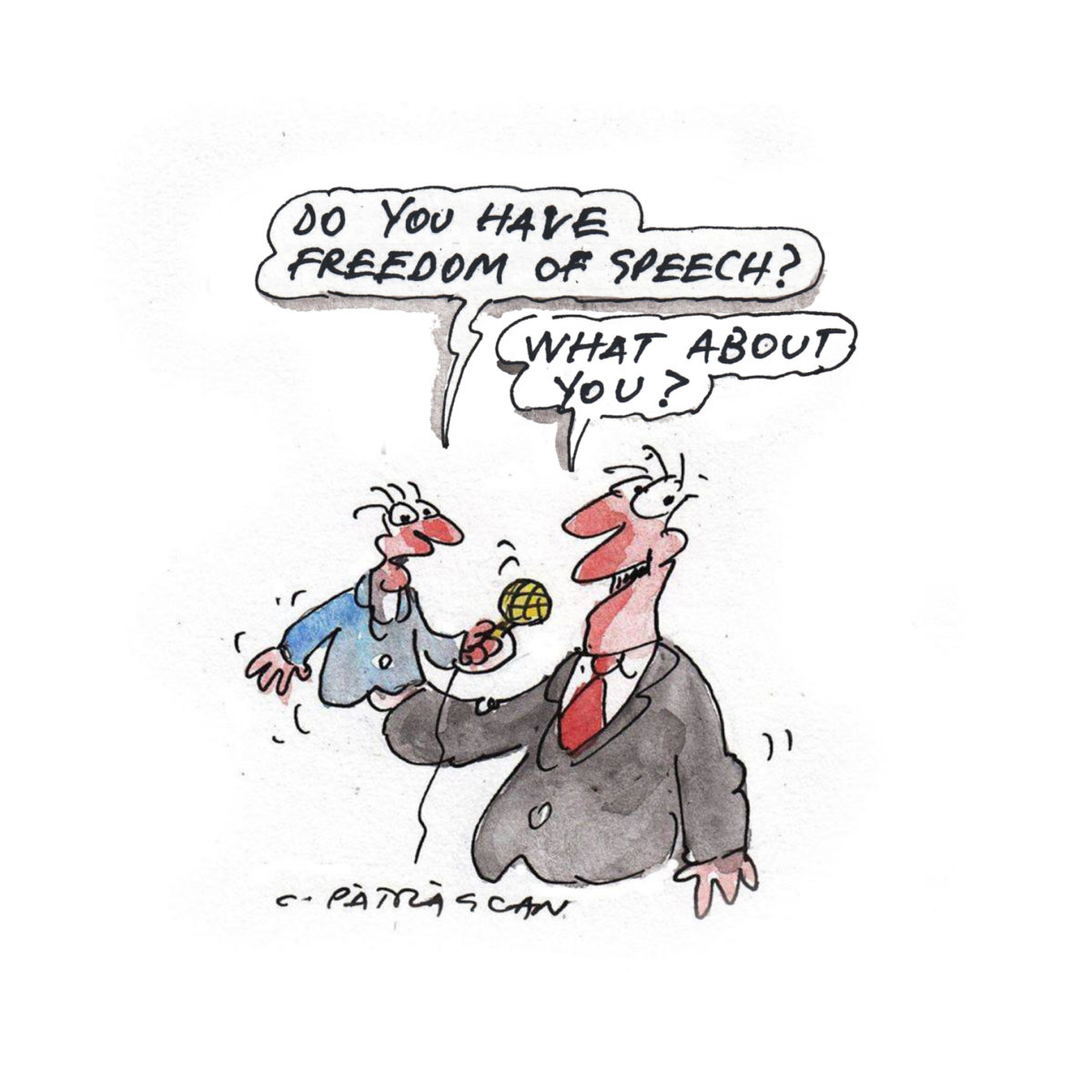

"The World Press Cartoon has returned to Caldas da Rainha, one of UNESCO's Creative Cities. Cartoonists from the four corners of the world are tracing a new chapter of humorous drawings. This 2021 edition is strongly marked by the COVID-19 pandemic, but also by defending the freedom of press and expression, a major tradition at the event.
The event kicked off with a caricature drawing session in the city centre, before the official awards ceremony which highlights 2020's best works published in the written press and on the internet.
The year was summed up well by Albanian cartoonist, Agim Sulaj, whose drawing of masks in the shape of 2020 won him second prize in the Gag Cartoon category. Sulaj says that the idea to do this drawing came from when he was looking for masks in his home. He found three or four and they were shaped like a zero. He saw them through "artistic eyes" and that's what inspired him.

In a year marked by the transition of power between former American President Donald Trump and Joe Biden and by the health crisis, cartoonists didn't forget the environmental emergency and this was reflected in the "Caricature" category's first prize. It was awarded to Mexican cartoonist, Darío Castillejos.
Castillejos told euronews that "caricatures are like a double mirror. The character of the person who is drawn can be reflected, but we can also be reflected".

He made a caricature drawing of Greta Thunberg to make the public reflect on the care of our planet. She is depicted as Little Red Riding Hood, but she is not carrying biscuits in her basket, but the world. The message is that the world in her basket needs to be protected from the wolves that are all around it.
[ Some of the other current events to grab cartoonists' attentions in 2020 were the death of George Floyd and the debate on police violence and racism, Brexit and the passing of Maradona. ]
In the "Editorial Cartoon" category, the first prize went to Ukrainian, Konstantin Kazanchev. António Antunes, the curator and organiser of the World Press Cartoon describes it as "the construction of the world in a lie. All the living forces of society, from military power, to religious power, to judicial power, all share the same lie".

He says that it is a "caustic vision", but it also acts as a warning.
Mariagrazia Quaranta, better known as 'Gio', was unable to be present at the event. However, she was the big winner of the day. She bagged the first prize in the Gag Cartoon category as well as the World Press Cartoon 2021's Grand Prix with a drawing published in the online newspaper Mundiario.

Antunes says the piece "underlines the importance of the written press, which leaves a fingerprint on our culture". In some way, "it also alerts us to the decadence of the written press", he adds.
The World Press Cartoon has returned to Caldas da Rainha, one of UNESCO’s Creative Cities. Cartoonists from the four corners of the world are tracing a new chapter of humorous drawings.
This 2021 edition is strongly marked by the COVID-19 pandemic, but also by defending the freedom of press and expression, a major tradition at the event.
The event kicked off with a caricature drawing session in the city centre, before the official awards ceremony which highlights 2020’s best works published in the written press and on the internet.
The year was summed up well by Albanian cartoonist, Agim Sulaj, whose drawing of masks in the shape of 2020 won him second prize in the Gag Cartoon category.
Sulaj says that the idea to do this drawing came from when he was looking for masks in his home. He found three or four and they were shaped like a zero. He saw them through “artistic eyes” and that’s what inspired him.
In a year marked by the transition of power between former American President Donald Trump and Joe Biden and by the health crisis, cartoonists didn’t forget the environmental emergency and this was reflected in the “Caricature” category’s first prize. It was awarded to Mexican cartoonist, Darío Castillejos.
Castillejos told euronews that “caricatures are like a double mirror. The character of the person who is drawn can be reflected, but we can also be reflected”.
He made a caricature drawing of Greta Thunberg to make the public reflect on the deva of our planet. She is depicted as Little Red Riding Hood, but she is not carrying biscuits in her basket, but the world. The message is that the world in her basket needs to be protected from the wolves that are all around it.
Some of the other current events to grab cartoonists’ attentions in 2020 were the death of George Floyd and the debate on police violence and racism, Brexit and the passing of Maradona.
In the “Editorial Cartoon” category, the first prize went to Ukrainian, Konstantin Kazanchev. António Antunes, the curator and organiser of the World Press Cartoon describes it as “the construction of the world in a lie. All the living forces of society, from military power, to religious power, to judicial power, all share the same lie”.
He says that it is a “caustic vision”, but it also acts as a warning.
Mariagrazia Quaranta, better known as ‘Gio’, was unable to be present at the event. However, she was the big winner of the day. She bagged the first prize in the Gag Cartoon category as well as the World Press Cartoon 2021’s Grand Prix with a drawing published in the online newspaper Mundiario.
Antunes says the piece “underlines the importance of the written press, which leaves a fingerprint on our culture”. In some way, “it also alerts us to the decadence of the written press”, he adds.

The exhibition shows drawings handpicked by the event's international jury from hundreds submitted. They are open to the public at Caldas da Rainha's Centro Cultural e de Congressos until the 17th of October.
Wednesday, July 21, 2021
TONIGHT 8-11PM: Live Music Angel Robles
ANGEL ROBLES is k nown for an eclectic set list that spans multiple genres, . . He utilizes loop pedals, acoustic guitars, and backing...

-
 Flash News: Ukraine Intercepts Russian Kh-59 Cruise Missile Using US VAMPIRE Air Defense System Mounted on Boat. Ukrainian forces have made ...
 -
A nor’easter is about to hit the Northeast in May. That’s very unusual.

