Saturday, July 24, 2021
Social Engineering SMART CITIES: There is emerging evidence that smart cities are not the egalitarian utopias we want them to be.
 HYPER-LOCAL: Here's an example from the next post on this blog of all that Happy-Talk:
 City of Mesa Smart City Master Plan
10-Page Power Point Presentation
What is A Smart City?
In short, a Smart City is one in which the latest technologies and data-driven insights are leveraged to improve the quality of life, civic engagement, economic development, service delivery, and community vibrancy for its citizens, businesses and visitors.
A Smart City is actually about people versus tech itself.
A Smarter Mesa is where modernized communications infrastructure, Internet of Things (IoT) connected smart systems and data work together to provide responsive solutions that enhance the live, work & play experiences of people in our community.
 They already have an urban heritage.
 When you bury fiber-optic under the curbs around the town, then you get internet.
When you have towers and smartphones, then you get portable ubiquity.
When you break up a smartphone into its separate sensors, switches, and little radios, then you get the internet of things.
These tedious yet important digital transformations have been creeping into town for a couple of generations.

"There may be a darker side to smart cities hidden behind the optimistic marketing that paints a colourful metropolis leveraging the ubiquity of IoT, geospatial data, automation and machine learning to provide better services and the more efficient allocation of resources. This, in turn, it’s repeated and repeated and repeated leads to better places for citizens to live, work, and play.
“But it was alright, everything was alright, the struggle was finished. He had won the victory over himself. He loved Big Brother.”
George Orwell, 1984
One of the leading proponents of smart cities seems to be the leveraging of technologies for a form of social control, reminiscent of Black Mirrors Nose Dive (S3E1). The Chinese system of ‘Social Credit’ is designed to monitor every part of a citizen’s life, recording consumer, social, legal and financial behaviour.
The danger lies with the quantity and quality of personal and private data that is being collected without consent or, in many cases, knowledge of the subjects.
“Those who would give up essential Liberty, to purchase a little temporary Safety, deserve neither Liberty nor Safety.”
Benjamin Franklin
But smart cities are more invasive than the current CCTV and ANPR monitoring we accept as normal. And the dangers are equally nebulous and potentially less recognisable than those of the War on Terror.
3 The danger lies with the quantity and quality of personal and private data that is being collected without consent or, in many cases, knowledge of the subjects.
Pole-Mounted Surveillance. . ."we are not without unease about the implications of that surveillance for future cases..."
 WHAT WAS ONCE CONSIDERED IMPOSSIBLE IS NOW MUNDANE:
 These future Americans will traverse their communities under the perpetual gaze of cameras. Camera-studded streets, highways, and transit networks will generate precise information about each vehicle and its passengers, for example, recording peoples’ everyday routes and deviations therefrom. Upon arrival at their workplaces, schools, and appointments, cameras on buildings will observe their attire and belongings while body cameras donned on the vests of police and security officers will record snippets of face-to-face or phone conversations. That same network of cameras will continue to capture Americans from many angles as they run errands and rendezvous to various social gatherings. By the end of the day, millions of unblinking eyes will have discerned Americans’ occupations and daily routines, the people and groups with whom they associate, the businesses they frequent, their recreational activities, and much more. . ."
=========================================================================
This might be the most alarming: 

The digital techniques that smart-city fans adore are flimsy and flashy—and some are even actively pernicious—but they absolutely will be used in cities.
They already have an urban heritage.
When you bury fiber-optic under the curbs around the town, then you get internet.
When you have towers and smartphones, then you get portable ubiquity.
When you break up a smartphone into its separate sensors, switches, and little radios, then you get the internet of things.
These tedious yet important digital transformations have been creeping into town for a couple of generations. At this point, they’re pretty much all that urban populations can remember how to do.
INSERT: QUESTION: When - if ever before - was
Mesa A Smart City?
TIME TO RE-BRAND THAT! Hire a consultant
In 2018, the City of Mesa engaged ThinkBig Partners, LLC to assist in the development of a Smart City Master Plan. Most importantly, this effort included engaging our citizens, businesses and the public as we identified the key strategies & priorities for building a smarter Mesa!
City of Mesa Smart City Master Plan
10-Page Power Point Presentation
What is A Smart City?
In short, a Smart City is one in which the latest technologies and data-driven insights are leveraged to improve the quality of life, civic engagement, economic development, service delivery, and community vibrancy for its citizens, businesses and visitors.
A Smart City is actually about people versus tech itself.
A Smarter Mesa is where modernized communications infrastructure, Internet of Things (IoT) connected smart systems and data work together to provide responsive solutions that enhance the live, work & play experiences of people in our community.
Smart City Mesa? When Are Sensors Collecting Your Data - Huh?

This workshop is all about the city TRACKING EVERYTHING ALL THE TIME collecting data - your data that you own.

It's true that Mesa mayor is sometimes way-out-there in his own mind with sugar-plum coated visions beyond reality of things and "Big League Dreams" to become a world-class city
But comparing this conservative most-suburbanized city in America - with only a population of 480,000 - where we live with three of the world's greatest cities Singapore, Dubai and Barcelona - is just not playing in the right ball park in the city's Field of Dreams.
=========================================================================
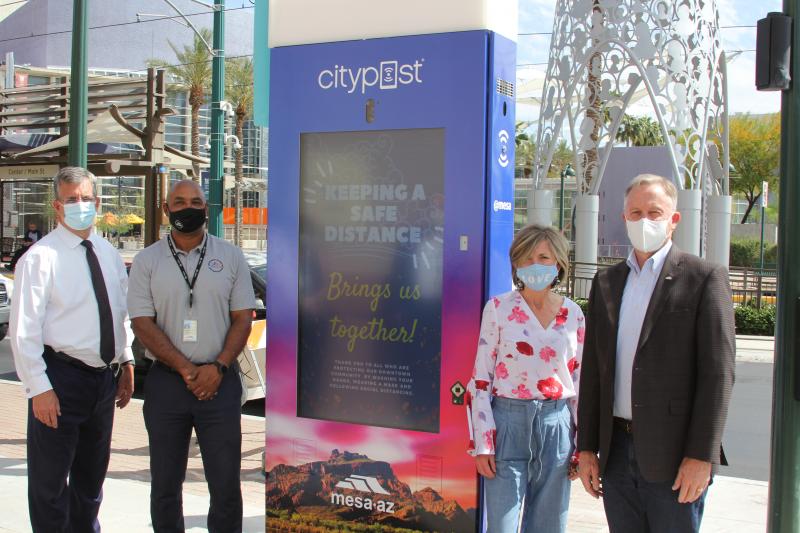
As part of the City of Mesa’s Smart City strategic plan, the City has partnered with Smart City Media to install ten dual screen smart digital kiosks throughout downtown Mesa and along the light rail corridor east to Gilbert Road. The digital kiosks will each offer two 55-inch touch screen displays with "way finding" functionality for people to locate specific businesses or receive Mesa focused content such as event promotions and safety alerts.
"The new kiosks amplify our efforts to engage residents and visitors in innovative ways, while supporting our business community and highlighting the great amenities in Mesa's downtown," Mayor John Giles said. "The resources provided through the kiosks will connect our residents, businesses, visitors and stakeholders in one common thread."
Each kiosk offers multi-language support.
TONIGHT 8-11PM: Live Music Angel Robles
ANGEL ROBLES is k nown for an eclectic set list that spans multiple genres, . . He utilizes loop pedals, acoustic guitars, and backing...

-
 Flash News: Ukraine Intercepts Russian Kh-59 Cruise Missile Using US VAMPIRE Air Defense System Mounted on Boat. Ukrainian forces have made ...
 -
A nor’easter is about to hit the Northeast in May. That’s very unusual.

