Saturday, August 07, 2021
On Language: KINDERGARTEN (German word) All of This + More Than Baby-Sitting, Daycare, Pre-School

The Kindergarten Exodus
As the pandemic took hold, more than 1 million children did not enroll in local schools. Many of them were the most vulnerable: 5-year-olds in low-income neighborhoods.
PHILADELPHIA — On a sweltering July afternoon, Solomon Carson, 6, jumped off the stoop of his family’s tidy rowhouse in West Philadelphia, full of what his father, David, called “unspent energy.”
When a stranger asked his name, he answered brightly, but added that he couldn’t spell it. “I can help you with that,” his father said, patiently pronouncing each letter, with Solomon repeating after him.
Solomon was supposed to have learned the basics in kindergarten this past year, but his first year of formal education was anything but.
When Covid-19 closed classrooms, his parents chose not to enroll him in city schools that they already had doubts about. As they were not working, they decided to teach him at home along with his two older brothers. And they signed him up for a virtual charter school that advertised in-person tutoring — and failed to provide it. . .
Solomon is part of a vast exodus from local public schools.
As the pandemic upended life in the United States, more than one million children who had been expected to enroll in these schools did not show up, either in person or online. The missing students were concentrated in the younger grades, with the steepest drop in kindergarten — more than 340,000 students, according to government data.

Fall enrollment change by grade, 2019 to 2020
12th
11th
10th
8th
+1.1%
+0..8%
K
1st
2nd
3rd
4th
5th
6th
7th
9th
+0.6%
+0.6%
–0.8%
–1.5%
–2.7%
–3.0%
–3.4%
–3.7%
–3.8%
–4.1%
–9.3%


Now, the first analysis of enrollment at 70,000 public schools across 33 states offers a detailed portrait of these kindergartners. It shows that just as the pandemic lay bare vast disparities in health care and income, it also hardened inequities in education, setting back some of the most vulnerable students before they spent even one day in a classroom.
The analysis by The New York Times in conjunction with Stanford University shows that in those 33 states, 10,000 local public schools lost at least 20 percent of their kindergartners. In 2019 and in 2018, only 4,000 or so schools experienced such steep drops.
The months of closed classrooms took a toll on nearly all students, and families of all levels of income and education scrambled to help their children make up for the gaps. . .
READ MORE > https://www.nytimes.com/2021/08/07/us/covid-kindergarten-enrollment.html
CBDC/Stable-Coins: Central Banks Realize They Need To Provide An Alternative To Money - or The Future Will Pass Them By > The World Wide Crypto Market In Different Phases of Development
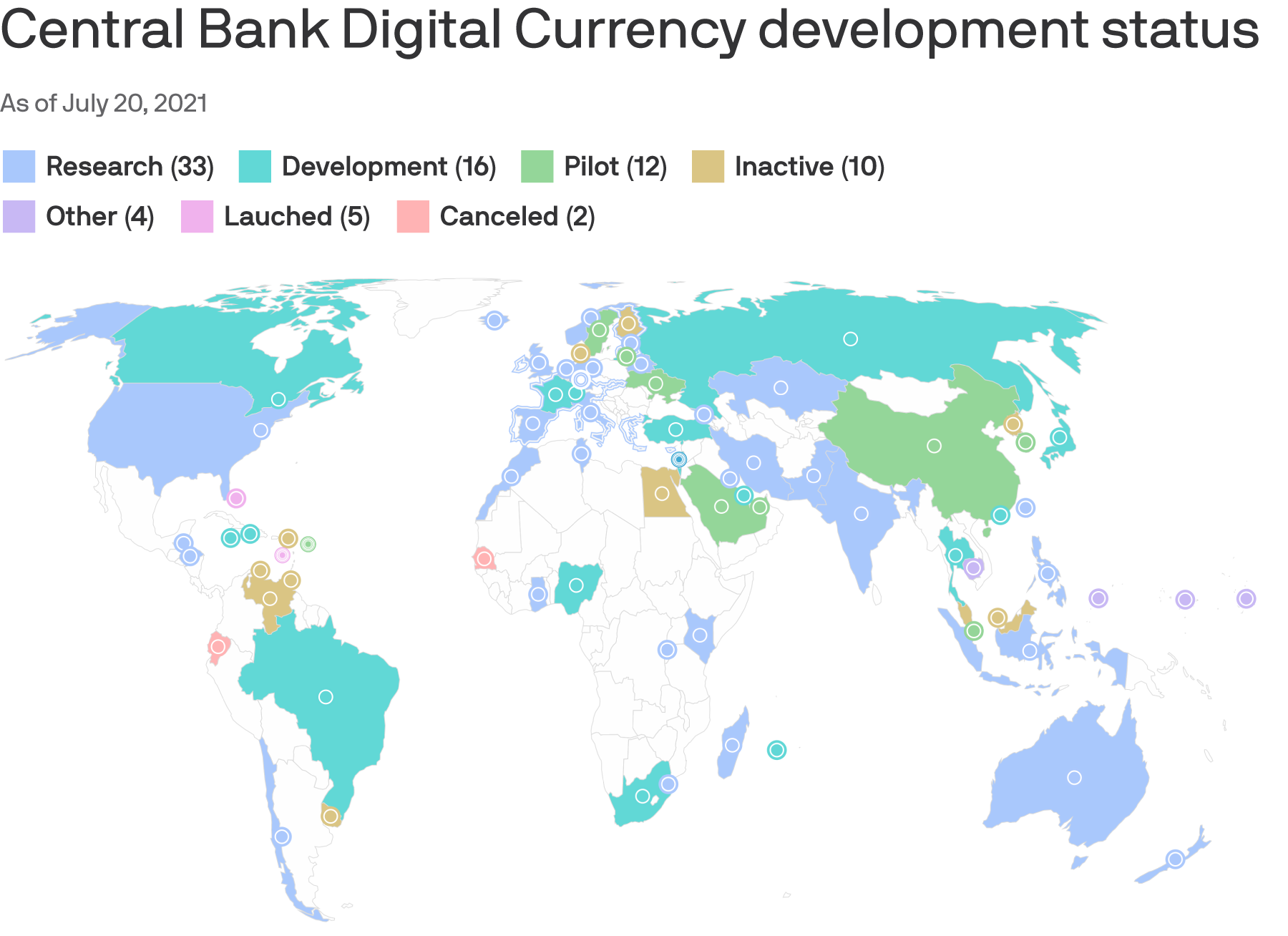
- "If the U.S. doesn't help standard-set and provide guidance on issues like privacy and cybersecurity, we could be headed into a fractured digital currency ecosystem that threatens the smooth operation of international finance," Josh Lipsky, director of the Atlantic Council's GeoEconomics Center, tells Axios.
Driving the news: The Atlantic Council, a think tank that will testify at a July 27 Congressional hearing on CBDCs, gave Axios a first look at its new interactive map showing just how many world governments are now considering it.
The backstory: CBDCs are digital versions of existing currencies — legal tender issued, governed and backed by a central bank.
State of play: China is furthest along among major global powers, having launched its pilot digital yuan in April.
- A total of 16 other countries are in the pilot phase or have launched, and another 15 countries have CBDCs in development.
- The U.S. is one of 33 countries still in the research phase.
What's next: Fed chair Jerome Powell has said that the U.S. central bank won't issue a CBDC without Congressional approval.
- In response, Congressional committees have stepped up their inquiries. Tuesday's hearing is before the House Financial Services Committee and will focus on national security implications.
The bottom line: The U.S. doesn't need to create a digital dollar immediately in order to have an impact on the development of digital currencies, Lipsky says.
- But it should engage with groups like the G7 and G20 nations to set standards for security and privacy, he adds
Central Bank Digital Currency Tracker
SCROLL TO EXPLORE
What exactly is a Central Bank Digital Currency (CBDC)?
A CBDC is virtual money backed and issued by a central bank. As cryptocurrencies and stablecoins have become more popular, the world’s central banks have realized that they need to provide an alternative—or let the future of money pass them by.
81 countries (representing over 90 percent of global GDP) are now exploring a CBDC.
In our original report published in May 2020, only 35 countries were considering a CBDC.
China is racing ahead, including by allowing foreign visitors to use digital yuan if they provide passport information to the People’s Bank of China during the upcoming Winter Olympics.
Of the countries with the 4 largest central banks (the US Federal Reserve, the European Central Bank, the Bank of Japan, and the Bank of England), the United States is furthest behind.
> 5 countries have now fully launched a digital currency. The Bahamian Sand Dollar was the first CBDC to become widely available.
> 14 other countries, including major economies like Sweden and South Korea, are now in the pilot stage with their CBDCs and preparing a possible full launch.
Without new standards and international coordination, the financial system may face a significant currency exchange problem in the future.
Fri, Feb 19, 2021
What precisely will the US Treasury Department do about the rise of digital currencies? Secretary Yellen and Federal Reserve Chairman Jerome Powell should quickly harness the potential of these evolving financial tools, including a US-backed digital dollar.
Tue, Apr 20, 2021
Digital payment systems are bringing millions of unbanked and underbanked online and rapidly revolutionizing global finance.
But new technology brings new challenges. From cybersecurity to sanctions evasion to money laundering. Should more governments step in and create their own Central Bank Digital Currencies (CBDCs)? What are China’s ambitions for its digital yuan? Can a transatlantic cooperative project can set new standards on digital currencies and ensure stable and transparent cross-border payments?
Friday, August 06, 2021
THE MANLIEST MEN: This Modern World | Monday, August 24, 2026 at 5:30 AM MST
Cartoon The manliest men by Tom Tomorrow follow Follow "Tom Tomorrow" to receive notifications about new pages on "Tom Tomo...

-
 Flash News: Ukraine Intercepts Russian Kh-59 Cruise Missile Using US VAMPIRE Air Defense System Mounted on Boat. Ukrainian forces have made ...
 -
A nor’easter is about to hit the Northeast in May. That’s very unusual.

