Tuesday, August 17, 2021

USA FACTS > How many people have had a breakthrough case of COVID-19?

USAFacts | Nonpartisan Government Data

https://usafacts.org
 
USAFacts is a not-for-profit, nonpartisan civic initiative making government data easy for all Americans to access and understand

Data shows severe breakthrough cases are rare

Government COVID-19 data shows that people who are fully vaccinated against the virus can still get infected. What else does the data reveal about the frequency of breakthrough infections? Here's what USAFacts found.

  • The Centers for Disease Control and Prevention (CDC) stopped tracking reported breakthrough cases that don't result in death or hospitalization in May. But, from January to the end of April 2021, there were 10,262 breakthrough cases across 46 states and territories. By then, 101.4 million people were fully vaccinated, and 0.01% of them had contracted COVID-19 after vaccination.
     
  • Through August 2, there were 7,525 breakthrough hospitalizations, or 0.004% of all fully vaccinated Americans. There were 1,503 breakthrough deaths, representing 20% of these severe COVID-19 cases.
     
  • The CDC defines breakthrough cases as detecting COVID-19 in someone more than two weeks after completing vaccination, whether it's a Pfizer or Moderna vaccine or the single-shot Johnson and Johnson vaccine.

See the breakthrough infections metrics here. As always, you can also track cases and vaccination rates at the COVID-19 data hub.


2020 Census reveals a changing nation

Last week, the US Census Bureau released new data about the American population. It's data that not only reveals the county's changing demographics over the past decade but means coming changes for federal representation. Here's the latest:

  • The nation's non-Hispanic white population dropped 5.1 million between 2010 and 2020, while the Hispanic population grew by 11.6 million.
  • Texas had the largest population increase during that time, growing from 25.1 million to 29.1 million. The Hispanic population increased 21% from 9.5 million to 11.4 million and accounted for half of the state's growth. Texas will gain two seats in reapportionment.
     
  • Both Florida's and California's populations increased by 2.7 million and 2.3 million, respectively. Florida's Hispanic population grew 35% from 4.2 million to 5.7 million. Florida gained one seat in reapportionment. 
     
  • California remains the most populous state but will lose one congressional seat in 2022. The state's Hispanic population increased 11% from 14 million to 15.6 million, accounting for 69% growth. The non-Hispanic white population decreased by 8%, from 15 million to 13.7 million.

How did other races shift over the decade? Which states also had large population growth? See the numbers at USAFacts.


More Americans are quitting their jobs

The quit rate, which measures the number of jobs quit as a percentage of total employment, reached 2.8% in April 2021. That's the highest since the Bureau of Labor Statistics (BLS) started measuring the rate 20 years ago. Quit rates typically trend down as unemployment rates go up; the lowest recorded quit rate of 1.2% was in August and September 2009. Here are the industries most affected by the great resignation:

  • Job sectors with lower average earnings tend to have higher quit rates. The leisure and hospitality sector had May's highest quit rate and lowest earnings: $18.05 per hour. The transportation, trade, and utilities sector had the second-highest quit rate and the second-lowest average wages at $26.21 per hour.
     
  • State-level experimental estimates provided by the BLS show Alaska had the highest quit rate in March: 3.6%. Kentucky and Mississippi followed with 3.4%. That same month, New York's was 1.6% (the lowest in the country), followed by New Jersey and Washington, DC at 1.9%.
  • The pandemic led to a record high unemployment rate of 14.8% in April 2020. The quit rate dropped to 1.6% then, not quite as low as 2009.


Twitter just got a little more factual 

USAFacts is partnering with FactSparrow to bring government facts to Twitter and combat misinformation. FactSparrow is a tool from Repustar that empowers people to surface relevant facts in social media conversations. Call on the FactSparrow Twitter bot to see supporting evidence behind a claim or learn more about the topic at hand. Read more about FactSparrow here.


One last fact

The distribution of COVID-19 deaths is shifting. For more about how cases are changing, click here.  

Some News For You from The City of Mesa Government

No need to worry - here's a formatted press release from Government News https://www.mesaaz.gov/Home/Components/News/News/7672/

Mesa’s water supply is secure despite Stage One Colorado River shortage declaration

People reacting to your name by saying, "That's weird!" or "Oh,  interesting..." and "Huh, OK." | Jon hamm, Hamm, Funny pictures

Post Date:08/16/2021 1:45 PM
  • Lead Mesa’s water supply is secure despite Stage One Colorado River shortage declaration. To learn more about Mesa’s water supply, visit www.mesaaz.gov/water.

The United States Bureau of Reclamation declared a Stage One Water Shortage on the Colorado River as part of the release of their August 24-month study. The City of Mesa has anticipated this declaration based on current hydrology and months of speculation. Stage One shortage on the river does not affect supply to Mesa water customers.

Drought and shortage are not short-term problems, but a reality of living in the desert. Long-term planning has always been a priority in Mesa.

co/ - Comics & Cartoons » Thread #97487176

“Mesa has a diverse water portfolio that not only includes the Colorado River, but also the Salt and Verde Rivers, and groundwater,” said Jake West, Mesa Water Resources Director. “Mesa also has creative strategies for acquiring additional water supplies. For example, Mesa provides treated wastewater (effluent) to farms in exchange for vital surface water.”

Each valley city has their own water outlook, and Mesa has long prepared for shortage by investing in our infrastructure, water supplies, underground water storage and demand management programs.

Water allocations to Colorado River Basin states were made decades ago based on times of higher precipitation and lower demands. Drought conditions and rapid growth have put unprecedented demands on water supplies.

In anticipation of shortages and as one of many sustainable water management strategies, about two years ago the Mesa City Council approved the Large Customer Sustainable Water Allowance ordinance. This policy creates a water “budget” for large water users who project their demand to be a half-million gallons or more of water per day. The ordinance requires these large users to stay within their water budgets and in some cases, they must bring their own water to the table – for example, in the form of long-term storage credits. These credits are used over time to meet the large water demands of their business operations.

“We take water conservation and the shortage on the Colorado River very seriously—it is our responsibility to be good stewards of these resources,” said Mayor John Giles. “The Large Customer Sustainable Water Allowance ordinance is one of many ways Mesa is actively protecting our water supplies from being compromised, while balancing economic development opportunity for our city.”

The City of Mesa will continue to plan for further shortage and carefully manage water supplies. To learn more about Mesa’s water stewardship strategy, visit www.mesaaz.gov/water. For tools and tips to save water, visit www.mesaaz.gov/conservation

Contact: Weston Brown

(480) 644-5713

Weston.Brown@mesaaz.gov

2 from Rogue Columnist Jon Talton > Faking 'GrowthGasms' for Phoenix in the 2020 Census + Maps Galore

Sure is still hot here in Sunny Arizona.

My Photo

There's more to Continue reading let's get started!


1

"Rogue Columnist" - 1 new article

  1. The Census
  2. More Recent Articles

The Census

Phx_skyline_2010

1024px-Skyline_of_Philadelphia

So Phoenix is officially the nation's fifth most populous city, surpassing Philadelphia in the 2020 Census. Much information and analysis is awaiting unpacking.

Phoenix grew 11.2% over the decade, the largest increase of the 10 largest cities. Yet this was the second-slowest growth rate in the city's history; only the 9.4% from 2000 to 2010, hobbled by the housing bust was slower. By contrast, the city grew by more than 34% in the 1990s.

The contest with the City of Brotherly Love was close. Phoenix clocked in with 1,608,139 vs. Philly's 1,603,797. The latter also continued to reverse its population loss, growing at 5.1 percent. Philadelphia benefited from the "back to the city" movement, where talented millennials and empty nest boomers chose vibrant, high-quality cities and corporate headquarters followed.

In Phoenix, the expected growthgasm was don't-wake-the-children muted. It's hard to know why, except Phoenix has been expecting the official word for years. I remember when, as an Arizona Republic columnist, I traveled with a Phoenix delegation in the mid-2000s to Philly when we had temporarily become No. 5. The Philadelphians were most gracious, the cheese steaks divine..."

More Recent Articles


2

Maps of Phoenix

When I was a child, I loved to get the maps from my Great Aunt's monthly National Geographic magazines. And the Arizona Room at the Phoenix Public Library had more maps, but of the state and city. 

Now Phoenix is the nation's fifth most populous city and runs nearly into Yavapai County. Here's a snapshot of how it got there (click on the map for a larger image).  

Maricopa_Wells_1867

1867: No Phoenix yet, and no railroads. The Overland Mail Route follows rugged country to the south past Maricopa Wells.

Phoenix_Block_numbers_1881_map

1881: The original. township. with two public squares. The north-south streets are named, not numbered.

Map_Salt_River_Valley_Tempe_1892

1892: The Salt River Valley with platted land and canals (Mostly Hohokam).

Phoenix_Maricopa_County_map_1884(1)

1884: Phoenix in the center of a multi-county map. The Gila and Salt River Base Line is prominent. It governed the surveys of Arizona Territory and became Baseline Road.

Continue reading "Maps of Phoenix" »


Techdirt Takes On FACEBOOK DERANGEMENT SYNDROME

So much over-the-top HYPE that Mesa snagged a new Facebook Data Center
Mark Zuckerberg is the New Favourite Meme on Social Media
Insert

Facebook Is NOT The Internet; Stop Regulating As If It Was

from the facebook-ruins-everything dept

For quite some time now we've been trying to remind people that the internet is not just Facebook. Unfortunately, this seems quite difficult for many people -- especially policy makers -- to understand. We've discussed how the various policy regulations (including some that Facebook now supports) will actually do a lot more harm to all of us -- and we urge people to examine how various policy proposals will impact tons of smaller sites and their users.

Indeed, I keep hearing from people in the policy world who are just... basically mad at Facebook for screwing up so much stuff, so badly, that it's going to end up destroying much of the rest of the internet. As we noted a few years ago, Facebook's bad behavior may cause everyone to lose recess.

Facebook Derangement Syndrome: The Company Has Problems, But Must We Read  The Worst Into Absolutely Everything? | Techdirt

Konstantinos Komaitis recently had a really excellent piece in Slate highlighting just how bad a problem this is and noting that regulators need to realize that Facebook is not the internet.

___________________________________________________________________________

Regulators Seem to Think That Facebook Is the Internet

That’s a problem.

". . .It’s understandable that both the public and regulators might think that regulating “the internet” means focusing on the biggest players. Much of it has to do with the fact that users are often exposed to various types of illegal behavior and content through some of the most popular services that exist on the internet. Fix misinformation, or extremism, or ideological silos, or security on Facebook, the thinking goes, and you’ve fixed it on the internet as a whole... But this is an unhelpful and misguided narrative. First, the internet is not a monolith, so treating it as if it is simply will not work. Second, many of the issues regulators are trying to address are not internet problems; they are societal. Terrorism, child abuse, and mis- and disinformation are not an offspring of the internet; they existed before the internet, and they will continue to exist after it as they are ingrained in human societies. Yet, they are treated as if they are exclusively internet problems. Third, and most importantly, regulators should stop thinking of the internet as Facebook and treating it as such. In the internet regulatory landscape, there is a mixed bag of different issues, and Facebook’s involvement in all of them, direct or indirect, adds to the current complexity. . ."

____________________________________________________________________________

It starts out by noting some of the history of social media (thankfully, he starts with SixDegree.com, the first social media website I ever used, which many people don't remember at all):

In 1997, SixDegrees.com was the first real attempt at social networking, creating a space where users could upload their information and list their friends. The site peaked at approximately 3.5 million users before it shut down in 1999.

Since then, a series of social networking business models have emerged, each time offering more advanced tools for user interaction. LiveJournal, a site for keeping up with school friends, combined blogging and social networking features inspired by the WELL; Friendster was a social network that allowed for increased interaction and control by users; Myspace had open membership and gave users the freedom to customize their pages. In 2005, it—and its 25 million user base—was sold to News Corp. But within three years, Myspace had been surpassed by Facebook, which launched in 2004 for college students and opened to everyone in 2006.

But, of course, unlike those chaotic early years, nothing has surpassed Facebook over the last decade and a half.

 Facebook has created an AI that can understand memes | TechSpot

And Facebook has grown larger and larger, and certainly for some people it feels like the entire internet. And, in some cases -- such as places where Facebook's sketchy Free Basics program exists, then Facebook effectively is the internet. Thankfully, that's not true of most of the world and most of the internet. But, unfortunately politicians are acting as if it were true and that Facebook has way more power and control than it actually does. That's a real problem.

First, the internet is not a monolith, so treating it as if it is simply will not work. Second, many of the issues regulators are trying to address are not internet problems; they are societal. Terrorism, child abuse, and mis- and disinformation are not an offspring of the internet; they existed before the internet, and they will continue to exist after it as they are ingrained in human societies. Yet, they are treated as if they are exclusively internet problems. Third, and most importantly, regulators should stop thinking of the internet as Facebook and treating it as such. In the internet regulatory landscape, there is a mixed bag of different issues, and Facebook’s involvement in all of them, direct or indirect, adds to the current complexity. Content moderation, privacy, intermediary liability, competition, encryption—these are all broader issues related to the internet, not just Facebook. Yet, the pattern that has emerged is to treat them as Facebook issues. What this means is that, instead of focusing on trying to address them in ways appropriate for the entire internet ecosystem, they are addressed through the Facebook lens. This has been quite accurately characterized as the “Facebook Derangement Syndrome.”

Actually, Mark Zuckerberg Is Wearing the Correct Amount of Sunscreen

For what it's worth, I used "Facebook Derangement Syndrome" in a different context three years ago, but this one is much better and much more important. People get so focused on societal problems that are seen on Facebook that the "Facebookness" of it expands to swallow everything else -- such as that Facebook is not the entire internet, that many of these problems are societal, and that at least some of the problems aren't actually Facebook problems, but rather Facebook enabling people to see these problems.

Komaitis, though, notes how many regulatory proposals we see for regulating the entire internet seem almost entirely focused on "the problem" of "Facebook" (which again, often is not actually the problems from Facebook).

In the United Kingdom, the Online Safety legislation wants to ban end-to-end encryption because of Facebook’s plan to introduce it as a default setting in its Messenger service. On the other side of the Commonwealth, Australia recently introduced a media bargaining code mainly targeting Facebook. Facebook famously “left” the country before renegotiating a new agreement. Similarly, in what seems to be a coordinated effort, Canada has vowed to work with Australia in an attempt to impose regulatory restrictions on Facebook.

And this trend is not limited to the Commonwealth.

India’s new intermediary guidelines aim at tightening a regulatory grip on Facebook and its partner company WhatsApp while Brazil’s fake news bill, which got approved by the Senate, is focusing on content moderation on Facebook and traceability on WhatsApp. In France, there have been conversations about the introduction of “new rules” for Facebook, while Germany’s Network Enforcement Law—NetzDG—was drafted with the primary focus of taming Facebook. Finally, in the United States, the Trump administration issued an unsuccessful executive order that aimed to regulate Facebook for bias.

And, he notes, many of these regulators and politicians (and, frankly, the media) are Louie Gohmert: 'Trump Derangement Syndrome' Is Reason Big Tech Companies  Censor Breitbart News

asking the wrong questions about all of this:

In this context, the question we should be asking is not whether regulation is appropriate, but what are the real implications of regulating in such a manner? There is already an argument that focusing on a few, big players has an impact on the health of innovation and the ability of newcomers to compete. And, then, there is the internet. The internet’s global reach is one of its main strengths. It is a feature, not a bug. Among other things, it allows the maintenance of supply chains all over the world; it allows people to communicate; it lowers costs; and it makes information sharing easier, all the while helping to address societal issues like poverty or climate change.

To this end, the attempt to regulate based on one—or a handful—of companies can jeopardize this very important goal of the internet. It can create fragmentation, in the sense of not allowing data to flow across borders or networks to interconnect, and this can be very real and have a very big impact. It can impose limits on the way information and data gets to be shared and the way networks may interoperate. These are significant trade-offs, and they must be part of any regulation’s process.

The article goes on to suggest better, more thoughtful approaches -- ones that recognize these kinds of regulations can have a widespread impact, and consequences way beyond what regulators (claim to) intend.

Being more humble and recognizing that throwing massive changes at the entire internet because lots of people on Facebook are terrible and Facebook has failed to manage its own platform well, is not a reasonable solution. It's a "solution" that could choke off much of what is good and important about the internet.

Hide this

Thank you for reading this Techdirt post. With so many things competing for everyone’s attention these days, we really appreciate you giving us your time. We work hard every day to put quality content out there for our community.

Techdirt is one of the few remaining truly independent media outlets. We do not have a giant corporation behind us, and we rely heavily on our community to support us, in an age when advertisers are increasingly uninterested in sponsoring small, independent sites — especially a site like ours that is unwilling to pull punches in its reporting and analysis.

While other websites have resorted to paywalls, registration requirements, and increasingly annoying/intrusive advertising, we have always kept Techdirt open and available to anyone. But in order to continue doing so, we need your support. We offer a variety of ways for our readers to support us, from direct donations to special subscriptions and cool merchandise — and every little bit helps. Thank you.

–The Techdirt Team

Filed Under: facebook derangement syndrome, internet, open internet, punishment, regulations
Companies: facebook

 

Saints Solar - A Subsidiary of NextEra Energy Resources, LLC - Joins Other Renewable Energy Suppliers for Facebook's New Data Center in Mesa

The three projects include two 200-MW solar plants and one 100-MW solar plant. 
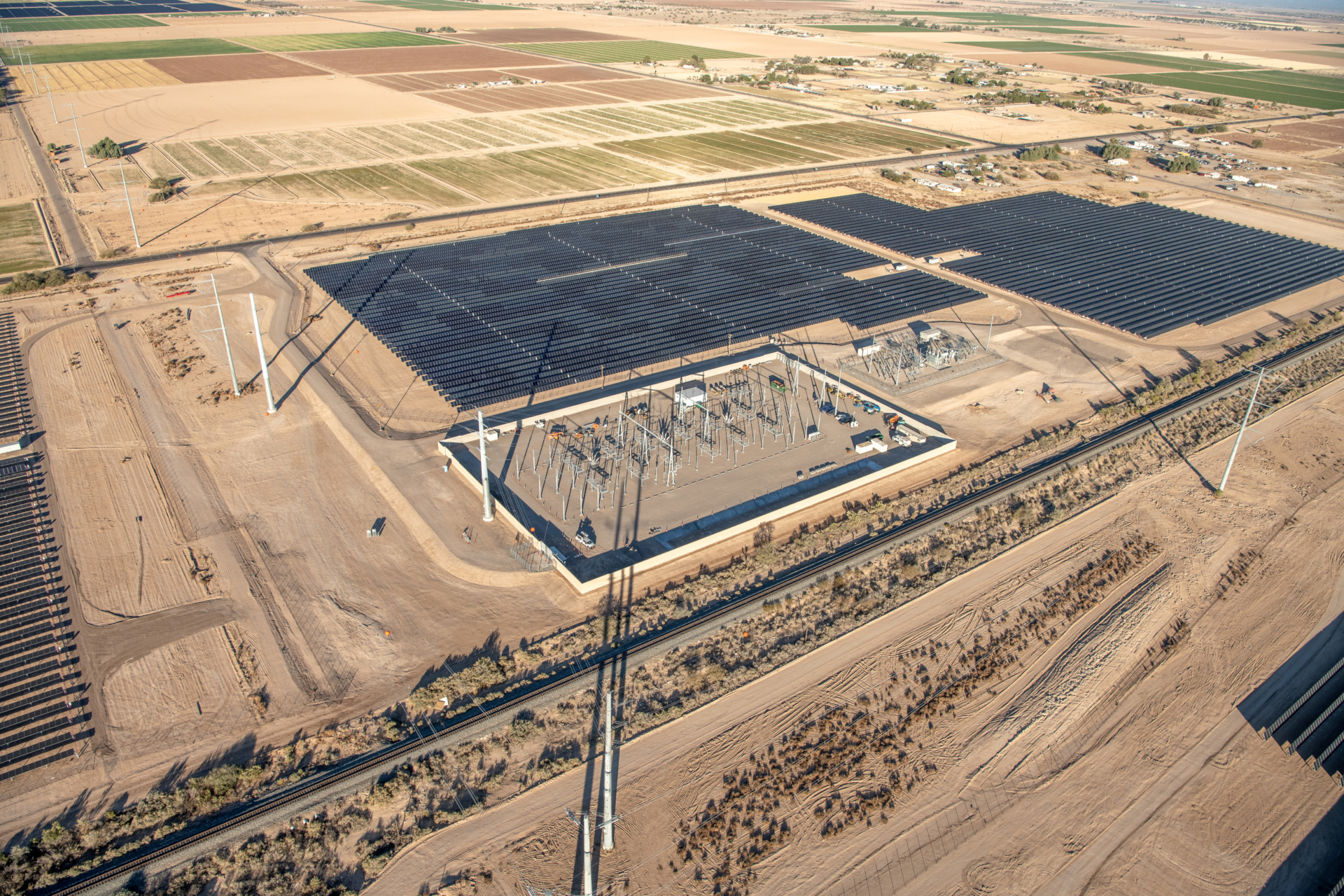
Below: Saint Solar is a 100 MW solar plant initiated by SRP’s Sustainable Energy Offering and is owned and operated by a subsidiary of NextEra Energy Resources, LLC.Business News | yesterday |
 
"Following its recent announcement to expand utility-scale solar resources to 2,025 megawatts (MW) by 2025, Salt River Project (SRP) today announced three new solar energy plants that will deliver a total of 500MW of renewable energy.
Facebook announced it will be SRP’s largest off taker of these new clean energy resources, utilizing 450MW of the combined solar capacity to support Facebook’s newly announced data center in Mesa, Arizona, and help meet the company’s 100 percent renewable energy commitments.
The three projects include two 200-MW solar plants and one 100-MW solar plant.
SRP is contracting with subsidiaries of solar developers AES, EDP and NextEra Energy Resources to construct and operate the three new plants.
> The first project is expected to come online in fall 2022 and start of construction for all the new solar plants, which will all be located in Pinal County, will begin at different points in time throughout 2022. . .
____________________________________________________________________________
NOTE:
CSRWire - Bonneville Environmental Foundation
> The Facebook data center in Mesa will receive water credits for its operations from an agreement with Gila River Water Storage, LLC. (GRWS), SRP’s joint venture with the Gila River Indian Community which provides renewable water in the form of Long Term Storage Credits (LTSCs) to entities seeking additional supplies.
> The data center will procure these LTSCs from GRWS
 water storage, which means that it will not use any water rights from Mesa’s municipal supply for operations.
 
RELATED CONTENT
Could Facebook be behind Redale LLC?– Mark Zuckerberg

Huge data center moves forward in Mesa despite Arizona water concerns


A massive new data center is set to be built in Mesa, Arizona, after the City Council voted in favor of a controversial development agreement.Critics noted that the huge facility would consume millions of gallons of water as the city and state struggle with dwindling supplies.

SEE THIS: https://mesazona.blogspot.com/2021/08/facebook-data-center-formerly-know-as.html

Facebook Data Center ( Formerly Known as "Project Huckleberry" ) = A LARGE WATER CONSUMER 

Let's backtrack to one item on the Mesa City Council agenda 17 May 2021

File #:21-0552   
Type:ResolutionStatus:Agenda Ready
In control:City Council
On agenda:5/17/2021
Title:Approving and authorizing the City Manager to enter into a Development Agreement and Sustainable Water Service Agreement with Redale LLC, for the development of approximately 396 acres of property generally located at the southeast corner of Elliot and Ellsworth Roads. The Agreements facilitate the phased development of a large data center that will generate economic benefits to the City of Mesa and authorize the development to be a MLM Customer (large water customer) under Title 8, Chapter 10 of the Mesa City Code. (District 6)
___________________________________________________________________________
Adding 500MW of renewable solar energy to SRP’s power grid to support the energy needs of Facebook’s data center in Mesa, as well as SRP small business customers, will save hundreds of millions of gallons of water per year than if the same amount of energy were generated by fossil fuel-burning resources.

Below is further detail on the new solar energy plants:

West Line Solar, Solar Developer: AES (100 MW)

The first of the new solar plants scheduled to be commercially operational is “West Line Solar.” The 100MW plant will come online in October 2022 and SRP is partnering with The AES Corporation (NYSE: AES), a Fortune 500 global energy company, to develop this solar resource which will be located in the city of Eloy, part of Pinal County, Ariz. West Line Solar will be 650 acres in size and construction is set to begin in spring of 2022. . .

Facebook will receive 50MW of solar energy from this solar plant, leaving 50MW of available renewable energy that SRP will offer to residential and small business customers as part of its new solar offerings available later this year.

Randolph Solar Park, Solar Developer: EDP Renewables North America (200 MW)

The next new solar plant to become commercially operational will be “Randolph Solar Park,” which is slated to come online in 2023. SRP is partnering with EDP Renewables, a global leader in renewable energy production, to develop and operate this 200MW solar park located in the city of Coolidge, Ariz., part of Pinal County, adjacent to SRP’s Randolph 230kV substation. Randolph Solar will span across 1,346 acres, and construction is anticipated to begin in fall of 2022 . . .

Facebook will receive the full 200MW of energy from this solar plant.

Valley Farms Solar, Solar Developer: NextEra (200 MW)

The third project, “Valley Farms Solar” is expected to become commercially operational by December 2023.

Saint Holdings on Twitter: "Saint Holdings continues to fuel #PinalCounty  through business growth and the sun! Saint Holdings just closed Pinal  County's most significant renewable #energy deal on a new 1,000-acre,  100-megawatt

SRP has contracted with a subsidiary of NextEra Energy Resources, the world’s largest generator of renewable energy from the wind and the sun, to develop this 200MW solar plant located in Coolidge, Ariz. The two companies have previously worked together to develop and contract a 20MW solar generation facility and battery storage system, Pinal Central Solar Energy Center, and a 100MW solar plant, Saint Solar, which began operations in 2018 and 2020 respectively.

Additionally, SRP and NextEra have plans to develop two solar-charged battery projects totaling nearly 350MW, Sonoran Energy Center and Storey Energy Center. Valley Farms Solar will be 1,900 acres in size and construction will begin in winter of 2022 . . .

=========================================================================

Huge Land Sale in Pinal County Sets Up Planned 100-Megawatt Solar Project

Article originally posted on Phoenix Business Journal on May 28, 2019
A Florida energy company paid close to $15 million for over 1,000 acres in Pinal County for a new solar power project.The 100-megawatt project will be the largest solar farm in Pinal County and one of the largest in the state, said Coolidge City Manager Rick Miller.

“This is a desirable location for solar,” Miller said. “We are also working with two other companies looking to do large-scale solar projects in the area.”

Scottsdale-based Saint Holdings sold 1,027 acres to a company called Saint Solar, an entity controlled by Florida Power & Light Co., the principal subsidiary of NextEra Energy Inc., according to real estate database Vizzda. The land sold May 15 for $14.8 million, according to Vizzda. . .The solar project is north of the planned $1 billion, 2,000-job manufacturing plant for Nikola Motor Co. and its hydrogen-electric trucks. . .

Mesa gets solar power from SRP

Posted

The city of Mesa is now one of 11 customers for Salt River Project receiving solar power from a new facility.

The power is coming from a 100-megawatt plant from Saint Solar that is part of the utility’s increasing efforts to provide its customers with renewable energy.

“The city of Mesa is always looking for ways to be a little greener,” Mesa Mayor John Giles said in a release. “Thanks to SRP’s Sustainable Energy Offering, we’ll be able to tap into our generous Arizona sunshine and add more solar power to our overall energy mix.”

Mesa isn’t the only city to receive power from the plant as Chandler and Phoenix also are part of the distribution. Businesses receiving power include Albertsons Cos. Inc., data centers Cyrus One and Digital Realty, and Mesa Public Schools.

“From the beginning of this process, discussing an innovative energy offering with a diverse group of customers, to now, experiencing how we jointly take a step closer to achieving our renewable energy goals, is something we recognize is extremely impactful,” SRP Associate General Manager and Chief Customer Executive Jim Pratt said in a release.

SRP’s latest renewable energy offering has a total of 33 companies signed up for 300 megawatts of power, of which the Saint Solar facility is part. SRP has a goal to reduce carbon intensity of its operations by 60% by 2035. . .

Let's crack open this latter-day charade
City envisions a $66M pipe as a lifeline to SE Mesa 
DUH? Hard to believe city officials are using that same old play-book
"This is just an illustration. We have no idea where the alignment is,’’
----- Jake West, Mesa’s water resources director, said
“We’re just in the beginning of an alignment study to make it as successful and economically done as possible.’’
________________________________________________________
BLOGGER NOTE:
Water is the most precious commodity here in the Desert
It can be bought and sold or traded on the private equity market  - all with higher prices all the time the hotter and drier our so-called 'stable environment' gets.
 
The Most Precious Commodity
Here in The Desert