Tuesday, November 02, 2021

LIDAR: Infrared Beams Reveal Ancient New World Civilization Cultural Centers and Infrastructure

Intro: City plans built around calendars or cosmology were key features of several Mesoamerican civilizations, including both the Maya and the Olmec.
The 32,800-square-mile area was surveyed by the Mexican Instituto Nacional de Estadistica y Geografia, which made the data public.
Over the last several years, lidar surveys have revealed tens of thousands of irrigation channels, causeways, and fortresses across Maya territory, which now spans the borders of Mexico, Guatemala, and Belize.
Infrared beams can penetrate dense foliage to measure the height of the ground, which often reveals features like long-abandoned canals or plazas. The results have shown that Maya civilization was more extensive, and more densely populated, than we previously realized.
Enlarge21st Century Fox

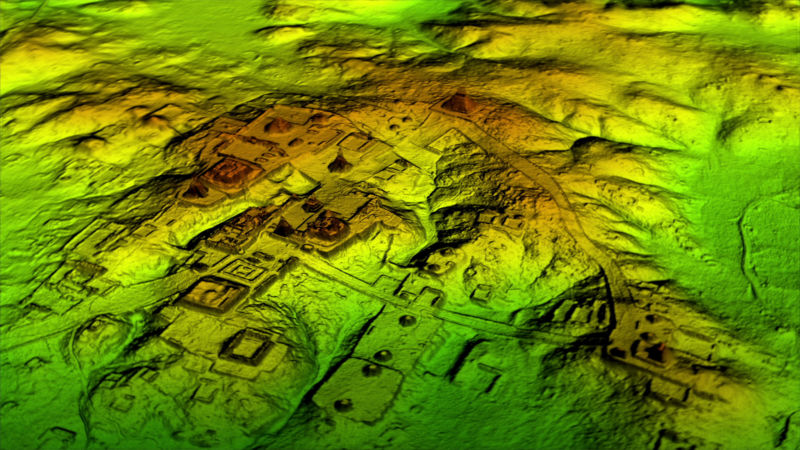
Lidar reveals hundreds of long-lost Maya and Olmec ceremonial centers
<div class=__reading__mode__extracted__imagecaption>Enlarge21st Century Fox

The sites suggest cultural links between the two Mesoamerican civilizations.

An airborne lidar survey recently revealed hundreds of long-lost Maya and Olmec ceremonial sites in southern Mexico. The 32,800-square-mile area was surveyed by the Mexican Instituto Nacional de Estadistica y Geografia, which made the data public. When University of Arizona archaeologist Takeshi Inomata and his colleagues examined the area, which spans the Olmec heartland along the Bay of Campeche and the western Maya Lowlands just north of the Guatemalan border, they identified the outlines of 478 ceremonial sites that had been mostly hidden beneath vegetation or were simply too large to recognize from the ground.

“It was unthinkable to study an area this large until a few years ago,” said Inomata. “Publicly available lidar is transforming archaeology.”

Over the last several years, lidar surveys have revealed tens of thousands of irrigation channels, causeways, and fortresses across Maya territory, which now spans the borders of Mexico, Guatemala, and Belize. Infrared beams can penetrate dense foliage to measure the height of the ground, which often reveals features like long-abandoned canals or plazas. The results have shown that Maya civilization was more extensive, and more densely populated, than we previously realized.

The recent survey of southern Mexico suggests that the Maya civilization may have inherited some of its cultural ideas from the earlier Olmecs, who thrived along the coastal plans of southern Mexico from around 1500 BCE to around 400 BCE

Cosmological construction

The oldest known Maya monument is also the largest; 3,000 years ago, people built a 1.4 kilometer-long earthen platform at the heart of a ceremonial center called Aguada Fenix, near what is now Mexico’s border with Guatemala. And the 478 newly rediscovered sites that dot the surrounding region share the same basic features and layout as Aguada Fenix, just on a smaller scale. They’re built around rectangular plazas, lined with rows of earthen platforms, where large groups of people would once have gathered for rituals.

Inomata and his colleagues say the sites were probably built in the centuries between 1100 BCE (around the same time as Aguada Fenix) and 400 BCE. Their construction was likely the work of diverse groups of people who shared some common cultural ideas, like how to build a ceremonial center and the importance of certain dates. At most of the sites, where the terrain allowed, those platform-lined gathering spaces are aligned to point at the spot on the horizon where the Sun rises on certain days of the year.

“This means they were representing cosmological ideas through these ceremonial spaces,” said Inomata. “In this space, people gathered according to this ceremonial calendar.” The dates vary, but they all seem linked to May 10, the date when the sun passes directly overhead, marking the start of the rainy season and the time for planting maize. Many of the 478 ceremonial sites point to sunrise on dates exactly 40, 80, or 100 days before that date."

AUGMENTED REALITY: iT'S ALL-OUT-THERE AS A POTENTIAL MARKET PLATFORM

Something you can see - "Over the last decade AR hardware designers have laid the groundwork for a new generation of mass-market products, even as technical hangups still limit its viability.

Over the next one, AR threatens to supercharge existing crises of privacy, trust, and consent.
But it’s also a chance to deliberately reset how we approach computing.
"Imagine a world where you barely notice the barriers between digital and physical space. Instead of looking at a TV or phone, you have a pair of glasses that can project a screen anywhere. You can seamlessly pull up translations for any street sign or instructions for any task. You can amplify a difficult-to-hear conversation through an earpiece or highlight a hard-to-see detail in your surroundings.

Now imagine the same world — but your glasses scan every conversation to personalize a barrage of advertising. Some locations are replete with helpful holographic instructions, while in other places, neglect and poor connectivity make them few and far between. A sophisticated facial recognition system tracks every stranger you encounter... and, in turn, lets those strangers track your every move.

These are a few of the best- and worst-case scenarios for augmented reality, a technology that some of the world’s biggest tech companies are spending billions to promote as the future of computing.

[. . .]

> Facebook founder Mark Zuckerberg predicted in 2016 that televisions and phones would be replaced by holographic glasses.

> Apple CEO Tim Cook called AR “a big idea, like the smartphone.”

> Microsoft envisioned people watching the Super Bowl in its HoloLens headset.

> Google launched its ambitious Glass platform as a potential successor to phones, then helped propel the AR startup Magic Leap toward billions of dollars in investments.

> More recently, telecoms have partnered with AR companies like the Chinese startup Nreal, hoping high-bandwidth holograms will create a demand for 5G networks.

These companies’ products — as well as those of other major players, including Snap, Vuzix, and Niantic — often look very different. But most of them promise a uniquely powerful combination of three features.

  • Their hardware is wearable, hands-free, and potentially always on — you don’t have to grab a device and put it away when you’re done using it
  • Their images and audio can blend with or compensate for normal sensory perception of the world, rather than being confined to a discrete, self-contained screen
  • Their sensors and software can collect and analyze huge amounts of information about their surroundings — through geolocation and depth sensing, computer vision programs, or intimate biometric technology like eye-tracking cameras

Over the past decade, nobody has managed to merge these capabilities into a mainstream consumer device. Most glasses are bulky, and the images they produce are shaky, transparent, or cut off by a limited field of view. Nobody has developed a surefire way to interact with them either, despite experiments with voice controls, finger tracking, and handheld hardware. . .Despite this, we’ve gotten hints of the medium’s power and challenges — and even skeptics of the tech should pay attention to them.

[. . .]

Writer and researcher Erica Neely says that laws and social norms aren’t prepared for how AR could affect physical space. “I think we’re kind of frantically running behind the technology,” she tells The Verge. In 2019, Neely wrote about the issues that Pokémon Go had exposed around augmented locations. Those issues mostly haven’t been settled, she says. And dedicated AR hardware will only intensify them.

Smartphone cameras — along with digital touchup apps like FaceTune and sophisticated image searches like Snap Scan and Google Lens — have already complicated our relationships with the offline world. But AR glasses could add an ease and ubiquity that our phones can’t manage. “A phone-based app you have to actually go to,” says Neely. “You are making a conscious choice to engage with it.” Glasses remove even the light friction of unlocking your screen and deliberately looking through a camera lens.

Augmentation also doesn’t just mean adding things to a wearer’s surroundings. It also means letting a computing platform capture and analyze them without other people’s consent. . .

Take facial recognition — a looming crisis at the heart of AR. Smartphone apps have used facial recognition for years to tag and sort people, and one of the most intuitive AR glasses applications is simply getting reminded of people’s names (as well as other background information like where you met them). It’s also a potential privacy disaster.

[. . .] But the EFF’s concern wasn’t premature. Andrew Bosworth, an executive at Facebook and Meta, reportedly told employees the company is weighing the costs and benefits of facial recognition for its Project Aria glasses, calling it possibly “the thorniest issue” in AR. And outside AR, some people are pushing for a near-total ban on the technology. Researcher Luke Clark has likened facial recognition to “the plutonium of AI,” saying any potential upsides are far eclipsed by its social harms. AR is a ready-made testbed for the widespread public use of facial recognition, and by the time any potential harms are obvious, it might be too late to fix them.

[. . .]

AR technology also isn’t going to develop in a vacuum. Despite talking up AR glasses’ novelty, figures like Zuckerberg and Cook still describe people using them almost exactly the way they use smartphones: as devices they carry around casually all the time. But ubiquitous, short-lived electronics like smartphones have imposed a steep environmental cost on the planet, and rolling out AR could add billions more devices that are replaced as readily as phones and powered by vast amounts of cloud computing infrastructure. “What are the environmental implications? And do those make sense?” Friedman asks. “If not, I think really the question for us is, what are the really critical areas in which some kind of augmented reality technology really does bring a substantial benefit to people?”

Either way, the past 10 years of tech have been a long struggle to manage crises once they’re already at a boiling point. Meanwhile, AR glasses’ status as a long-awaited, not-quite-there dream can buy us time to figure out what they can do for the world — and whether we actually want them."

Monday, November 01, 2021

Announcing the 2021 Social Progress Index and special report on social progress and climate change!

GLOBAL INDEX.png

The Social Progress Index enables policymakers, business and finance executives, to put people and the planet at the heart of policy and investment decisions.

We are delighted to announce the release of the 2021 Social Progress Index.


As we focus on an inclusive, resilient, and sustainable recovery, a common agreement on the truth of a society's successes and failures has never been more important. We don't yet know the true social cost of the pandemic, from health to education, to food insecurity, and beyond, we expect the impact will not be minimal. As billions of dollars are being poured into recovery efforts we need to have a good understanding of where we need investment and policies that can make the most positive impact.


This year's Social Progress Index reveals how countries across the world are doing in light of the many challenges we all face. Our rich publicly available data set allows you to look at which countries are doing better than others and in what areas, so we can figure out what is working and where we need to focus our efforts. Explore the 2021 global index today to learn the strengths and vulnerabilities of 168 countries!


For the first time, we have released a special report that examines the complex relationship between social progress, development, and greenhouse gas emissions. As world leaders gather for COP26, many across the world hold their collective breath hoping that accountability and action taken and pledged, will be strong enough to avoid catastrophic climate calamity. In this report, we find that social progress does not have to come at the cost of the planet. Our report provides a compelling data-driven story about what is achievable.


Join us at 10 am ET on November 2nd, for a special live stream with our CEO Michael Green, as he shares the latest findings from the index and the report. Watch here.


Thanks to all of our partners and donors, we could not do this without their support.

To help keep our work alive, please donate today.


Social-Progress-Imperative-.png

Best wishes,


The Social Progress Imperative Team


GI-COVER.jpg

The 2021 Social Progress Index is here! Discover how your country progressed over the last year.


Find out more

SR-GHG-COVER.jpg

Download the special report on greenhouse gas emissions and its relationship with societal progress.


Download the report

countries3.jpg

168 countries

socialandenvironment.jpg

53 social and environmental indicators

people.jpg

Data insights for 7.6+ billion people

Supporting sponsor

download-3.png

P.S. To find out how you can get involved, from partnerships, to sponsor opportunities and more, please get in touch with us: hello@socialprogress.org

PAYDIRT // A PUBLIC HEARING WITH NO INPUT OR OVERSIGHT FROM THE PUBLIC: Council Study Session - 10/28/2021

The staff was prepared . . we're you?
GET THIS: 71.3 acres has a valuation of what?
Owner Total Assessed Valuation of private land ................................ $1,292.00

Not appearing in the presentation are these city officials:

To: City Council T
Through: Natalie Lewis, Assistant City Manager 
From: 
Christine Zielonka, Development Services Director 
Nana Appiah, Planning Director 

_____________________________________________

NOTE:
The City of Mesa Departments/Divisions of Transportation, Fire, Solid Waste, and Water Resources have provided comments related to the future development of the Property; however, none of the comments pertain to the annexation of the Property, which is currently vacant land. 
 
 
HUH? The blank petition was recorded on October 6, 2021. 
Staff anticipates making a recommendation of approval for the annexation. 
 
 
File #:21-1104   
Type:Public HearingStatus:Agenda Ready
In control:City Council
On agenda:11/1/2021
Title:Public hearing prior to the release of the petition for signatures
for the proposed annexation case ANX21-00728,
located north of Pecos Road and west of Signal Butte Road (71.3± acres). 
This request has been initiated by the applicant, Josh Tracy, Ryan Companies;
for the owner, Tucker Properties, LTD. (District 6)
Attachments:1. Council Report, 2. Annexation Map, 3. Annexation Petition 
_________________________________________________________________
CITY COUNCIL REPORT
City Council Report 
Date: November 1, 2021 
To: City Council T
Through: Natalie Lewis, Assistant City Manager 
From: 
Christine Zielonka, Development Services Director 
Nana Appiah, Planning Director 

Subject: Public Hearing prior to the release of the petition for signatures 
for annexation case ANX21-00728, located north of Pecos Road and west of Signal Butte Road (71.3± acres). 
Council District 6 

Purpose and Recommendation
The purpose of this agenda item is for the City Council to conduct a public hearing on the proposed annexation of 71.3+ acres of property depicted on Exhibit “A” (the Property”). 
State Statute requires the blank annexation petition to be recorded prior to the public hearing (A.R.S. §9-471-A). 
The blank petition was recorded on October 6, 2021. 
The subject annexation request was initiated by the applicant, Josh Tracy, Ryan Companies, for the owners, Tucker Properties, LTD. 
Following the public hearing, the annexation petition will be released for property owner signature. 
Once the signatures have been received, the annexation ordinance will be scheduled for the City Council’s consideration and adoption. 
Staff anticipates making a recommendation of approval for the annexation. 

Background 
The annexation area consists of one undeveloped parcel generally located north of East Pecos Road and west of South Signal Butte Road (see Exhibit ‘A”). 
The applicant is requesting annexation to develop the Property within the corporate limits of the City of Mesa. 
Currently, the Property is zoned Single Residence 43 (RU-43) in Maricopa County. 
The annexation ordinance will establish City of Mesa zoning designation of Agriculture (AG) on the Property. 

Discussion 
The Property is completely surrounded by the existing City of Mesa corporate boundaries and is within the City of Mesa Planning Area. 
The Property has a General Plan character area designation of “Employment”. 
If annexed, any development of the Property will be required to comply with City of Mesa development standards, [ page 2 ]
including storm water retention, street improvements, landscaping, screening, and signage. 
The City will also collect the development fees as well as supply water and gas utilities. 
Utilities and City services are already provided in the area and extension of these services will have minimal impact on the City. 
The City of Mesa Departments/Divisions of Transportation, Fire, Solid Waste, and Water Resources have provided comments related to the future development of the Property; however, none of the comments pertain to the annexation of the Property, which is currently vacant land. 
Planning State Statute requires the City to adopt a zoning classification that permits densities and uses no greater than those permitted by the County on newly annexed land (A.R.S. §9-471-L). 
The Property is currently zoned RU-43 in Maricopa County. 
City of Mesa zoning designation of AG will be established through the annexation ordinance. 

Fiscal Impact 
Annexation of the Property will result in the collection of any future secondary property tax, construction tax, and development fees generated from the Property. 
Notification The Property has been posted and notifications have been sent to all property owners and county agencies as required by state statute (A.R.S. §9-471). 
GENERAL INFORMATION Area ....................................................................................... 71.3± acres 
Population............................................................................... 0 
People Dwelling Units ........................................................................ 0 
Homes Existing Businesses ................................................................ 0 
Businesses Arterial Streets ........................................................................ 0 miles 
Total Owners .......................................................................... 1 
Owner Total Assessed Valuation of private land ................................ $1,292.00
 
===================================================


FORBES DAILY COVER STORY 01 NOVEMBER 2021: Take a Look + Read More (Dana Alexander)

Yes it's WRIT LARGE

Trump’s SPAC Is Planning For The Possibility That He Could Be Convicted Of A Felony (Or Run For President Again)

Daily Cover|  1, 2021,06:30am EDT|Trump’s New Company Is Planning For His Possible Conviction (Or Presidential Run)

Here's the story:

Daily Cover|

Trump’s New Company Is Planning For His Possible Conviction (Or Presidential Run)

Forbes | 2021-11-01


"The future is unclear for Donald Trump. On the one hand, a grand jury has already accused the Trump Organization of committing a series of crimes, and rumor has it that more indictments are coming. On the other hand, the real estate tycoon might run for president again in 2024 . . ."


UP-TICK IN PAGE-VIEWS

A pleasant surprise
 
Analysis

MesaZona > Table of Contents :

Here's The Menu. Enjoy

Views
3 Oct5 Oct7 Oct9 Oct11 Oct13 Oct15 Oct17 Oct19 Oct21 Oct23 Oct25 Oct27 Oct29 Oct31 Oct02K4K6K8K
Oct 2, 2021, 5:00:00 PM410
Oct 3, 2021, 5:00:00 PM449
Oct 4, 2021, 5:00:00 PM279
Oct 5, 2021, 5:00:00 PM455
Oct 6, 2021, 5:00:00 PM381
Oct 7, 2021, 5:00:00 PM494
Oct 8, 2021, 5:00:00 PM312
Oct 9, 2021, 5:00:00 PM387
Oct 10, 2021, 5:00:00 PM332
Oct 11, 2021, 5:00:00 PM278
Oct 12, 2021, 5:00:00 PM165
Oct 13, 2021, 5:00:00 PM183
Oct 14, 2021, 5:00:00 PM241
Oct 15, 2021, 5:00:00 PM204
Oct 16, 2021, 5:00:00 PM136
Oct 17, 2021, 5:00:00 PM287
Oct 18, 2021, 5:00:00 PM281
Oct 19, 2021, 5:00:00 PM306
Oct 20, 2021, 5:00:00 PM229
Oct 21, 2021, 5:00:00 PM273
Oct 22, 2021, 5:00:00 PM474
Oct 23, 2021, 5:00:00 PM367
Oct 24, 2021, 5:00:00 PM352
Oct 25, 2021, 5:00:00 PM6,299
Oct 26, 2021, 5:00:00 PM2,397
Oct 27, 2021, 5:00:00 PM496
Oct 28, 2021, 5:00:00 PM491
Oct 29, 2021, 5:00:00 PM351
Oct 30, 2021, 5:00:00 PM329
Oct 31, 2021, 5:00:00 PM247
17.9K
. . .Thank you, You All!

SAME OLD RE-RUN OF THE TRUMPSTER ROUTINE: Youngkin's Race for Georgia Governor Uses The Oldest Tactic

If the campaign image you see looks-and-sounds familiar there are reasons why. There is no need to look farther - his political identity can’t be separated from Republican identity politics in the decadent stage of Trumpism sowing confusion and chaos.

The Republicans’ racial culture war is reaching new heights in Virginia

Why is the Republican running for governor of Virginia going after Toni Morrison’s award-winning novel Beloved?

‘The Republican Party has long specialized in fabricating esoteric threats, from the basements of Pizzagate to the stratosphere of Jewish space lasers. Youngkin’s campaign, though, has contrived a brand-new enemy within.’
‘The Republican party has long specialized in fabricating esoteric threats, from the basements of Pizzagate to the stratosphere of Jewish space lasers. Youngkin’s campaign, though, has contrived a brand-new enemy within.’ Photograph: Anna Moneymaker/Getty Images
 
Sidney Blumenthal:
"Running for governor of Virginia as the Republican candidate, Glenn Youngkin appears to have a split personality – sometimes the generic former corporate executive in a fleece vest, the suburban dad surrounded by his sun-lit children and tail-wagging dogs, and sometimes the fierce kulturkampf warrior and racial dog-whistler.
His seemingly dual personality has been filtered through a cascade of Republican consultants’ campaign images.
His latest TV commercial attempts to resolve the tension by showing him as a concerned father who shares the worries of the ordinary Trumpster. In the closing hours of the campaign, he has exposed that his political identity can’t be separated from Republican identity politics in the decadent stage of Trumpism.

The Republican party has long specialized in fabricating esoteric threats, from the basements of Pizzagate to the stratosphere of “Jewish space lasers”. Youngkin’s campaign, though, has contrived a brand-new enemy within, a specter of doom to stir voters’ anxieties that only he can dispel: the Black Nobel prize-winning novelist Toni Morrison and her novel Beloved.

His turn to a literary reference might seem an obscure if not a bizarre non sequitur, at odds with his pacifying image, but the ploy to suppress the greatest work by the most acclaimed Black writer has an organic past in rightwing local politics and an even deeper resonance in Virginia history.

[. . .] For a while the nice guy Youngkin tried to walk his thin line, lest he lose the party’s angry base voters. He attempted to use the soft image to cover the hard line. He is vaccinated, but against vaccine mandates. He is inspired by Donald Trump, has proclaimed his belief in the need for audits and “election integrity”; opposed to abortion, but was careful not to appear with Trump at his “Take Back Virginia” rally. He appeared on Tucker Carlson’s Fox News in a ritual cleansing to profess that his motive is pure.

[. . .] Actually, according to Bloomberg News, he “flamed out” as co-CEO of the Carlyle Group, with a “checkered record”, losing billions on “bad bets”, and “retired after a power struggle”. In May, just before leaving the firm and speaking to Carlson, after the murder of George Floyd, Youngkin signed a statement affirming that contributions to the Southern Poverty Law Center, the Equal Justice Initiative and the NAACP Legal Defense Fund would receive matching grants from Carlyle. When asked about this later, however, a campaign spokesperson fired back, “Glenn has never donated to the SPLC and does not agree with them. He is a Christian and a conservative who is pro-life and served in his church for years.”

> Youngkin’s seeming confusion around controversial racial issues highlighted his conflicting roles. In Washington, while at Carlyle, he was the responsible corporate citizen practicing worthy philanthropy. In the Republican party, where that sort of non-partisan moderation is not only suspect but mocked as a source of evil, he has had to demonstrate that he is not tainted.

> Soon enough, Youngkin waded into the murky waters of racial politics. He offered himself as the defender of schoolchildren from the menace of critical race theory, even though the abstruse legal doctrine is not taught in any Virginia public school. Yet he suggested that his opponent, former governor Terry McAuliffe, would impose its creed on innocent minds, depriving parents of control. “On day one, I will ban critical race theory in our schools,” Youngkin has pledged.

[. . .] He needed one more push, searched for one more issue and produced one more ad. . .So, Youngkin seized upon a novel racial symbol, in fact a novel. The danger, he claimed, comes from Beloved by Toni Morrison – the Pulitzer prize-winning novel by the Nobel prize-winning author, about the psychological toll and loss of slavery, especially its sexual abuse, and considered one of the most important American literary works.

While no other Republican has ever before run against Beloved as a big closing statement, there is a history to the issue in Virginia. . ."

=========================================================================

BLOGGER INSERT: The Spoiler over using that good old All-American word "Mom" with details from author Sidney Blumenthal: “This Mom knows – she lived through it. It’s a powerful story,” tweeted Youngkin. (

1) Ms Murphy, the “Mom”, is in fact a longtime rightwing Republican activist.

(2) Her husband, Daniel Murphy, is a lawyer-lobbyist in Washington and a large contributor to Republican candidates and organizations.

(3) Their delicate son, Blake Murphy, who complained of “night terrors”, was a Trump White House aide and is now associate general counsel for the National Republican Congressional Committee, which sends out fundraising emails reading: “Alert. You’re a traitor. You abandoned Trump …”

========================================================================

HERE'S THE SCRIPT PRVIDED BY THE YOUNGKIN CAMPAIGN:: “When my son showed me his reading material, my heart sunk,” Laura Murphy, identified as “Fairfax County Mother”, said in the Youngkin ad. “It was some of the most explicit reading material you can imagine.” She claimed that her son had nightmares from reading the assignment in his advanced placement literature class. “It was disgusting and gross,” her son, Blake, said.

“It was hard for me to handle. I gave up on it.”

As it happens, in 2016 Murphy had lobbied a Republican-majority general assembly to pass a bill enabling students to exempt themselves from class if they felt the material was sexually explicit. Governor McAuliffe vetoed what became known as “the Beloved bill”.

=======================================================================

[. . .]  Virginia’s racial caste system existed for a century after the civil war. In 1956, after the supreme court’s decision in Brown v Brown of Education ruled that school segregation was unconstitutional, Virginia’s general assembly, with Confederate flags flying in the gallery, declared a policy of massive resistance that shut down all public schools for two years. The growth of all-white Christian academies and new patterns of segregation date from that period. Only in 1971 did Virginia revise its state constitution to include a strong provision for public education.

Youngkin’s demonizing of Toni Morrison’s Beloved may seem unusual and even abstract, but it is the oldest tactic in the playbook. It was old when Lee Atwater, a political operative for Ronald Reagan and George HW Bush, explained, “You start out in 1954 by saying, ‘Nigger, nigger, nigger.’ By 1968 you can’t say ‘nigger’ – that hurts you, backfires. So you say stuff like, uh, forced busing, states’ rights, and all that stuff, and you’re getting so abstract.”

Youngkin well understands the inflammatory atmosphere in Virginia in which he is dousing gasoline and lighting matches . . "

YOU ARE ENCOURAGED TO READ MORE

The Republicans’ racial culture war is reaching new heights in Virginia

Cartoon Carousel The nation’s cartoonists on the week in politics | By POLITICO STAFF 01/23/2026 05:00 AM EST

Every week political cartoonists throughout the country and across the political spectrum apply their ink-stained skills to capture the fo...