Wednesday, November 17, 2021

ANYTHING NEW THERE??? Afghanistan's economy still relies heavily on opium, cannabis | DW News

Drugs + Wars . . Guns + Money
Just a curious coincidence or what?
65% of Afghanistan's Gross Domestic Product was always from Poppy Cultivation and Opium Production. There was never any question about that.
A recent report in this streaming video had THIS TO SAY:
"Amid the economic malaise in Afghanistan, there's one market raking in cash – the opium trade.
The UN has reported a record opium harvest in the country for the fifth year running – worth up to 2.7 billion dollars annually.
Over 100,000 Afghans are involved in the illegal trade.
For many farmers, opium is the only way to make ends meet.
DW correspondent Nick Connolly met some of them.
After years of earning protection money from the illegal drug trade, while fighting their insurgency against Afghanistan’s Western-backed government, the Taliban now say they want to put an end to the cultivation and use of what is – by most estimates – the country’s most valuable export.
This at a time of extreme stress for the country’s farmers. Drought, plummeting consumer demand and border closures have seen their incomes dwindle.
The one crop still performing for these farmers is the opium poppy. Here in Kandahar province it’s sold openly alongside the farmers’ other produce. The only thing the Taliban announcement changed, these farmers tell us, was to drive up opium prices, while the prices for other crops are collapsing.
With Afghanistan’s land borders for the most part shut to legal exports - entire harvests of pomegranates and other export crops have rotted or been sold for a pittance - while smuggling routes for opium and cannabis have stayed open.
Margins are tight even at the best of times.
But for now there’s little prospect of international aid returning in anything like the volumes seen under the previous government. Without it, Afghanistan’s economy looks set to suffer for the foreseeable future, opening the way for more poppies and more cannabis across these fields - and more drugs on the streets of Afghanistan’s
neighbors.
 

Please Don’t Destroy - Three Sad Virgins (ft. Taylor Swift) - SNL

FACTS USA Week of November 15-19 2021

upload.wikimedia.org/wikipedia/commons/c/cb/USAFac...

More than half - 67.5% -of Americans have received at least one dose of the COVID-19 vaccine. How is your state faring? Check in the USAFacts vaccine tracker.

It's National Education Week. . .

November 15 through 19 is National Education Week. USAFacts is marking the occasion with facts and metrics on the nation's teachers and school staff. Here's a refresher on just some of the education articles and data available right now at USAFacts.org:
  • Learn more about the nation's 4 million teachers, including that women comprise 89% of teachers in public elementary schools, 72% of teachers in public middle schools, and 60% of teachers in public high schools.
     
  • Asian and Black women are the public school teachers most likely to have a postgraduate degree.
  • When the National Center for Education Statistics polled public school teachers on whether they would leave teaching as soon as possible for a higher-paying job, 65% disagreed to at least some extent. Over half of those teachers strongly disagreed.
     
  • See the metrics on teacher salaries. By 2018, Illinois teacher salaries were in the middle of educator salaries nationally, while the top salary was $83,585 in New York and the lowest was in Mississippi at $43,107.
     
  • From 2000 to 2018, teacher salaries increased in 19 states while decreasing in 32 others (including Washington, DC).

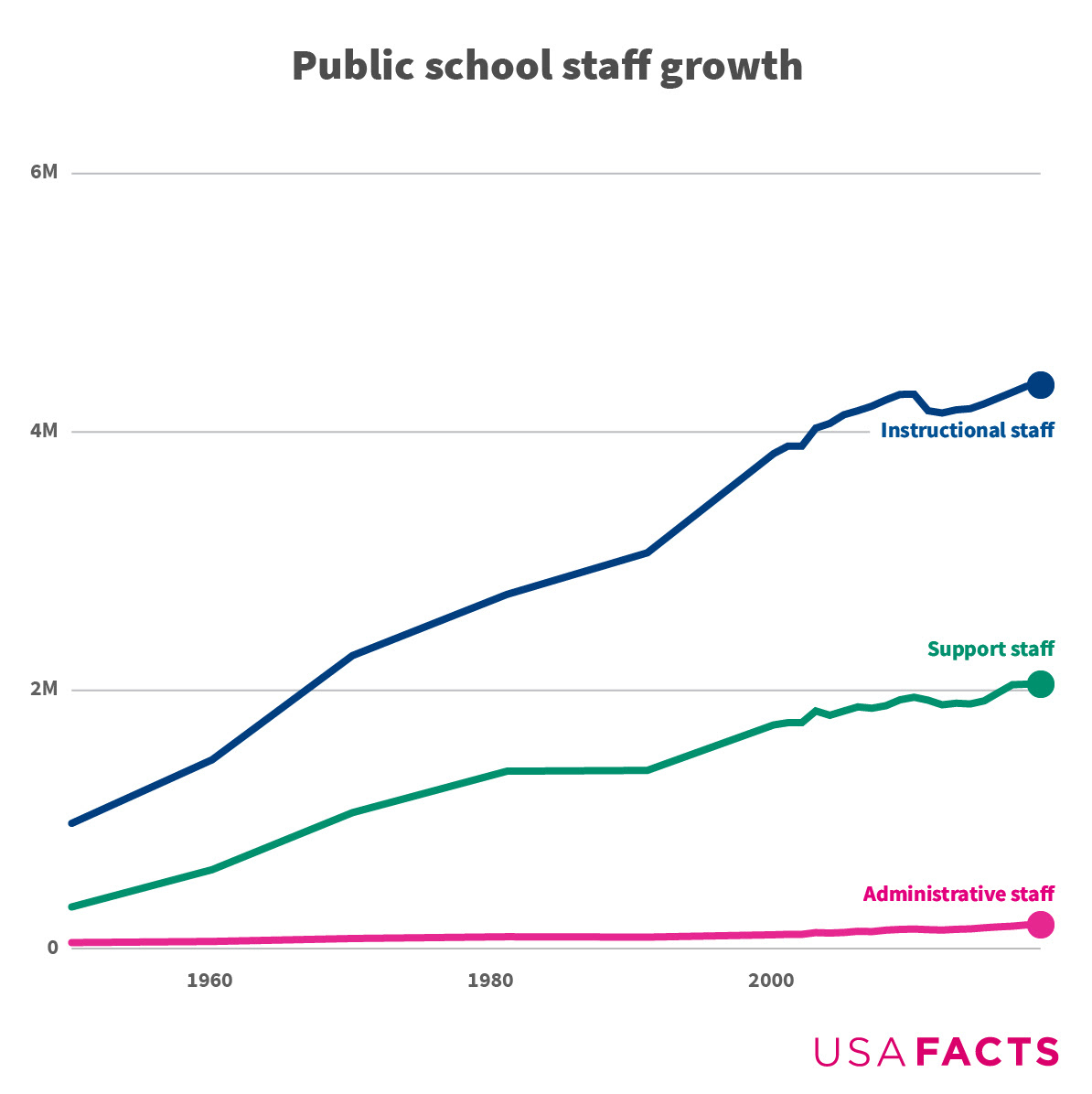
Plus, be sure to check out the wide range of education data, from student-to-teacher ratios to STEM degrees conferred to how public school staffs have grown since the 1950s. 


Celebrating Native American Heritage Month

The 2020 census found that the number of Americans claiming some Native ancestry rose 85% since the census 10 years prior. November is Native American Heritage Month, a time to recognize the contributions Native Americans have made to the growth and vibrancy of the US.

To celebrate, USAFacts analyzed the 2020 census results for a data portrait of this diverse group of people.

  • One million people at least partially identify as Cherokee, making it the largest individual tribal identity.
  • Native Americans are less likely to live to be 65 or older than Americans overall. Seventeen percent of the country is 65 or older compared to 11% of Native Americans. People identifying as Cherokee have the oldest median age of any tribal grouping at 37.1 years old.
  • Native American adults are likelier to have served in the military than the overall US population. While 6.9% of American adults are veterans, 7.5% of Native Americans are. Veteran status is highest among Blackfeet, Chickasaw, Iroquois, Sioux, Choctaw, and Cherokee tribes.

See much more data in this demographic breakdown.


What states grow the most Thanksgiving staples?

Thanksgiving is next week, and farmers nationwide have been busy all year preparing the food that will grace American dinner tables. What states play the most prominent role in your Thanksgiving meal? Here's the delicious data behind the states and farms that produce food for the big day.

  • In 2020, farmers raised 224 million turkeys and produced 5.7 billion pounds of ready-to-cook turkey. Minnesota produced 40 million turkeys — the most of any state.
     
  • Americans are increasingly sweet on sweet potatoes. Annual domestic sweet potato per capita availability, a measure used as a proxy for consumption, grew from 4.2 pounds in 2000 to 6.7 in 2020.
     
  • Wisconsin produced the most snap beans of any state in 2020: 633 million pounds. Nationwide, snap beans were among the top three vegetables harvested last year. Snap bean farms covered 185,200 acres in 2020, while sweet corn covered 402,900 acres and tomatoes covered 280,000 acres.

Was your favorite dish mentioned here? Read this article for more on Thanksgiving foods, including potatoes, cranberries, and pumpkins.


USAFacts talks climate on Earth911

Last week, USAFacts Data Visualization Manager Tanveer Ali dropped by the Earth911 Sustainability in Your Ear podcast to discuss how the Climate in the US is a handy tool to help Americans keep tabs on changing weather patterns. Listen here.


One last fact

More than half of Americans have received at least one dose of the COVID-19 vaccine. How is your state faring? Check in the USAFacts vaccine tracker.

Tuesday, November 16, 2021

One for The Money / Two for The Show. . .Mesa City Council Study Session Mon 11.15.2021

Stay tuned to see the characters and how informed they are

One for The Money / Two for The Show . . .Mesa City Council Meeting Mon 11.15.2021

Stay tuned for the cast of characters

DeFi: Crypto’s ‘Wild West’ of Finance | WSJ

DOUBLE-DOWN ON THAT DATA! The plan to save the world from the worst of climate change is built on data.

PLEASE NOTE THIS REPORT IS TIME-STAMPED ON NOVEMBER 7, 2021
"Across the world, many countries underreport their greenhouse gas emissions in their reports to the United Nations, a Washington Post investigation has found.
An examination of 196 country reports reveals a giant gap between what nations declare their emissions to be vs. the greenhouse gases they are sending into the atmosphere. The gap ranges from at least 8.5 billion to as high as 13.3 billion tons a year of underreported emissions — big enough to move the needle on how much the Earth will warm.
The plan to save the world from the worst of climate change is built on data.
But the data the world is relying on is inaccurate. 
_________________________________________________________________
“It’s hard to imagine how policymakers are going to pursue ambitious climate actions if they’re not getting the right data from national governments on how big the problem is,” said Glenn Hurowitz, chief executive of Mighty Earth, an environmental advocacy group.
_________________________________________________________________
 

Countries’ climate pledges built on flawed data, Post investigation finds

[. . .]

As tens of thousands of people are convening in Glasgow for what may be the largest-ever meeting of the United Nations Framework Convention on Climate Change (UNFCCC), also known as COP26, the numbers they are using to help guide the world’s effort to curb greenhouse gases represent a flawed road map.

That means the challenge is even larger than world leaders have acknowledged.

“In the end, everything becomes a bit of a fantasy,” said Philippe Ciais, a scientist with France’s Laboratory of Climate and Environmental Sciences who tracks emissions based on satellite data. “Because between the world of reporting and the real world of emissions, you start to have large discrepancies.”

The UNFCCC collects country reports and oversees the Paris agreement, which brought the world together to progressively reduce emissions in 2015. The U.N. agency attributed the gap that The Post identified to “the application of different reporting formats and inconsistency in the scope and timeliness of reporting (such as between developed and developing countries, or across developing countries).”

When asked if the United Nations plans on addressing the gap, spokesman Alexander Saier said in an email it is continuing its efforts to strengthen the reporting process: “However, we do acknowledge that more needs to be done, including finding ways to provide support to developing country Parties to improve their institutional and technical capacities.”

The gap comprises vast amounts of missing carbon dioxide and methane emissions as well as smaller volumes of powerful synthetic gases. It is the result of questionably drawn rules, incomplete reporting in some countries and apparently willful mistakes in others — and the fact that in some cases, humanity’s full impacts on the planet are not even required to be reported.

The Post’s analysis is based on a data set it built from emissions figures countries reported to the United Nations in a variety of formats. To overcome the problem of missing years of data, reporters used a statistical model to estimate the emissions each country would have reported in 2019, then compared that total to other scientific data sets measuring global greenhouse gases. . .

At the verge of the abyss

The emissions reports are so unwieldy that the United Nations does not have a complete database to track country emissions. Some 45 countries have not reported any new greenhouse gas numbers since 2009.

> A key problem is that the U.N. reporting guidelines don’t currently require any atmospheric or satellite measurements, known as a “top-down” approach. .

Without requiring satellite or atmospheric measurements, richer and poorer countries alike are likely to underreport for years to come. . ."