Distraction disaster! Notifications are ruining our concentration – here’s how to escape them
(Image: App attack … being notified of a text from a friend, which you don’t need to read straight away, can be surprisingly draining. Illustration: Guardian Design)
Whether socialising with friends or completing a difficult task, a ping on your phone can destroy the moment. It is time to address the constant stream of interruptions
". . .With increasing chunks of life handled online – from banking to entertainment to health – we have spiralled into notifications hell. On a bad day, life can feel like one long stressy game of Space Invaders. You open a device to check the weather, only to be greeted with a barrage of invasive alerts – some interesting (you got paid!) and some irritating (a pointless post on your neighbourhood WhatsApp group, a software update …) and before you know it, you’ve forgotten all about the weather. . .
[...] Scrolling down YouTube’s endless list of video explainers for opting out of notifications provides a window into this distracting reality: “Turn off annoying Outlook alerts,” “How to disable notifications in Google Chrome browser,” “How to TURN OFF ALL notifications on ANY iPhone.” PlayStation, Microsoft Teams, Facebook, Garmin smartwatch, the list goes on and on, because this is a constantly evolving situation and we can’t keep up.
. . .Being notified of a text from a friend, which you don’t need to read straight away, can be surprisingly draining. “You’re like: ‘OK, what does my friend want?’ There’s uncertainty, and we don’t deal with uncertainty very well.” Ignoring it, says Leroy, is “cognitively difficult”.
Self-control is required, and when it’s needed several times an hour, your brain will become exhausted. If your current task feels taxing, you’ll soon take a break to scratch some of your notifications itches. But even if you’re really keen to continue working, says Leroy, “when we use the resource of self-control, it depletes over time, and it’s going to be harder to ignore those notifications.”
. . .Checking a notification quickly, so that it can be batted away and we can return to our work, might therefore seem the best option, but the mental cost is significant. “As the brain transitions between context,” says Leroy, “our train of thought has been broken. And when we go back to what we’re doing, the brain has a hard time remembering exactly where we were. Getting that momentum back, reaching the same level of concentration – that takes time. Even after a few seconds’ attention switch, coming back can be very costly.”
. . .Like obedient puppies, tech has conditioned humans to react to notifications. Most of these digital nags are boring things, but because we occasionally get a high-reward one – a message from a new love, or an update on an exciting delivery, “we get this Pavlovian response,” says Cox, “where we end up thinking: ‘Oh, maybe this is an exciting one,’ and we want to respond to it straight away.”
Every day the world consumes some 100 million barrels of oil and 60 million equivalent barrels of natural gas.
By Mohammed Hussein
Published On 16 Dec 202116 Dec 2021
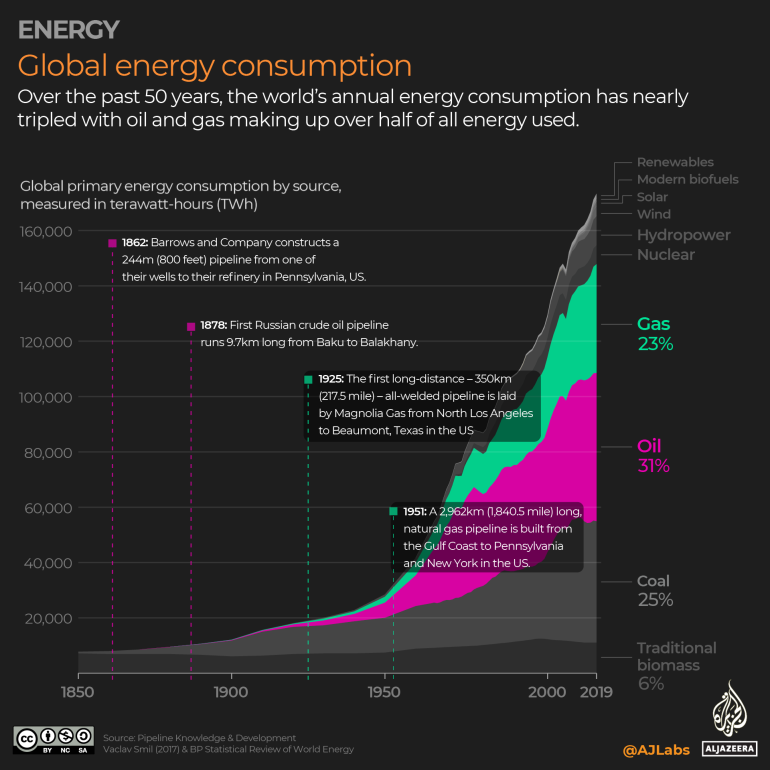
Over the past 50 years, the world’s annual energy consumption has nearly tripled – from 62,949 terawatt-hours (TWh) in 1969 to 173,340 TWh in 2019.
For centuries, burning coal was the main source of the world’s energy.
By the 1960s, rapid advancements in sourcing, transporting and refining oil and gas allowed those energy-dense fossil fuels to overtake coal and become the world’s primary source of energy – which they remain today.
Despite advances in renewable energy, fossil fuels including coal, oil and gas still make up more than 80 percent of the world’s primary energy consumption.
(Al Jazeera)
Every day, the world consumes some 100 million barrels of oil and 60 million equivalent barrels of natural gas.
To transport this massive amount of energy, pipelines – usually made out of carbon steel – are widely used.
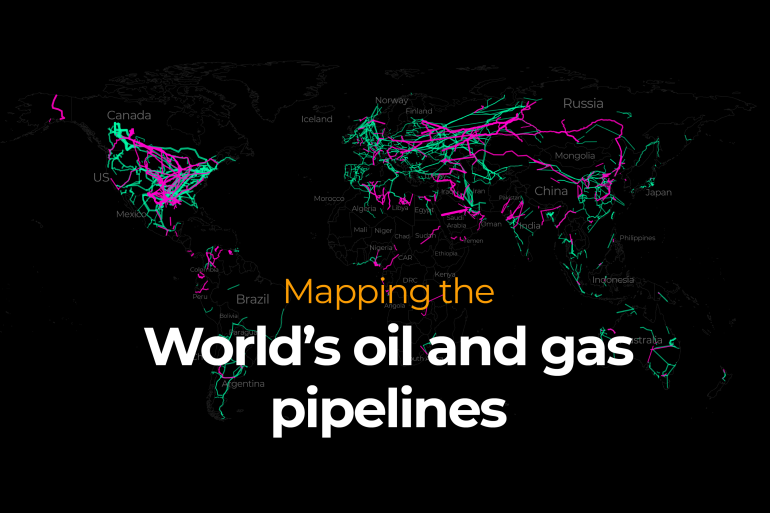
In the following infographic series, we map the world’s current and planned oil and gas pipelines.
Global pipelines – 30 times Earth’s circumference
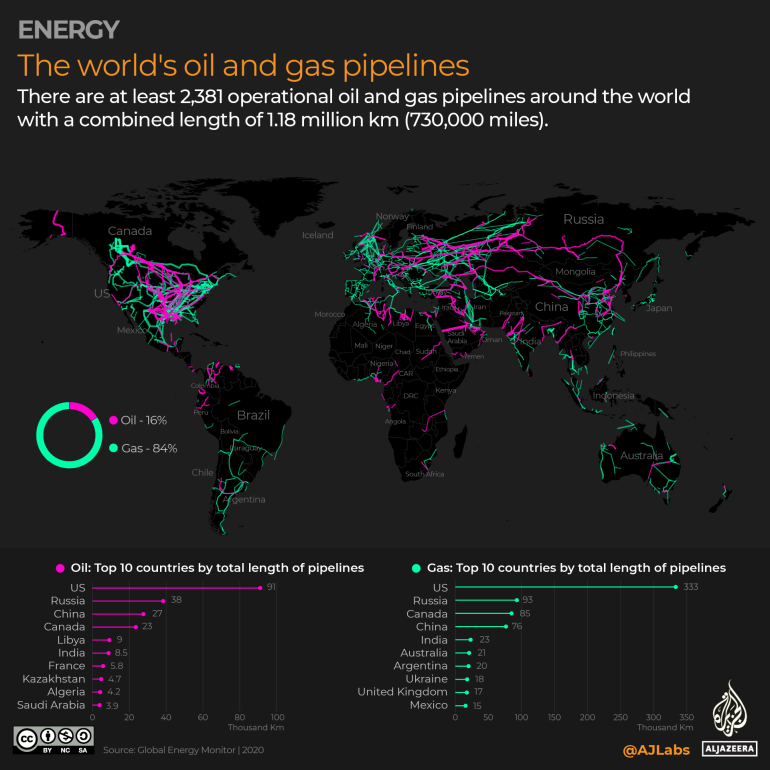
According to the Global Energy Monitor, there were at least 2,381 operational oil and gas pipelines distributed across some 162 countries as of December 2020. The combined length of these pipelines is more than 1.18 million km (730,000 miles) – enough to circle the Earth 30 times.
The countries with the longest network of oil and gas pipelines include:
United States – Oil: 91,067km (56,587 miles); Gas: 333,366km (207,145 miles)
Russia – Oil: 38,419km (23,872 miles); Gas: 92,831km (57,683 miles)
China – Oil: 27,441km (17,051 miles); Gas: 76,363km (47,450 miles)
Australia – Oil: 1,636km (1,017 miles); Gas: 23,002km (14,293 miles)
The map below shows pipeline networks across the globe. Pipelines that are shorter than 100km (62 miles) or that have a capacity of less than 6,000 barrels per day are not included.
(Al Jazeera)
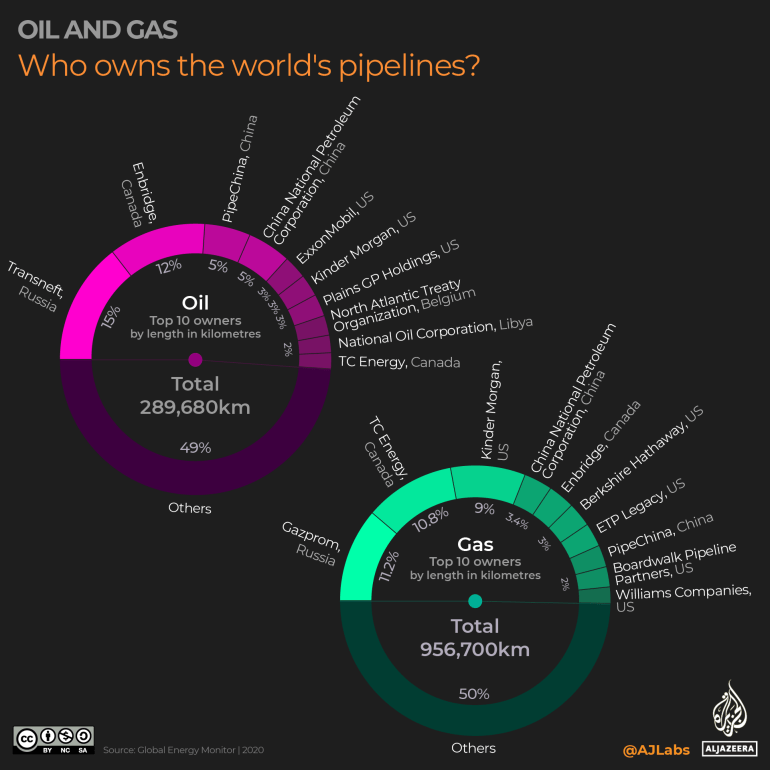
The companies that own most of the of oil pipelines by length include:
Transneft, Russia – 42,383km (26,335 miles) – 15 percent
Kinder Morgan, US – 82,075km (50,999 miles) – 9 percent
(Al Jazeera)
Pipelines by region
Americas
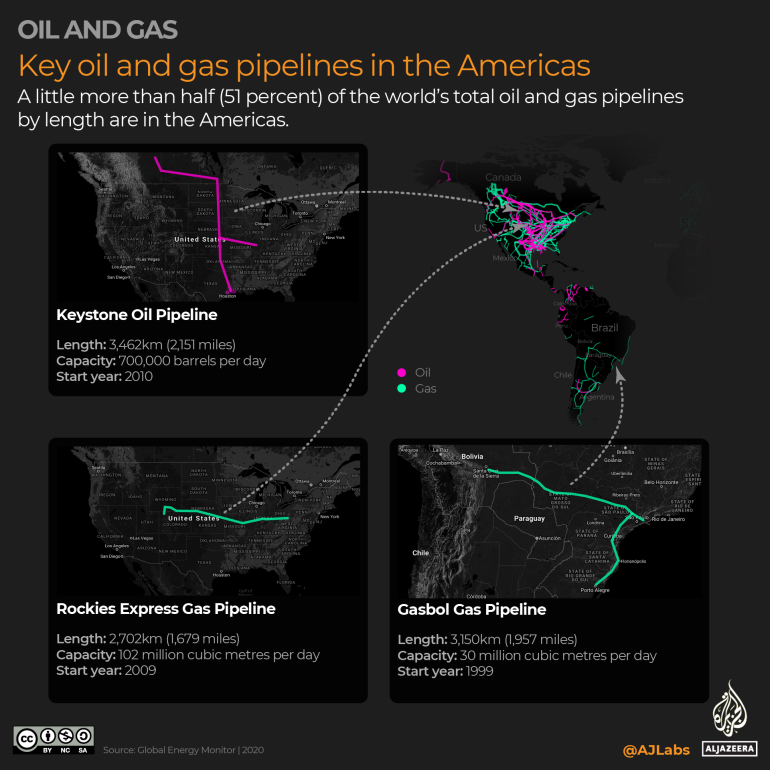
A little more than half (51 percent) of the world’s total oil and gas pipelines by length are in the Americas.
Some of the most noteworthy pipelines include:
The Keystone Oil Pipeline
Length: 3,462km (2,151 miles)
Capacity: 700,000 barrels per day
Start year: 2010
Runs from Alberta province in western Canada down to refineries in Illinois and Texas in the US. In 2021, an expansion to the pipeline known as Keystone XL was cancelled after its permit was revoked by the administration of US President Joe Biden.
Rockies Express Gas Pipeline
Length: 2,702km (1,679 miles)
Capacity: 102 million cubic metres (3.6 billion cubic feet) per day
Start year: 2009
The pipeline system is one of the largest natural gas pipelines ever built in North America. It runs from the Rocky Mountains in Colorado to eastern Ohio, crossing through US eight states.
GASBOL Gas Pipeline
Length: 3,150km (1,957 miles)
Capacity: 30 million cubic metres (1.06 billion cubic feet) per day
Start year: 1999
Also known as the Bolivia–Brazil pipeline, GASBOL is the longest natural gas pipeline in South America.
Colonial Pipeline
Length: 8,850km (5,500 miles)
Capacity: 3 million barrels per day
Start year: 1962
It is the largest pipeline system for refined oil products in the US. In May, hackers launched a cyberattack against the company that disrupted fuel supplies and led to shortages across the East Coast.
(Al Jazeera)
Europe
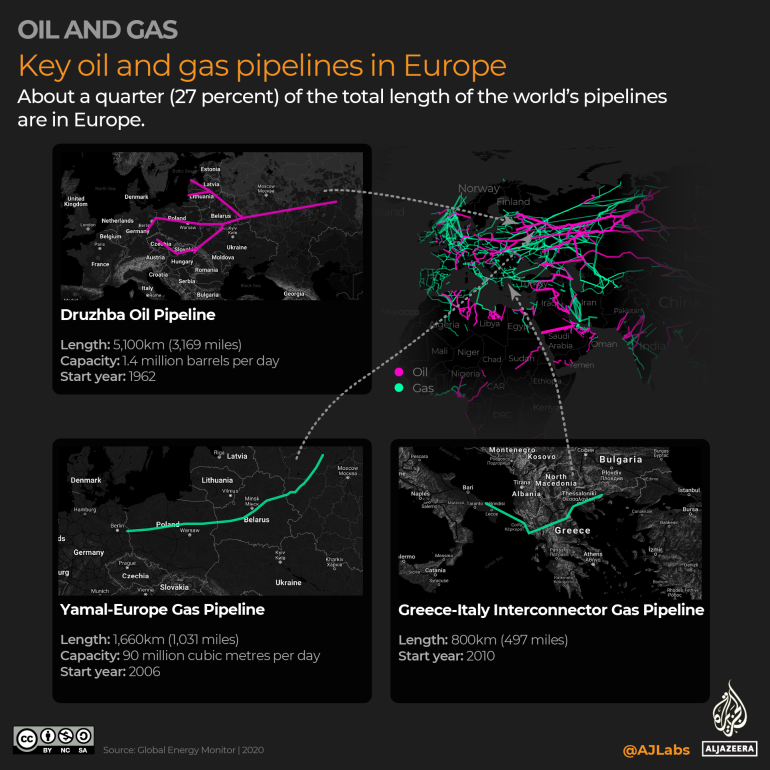
About a quarter (27 percent) of the total length of the world’s pipelines are in Europe.
Some key pipelines in Europe are:
Druzhba Oil Pipeline
Length: 5,100km (3,169 miles)
Capacity: 1.4 million barrels per day
Start year: 1962
It is the world’s longest oil pipeline and one of the largest oil pipeline networks in the world. It carries oil from the eastern part of Russia to points in Ukraine, Belarus, Poland, Hungary, Slovakia, the Czech Republic and Germany.
Yamal-Europe Gas Pipeline
Length: 1,660km (1,031 miles)
Capacity: 90 million cubic metres (3.2 billion cubic feet) per day
Start year: 2006
Transports gas from Russia’s Yamal Peninsula to European consumers across Russia, Belarus, Poland and Germany, among other countries.
Greece-Italy Interconnector Gas Pipeline
Length: 800km (497 miles)
Start year: 2010
It is an onshore and offshore natural gas pipeline that runs from Greece to the Apulia region in southeastern Italy.
(Al Jazeera)
Middle East and Africa
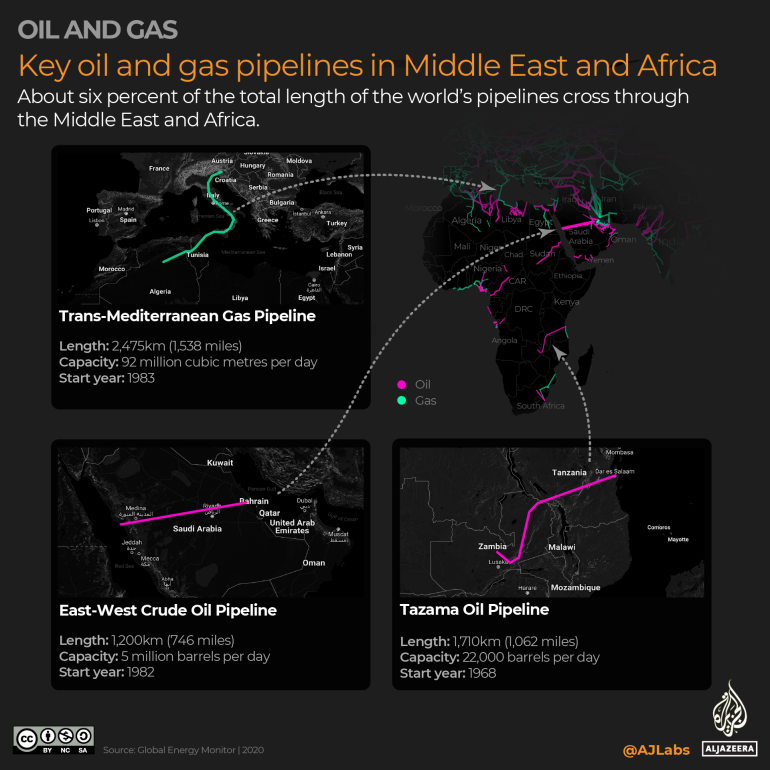
About 6 percent of the total length of the world’s pipelines cross through the Middle East and Africa.
Some of the main pipelines include:
Trans-Mediterranean Gas Pipeline
Length: 2,475km (1,538 miles)
Capacity: 92 million cubic metres (3.3 billion cubic feet) per day
Start year: 1983
Begins in Algeria, passes through Tunisia and crosses the Mediterranean Sea on to Italy and Slovenia.
East-West Crude Oil Pipeline
Length: 1,200km (746 miles)
Capacity: 5 million barrels per day
Start year: 1982
Known as the Petroline and Abqaiq-Yanbu oil pipeline, the Saudi oil pipeline runs from Abqaiq in the east of the country to Yanbu Oil Terminal on the Red Sea coast.
Tazama Oil Pipeline
Length: 1,710km (1,062 miles)
Capacity: 22,000 barrels per day
Start year: 1968
Runs from the Indian Ocean port of Dar es Salaam, Tanzania onto Ndola in central Zambia.
(Al Jazeera)
Asia Pacific
About 16 percent of the total length of the world’s pipelines cross through the Asia-Pacific region.
Some of the main pipelines include:
Eastern Siberia–Pacific Ocean Oil Pipeline
Length: 4,857km (3,018 miles)
Capacity: 1 million barrels per day
Start year: 2009
It is used to export Russian crude oil to Asia-Pacific markets, including Japan, China and South Korea.
West-East Gas Pipeline
Length: 18,854km (11,715 miles)
Capacity: 82 million cubic metres (2.9 billion cubic feet) per day
Start year: 2005
Consists of four pipelines that run between Xinjiang in the west of China to Shanghai in the east.
Moomba to Sydney Gas Pipeline
Length: 2,081km (1,293 miles)
Capacity: 13 million cubic metres (463 million cubic feet) per day
Start year: 1976
Runs from gas fields in southern Australia to gas distribution systems in Sydney, Newcastle, Wollongong, and Canberra.
(Al Jazeera)
About 200,000km of planned expansions
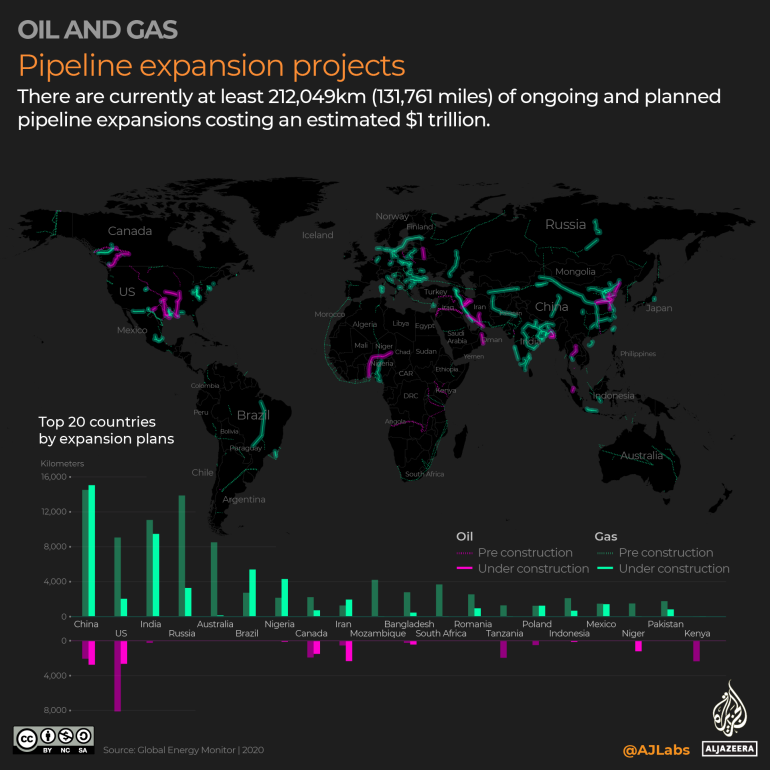
There are currently at least 212,049km (131,761 miles) of ongoing and planned pipeline expansions costing an estimated $1 trillion.
China’s 32,800km (20,381-mile) expansion of its oil and gas pipeline is the highest in the world. PipeChina, known formally as China Oil and Gas Pipeline Network, will soon become the largest builder of gas pipelines in the world, according to Global Energy Monitor.
The map below highlights where these planned pipelines are located.
(Al Jazeera)
Some notable pipelines include:
Nord Stream 2 Gas Pipeline
This 1,230km (764-mile) gas pipeline is set to run from Ust-Luga in Russia to Greifswald, Germany, and to carry 151 million cubic metres (5.3 billion cubic feet) of natural gas per day. The pipeline will cost $11.6bn, and plans to start operations in 2022.
Capline Oil Pipeline
Running from Pakota, Illinois to St James, Louisiana in the US and scheduled to open in 2022, this pipeline will have a capacity of 300,000 barrels per day and total length of 1,017km (632 miles).
Niger-Benin Oil Pipeline
Stretches from Agadem oil field in Niger to the port of Seme Terminal in Benin. Its capacity is 90,000 barrels per day and its total length is 1,980km (1,230 miles). The pipeline will cost $7bn and is slated to start operations in 2024.
Xinjiang Coal-to-Gas Pipeline
Runs from Xinjiang Autonomous Territory to Shaoguan, Guangdong, China. Its capacity is 82 million cubic metres (2.9 billion cubic feet) per day and it has a total length of 8,372km (5,202 miles). The pipeline was planned to start its operations in 2021.
MBDA's new Marte ER anti-ship misile succesfully completed its final test firing at the end of November 202. Carried out at an Italian test range in Sardinia, the firing was a key milestone in the ...
Sweden has officially announced its desire to join the Finnish-led CAVS programme (Common Armoured Vehicle System), which is also open to other countries with the mutual consent of the participating c....
Cubic Awarded Multimillion–Dollar Australian Defence Contract to Support Combat Training Centre
Cubic Defence Australia announced today that it has been awarded up to 4-year contract to support the Australian Army's Combat Training Centre Live Instrumentation Simulation, Range Instrumentation, a...
De Havilland Canada and ZeroAvia Announce MOU to Develop Hydrogen–Electric Engine Program for Dash 8–400 Aircraft
ZeroAvia, the leading innovator in zero-emision aviation powertrains, and De Havilland Aircraft of Canada Limited ("De Havilland Canada") today announced that they have entered into a Memorandum of Un...
ALC Announces Lease Placement of 2 New Airbus A350–1000 Aircraft with Virgin Atlantic
Today Air Lease Corporation (NYSE: AL) announced long-term lease placements for two new Airbus A350-000 aircraft with Virgin Atlantic. The two new A350-000s are scheduled to deliver to the airline in...
Elbit Awarded $350M Contract to Supply an Array of Land Systems to an International Customer
Elbit Systems Ltd. ("Elbit Systems") announced today that it was awarded a contract valued at approximately $350 million to supply an array of land systems to an international customer. The contract w...
NASA Enters the Solar Atmosphere for the First Time, Bringing New Discoveries
For the first time in history, a spacecraft has touched the Sun. NASA's Parker Solar Probe has now flown through the Sun's upper atmosphere - the corona - and sampled particles and magnetic fields the...
BGC FAAD C2 to Provide the Baltics Full Interoperability with NATO Air Defense Architecture
Northrop Grumman Corporation has been awarded a contract from the U.S. Army in support of U.S. European Command (EUCOM) to provide Forward Area Air Defense Command and Control (FAAD C2) to Estonia, Li...
KBR was awarded eight prime contracts as a part of the General Services Administration (GSA) ASTRO multiple award, indefinite delivery/indefinite quantity (IDIQ) contract, which encompases services re...
The aircraft will be delivered to Comlux in the coming weeks and then outfitted with a VVIP cabin by COMLUX in Indianapolis, USA after the delivery. Comlux has been selected as an exclusive outfitting...
Airbus and OneWeb Expand Their Partnership to Connect European Defence and Security Forces
Airbus and OneWeb have signed a distribution partner agreement to provide low Earth orbit (LEO) satellite communication services for military and governmental use. As the leading provider of military ...
The first Eurofighter Typhoons for the Air force of Kuwait landed today in country. These are the first two Typhoons in the framework of a wider order for a total of 28 aircraft that will be delivered...
Watch Stars Move Around the Milky Way's Supermassive Black Hole in Deepest Images Yet
The European Southern Observatory's Very Large Telescope Interferometer (ESO's VLTI) has obtained the deepest and sharpest images to date of the region around the supermasive black hole at the centre ...
GBP1.02M Research Funding Awarded for Robotic Chemist Project
To continue to deliver critical analytical capability for chemical, biological and explosives analysis, Dstl is working with industrial and academic partners to develop the application of mobile robot...
U.S. personal income is one of the principal economic indicators produced by the Bureau of Economic Analysis. Today’s report includes updated statistics on the distributions of personal income and disposable personal income, that is, personal income minus personal current taxes.
The estimates show the income shares by deciles as well as the share of the top 1%. In addition, inequality metrics are provided for quintiles. There are also breakdowns by sources of income, including compensation, interest income, and government benefits for every year, as well as a summary table of inequality metrics for all years.
The statistics, their methodology, and related research are available on bea.gov. BEA continues to seek feedback to help refine the methodology and presentation of the prototype statistics
After-tax income. The amount that U.S. residents have left to spend or save after paying taxes is important not just to individuals but to the whole economy. The formula is simple: personal income minus personal current taxes.


 (Al Jazeera)
 (Al Jazeera)
 (Al Jazeera)
 (Al Jazeera)
 (Al Jazeera)
 (Al Jazeera)
 (Al Jazeera)
 (Al Jazeera)