Friday, December 24, 2021
Wednesday, December 22, 2021
NATO News | Aljazeera
Russian President Vladimir Putin has blamed the West for escalating tensions in Europe, saying it had incorrectly assessed the outcome of the Cold War.
Putin blames West for tensions as fears rise over Ukraine
Russian president says he is not seeking ‘bloodshed’ in Ukraine and explains his fears of NATO’s ‘expansion’.
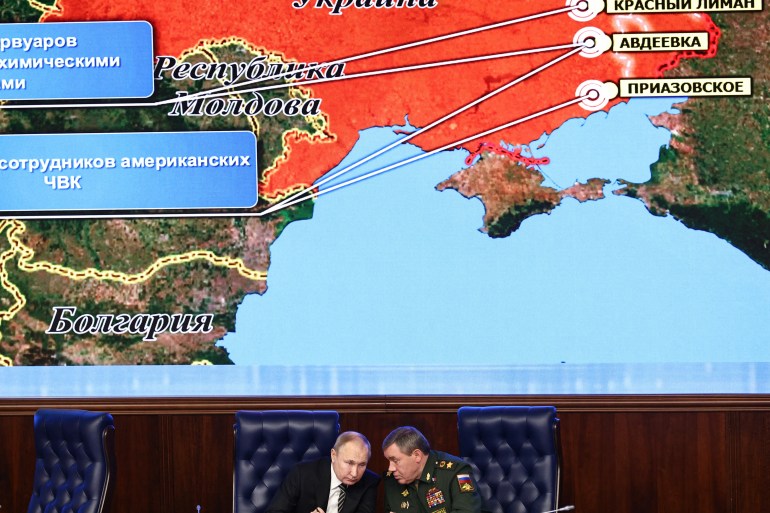
Speaking to senior military officials on Tuesday, Putin said Russia would respond “adequately” to any Western aggression and would develop its army further.
“Why did they expand NATO and renounce the missile defence treaties? They are to blame for what is happening now, for the tensions building up in Europe,” Putin said, reiterating his demand for guarantees from the US and its allies that NATO will not expand eastwards.
After what it regarded as its victory in the Cold War, Washington’s judgement has been clouded by euphoria, he said, leading it to poor policy choices.
According to Washington, Russia has amassed tens of thousands of troops on the border with Ukraine. . .
INSERT:
Treaty between The United States of America and the Russian Federation on security guarantees
Unofficial translation
Draft
The United States of America and the Russian Federation, hereinafter referred to as the "Parties",
guided by the principles contained in the Charter of the United Nations, the 1970 Declaration on Principles of International Law concerning Friendly Relations and Cooperation among States in accordance with the Charter of the United Nations, the 1975 Helsinki Final Act of the Conference on Security and Cooperation in Europe, as well as the provisions of the 1982 Manila Declaration on the Peaceful Settlement of Disputes, the 1999 Charter for European Security, and the 1997 Founding Act on Mutual Relations, Cooperation and Security between the North Atlantic Treaty Organization and the Russian Federation,
recalling the inadmissibility of the threat or use of force in any manner inconsistent with the purposes and principles of the Charter of the United Nations both in their mutual and international relations in general,
supporting the role of the United Nations Security Council that has the primary responsibility for maintaining international peace and security,
recognizing the need for united efforts to effectively respond to modern security challenges and threats in a globalized and interdependent world,
considering the need for strict compliance with the principle of non-interference in the internal affairs, including refraining from supporting organizations, groups or individuals calling for an unconstitutional change of power, as well as from undertaking any actions aimed at changing the political or social system of one of the Contracting Parties,
bearing in mind the need to create additional effective and quick-to-launch cooperation mechanisms or improve the existing ones to settle emerging issues and disputes through a constructive dialogue on the basis of mutual respect for and recognition of each other’s security interests and concerns, as well as to elaborate adequate responses to security challenges and threats,
seeking to avoid any military confrontation and armed conflict between the Parties and realizing that direct military clash between them could result in the use of nuclear weapons that would have far-reaching consequences,
reaffirming that a nuclear war cannot be won and must never be fought, and recognizing the need to make every effort to prevent the risk of outbreak of such war among States that possess nuclear weapons,
reaffirming their commitments under the Agreement between the United States of America and the Union of Soviet Socialist Republics on Measures to Reduce the Risk of Outbreak of Nuclear War of 30 September 1971, the Agreement between the Government of the United States of America and the Government of the Union of Soviet Socialist Republics on the Prevention of Incidents On and Over the High Seas of 25 May 1972, the Agreement between the United States of America and the Union of Soviet Socialist Republics on the Establishment of Nuclear Risk Reduction Centers of 15 September 1987, as well as the Agreement between the United States of America and the Union of Soviet Socialist Republics on the Prevention of Dangerous Military Activities of 12 June 1989,
have agreed as follows:
Reference: https://mid.ru/ru/foreign_policy/rso/nato/1790818/?lang=en
Putin said during the meeting with senior military officials on Tuesday that he hoped for constructive talks with Washington and Brussels on Russia’s demands.
“Armed conflicts and bloodshed are absolutely not something we would choose, we do not want such a scenario,” Putin said.
“We are extremely concerned that elements of the US global missile defence system are being deployed next to Russia,” he added, specifying that Romania and Poland would soon be capable of launching Tomahawk cruise missiles.
He said Russia’s proposals were no ultimatum, but it had nowhere to retreat over Ukraine.
Speaking at the same meeting, Defence Minister Sergei Shoigu said the United States had deployed about 8,000 troops near Russian borders and, alongside NATO allies, frequently mounted flights by strategic bomber planes close to Russia.
Attempts by NATO to get the Ukrainian army involved in the alliance’s activities present a security threat, Shoigu said.
Diplomatic efforts
Earlier on Tuesday, a senior Russian diplomat said contacts had already begun between Moscow and Washington on the issue of security guarantees that Russia is seeking, and there was a possibility that the sides would reach an understanding.
Assistant Secretary of State for European and Eurasian Affairs Karen Donfried told reporters in a phone briefing that a specific date would be agreed together with Russia to begin talks aimed at reducing the tensions.
Meanwhile, NATO will seek discussions with Moscow early next year to address tensions amid a Russian military build-up on Ukraine’s border, alliance Secretary-General Jens Stoltenberg said on Tuesday.
“We remain ready for meaningful dialogue with Russia and I intend to call a new meeting of the NATO-Russia Council as soon as possible in the new year,” Stoltenberg told a news conference in Brussels.
The NATO-Russia Council (NRC) was created in 2002 to facilitate consultation between the Western military alliance and Moscow, but relations are strained and it last convened in July 2019 despite repeated calls by NATO to revive the format.
Also on Tuesday, however, Ukrainian President Volodymyr Zelenskyy voiced frustration with NATO’s reluctance to speed up Kyiv’s membership in the alliance.
Kyiv has for years been seeking to join the US-led alliance, but Western officials have on numerous occasions said the prospect is not in the cards anytime soon, frustrating Ukraine.
TROUBLING NEWS ON SECRET $275B DEALS | TechDirt
A report by Tim Cushing: "More troubling news has surfaced about Apple's and China's relationship. Apple relies on Chinese manufacturing to make its phones and the Chinese government relies on its massive amount of power to leverage deals that allow it to achieve its ends, many of which are oppressive.
Details Leak On Apple's Secret $275 Billion Deal With The Chinese Government
from the raising-marketshare,-eyebrows,-and-concerns dept
An exclusive report by The Information (paywalled) details a $275 billion deal Apple struck with the Chinese government, apparently in hopes of exempting the company from new regulations that would have negatively affected its products and services. That deal was signed in 2016 and apparently includes an option for a sixth year, which would extend it through 2022.
Here's what appears to have been the end result of this deal, which required Apple to invest heavily in China and work with the government to develop new technologies and cultivate Chinese tech talent. The South China Morning Post notes Apple is now back on top of the Chinese phone sales charts.
In October, Apple regained its title as the largest smartphone brand in China by shipments, its first time at the top of the list since December 2015, according to Counterpoint. Sales grew 46 per cent that month compared with the previous month, while the overall smartphone market grew just 2 per cent.
There's something in it for China as well.
China has also become more important to Apple’s supply chain. The company has added more suppliers from mainland China to its list of vendors than anywhere else from 2017 to 2020, according the Apple’s supplier list for the period. Mainland Chinese companies make up nearly a third of newly-listed companies.
The Chinese government also asked for -- and apparently received -- some smaller, much stranger concessions from Apple, as Richard Lawler reports for The Verge.
That includes a request Apple reportedly received in 2014 or 2015 about a small group of uninhabited islands that China and Japan apparently have a dispute over in terms of who owns them. Going by either the Senkaku Islands or the Diaoyu Islands, depending on which side of the argument you’re taking, they inspired a request from China to members of the Maps team to make them appear larger, even when viewers are zoomed out on the map. According to The Information, not only did Apple eventually make the change, but even today, for viewers using its map from within China, the islands are still shown at a larger scale than the territories around them.
Weird flex by the Chinese government. But the government has plenty of weird flexes. More concerning is whatever concessions were made to allow the Chinese government to more directly control iPhone users in the country.
Apple has already made several concessions, including erecting local data centers that can be easily accessed by the government. It has also removed content deemed unlawful or offensive by the Chinese government, some of which has been directly related to the government's ongoing repression of its Muslim minority.
For Apple, this is a problem of both supply and demand. Apple obviously wants to be able to sell its products to the large Chinese market. But it's pretty difficult to obtain much leverage when you're also reliant on this market to manufacture the same devices you want to sell to this market.
Despite that lack of leverage, Apple has still secured some minor wins, as Samuel Axon points out at Ars Technica.
Encryption keys for iCloud user data for the region are controlled by Apple, despite the government's efforts to encourage, pressure, or force foreign companies to hand over responsibility for that data to Chinese companies.
Still, the deal with the Chinese government suggests the country will continue to have the upper hand in negotiations. Apple may be investing in its future, but it's pouring money into a regime that has continually expanded its power and escalated its oppressive activities against its own people. Apple's money will fund these activities, even if only indirectly. Striking a secret deal worth hundreds of billions of dollars with an authoritarian government is never a good look.
Apple hasn't said much about this report. The Chinese government, however, has reacted (via its state-owned press) and that reaction is bizarre, to say the least.
A commentary published on the WeChat blog Buyidao, operated by the state-run tabloid Global Times, defended the investments. The attack on Apple’s ties to China are “clearly driven by the ‘political correctness’ of Sinophobia”, according to the article.
“Forcing American companies to decouple from China is forcing them to decouple from opportunities and gains,” the article reads. “This is as good as McCarthyism for business.”
Huh. Well, that's a take. The Chinese government has shown repeatedly it cannot and should not be trusted, that it's an abuser of its considerable power. It's possible to question deals struck with an oppressive regime without engaging in Sinophobia. This isn't about the Chinese people or their way of life. It's about a government that disappears unwanted residents into prisons, threatens government critics with death sentences, and reacts with hostile indignation any time its narrative and claims are questioned. . .
There's nothing inherently wrong with striking deals with foreign governments to ensure steady supply chain operations or expand customer bases. But striking a deal of this size with a government that expects its foreign partners to assist it in the oppression of its constituents is cause for concern."
NOTICES FOR THE UN-VACCINATED FROM HIGH TECH GIANTS
Intel will put unvaccinated employees on unpaid leave
/cdn.vox-cdn.com/uploads/chorus_image/image/70304135/acastro_210120_1777_intel_0002.0.jpg)
Intel has reportedly notified employees that anyone who remains unvaccinated will need to get the COVID-19 vaccine or submit an exemption by January 4th. Otherwise, they face being put on unpaid leave, according to The Associated Press and The Oregonian.
In the December 7th memo obtained by both publications, Intel HR boss Christy Pambianchi said unvaccinated employees will need to seek an exemption or get weekly tests, even if they’re working from home. She also reportedly told employees that the company will review medical and religious exemptions up until March 15th of next year. The company initially put the January 4th vaccine deadline in place last month, but didn’t specify what would happen to unvaccinated employees if they didn’t comply.
If an employee’s exemption isn’t granted, they’ll be put on unpaid leave for at least three months starting on April 4th and “will not be terminated,” as Pambiachi reportedly puts it. She also stated that Intel will still provide healthcare benefits to those on leave.
Intel’s vaccine requirement was put in place to comply with President Joe Biden's vaccine mandate for companies with over 100 employees. However, federal courts are still debating whether a sweeping mandate like this is constitutional. “We are closely monitoring the legal environment and expect it will take time for the case in Georgia, as well as other similar cases, to be fully resolved,” Intel said in a statement obtained by The Oregonian.
Google has also started cracking down on unvaccinated employees, and reportedly said that they will be placed on a 30-day administrative leave if they fail to get vaccinated or submit an exception by January 13th. If they’re still not vaccinated after the 30 days are up, they could be subject to unpaid leave and even termination, unlike at Intel. Facebook and Microsoft are also enforcing vaccine mandates — they’re requiring that employees get vaccinated before their offices reopen, which has been set back until 2022 for both companies. Apple hasn’t gone as far as any of its big tech counterparts; it hasn’t set a vaccine mandate. Apple does still require employees to take regular COVID tests, however.
The Verge reached out to Intel with a request for comment but didn’t immediately

-
 Flash News: Ukraine Intercepts Russian Kh-59 Cruise Missile Using US VAMPIRE Air Defense System Mounted on Boat. Ukrainian forces have made ...

