Sunday, January 02, 2022

Edward Snowden on Julian Assange: "If we are going to free the world, we...

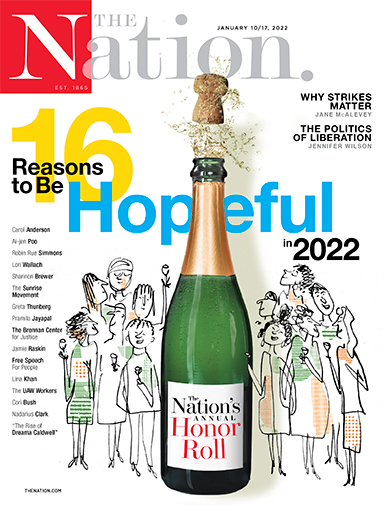
The Nation January 10/17, 2022 Issue

Looking ahead to the next issue: FEATURE

These Progressives Fought the Good Fight in 2021—and Gave Us Hope for 2022

For a year that saw progress come slowly and presidential approval ratings decline, these progressives held the line, speaking truth to power, defending democracy, and showing up for the American people. 

Listing Image

How Workers Can Win in 2022

They need to create a crisis in order to turn this country around.

(Cover art by Serge Bloch)

El-Erian Sees 'Trifecta' of Risks Facing U.S. Economy

CULTURAL COALITION Celebrating 25 years of Community Arts!

Cultural Coalition celebrated its 25 year anniversary in 2021. As this year comes to a close, we thought it would be a perfect time to take a look back over the last quarter century and how that has led to who we are today.
The idea of Cultural Coalition began in 1996, with Zarco Guerrero and Carmen de Novais Guerrero, already established artists and musicians, when they sponsored the Los Angeles production of The Last Angry Brown Hat to the Phoenix Orpheum Theater. A groundbreaking play exploring the story of four middle-aged Chicanos who meet again after 25 years and reminisce on their involvement in the Brown Berets and the Chicano Movement of the 1960’s.
From there, Zarco and Carmen continued to share the stories and culture of the American Southwest and Mexico with an emphasis on bringing back the lost connection of these cultures to their indigenous ancestral practices.
In 1997, Cultural Coalition produced its first festival in Phoenix, El Dia de la Raza, a collaboration with José Cortez, and Chicanos Por La Causa. It took place in Maryvale,
Cultural Coalition Executive Director Carmen Guerrero on that first event, “Our first festival celebration as Cultural CoAZ. was an affirmation of our desire to serve our community with free access to culture and art. Music, dance, storytelling and theater together with delicious foods and drinks are the very medicine we need to heal and nurture a healthy people. It is also a way to bring in the next generation into sharing cultural knowledge."
While the Dia de la Raza festivals were the first festivals produced as Cultural Coalition, it was not the first festival that Carmen and Zarco had produced. Their dedication to uplifting the art and culture of Indigenous peoples has a long legacy in Arizona.
> They are the founding members of XicanIndio Artes Inc. (now known as Xico, Inc,) and established the first community celebration of Dia De Los Muertos in Arizona in 1975.
> They were also the founders in 2007 of ALAC, (Arizona Latino Arts and Cultural Center). Together with other artists, they established these organizations in order to provide opportunities for the arts to flourish in our metropolitan area.
> In 1997, Cultural Coalition’s tradition of storytelling continued with performances of La Pastorela, a traditional Mexican Christmas play that is a combination of humor and satire, exploring religious and secular themes. Part of the Untold Stories show at Gammage Auditorium at Arizona State University, the first Pastorela was performed by Teatro de La Esperanza, written by Rodrigo Duarte Clark.
Zarco later rewrote the script to include current local events of those tumultuous times and made all the masks for future performances. The Pastorela traveled throughout the Valley for many years, and it was performed at several high schools, local theaters and community colleges.
> Cultural Coalition has maintained their connection to the theater community throughout its 25 year existence in a variety of ways. Through important partnerships, the Coalition has connected their roster of artists with organizations and festivals throughout the Valley. Zarco has made hundreds of masks for theater, music, and dance companies all over Arizona. You have probably seen his work used in performances by Childsplay Theater, Quetzalli Ballet Folklórico, and Borderlands Theater in Tucson, to name a few.
“After 25 years, the Cultural Coalition continues to reach out to individual artists and local arts organizations in order to assist in our common goal to bring people from all walks of life together to celebrate the rich cultural diversity of our community,” says Zarco Guerrero.
“Since the first Dia De Los Muertos Festival in 1975, the Mask artform has become recognized as an iconic symbol for artistic expression in Arizona. The Mask is the very tool that makes us unique, it’s both ancient and modern. Now is the time to continue the planning of the Mask Museum and Cultural Center to keep our legacy alive for generations to come.”
 
> Cultural Coalition Inc was officially incorporated as a 501(c)3 charitable organization in April of 2000. Beginning in the early 2000’s, Cultural Coalition began expanding its mission of supporting Latino and Indigenous artists to also provide arts education to underprivileged families and communities. We began hosting festivals in Patriot Park in downtown Phoenix with music and dance performances. We provided hands-on arts engagement activities for children and partnered with AZ Health to talk to kids about how to stay healthy. This annual procession in downtown Phoenix to the festival continued until 2006.
> In 2012, Cultural Coalition hosted its inaugural MIKITZLI: Dia de los Muertos Phx Festival (DDLM). Originally funded by a grant, the festival was a partnership with CALA Alliance, (Celebración Artística de las Américas).
MIKITZLI has evolved and grown to become our signature event, focused on decolonizing the celebration with a return to its indigenous roots, and just celebrated its 10 year anniversary at Steele Indian School Park in Phoenix.

Event Coordinator, Ami Rogers has been with Cultural Coalition for over three years. Her favorite memory since joining the staff, she shared was at the 2019 MIKIZTLI festival, “QVLN headlined the Mikitzli DDLM and their performance at sunset with everyone dancing was magical. There were people of all ages and backgrounds coming together and celebrating.”
> Since its inception (over the last 25 years) the Cultural Coalition has established annual cultural festivals in partnership with different municipalities all over the Valley.
Mask Alive! Festival of Masks has been growing as an arts placemaking community favorite at Pioneer Park in Mesa for the last four years. Showcasing the art of masked storytelling and performance, Mask Alive is a multicultural festival of art from around the world that celebrates the diversity of our city.

At the Tempe Center for the Arts, Cultural Coalition has been producing El Puente Festival since 2013. Focused on families and young artists, this festival has music and dance performances by youth from around the Valley, continuing the legacy of Latino traditional cultural arts.
 
And our newest festival, Portal to the Past, in partnership with Pueblo Grande Museum, celebrates the water legacy of the Ancestral Sonoran Desert People. We continue to create new opportunities for community celebrations at different locations of the Valley.

In addition to festivals, in 2015 Cultural Coalition opened a dedicated art space for children at the low income housing complex Rancho del Art in Mesa, Arizona. Here, teaching artists work with school aged youth to provide arts engagement activities that range from music, drawing, painting, and mask making. Children also receive help with their homework, cooking and gardening lessons, and a free meal donated by St. Mary’s Food Bank to help encourage healthy eating and educational success.
Stirling Anderson, who has been with Cultural Coalition for five years as the Social Media Manager and Teaching Artist, has been a part of the festivals and the art space at Rancho del Arte. When asked what her favorite thing about working with us is, she replied. “I love being a part of keeping culture and traditions alive while making it accessible to the community and future generations.”

2020 was the first year that Cultural Coalition did not have any in-person festivals. But the desire to keep people connected to the arts and to support our community of artists led us to produce our first ever virtual festivals. A couple of our festivals were rescheduled that year, but thanks to the dedication of our staff and artists, none of our festivals were cancelled. We were able to bring the amazing, colorful, healing power of the arts into people’s homes during the pandemic through live streaming.
This fall, with a variety of health and safety measures in place, we were able to host our Mask Alive, Portal to the Past, and MIKITZLI festivals in-person again! Both events were wonderfully attended, and we heard such heartwarming feedback about how much people missed our events. And how much it meant to be at an event again with family and friends.

“You could sense how much this event meant to everyone,” said Renee Aguilar, Marketing & Museum Collections Manager. “Walking around the MIKIZTLI festival, you felt the release of all that we went through last year and the joy of celebrating the gift of life.”
As we reflect on all that we have accomplished over the years, the ways we have grown, and all the amazing artists we have worked with, we are excited to continue expanding the ways we can connect our community with the vibrant cultures of the Southwest.

Looking towards the future, Cultural Coalition is working to launch an online museum with a complete archive of artwork from Zarco Guerrero and other Cultural Coalition artists.
With so many pieces connected to cultural festivals and theatrical performances throughout the Valley, this museum will tell the history of art as storytelling and culture keeping for audiences extending outside Arizona.
The Mask Alive Museum of Art will have a comprehensive collection of cultural masks and art that will engage visitors with the traditional practice of art as storytelling around the globe.
As a non-profit, it is with the help of grants and donations that we are able to continue the work we do. It is because of artists, the individuals and families who come to our festivals, and our amazing partner organizations, that we have the support to provide our community with accessible and meaningful ways to interact with each other to cultivate culture while creating positive social change.
 
We look forward to your continued financial support!

Cultural Coalition | culturalcoalition.com

7-Minute Read: Turning Over Philanthropy 2022 | MacKenzie Scott


No Dollar Signs This Time

"Sometimes what’s going on in the world or in my work brings a line of poetry repeatedly to mind, but just as often it’s a single word. Lately the one I keep turning over is “philanthropy.”

It’s not a word I have ever loved or identified with. A lifetime of cultural references associated it with financially wealthy people who believed they knew best how to solve other people’s problems. Since I did not believe myself to be such a person, I had always felt more kinship with people who offered a couch when someone said they needed a couch.

So I was surprised to discover that dictionary definitions of philanthropy are so inclusive and beautiful: “love of humankind”; “the desire to promote the welfare of others”; “generous donation of money to good causes”; “work of practical beneficence.” What had happened? Somewhere along the line, this big, lovely word had shriveled to describing the humanitarian impulses of less than 1% of the world’s population. When did the rich become the only people with a “desire to promote the welfare of others”? Which is a more “generous donation of money to good causes” — 100 dollars from someone who earns 50,000 a year, or 100,000 from someone with 50 million in the bank? How did the only “work of practical beneficence” worth acknowledging become writing checks?

Language experts call this kind of change in the meaning of a word semantic narrowing. Apparently once upon a time “girl” meant any young person, “deer” meant any animal, and “art” meant any skill. But none of these narrowed words disappoint me. They didn’t come to signify something diminished, just something more specific, and specificity is often more beautiful. The problem is that half the beauty of the original meaning of “philanthropy” was in its breadth. It’s as if we had taken the word “love” and reduced it to mean only familial love, or only romantic love, cutting out the love we feel for friends, or food, or sunsets, or strangers.

Even by the traditional yardstick — money — contributions to the welfare of others by financially wealthy people don’t merit disproportionate attention. To use the United States as an example, the total donated to U.S. charities in 2020 was 471 billion. Of this, nearly a third was given in increments under 5,000 dollars. In addition to these gifts few people picture when they think of philanthropy, there was 68 billion in financial support to family members in other countries (hard to track and likely way underreported), tens of billions in crowdfunding, nearly 200 billion in volunteer labor at non-profits, and 670 billion in wages for the paid employees who deliver those non-profit services. That’s over a trillion dollars in “donation of money to good causes” and “work of practical beneficence.” That trillion far exceeds contributions by the tiny segment of the population still being acknowledged and colloquially called “philanthropists.”

And that trillion is only a fraction of the value pumped into the generosity economy by the other 99%.

What’s getting left out?

The biggest omission is probably informal person-to-person giving. In a 2020 survey about generous behavior, over 70% of Americans reported giving both labor and money to people they know, and half reported doing the same for strangers. This represents billions of dollars no one seems to be counting.

What else? Voice. Millions of people participated in racial justice demonstrations following the murder of George Floyd last year. Millions more use their voices spontaneously in moments of discrimination in an office or at school. To my knowledge, no one is quantifying the value of organized and informal humanitarian speech and demonstration either.

The multiplier effect on the social and economic value of both of these forms of giving is gigantic. Generosity engages the same pleasure centers in the brain as sex, food, and receiving gifts, and it improves our health and long-term happiness as well. Just as spending in a store triggers a long chain of spending outside the store (gas for customers, lunch at the mall, supplies for the food court), the kindness in one unexpected hour of free snow-shoveling for a sick neighbor may trigger a domino effect of gratitude- and gratification-inspired kindnesses that could go on for years. Seeing someone speak up on your behalf is just as likely to inspire you to act on behalf of others, especially if that speech helps secure rights that enable you to do it.

I have seen economists focus on the costs of change-making efforts (reduction in property values or decreased business activity from protests, for example), but the immediate and knock-on benefits of humanitarian speech and compassionate action rarely get mentioned. While many of the returns — confidence, insight, and empathy, for example — are difficult to measure, many others — such as improved health outcomes — are not. Maybe someday someone will shine a quantitative spotlight on some of these, or find new ways of capturing their impact. In the 1970’s an economist named Marilyn Waring traveled around the world studying a form of labor that economists weren’t even acknowledging as an omission in their calculations, and concluded that if you hired workers at the market rate to do all the unpaid work women do, it would be the biggest sector of the global economy.

The historical omission of so many forms of generous action from our economic calculations of philanthropic value may be understandable. But their exclusion from a durable cultural concept of collective humanitarian contribution is baffling to me. I suspect our very compulsion to count and categorize and rate things is part of the problem. We tend to give more focus to things we can tally, and to rank everything else. Why does one form of compassionate action, one group of beneficiaries, one group of givers have to be more important than the others? Financially valuable versus socially valuable. Generosity to strangers versus generosity to friends and family. An employee at a non-profit takes leave from that care work to care for a dying parent. A traveler cut off from her usual volunteer work on a month overseas helps an isolated elderly neighbor get a cell phone she can use to talk to her kids. A volunteer isolated by the pandemic makes sandwiches and drives them to a road newly lined with tents and RVs in his town.

This is all philanthropy.

And so is the effort of every team member — staff or consultant, professional advisor or grassroots field worker, formally contracted or informally polled, paid or unpaid, long-term or short-term, full-time or part-time or one-time — in the big, non-traditional network of people generously helping me with my giving.

And so is the effort of all the employees and volunteers at every one of the non-profits we give to.

And so is donating your old furniture to a local shelter, or speaking up for a bullied classmate, or shoveling your sick neighbor’s driveway, or staying after the school dance to help stack chairs.

How much or how little money changes hands doesn’t make it philanthropy. Intention and effort make it philanthropy. If we acknowledge what it all has in common, there will be more of it. That’s why I keep referring to what I’m doing as “giving”, a word still being used to describe what humans have been doing with their time, focus, food, cash, and trust to lift each other up for thousands of years. It’s also why I’m not including here any amounts of money I’ve donated since my prior posts. I want to let each of these incredible teams speak for themselves first if they choose to, with the hope that when they do, media focuses on their contributions instead of mine.

In the meantime, I hope any attention from this writing falls on what I have in common with every person who ever acted on an impulse to help someone. Two years ago I wrote a letter about the safe full of resources we all have to draw from, including the beliefs and experiences that shape how each of us chooses to give. I wanted to give away more money, at a faster rate, to serve a wider diversity of under-supported causes and people, with greater effectiveness than I have the perspective and capacity to give alone. For me, this meant trusting the effort and perspective of a diverse team of staff and advisors, who in turn trust the effort and perspective of field experts, funders, and non-profit practitioners drawing on decades of experiences of their own. Together we trust the track records of impact and on-the-ground insights of hundreds of carefully selected teams working from within communities, offering them all the money up front and then stepping out of their way, encouraging them to spend it however they choose. I understand that this approach, and probably any approach, will mean having given to organizations that might make choices I wouldn’t make myself, but that’s the point. I believe the gifts will do more good if others are free from my ideas about what they should do. And this trust — another resource it’s difficult to measure — is the aspect of gifts that many have said they value most.

This approach to philanthropy is not the only way. It’s just the one my resources and opportunities inspired in me.

If you think you know how much impact might flow from acting on any of your own impulses to give, you are almost certainly wrong. Whose generosity did I think of when I made every one of the hundreds of gifts I’ve given so far? It was the local dentist who offered me free dental work when he saw me securing a broken tooth with denture glue in college. It was the college roommate who found me crying, and acted on her urge to loan me a thousand dollars to keep me from having to drop out sophomore year. And after she saw the difference she made in my life, what was she inspired to do, twenty years later? Start a company that offers loans to low-income students without a co-signer. And how quickly did I jump at the opportunity to support her dream of supporting students like she once supported me? And to whom will each of the thousands of students thriving on those gratitude-powered student loans go on to give? None of us has any idea.

Each unique expression of generosity will have value far beyond what we can imagine or live to see."
Context Dependent Attraction

Cartoon Carousel The nation’s cartoonists on the week in politics | By POLITICO STAFF 01/23/2026 05:00 AM EST

Every week political cartoonists throughout the country and across the political spectrum apply their ink-stained skills to capture the fo...