Sunday, January 30, 2022
ELECTION SUBVERSION IN ARIZONA | The Guardian
Intro: The cast of characters keeps on
Arizona Republicans introduce election subversion bill
The proposal would end all voting by mail and allow legislature to reject election results, part of nationwide rightwing effort to overturn elections

"Arizona Republicans have introduced a bill that would impose significant new voting restrictions and allow the state legislature to reject election results.
The measure would require the state legislature to convene after primary and general elections to review the ballot counting process and “shall accept or reject the election results”.
>The proposal does not require lawmakers to find evidence of fraud or lay out any factors they would have to consider in order to overturn an election. If the lawmakers were to reject the results, any voter in Arizona would be allowed to petition a local judge to hold a new election.
The same measure would also require Arizona voters to give an excuse if they want to vote by mail, even though mail-in voting has long been used by the vast majority of voters in the state. It also would restrict voting to election day and prevent the use of vote centers, essentially mega voting precincts where anyone in a county can vote, regardless of where they live.
One of the co-sponsors of the bill is Mark Finchem, a state representative who believes the 2020 election was stolen, has ties to the Oath Keepers, and was at the Capitol on 6 January. Finchem is running to be Arizona’s chief election official and Donald Trump has endorsed him.
“We need to get back to 1958-style voting,” John Fillmore, another Republican state representative who introduced the bill said on Wednesday, according to the Arizona Republic. Arizona had a racist literacy test in place in 1958, the Republic noted. The Voting Rights Act, which wiped out many blatant efforts to keep Black people from the polls, passed in 1965.
Fillmore did not respond to an interview request from the Guardian.
“What’s clear from this bill is that there are some members of the Arizona legislature who are prepared to replace the judgment of Arizona voters with their own,” said David Becker, an election administration expert who leads the Center for Election Innovation and Research.
It’s unclear if the measure will ultimately pass. Republicans hold a 16-14 majority in the state senate, which means, if Democrats unanimously oppose it, any Republican could kill the bill by voting against it. A Republican bill last year that would have allowed the legislature to override the results of a presidential election stalled.
“I can’t imagine that they will move forward with that idea because I think the outrage from the community would be pretty big,” said Martin Quezada, a Democrat in the state senate. “But the fact that they’re even talking about this issue just shows what kind of a space that we are in right now.”
Even if Republicans drop the provision allowing the legislature to overturn elections, Quezada said, the measures that roll back vote-by-mail access in Arizona would still be extreme.
“The impact would be tremendous. It would drastically change the way elections work in the state of Arizona. I mean right now the overwhelming majority of voters vote by mail,” he said. “The turnout overall would be suppressed tremendously … The process of actually showing up at the polls to vote would be so frustrating and time-consuming that many people would feel even if they did want to vote, it’s just not worth it to deal with that type of problem.”
The proposal comes as there is increased alarm over Republican efforts across the country to make it possible for partisan actors to overturn election results, something scholars have begun calling election subversion.
“This bill follows a worrisome anti-democratic trend of legislation introduced in statehouses across the country that would make it possible for legislatures to overturn election results they don’t like,” said Jessica Marsden, a lawyer at the watchdog Protect Democracy who is tracking election subversion bills across the country.
“This brazen power grab reveals the cynical strategy behind the deceptive big lie movement: to create a pretext for interfering in election outcomes by undermining confidence in elections.”
The bill also underscores how Arizona, where Joe Biden narrowly defeated Donald Trump in 2020, has become a hotbed of conspiracy theories about the election. The state senate authorized an unprecedented months-long post-election review of 2.1m ballots in the state’s most populous county that fanned lies about the 2020 race but ultimately affirmed Biden’s win.
Some provisions in the legislation appear to be connected to conspiracy theories that flourished during that review, including the debunked belief that voting equipment was tampered with and ballots had bamboo fibers in them. The bill would require a hand count of ballots within 24 hours of an election and require the use of a hologram or other unique mark to verify the authenticity of ballots.
“They keep inventing solutions where there are no problems,” said Tammy Patrick, a senior adviser at the Democracy Fund and a former election official in Arizona. . .
[...] Earlier this week, Republicans in the state legislature advanced several other bills that would change election processes in the state. One bill would expand the threshold for an automatic recount from 0.1 percentage point to 0.5 (Biden defeated Trump by 0.3 points). Other bills would require the state to make ballot images public after an election while another would end all mail-in elections for school boards and cities."
ALTERNATIVE SLATE OF ELECTORS: The Kooky Klinker in The Electoral College Count 2020
The 59 Republicans Who Joined Electoral Voter Fraud Scheme For Trump Could Face Prison
What seemed like political theater at the time actually violated state and federal fraud laws, according to current and former prosecutors.
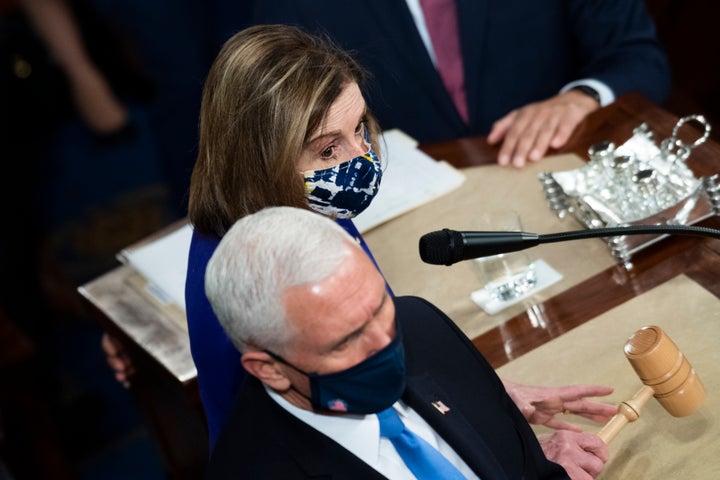
WASHINGTON ― Dozens of local and state Republican leaders who showed their loyalty to Donald Trump by casting fake electoral votes for him a year ago may now face prison time in return for that devotion.
Because as the House select committee investigating the U.S. Capitol riot on Jan. 6, 2021, starts to look into the origins of the scheme to send “alternate” ballots to Congress from states narrowly won by Joe Biden, the 59 ersatz Trump electors who claimed to be “duly elected and qualified” could face federal charges ranging from election fraud to mail fraud, in addition to a range of state-level charges.
And in two of the states, the Democratic attorneys general are openly calling on the Department of Justice to act.
“I believe it’s critical that the federal government fully investigates and prosecutes any unlawful actions in furtherance of any seditious conspiracy,” said Josh Kaul, attorney general of Wisconsin, where 10 Republicans filed papers claiming to be the state’s electors even though Biden narrowly won there.
“This is a crime,” Michigan Attorney General Dana Nessel told reporters earlier this month, adding that calling the elector slate “alternate” did a disservice and that it should be called a “false, counterfeit, fake slate of electors.”
In her state, 16 Republican office holders and party officials filed paperwork claiming then-President Trump had won the state even though he had lost it by 154,000 votes. “This is election fraud, and it’s many other crimes as well, both, I believe, at the state and the federal level.”
Deputy U.S. Attorney General Lisa Monaco on Tuesday confirmed to CNN that Justice Department prosecutors “are looking at those” but would not comment further.
Arizona, where 11 Republicans filed papers falsely claiming to be the state’s electors; Georgia, which had 16; and Nevada, which had six, account for the rest of the 59.
Georgia Republican Party Chairman David Shafer, though, said he and the other 15 Georgians who sent electoral votes for Trump did so only to make sure Trump could continue pushing a lawsuit alleging vote fraud.
“There’s been no credible suggestion that there’s anything wrong,” he told HuffPost. “We made it very clear what we were doing. We did it right out in the open.”
But Georgia’s would-be GOP electors chose not to include language clarifying that they would actually only be the “duly elected and qualified” electors in the event that a court challenge or other proceeding reversed the outcome there ― the approach taken by Trump slates in two other states.
Five New Mexico Trump supporters filed a “certification” that began: “We, the undersigned, on the understanding that it might later be determined that we are the duly elected and qualified electors ...”
And 20 Republicans in Pennsylvania went even further to make clear that their paperwork was not valid unless the Nov. 3 election result was reversed in their state. “We, the undersigned, on the understanding that if, as result of a final non-appealable Court Order or other proceeding prescribed by law, we are ultimately recognized as being the duly elected and qualified electors,” their paperwork began.
That proviso was key to Pennsylvania Attorney General Josh Shapiro’s decision not to prosecute the 20. “These ‘fake ballots’ included a conditional clause that they were only to be used if a court overturned the results in Pennsylvania, which did not happen,” he said in a statement. “Though their rhetoric and policy were intentionally misleading and purposefully damaging to our democracy, based on our initial review, our office does not believe this meets the legal standards for forgery.”
According to Shafer, it was Trump’s lawyers in Georgia who told him and his group that any changes to the language they had provided would endanger Trump’s legal challenge in state court alleging fraud and other election “irregularities.”
“We were told not to alter the form,” he said, but pointed to an accompanying statement on Dec. 14, 2020, the date of the Electoral College vote, that explained that the GOP slate was being sent to Congress and the National Archives only to “preserve [Trump’s] rights under Georgia law.”
Still, the decision not to include explanations along those lines in the actual documents the five GOP slates sent to Washington, D.C., may prove costly should federal prosecutors zero in on Shafer and the 58 others.
Glenn Kirschner, a former federal prosecutor, said the potential federal crimes include forgery, obstruction of an official proceeding, conspiracy to commit fraud and, because the material was sent to its recipients via the Postal Service, mail fraud. The more serious of the offenses carry prison terms as long as 20 years.
“That’s not an exhaustive list,” he said, adding that the potential penalties could help prosecutors get some of those involved to provide information as to how the scheme came together and implicate those planners. “They are far more likely to cooperate if the DOJ leveraged them…. These folks should all be charged yesterday.”
The source of the scheme, however, was clear even as it was unfolding. The Trump White House was pushing it openly while outside adviser Steve Bannon was promoting it almost daily on his podcast. On the actual day of the Electoral College vote, top White House aide Stephen Miller laid it out it on a Fox News appearance.
“As we speak, an alternate slate of electors in the contested states is going to vote, and we are going to send those results to Congress,” Miller said.
Miller hung up Wednesday when contacted by HuffPost about that statement.
The White House’s plan for those “alternate” slates nevertheless was made clear in a memo by lawyer John Eastman, who presented it to Trump himself in the Oval Office. Because some states had “competing” slates of electors, Vice President Mike Pence could simply not count either set and leave those states out of the total entirely. “There are at this point 232 votes for Trump, 222 votes for Biden. Pence then gavels President Trump as re-elected,” Eastman wrote.
Trump’s tweets in that period suggest that he, too, was fully aware of the alternate slate scheme as he repeatedly urged Pence to abuse his authority as presiding officer during the certification ceremony.
“The Vice President has the power to reject fraudulently chosen electors,” he wrote, falsely, on Jan. 5.
“Many States want to decertify the mistake they made in certifying incorrect & even fraudulent numbers in a process NOT approved by their State Legislatures,” Trump wrote in an early morning Twitter message on Jan. 6. “Mike can send it back!”
DO READ MORE >> https://www.huffpost.com/entry/fake-electors-prison-capitol-riot-2020-election_n_61f1c3e3e4b02de5f513fa73
Saturday, January 29, 2022
MARKET WATCH: Marking Its First Bear Market since 09 March 2020
Market Pulse
Stock-market index that led the pandemic-fueled tumble just entered a bear-market for the first time in 2 years
By Mark DeCambre

The Russell 2000 index finished more than 20% from its Nov. 8 peak on Thursday
""The Russell 2000 index, which gauges the performance of small-capitalization stocks, ended Thursday down more than 20% from its recent high, meeting the commonly used definition of a bear market.
The index RUT, -2.29%, which closed at a record of 2,442.742 on Nov. 8, finished about 21% from its peak on Thursday, marking its first bear market since March 9, 2020. The index needed to avoid a close at or below 1,954.19 to avert a bear market, but selling pressure forced the index deep into the red.
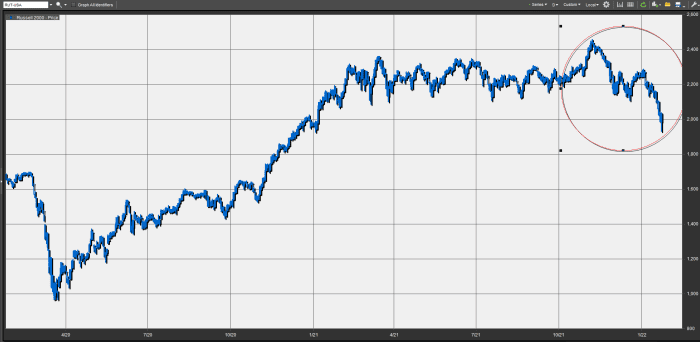
The index led the way in the past stock-market downturn in 2020 as the COVID pandemic took hold in the U.S. The benchmark is often viewed as an area of the market that tends to be more sensitive to concerns about economic growth, rising inflation and rising interest rates, all conditions that the economy is experiencing or will likely experience in coming months as the U.S. Federal Reserve sets the stage for a series of rate increases starting in March.
After the Russell 2000 index entered a bear market in early March, the Dow Jones Industrial Average DJIA, -0.02% closed in bear market on March 11. The S&P 500 SPX, -0.54% and Nasdaq Composite COMP, -1.40% entered bear markets a day later.
Flash forward to 2022 and the Nasdaq Composite is already in correction, defined as a decline of at least 10% (but not more than 20%) from its Nov. 19 peak. The index is about 17% from its November peak and the S&P 500 stands about 10 points from a correction, as of Thursday’s close."
Facts USA: The changing American family
| |||||||||||||||||||||||
|


-
 Flash News: Ukraine Intercepts Russian Kh-59 Cruise Missile Using US VAMPIRE Air Defense System Mounted on Boat. Ukrainian forces have made ...

