The 59 Republicans Who Joined Electoral Voter Fraud Scheme For Trump Could Face Prison
What seemed like political theater at the time actually violated state and federal fraud laws, according to current and former prosecutors.
WASHINGTON ― Dozens of local and state Republican leaders who showed their loyalty to Donald Trump by casting fake electoral votes for him a year ago may now face prison time in return for that devotion.
Because as the House select committee investigating the U.S. Capitol riot on Jan. 6, 2021, starts to look into the origins of the scheme to send “alternate” ballots to Congress from states narrowly won by Joe Biden, the 59 ersatz Trump electors who claimed to be “duly elected and qualified” could face federal charges ranging from election fraud to mail fraud, in addition to a range of state-level charges.
And in two of the states, the Democratic attorneys general are openly calling on the Department of Justice to act.
“I believe it’s critical that the federal government fully investigates and prosecutes any unlawful actions in furtherance of any seditious conspiracy,” said Josh Kaul, attorney general of Wisconsin, where 10 Republicans filed papers claiming to be the state’s electors even though Biden narrowly won there.
“This is a crime,” Michigan Attorney General Dana Nessel told reporters earlier this month, adding that calling the elector slate “alternate” did a disservice and that it should be called a “false, counterfeit, fake slate of electors.”
In her state, 16 Republican office holders and party officials filed paperwork claiming then-President Trump had won the state even though he had lost it by 154,000 votes. “This is election fraud, and it’s many other crimes as well, both, I believe, at the state and the federal level.”
Deputy U.S. Attorney General Lisa Monaco on Tuesday confirmed to CNN that Justice Department prosecutors “are looking at those” but would not comment further.
Arizona, where 11 Republicans filed papers falsely claiming to be the state’s electors; Georgia, which had 16; and Nevada, which had six, account for the rest of the 59.
Georgia Republican Party Chairman David Shafer, though, said he and the other 15 Georgians who sent electoral votes for Trump did so only to make sure Trump could continue pushing a lawsuit alleging vote fraud.
“There’s been no credible suggestion that there’s anything wrong,” he told HuffPost. “We made it very clear what we were doing. We did it right out in the open.”
But Georgia’s would-be GOP electors chose not to include language clarifying that they would actually only be the “duly elected and qualified” electors in the event that a court challenge or other proceeding reversed the outcome there ― the approach taken by Trump slates in two other states.
Five New Mexico Trump supporters filed a “certification” that began: “We, the undersigned, on the understanding that it might later be determined that we are the duly elected and qualified electors ...”
And 20 Republicans in Pennsylvania went even further to make clear that their paperwork was not valid unless the Nov. 3 election result was reversed in their state. “We, the undersigned, on the understanding that if, as result of a final non-appealable Court Order or other proceeding prescribed by law, we are ultimately recognized as being the duly elected and qualified electors,” their paperwork began.
That proviso was key to Pennsylvania Attorney General Josh Shapiro’s decision not to prosecute the 20. “These ‘fake ballots’ included a conditional clause that they were only to be used if a court overturned the results in Pennsylvania, which did not happen,” he said in a statement. “Though their rhetoric and policy were intentionally misleading and purposefully damaging to our democracy, based on our initial review, our office does not believe this meets the legal standards for forgery.”
According to Shafer, it was Trump’s lawyers in Georgia who told him and his group that any changes to the language they had provided would endanger Trump’s legal challenge in state court alleging fraud and other election “irregularities.”
“We were told not to alter the form,” he said, but pointed to an accompanying statement on Dec. 14, 2020, the date of the Electoral College vote, that explained that the GOP slate was being sent to Congress and the National Archives only to “preserve [Trump’s] rights under Georgia law.”
Still, the decision not to include explanations along those lines in the actual documents the five GOP slates sent to Washington, D.C., may prove costly should federal prosecutors zero in on Shafer and the 58 others.
Glenn Kirschner, a former federal prosecutor, said the potential federal crimes include forgery, obstruction of an official proceeding, conspiracy to commit fraud and, because the material was sent to its recipients via the Postal Service, mail fraud. The more serious of the offenses carry prison terms as long as 20 years.
“That’s not an exhaustive list,” he said, adding that the potential penalties could help prosecutors get some of those involved to provide information as to how the scheme came together and implicate those planners. “They are far more likely to cooperate if the DOJ leveraged them…. These folks should all be charged yesterday.”
The source of the scheme, however, was clear even as it was unfolding. The Trump White House was pushing it openly while outside adviser Steve Bannon was promoting it almost daily on his podcast. On the actual day of the Electoral College vote, top White House aide Stephen Miller laid it out it on a Fox News appearance.
“As we speak, an alternate slate of electors in the contested states is going to vote, and we are going to send those results to Congress,” Miller said.
Miller hung up Wednesday when contacted by HuffPost about that statement.
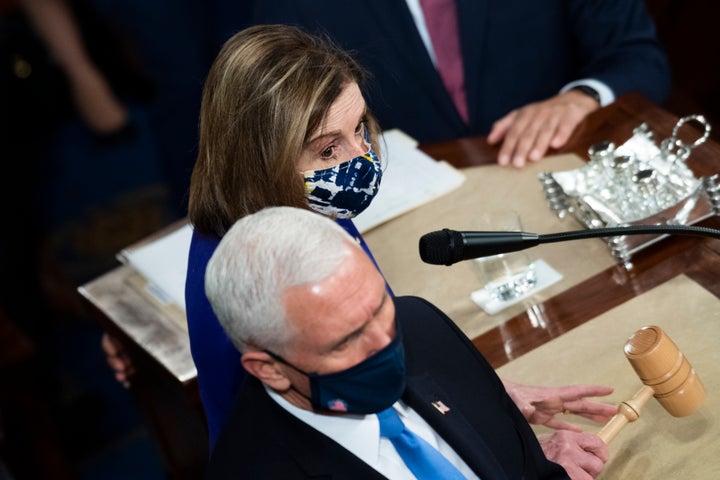
The White House’s plan for those “alternate” slates nevertheless was made clear in a memo by lawyer John Eastman, who presented it to Trump himself in the Oval Office. Because some states had “competing” slates of electors, Vice President Mike Pence could simply not count either set and leave those states out of the total entirely. “There are at this point 232 votes for Trump, 222 votes for Biden. Pence then gavels President Trump as re-elected,” Eastman wrote.
Trump’s tweets in that period suggest that he, too, was fully aware of the alternate slate scheme as he repeatedly urged Pence to abuse his authority as presiding officer during the certification ceremony.
“The Vice President has the power to reject fraudulently chosen electors,” he wrote, falsely, on Jan. 5.
“Many States want to decertify the mistake they made in certifying incorrect & even fraudulent numbers in a process NOT approved by their State Legislatures,” Trump wrote in an early morning Twitter message on Jan. 6. “Mike can send it back!”
DO READ MORE >> https://www.huffpost.com/entry/fake-electors-prison-capitol-riot-2020-election_n_61f1c3e3e4b02de5f513fa73